
With all the world’s facts just a web search or an AI prompt away, it’s tempting to ask a provocative question:
Does memorization still have a place in modern education?
Could schools run purely on skills, projects, and problem-solving, without asking students to memorize anything at all?
The short answer is no! But the more useful answer for educators is why memorization still matters, what should be memorized, and how to do it without sacrificing deep understanding.
We’ll be addressing all three things in this article.
Why Does Memorization Still Matter in the Real World?
Having knowledge available on demand, without looking it up, has real social, professional, and cognitive value.
Consider a simple social example. At a networking event, casually mentioning that Yoruba is spoken in Nigeria can change the tone of a conversation. The fact itself isn’t rare. But having it ready signals competence, curiosity, and engagement.
The same principle shows up at work. Imagine a pharmaceutical sales rep discussing a drug with a physician. If the doctor asks about its effect on peristalsis, pausing to consult a dictionary undermines confidence. In high-stakes environments, fluency matters.
Knowledge stored in long-term memory helps people make decisions faster, communicate clearly, and exercise better judgment. Those benefits come from recall, not lookup.
Do Students Really Need to Memorize Everything?
Absolutely not.

No one needs to memorize every Python command, every French word, or every legal case to function competently. But students do need a meaningful subset of information that becomes automatic. For example:
- Coders must internalize common syntax and structures
- Language learners need instant access to core vocabulary and rules of grammar
- Lawyers must recall foundational legal principles
- Teachers need to remember students’ names, not to mention the content of what they teach!
The goal isn’t encyclopedic recall. It’s strategic memorization: choosing the facts with the highest downstream payoff and committing those to memory.
For educators, the real challenge isn’t whether to use memorization, but what to prioritize.
How Does Rote Memorization Compare to Constructivist Learning?
Constructivist approaches like project-based learning, simulations, and apprenticeships are powerful. They help students apply knowledge in context and learn why it matters, but they don’t cover everything on their own.
No single experience reliably guarantees comprehensive exposure to required concepts or long-term retention of foundational facts. For example:
- Medical residencies build intuition but don’t guarantee full recall of anatomy
- Legal articling teaches practice, not the entirety of law
- Working at a vineyard builds experience, but not the full knowledge base required of a sommelier
Even in the most hands-on professions, a stable, memorized core supports higher-order reasoning, especially under pressure. Constructivist learning doesn’t replace memorization. It relies on it.
Why Isn’t It Good Enough to “Just Google It” (or Ask ChatGPT)?

Because knowing and searching are different skills. Search engines and AI tools can be incredibly helpful, but they don’t replace internal knowledge. They work best when they amplify what the learner already understands.
Two points from cognitive science matter here:
First, working memory is limited. If students are constantly looking up definitions, formulas, or background facts, they have less mental space left for reasoning, analysis, and creativity.
Second, tools like ChatGPT are only as useful as the user’s understanding. Without foundational knowledge, students struggle to evaluate whether an answer is correct, spot oversimplifications, or ask strong follow-up questions.
Memorization provides the internal compass that allows students to interrogate AI rather than defer to it. The more students know, the more powerful AI becomes. But the knowledge has to be there first.
How Should Teachers Actually Use Memorization in Modern Classrooms?
This is where the debate often gets messy. Class time is scarce. Spending most of it on the memorization of facts is usually inefficient, not because memorization is bad, but because it can be done more effectively outside the classroom.
A helpful reframing is this: the goal is not to eliminate rote memorization. The goal is to move rote memorization out of the classroom, so class time can be used for the work that benefits most from a dialogue between teacher and peers.
Memorization fails when it becomes mindless repetition. It succeeds when it follows well-supported learning principles and uses time effectively both in and out of the classroom.
(Read: How to Make Flashcards Students Will Actually Want to Study)
How Spaced Memorization Frees Class Time for Deeper Learning
When students arrive with key facts already stored in long-term memory, it significantly reduces their cognitive load when engaging with class activities. Discussions move faster. Explanations go deeper. Misconceptions show up sooner because students are actually trying to use the knowledge; they’re not hearing it for the first time.
Instead of using class time to define terms, repeat background information, and re-teach forgotten basics, teachers can spend it on application, case analysis, simulations, projects, and coached practice.
In this model, memorization is the infrastructure. Class is where students do something with it.
(Read: Why You Should Assign Flashcards Before the Lesson, Not Just After)
How Digital Flashcard Apps Enable This Division of Labor
One practical way to move memorization out of class is to use spaced repetition through digital flashcards.
Digital flashcard apps such as Brainscape transform entire syllabi into neatly organized collections of question-and-answer facts, which they can then review on any device (web or mobile). Framing facts as questions compels students to pull the answers out of their memory, thereby engaging active recall, a powerful learning tactic that’s proven to deepen retention far quicker than passive review.
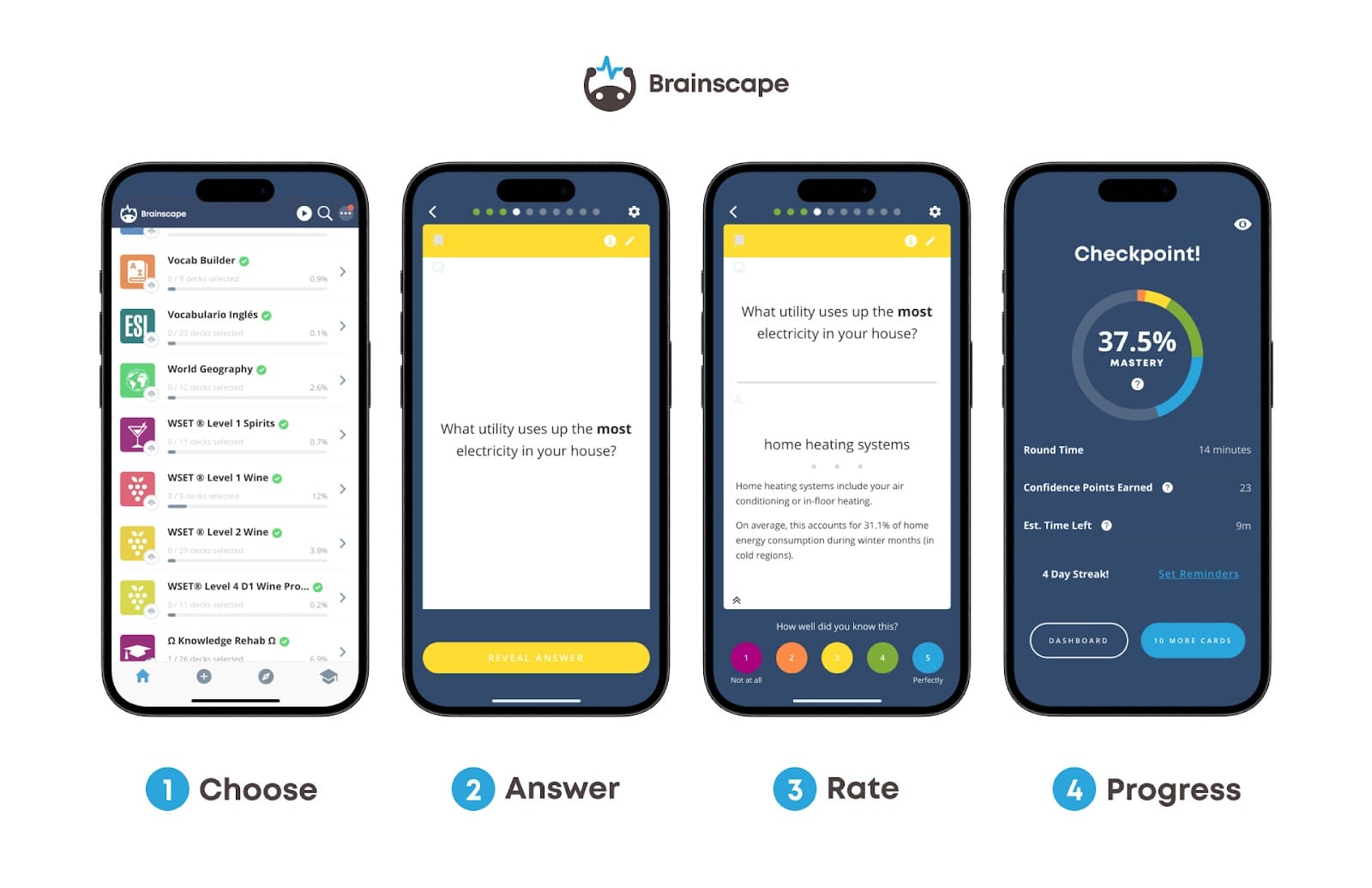
Moreover, with flashcard apps delivering concepts according to a spaced repetition schedule that’s calibrated to the individual’s unique strengths and weaknesses, ingraining facts goes from being a tiresome exercise to a highly efficient and streamlined system. Plus, it teaches your students the value of regular study.
For educators, the value of flashcard apps like Brainscape is straightforward: students can easily handle factual learning outside class, and teachers can reserve class time for discussion, application, and higher-level work. You can either assign high-quality flashcards to students, or involve them in the process of creating flashcards. This is rote learning in service of constructivism.
This allows educators to offload factual memorization to a system optimized for memory, freeing classroom time for discussion, application, and constructivist work. Students memorize what needs to be automatic, so they can focus on higher-level thinking when it matters most.
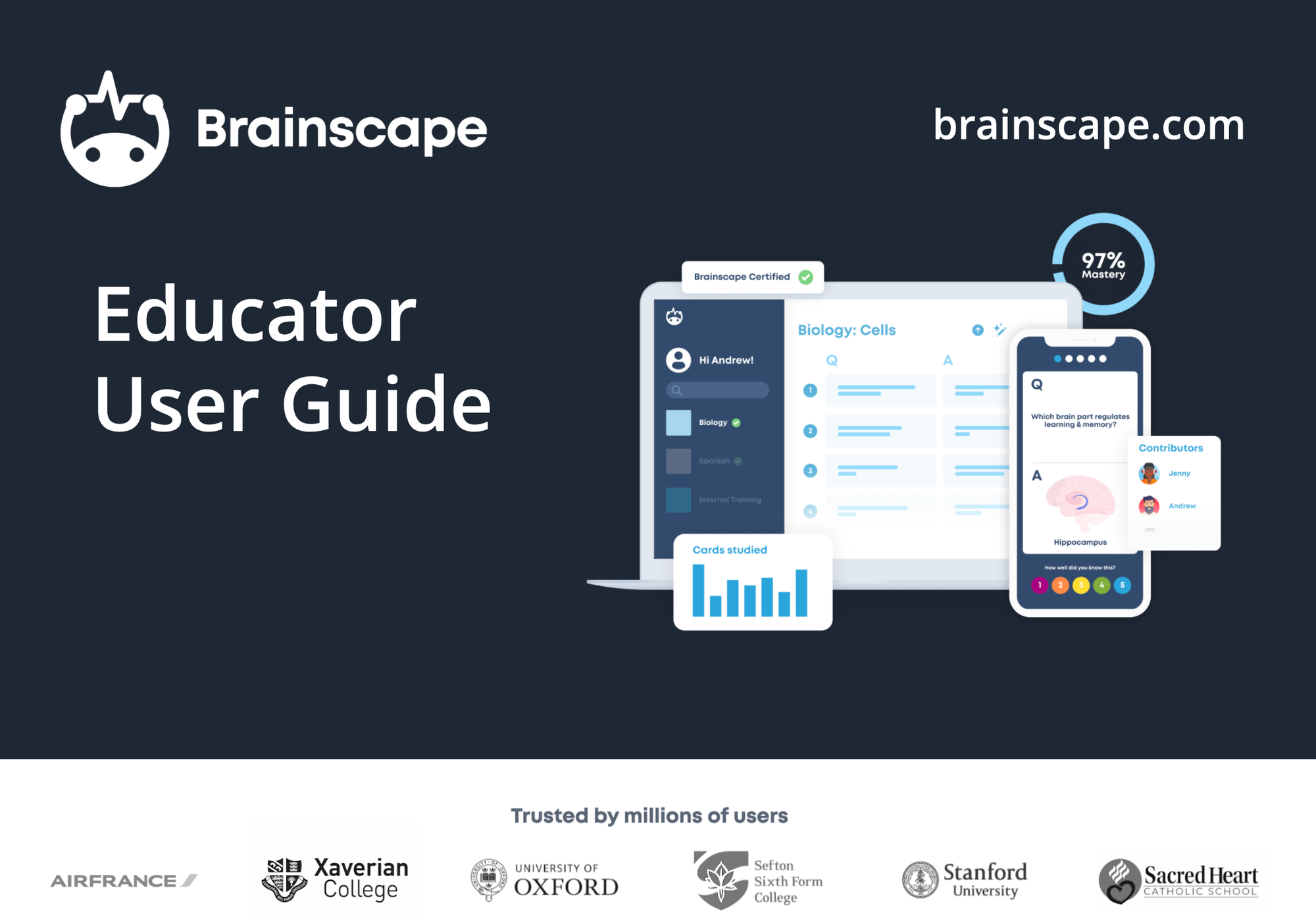
Get Brainscape's Educator User Guide
Curious to learn more about how to introduce Brainscape into your physical or virtual classroom? Our Educator User Guide provides a detailed walkthrough of how to get set up. It'll also give you all the material you need to motivate for its adoption amongst your students, their parents, and/or the faculty of your school or college:
So, Is Rote Memorization Really the Enemy of Deep Understanding?
No. The enemy is poor memorization techniques.
Deep understanding depends on a stable base of accessible knowledge. It also depends on a manageable cognitive load during problem-solving, plus fluency with foundational concepts.
Memorization isn’t the opposite of understanding. In many subjects, it’s a prerequisite. When key facts are automatic, students can recognize patterns, make connections, and transfer knowledge to new contexts with less friction.
Without that foundation, “deep understanding” becomes slow and fragile. With it, students have more room to think. When used thoughtfully, memorization is an essential aid to deep understanding.
And when used thoughtfully, it’s still essential.
Free Educator Resources For You:
- Brainscape Teacher’s Academy: Practical guides for implementing the cognitive science of learning and memory into your classroom, at scale
- “Tips for Teachers” YouTube Channel: Short, research-backed advice and classroom strategies
- The Cognitive Science of Studying: 16 Principles for Faster Learning: Discover how principles like retrieval practice, spaced repetition, and metacognition can help you learn faster and remember longer.
References
Cepeda, N. J., Pashler, H., Vul, E., Wixted, J. T., & Rohrer, D. (2009). Distributed practice in verbal recall tasks: A review and quantitative synthesis. Psychological Bulletin, 135(3), 354–380. https://doi.org/10.1037/a0015166
Fiorella, L., & Mayer, R. E. (2021). Learning as a generative activity (2nd ed.). Cambridge University Press.
Oxford Learning. (2017, March 23). Rote learning vs. meaningful learning. https://www.oxfordlearning.com/difference-rote-learning-meaningful-learning/
UNC–Chapel Hill Learning Center. (2024, February 19). Memorization strategies. https://learningcenter.unc.edu/tips-and-tools/enhancing-your-memory/
Xu, J., Wu, A., Filip, C., Patel, Z., Bernstein, S. R., Tanveer, R., Syed, H., & Kotroczo, T. (2024). Active recall strategies associated with academic achievement in young adults: A systematic review. Journal of Affective Disorders, 354, 191–198. https://doi.org/10.1016/j.jad.2024.03.010