Define Cryptology
Cryptology = Science concerned with communications in secure and usually secret form.
Define Cryptography
Cryptography = Study of the principles and techniques by which information can be concealed in ciphertext and later revealed by a secret key.
Define Cryptanalysis and its types
Cryptanalysis = The Science/process of recovering information (plaintext or key) from ciphers without the knowledge of the key.
Types:
- Ciphertext only (plaintext patterns in thecipher)
- Known ciphertext/plaintext pairs
- Chosen plaintext/ciphertext
What is the Encryption of data?
The process of transforming plaintext data into ciphertext to conceal it’s meaning.
What is the Signing of data?
Computing a “check value” or “digital signature” to a cipher/plaintext, that can be verified by some or all entities able to access the signed data.
Describe the principal categories of cryptographic algorithms:
- Symmetric cryptography (1 key)
- Modes of Operation
- DES
- AES
- Asymmetric cryptography (2 keys)
- RSA
Diffie-Hellman - ElGamal
- RSA
- Cryptographic hash functions (0 key, appended/mixed with data)
- MDC’s & MAC’s
- MD-5
- SHA-1
- CBC-MAC
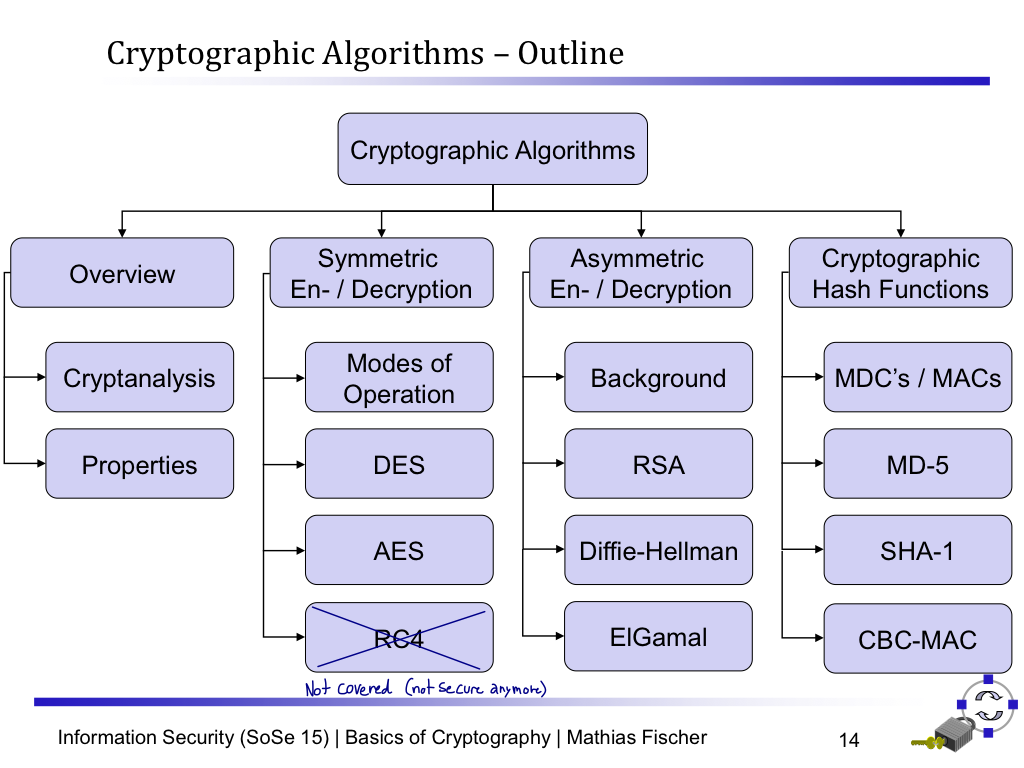
Graphically describe the Cryptographic Algorithms outline:
What is the aim of the Cryptanalysis of public keys?
Public key cryptanalysis aim at breaking the cryptosystem itself through mathematical research.
What does a Brute Force Attack does?
A brute force attack tries every possible key until it finds an intelligible plaintext.
Every cryptographic algorithm (in theory can be attacked by brute force). On average, 50% of possible keys will have to be tried.
What is Error propagation?
Error propagation characterizes the effects of bit-errors during transmission of ciphertext to reconstructed plaintext.
An erroneous ciphertext bit could produce 1 or more erroneous plaintext bits.
What is Synchronization?
Synchronization characterizes the effects of lost ciphertext data units to the reconstructed plaintext.
Some algorithms need explicit synchronization (can’t recover from lost ciphertext). Other algorithms automatically re-synchronize after 0 to n ciphertext bits.
What is Substitution?
Mapping each element (bit, letter, groups of bits/letters) in the plaintext into another element.
What is Transposition?
Re-arranging elements in the plaintext.
What is the main difference between Stream ciphers and Block ciphers?
Stream ciphers work on bit streams (encrypting one bit after another). Based on linear feedback shift registers. They don’t propagate errors but are sensible to loss of synchronization.
Block ciphers work on blocks of width b. They handle errors and synchronization in different ways.
What are Modes of Operation?
Ways of using a block cipher (of b-lenght) for encryption.
How do stream ciphers encrypt a message?
They encrypt the digits of a message one at a time.
How does block ciphers encrypt?
Taking a chunk/number of bits and encrypt them as single units, padding them to have a multiple of the block size.
What are the types of cryptanalysis?
- Ciphertext only
- Known ciphertext/plaintext pairs
- Chosen plaintext
- Chosen ciphertext
- Differential cryptanalysis
- Linear cryptanalysis
What is the aim of the cryptanalysis of public key cryptography?
- One key is publicly exposed, the aim is to break the cryptosystem itself.
- Usage of computation of discrete logarithms or the factorization of large integers.
Describe the key elements of Symmetric Encryption:
- P denotes a plaintext message
- E(KA,B, P) denotes a ciphertext creation
- D(KA,B, E(KA,B, P)) = P denotes the decryption process.
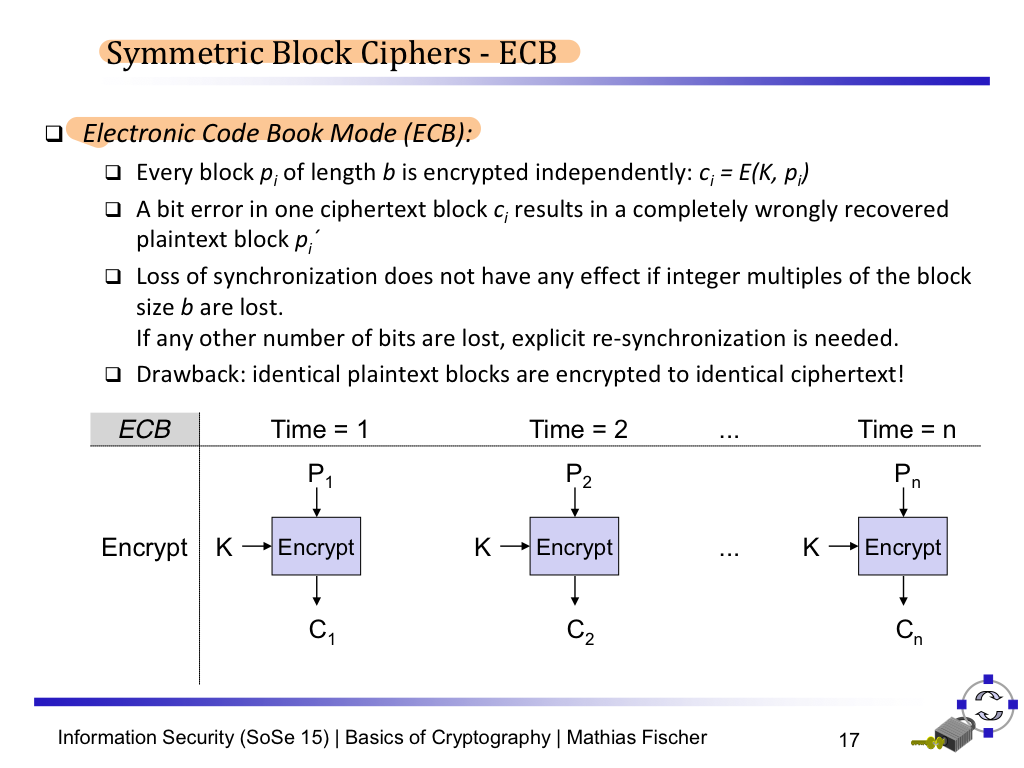
What is ECB and describe how it works:
ECB = Electronic Code Book Mode.
- Every block pi of length b is encrypted independently ci =E(K, pi).
- A bit error in ciphertext block ci= wrongly recovered plaintext pi’
- Loss of sync doesn’t affect if integer multiples of the block size b are lost.
- Drawback = identical plaintext blocks are encrypted to identical ciphertext! (direct encryption and decryption)
What is CBC and describe how it works:
CBC = Cipher Block Chaining Mode.
- Before encrypting a plaintext block pi it is XORed with the previous ciphertext block ci-1.
- Parties agree on an Initialization Vector (IV) for C0.
- A distorted ciphertext block results in two distorted plaintext blocks.
- If the number of lost bits is a multiple integer of b, one additional block pi+1 is distorted before synchronization is re-established.
- Advantage = identical plaintext blocks don’t produce identical ciphertext.
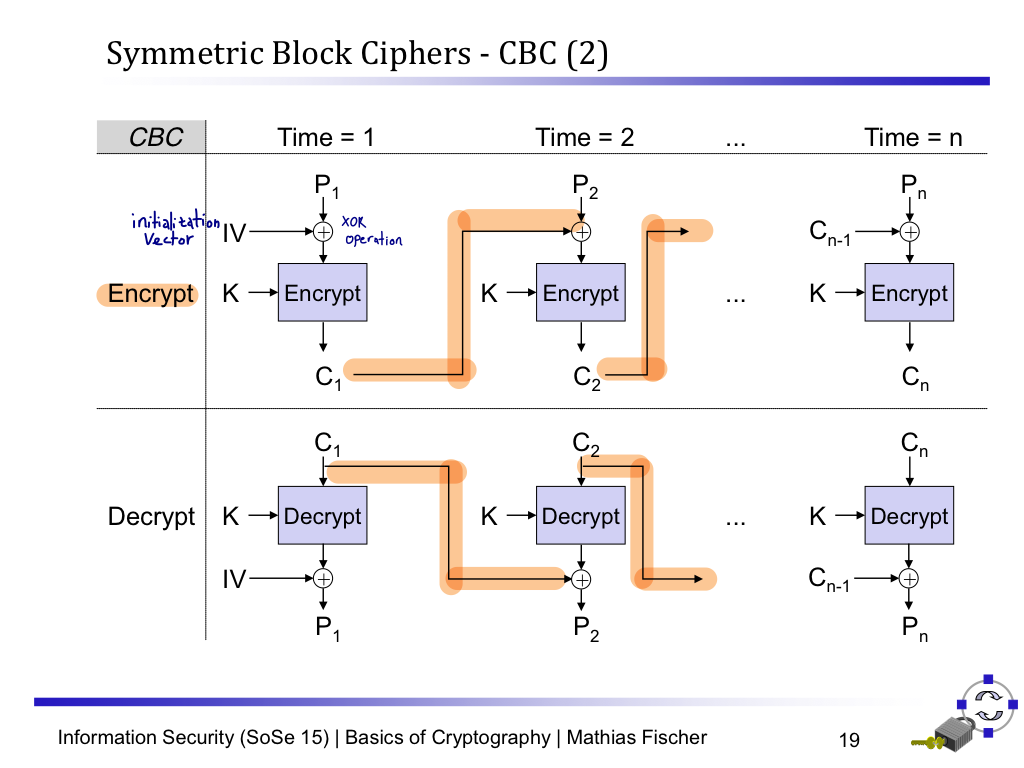
How is the decryption process in CBC?
In CBC, decryption is the inverted process of the encryption steps:
- C1 is taken as an input and K is applied to decrypt it, the result is XORed with the IV to recover P1
- C2 is taken as an input and K is applied to decrypt it, the result is XORed with C1 (previous step) to produce P2
- Cn is taken as an input and K is applied to decrypt it, the result is XORed with Cn-1 to obtain Pn
What is CFB and describe how it works:
CFB = Ciphertext Feedback Mode.
- A block encryption algorithm working on block size b is converted to an algorithm working on blocks size j (where j is the previous Ciphertext)
- The IV is encrypted with K and a “select-discard” (the b-j right-hand bits) is done to have just a j which is exactly the size of the first part P1.
- P1 is now XORed and then taken to the next operations (Time=2) to conform: R1 (or IV1) = shifted IV0+C1
- The process continues with that new input in T=2 to be Encrypted with K and so on..



