What is current?
ai)
The rate of flow of charged particles {e.g. electrons}
What is Kirchhoff’s first law?
The total current entering a junction = the total current leaving it
What is potential difference?
aii)
The Potential Difference [p.d.], V, is the energy converted (work done) per unit charge moved.
or
What is the potential difference equation for change in energy?
V=∆E/Q
Do you connect a voltmeter in parallel or series. Why?
The voltmeter is connected in Parallel
A voltmeter measures the potential difference between two points in an electric circuit. In order for a voltmeter to measure a device’s voltage, it must be connected in parallel to that device. This is necessary because objects in parallel experience the same potential difference.
What is joule heating?
What is the equation to calculate joule heating or wasted energy?
Joule heating refers to the increase in temperature of a conductor as a result of resistance to the electrical current flowing through it.
At an atomic level, Joule-heating is the result of moving electrons colliding with atoms in a conductor, whereupon momentum is transferred to the atoms, increasing their kinetic energy in the form of heat.
Heat arising from Joule heating of the conductor causes the atoms to vibrate further from their ideal lattice positions, thereby increasing the electron scattering events. This is manifested as an increase in resistance, and acceleration in the process of electromigration.
High current density → Large number of scattered electrons → More electromigration
W = VIt
W = work done; t = time
also P = I2R
What is power?
What is it measured in? Units?
The rate of transfer of energy (the rate of work done)
Measured in J s-1, which is the equivalent of the Watt (W)
What are the equations for power?
P = I V
P = I2 R (dissipation)
P=V2/R
How can you reduce the power dissipated during transmission of mains electricity?
P=IV
Mains electricity is transmitted at a high voltage and low current to minimise the power dissipated {low resistance transmission cables are also needed to help reduce the effects of Joule heating}
Click on the diagram to enlarge it. Then answer the questions.
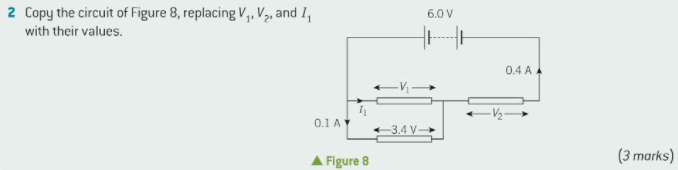
Kirchhoff’s first law states that current entering junction is the same as that leaving it, so in the parallel section there’s 0.1 A, so 0.4 - 0.1 = 0.3A going through I1,
as V1 is part of the parallel circuit, and pd is the same everywhere in a parallel circuit, V1 is 3.4V
so V2 is 6 - 3.4V = 2.6V
- What is resistance?
- What simple equation can be used to determine Resistance?
- What are the units of Resistance?
- A measure of how difficult it is to get a current to flow through a component
- R = V / I
- V A-1 (Ohms Ω)
What is Ohm’s Law?
Describe a simple of graph that obeys Ohm’s Law
If temperature is constant, the current through an ohmic conductor is directly proportional to the p.d across it (V=IR)
The gradient of the IV graph is constant (so resistance is constant) and the graph goes through the origin
Click on the image below to enlarge it

- What is conductance?
- Units of Conductance?
- Unit equivalence of Conductance?
- Measure of how well or how easily electrons can flow through a conductor
- Conductance: G=1/R=V/I Units are the Siemen (S)
- The equivalent unit of conductance is A V-1
How do you work out resistance and conductance in series and parallel circuits?
Click on the diagram below to enlarge it

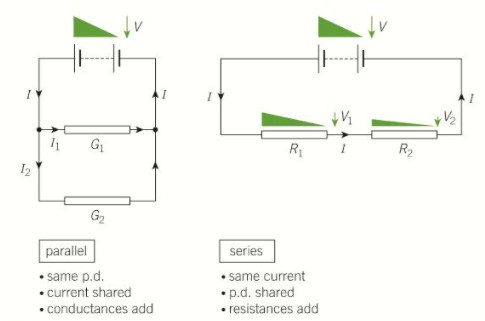
How are pd, current, conductance and resistances shared in parallel and series circuits?
Click on the diagram to enlarge.
How do you reduce the effect of random errors when investigating the I-V characteristic of a component?
Repeat your measurements and take averages
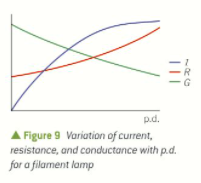
Describe and draw the I-V characteristic of a filament lamp, include pd against resistance and conductance
Why is it this shape?
Current: A curve, which starts steep but then gets shallower as the p.d rises
Current flowing though the lamp increases its temperature, but current also dissipates energy through joule heating at a rate of (P = I²R) so its resistance increases. because of that, conductance decreases.
Click on the image to enlarge
How can you investigate the I-V characteristic of a component using a test circuit?
- Use a variable resistor [or resistance ladder] to alter the p.d across the component and so the current flowing through it, record V and I
- Plot a graph of current against p.d difference from your results. This graph is the I-V characteristic of the component
What is a conductor?
Materials (such as metals) which have a high proportion of mobile charge carriers (free electrons). These materials permit electrons to flow freely from particle to particle.
What are semiconductors?
Materials with a low proportion of mobile charge carriers, but the number of mobile charge carriers increases with a factor like light or temperature, enabling them to conduct electricity.
Under normal conditions, however, they do not conduct very well.
What are insulators?
Materials with no (or very few) mobile charge carriers, which do not conduct electricity
What does the resistance of a wire depend on?
Explain each one
- Length. The longer the wire, the more difficult it is to make a current flow
- Cross-sectional Area. The wider the wire, the easier it will be for the electrons to pass along it
- Resistivity. This depends on the material the wire’s made from, as the structure of the material may make it easy or difficult for charge to flow. Resistivity also depends on external factors like temperature
What affects how conductive a material is?
- Its number or density of mobile charge carriers - the number of free electrons (or ions that are free to move) there are per cubic metre of the material.
- The more mobile charge carriers a material has per unit volume, the better a conductor it will be
What is the relationship between conductance and resistance with length of wire?
- resistance doubles if the length of the wire doubles
- so R ∝ L,
- so conductance is G ∝ 1 / L


-
Module 2 Fundamental data analysis_checked12
-
Practicals_checked6
-
1: Imaging_checked53
-
2: Signalling_checked31
-
3: Sensing_checked67
-
4: Testing Materials_checked46
-
5: Looking Inside Materials_checked13
-
5: Exam Questions7
-
6: Wave Behaviour91
-
ch6 practicals5
-
6: Exam Questions8
-
7: Quantum Behaviour59
-
7: Exam Questions2
-
7: Equations11
-
ch8 practicals5
-
9: Momentum, Force and Energy29
-
chapter 9 momentum27
-
9: Equations8
-
10: Modelling decay42
-
10: Exam Questions5
-
10: Equations13
-
11: Modelling Oscillations37
-
ch1161
-
11: Exam Questions3
-
11: Equations3
-
12: The Gravitational Field54
-
ch121
-
12: Exam Questions7
-
12: Equations12
-
13: Our Place in the Universe44
-
ch1345
-
13: Exam Questions7
-
13: Equations10
-
Is there life on mars? Questions25
-
ch1433
-
14: Exam Questions5
-
14: Equations5
-
15: The Boltzmann Factor16
-
15: Exam Questions2
-
16: Electromagnetism67
-
16: Exam Questions5
-
16: Equations8
-
chapter 17 electric field46
-
17: Exam Questions1
-
17: Equations10
-
18: Looking Inside the Atom132
-
18: Exam Questions1
-
18: Equations3
-
19: Using the Atom126
-
19: Exam Questions3
-
19: Equations4
-
ch14 COPY31
-
ch1870
-
questions that I got wrong31
-
EM SPECTRUM8
-
2017 Multi Choice24
-
2018 Multi Choice25
-
PMT0
-
Chapter 8: Motion_checked40
-
Chapter 8: Practicals_checked4
-
Chapter 9: Momentum, Work, Power48



