What is the respiratory unit composed of?
- respiratory bronchiole, alveolar duct, atria and alveoli
- 300 million alveoli in 2 lungs, each with extremely thin walls and are about .2mm in diameter
*
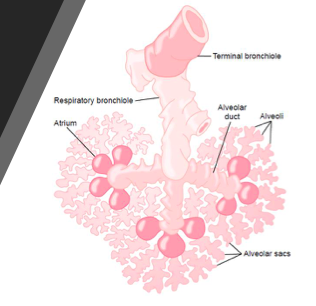
What are alveolar walls like in terms of thickness?
extremely thin
gas exchange occurs through the membranes of ____________
gas exchange occurs through the memebranes of all terminal portions of lungs-respiratory/ pulmonary membrane
solid interconnecting capillaries
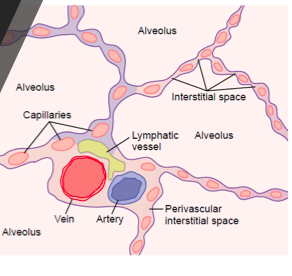
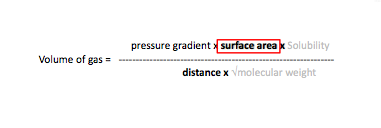
What is diffusion? What law describes it? What is diffusion directly/inversely proportional to?
- transfer of gas across the blood-gas barrier described by Fick’s law
- rate of transer of a gas through a sheet of tissue
- directly proportional: to tissue area, the difference in gas partial pressure between the two sides, and the diffusion property of the gas
- inversely proportional: to the tissue thickness
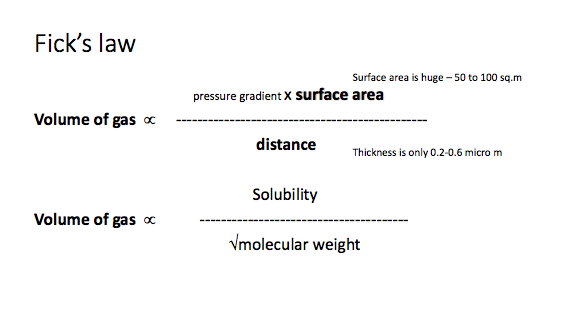
What 3 things affect the diffusing capcaity of a gas?
surface area
thickness
pressure gradient
What is diffusing capacity of a respiratory memebrane? What does this mean for mean oxygen pressure? use an average young man as an example.
- diffusing capcaity is the volume of a gas that will diffuse through the memebrane each minute for a partial pressure difference of 1mmHg
- average young man- diffusing capcaity for oxygen under resting conditions is 21ml/min/mmHg
- mean oxygen pressure difference across the respiratory memebrane under normal resting conditions is 11mmHg
- 230ml of oxygen diffuses through the respiratoy membrane each minute (21x11=230)
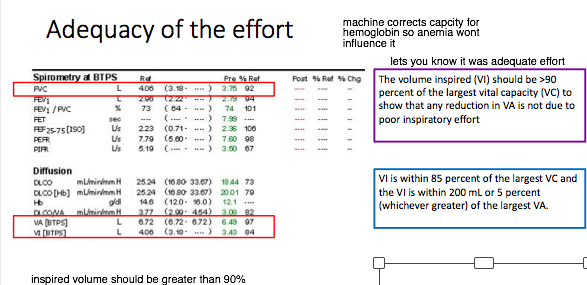
How do we assess the adequecy of effort for a PFT?
the volume inspired (VI) should be>90% of the largest vital capacity (VC) to show that any reduction in VA is not due to poor inspiratory efort
VI is within 85% of the individual’s largest VC, and the VI is withitn 200ml or 5% of the largest VA
WHat 3 things does a Pulmonary Function Test (PFT) assess?
spirometry/FV loop
lung volumes
diffusing capcaity
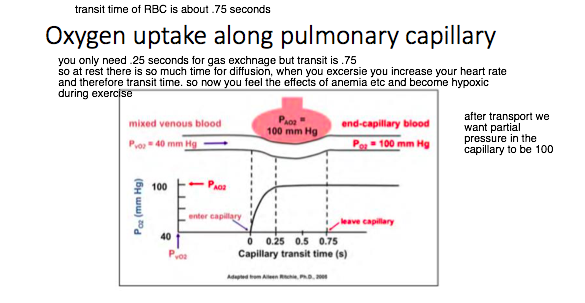
How long do RBCs have in the capillary for oxygen uptake (transit time)? How long do they need? How does this relate to hypoxemia symptoms that occur only with exercise?
RBCs have .75 seconds
they onyl need .25
this is why at rest anemic people usually aren’t symptomatic because their RBCs have plenty of time for transfer. when there is less transit time due to exercise, then your body will notice the decreased amount of hemoglobin because there isnt enough time for the RBCs to exchange oxygen and there arent enough hemoglbin to grab the oxygen
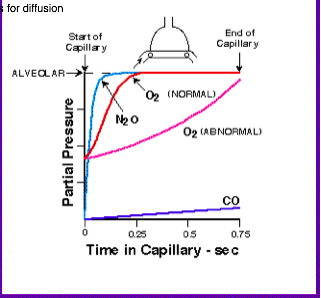
What are the 3 determining facotrs for diffusion? Why is CO used instead of N2O to measure diffusion?
membrane thickness
partial pressure/gradient
surface area
- N2O: no afinity to O2
- partial pressure rises rapidly
- gradient wiped out is perfusion is low
- purely perfusion limited
- CO: Hb has high afiinity
- partial pressure stays low
- no appreciable back pressure
- purely diffusion limited **therefore good measure of diffusion**
How do you analyze a case for restrictive vs. obstructive? what are the enxt steps in deciding your differnetial?
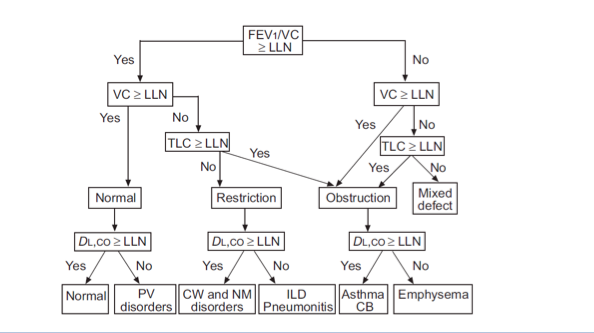
What are your two possible diagnosis based on DL,CO when:
FEV1/FVC> 70% (or LLN)
TLC> 80% (or LLN)
FEV1/FVC> 70 means not obstructive
TLC> 80 means not restrictive
DL, CO > 80 (or LLN)= healthy and normal!
DL, CO < 80 (or LLN) = Pulmonary vascular disroders (lungs are fine its a vascular problem) or early ILD
What are the 2 possible differentials based on DL,CO if:
FEV1/FVC >70% (or LLN)
TLC< 80% (or LLN)
FEV1/FVC >70 means not obstructive
TLC< 80 (or LLN) means restrictive
DL,CO > 80= CW and Neuromuscular disorders
DL,Co< 80= ILD Pneumonitis
What are the 2 possible differentials based on DL,CO if:
FEV1/FVC< 70
TLC>80
FEV1/FVC<70 means obstructive
TLC> 80 seconds obstructive
DL,CO >80= Asthma, Chronic Bronchitis
DL, CO<80= COPD (Emphysema)
remember obstrutive disroders are COPD, Chronic bronchitis, CF
In a patient with emphysema would you expect the DL,CO to be high or low? why?
LOW!
- structural changes
- abnormal and permanent enlargement of the air spaces
- destruction of the airspace walls (decreasing surface area)
In a patient with pulmonary HTN would you expect the DL,CO to be high or low? Why?
LOW!
remodeling and progressive loss of pulmonary arterial vasculature
results in decreased capillary blood volume available for gas exchange
(decreased SA)
In a patient who had a pneumonectomy would you expect the DLCO to be high or low?
low! but DLCO/VA will increase because the same CO will be flowing through less space, meaning more blood being deleivered to each functioning alveoli.
What is DLCO/VA (KCO)? what is it commonly confused as? What kind of relationship exists between KCO and lung volume?
- DLCO/VA reflects the alveolar CO uptake efficiency at a given volume
- it is not a correction factor for low lung volume
- the non-linear relationship between KCO and lung colume precludes KCO from being a correction factor fo DLCO when lung volumes are reduced
- the average VA of the tests used to generate the reported DLCO should be reported
NON-LINEAR RELATIONSHIP BETWEEN KCO AND LUNG VOLUME
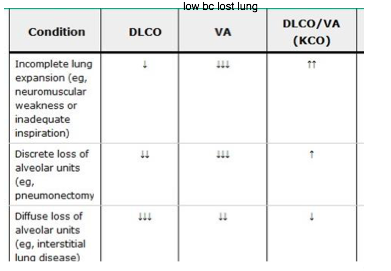
What happens to DLCO, VA, and DLCO/VA (KCO) for the following conditions:
- Incomplete lung expansion ( neuromuscular weakness or inadequate inspiration)
- discrete loss of alveolar units (pneumonectomy)
- diffuse loss of alveolar units (interstitial disease)
- Incomplete lung expansion ( neuromuscular weakness or inadequate inspiration)
- DLCO: decrease
- VA: decrease
- DLCO/VA (KCO): increase
- discrete loss of alveolar units (pneumonectomy)
- DLCO: decrease
- VA: decrease
- DLCO/VA (KCO): increase
- diffuse loss of alveolar units (interstitial disease)
- DLCO: decrease
- VA: decrease
- DLCO/VA (KCO): decrease
What problems lead to a reduced DLCO due to decreased area? What conditions will you see this in?
loss of alveoli, loss of alveolar walls, loss of interstitium, loss of blood
- Conditions:
- emphysema
- lung/lobe resection
- bronchiol obstruction, as by tumor
- anemia
- multiple pulmonary emboli
- pulmonary HTN
*
What would you expect DLCO to change for a patient who has silicosis from chronic exposure to silica dust? why?
DLCO will decrease beacuse of decreased SA and increased distance due to scarring
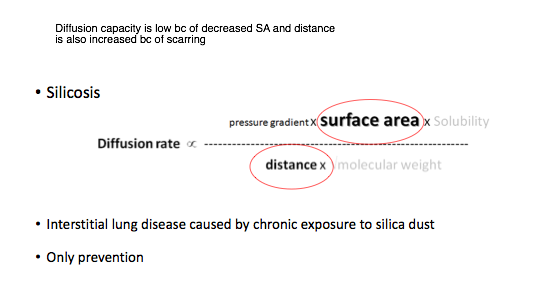
How does scarring influence DLCO?
decreases!
loss of surface area and increased distance
what conditions are associated with increased thickness of alveolar capillary memebrane? how does this influence DLCO?
decreases due to increased distance
interstitial lung disease/pulmonary fibrosis
asbestosis
sarcoidosis
collagen vascular disease
hypersensitivity pneumonitis
histiocytosis X
What happens to DLCO in a patient with SLE? Why?
increases! increased thoracic blood due to alveolar hemorrhage

-
1 - Respiratory System Histology39
-
2 - VM Respiratory System19
-
3 - Respiratory Devo48
-
4 - Chronic Obstructive Lung Disease36
-
5 - Pulmonary Mechanics31
-
6 - Respiratory Pharm50
-
7 - Spirometry for Obstructive Lung Disease30
-
8 - Obstructive Lung Disease Cases32
-
9- Diffusion Capacity35
-
10- Ventilatory Control and the Chemoreflexes18
-
11- Clinical Response to Hypoxemia and Hypercapnia37
-
12 - Sleep Pathophysiology49
-
13a- Clinical Correlations: Hypoxemia18
-
13b - Clinical Correlations of Hypoxemia31
-
14 - Radiology of the airway20
-
15 - Interstitial lung diseases35
-
16 - Acute lung injury/Atelectasis22
-
17 - Interstitial/Acute lung injury cases20
-
18 - Lung Neoplasms44
-
19 - Pleural and Mediastinal Pathology42
-
20/21 - Pulmonary Vascular Disease & Cases39
-
22 - Bacterial Pathogens of the Respiratory Tract59
-
22b - Individual Bacteria of RT and Notable Features11
-
23 - Respiratory Infections Caused by Viruses45
-
24 - Diagnostics for Detection of Infectious Diseases in Respiratory Tract Infections56
-
25 - URT Infections47
-
26 Lower respiratory tract cases22
-
27 Head and Neck Pathology43



