What is the structure of an atom?
- Negatively charged electrons orbit the nucleus in discrete orbital shells.
- Electrons have quantised positions and specific energies.
- Stable atoms have a full outer shell, and reactive atoms have incomplete outer shells.
What is the set up of the periodic table?
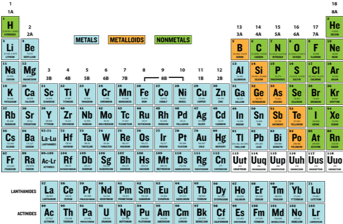
- Metals are shown in blue.
- Metaloids are shown in orange.
- Non-metals are shown in green.
- Noble gases are found in the far right column and have full outer shells meaning they are unreactive.
What are electropositive/electronegative elements?
Electropositive:
- Act as donors to readily give up electrons and become ‘+ ions’.
- Metals.
Electronegative:
- Act as acceptors to readily acquire electrons and become ‘- ions’.
- Non-metals.
What are the features of the element symbol?
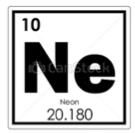
Atomic number:
- Number of protons.
- Number of electrons.
Atomic mass number:
- Number of protons + Number of neutrons.
What is the atomic mass unit?
1/12th the mass of a C-12 atom.
What is the relative atomic mass?
The mass of one mol (6.02x10²³ atoms) of the element.
What are the features of shells?
- The lowest energy state of the atom is always filled first.
- Shells are defined as K,L,M,N,O and relate to the distance from the nucleus.
- Sub-shells are defined as s,p,d,f and relate to the shape of, and how many electrons can fit onto that sub-shell.
- Valence electrons (the outermost electrons which are involved with bonding) determine the physical and chemical properties of the element.
What are the different types of sub-shell?

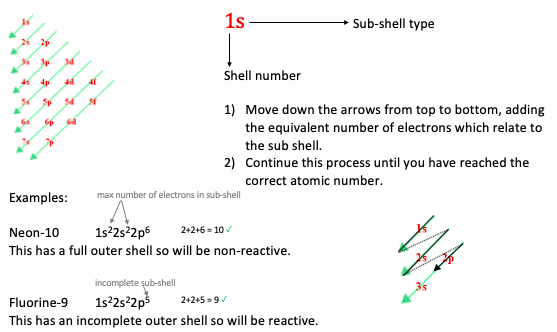
What is electron configuration?
What are the different types of bonding??
Primary bonding:
- Ionic
- Covalent
- Metallic
Secondary bonding:
- Van der Waals
- Hydrogen
- (Often weaker)
What is ionic bonding?
Electrons are transferred from metallic (electropositive) elements to non-metallic (electronegative) elements.
- Often occurs in ceramics
- Non-directional
- Strong
- High melting point
- High elastic modulus
- Brittle
- Electric and thermal insulators (no free electrons)
What is covalent bonding?
Electrons are shared between two non-metallic (electronegative) elements.
- Often occur in polymer C=C bonds
- Directional
- Strong
- High melting point
- High elastic modulus
- Brittle
- Electrical and thermal insulators (no free electrons)
- Less dense than ionic bonding
What is metallic bonding?
Electrons are free to drift throughout a metal producing a ‘sea of electrons’ around positive ion cores.
- Non-directional
- Medium strength
- Medium melting point
- Medium elastic modulus
- Ductile as planes can slide over each other
- High electrical conductivity
- High density
What are Van der Waals bonds?
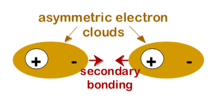
Electrons move around acting as electron clouds which can become asymmetrical, forming fluctuating dipoles. This allows weak bonds to form between two atoms.
Alternatively, through ionic/covalent bonding, permanent dipoles are produced, again allowing weak bonds to form between atoms.
- Weak
- Directional
- Occur in polymers
- Low stiffness
- Low melting point
- Very ductile
What are hydrogen bonds?
Covalent bonding causes one side of a water molecule to become slightly positively charged, and the other end slightly negatively charged.
This allows weak hydrogen bonds to form between the positively charged side of one atom and the negatively charged side of another atom.
- Weak
- Directional
- Low melting point
What are bonding forces?
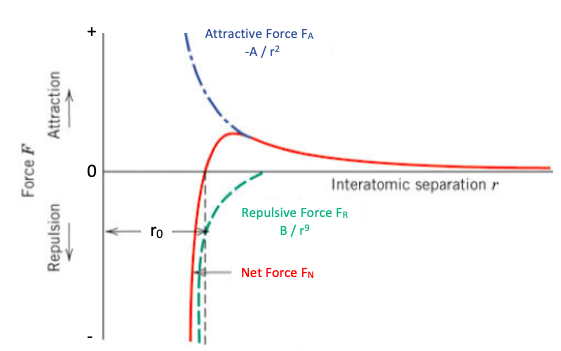
At large distances, atoms have very little interaction with each other, but as they approach, attraction and repulsion forces increase.
What are the equations for bonding forces?
FN = FA + FR
FA = -A / r2
FR = B / r9
A and B are just constants, r is the atomic separation.
FA = dEA / dr
FR = dER / dr
To calculate the repulsive/attractive forces you can just differentiate the corresponding energies.
How does a materials property affect its bonding energy?
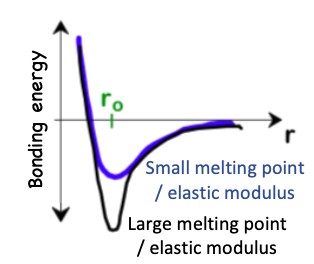
The greater the melting point, the larger the bonding energy.
The greater the elastic modulus, the larger the bonding energy.
What type of bonding is involved in ceramics?
Ionic and covalent
What type of bonding is involved in metals?
Metallic
What type of bonding is involved in polymers?
Covalent and secondary
What is a halogen?
Halogens have 7 valence electrons.



