What is potable water? How is it different from pure water?
Water that is safe to drink, with low levels of dissolved salts and microbes.
It is not pure water in the chemical sense because it contains dissolved substances.
What do the methods of potable water production depend on?
- Available supplies of water
- Local conditions
What is fresh water?
Water with low levels of dissolved substances, e.g. rainwater, that collects in the ground, lakes and rivers.
How is most potable water produced?
- choosing an appropriate source of fresh water
- passing the water through filter beds
- sterilising with ozone/chlorine/UV light
How is potable water sourced if supplies of fresh water are limited?
By the desalination of salty or sea water.
How is desalination of sea water carried out?
What is the disadvantage of desalination?
- By distillation.
- By processes that use membranes, such as reverse osmosis.
- These processes require large amounts of energy.
Practical
Describe in brief terms how you would test and purify seawater to make it potable.
- Test pH, neutralise if needed
- Test for sodium chloride
- Distil the water if needed and recheck for NaCl
- Retest pH
Practical: testing + purifying seawater
How would you test and correct the pH of a sample of water?
- Test the pH using a pH meter
- If below 6.5, add alkali to neutralise
- If above 8.5, add acid to neutralise
Practical: testing + purifying seawater
How would you test seawater for NaCl?
- Sodium: do a flame test on a small sample - yellow in presence of Na
- Chloride: add a few drops of dilute nitric acid and silver nitrate solution to a sample - white precipitate will form in presence of Cl-
Practical: testing + purifying seawater
How would you distil water to purify it?
- Heat the water in a flask.
- The water will evaporate, leaving any dissolved salts in the flask.
- The steam is condensed in a condenser, then collected in a beaker at the end of the condenser.
Why does sewage from domestic, industrial and agricultural sources have to be treated?
- Domestic and agricultural waste water may contain organic matter and harmful microbes.
- Industrial waste water may contain organic matter and harmful chemicals.
- Water is treated so that it can be safely returned to fresh water sources.
Describe the process of sewage treatment.
- screening and grit removal
- sedimentation to produce sewage sludge and effluent
- anaerobic digestion of sewage sludge (produces methane and fertiliser)
- aerobic biological treatment of effluent
- water containing toxic substances is treated with chemicals, UV radiation or membranes
Why is sewage treatment potentially better than desalination in areas where there is limited fresh water?
It uses less energy than desalination.
Copper ores are becoming scarce. Name 2 new ways of extracting copper from low-grade ores.
- phytomining
- bioleaching
What is phytomining?
- Uses plants to absorb metal compounds.
- These are harvested and burned to produce ash that contains metal compounds.
What is bioleaching?
A process which uses bacteria to produce leachate solutions that contain metal compounds.
Phytomining and bioleaching are both processes which produce copper compounds. How are they then processed to obtain pure copper?
Copper can be obtained from solutions of copper compounds by displacement using scrap iron, or by electrolysis.
Why are phytomining and bioleaching sustainable methods of obtaining copper?
These methods avoid traditional mining methods of digging, moving and disposing of large amounts of rock.
Life cycle assessments (LCAs) are carried out to assess the environmental impact of products. What are the stages of a product’s life cycle that need to be considered?
- extracting and processing raw materials
- manufacturing and packaging
- use and operation during its lifetime
- disposal at the end of its useful life, including transport and distribution.
Why are LCAs not purely objective processes?
Use of water, resources, energy sources and production of some types of waste can be fairly easily quantified.
But allocating numerical values to pollutant effects is less straightforward, and requires judgements on value.
How can LCAs be biased?
Selective or abbreviated LCAs can be carried out to evaluate a product, but these can be misused to reach pre-determined conclusions, e.g. to support advestising claims.
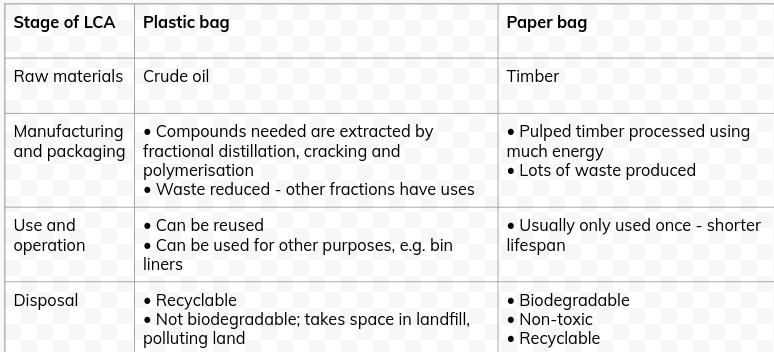
Carry out a simple LCA for plastic vs. paper shopping bags.
Some glass bottles can be reused. How are others recycled to make new glass products?
They are crushed, melted and reshaped.
How can metals be recycled?
- Melting and recasting/reforming them into different products.
- The amount of separation required depends on the material and the properties required of the final product.
- E.g. some scrap steel can be added to iron from a blast furnace, to reduce the amount of iron that needs to be extracted from iron ore.

-
C1: Atomic structure and the periodic table68
-
C2: Bonding, structure and properties of matter48
-
C3: Quantitative chemistry48
-
C4: Chemical changes93
-
C5: Energy changes28
-
C6: The rate and extent of chemical change18
-
C7: Organic chemistry65
-
C8: Chemical analysis34
-
C9: Chemistry of the atmosphere28
-
C10: Using resources76



