future value
- the expecte value of an investment at a specified future date
- FV > PV
- FV = PV x (1 + interest %)^qty of periods
formula/calc example: FV
“What is the future value of $20,000 if it could be invested for five years at 3.9%, compounded annually?”
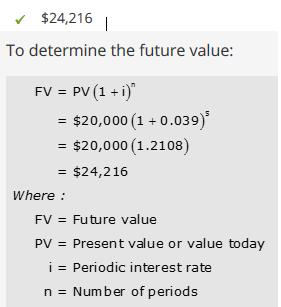
formula: FV
= PV x (1 + interest %)^qty of periods
formula: present value (PV)
= FV / (1 + invest. % per period )^qty. of periods
- process of calculation PV = “discounting”
- rate in the calculation is often referred to as “discount rate”

Tsy professional’s role relative to budgets
Tsy typically has some degree of responsibility in the budgeting process, due to the budget’s impact on the firm’s cash flow streams and overall liquidity.
Also, may need to assess budget’s impact on debt covenants and credit ratings.
budgeting process
master budget - annual budget of combined (1) ops budget (profit plan) and (2) fin budget
- ops budget - focuses oan day to day ops
- sales budget
- expenses to support necessary ops
- financial - addresses fin and investing activities
- capital budget - detailed fcst of expected costs of capital investments
- cash budget - translates info from ops and capital budgets into sources/uses of cash
- ID sources for fcst’ed cash needs
NPV
- estimates increase/decrease in firm value created from an investment
- positive NPV = related cash inflows sufficiently cover initial investment and all financing costs.
formula: NPV (general)
= PV of future cash inflows - initial cost
formula: NPV (if only cash outflow takes place in the present)
= [cash outflow in yr 1/ (1 + WACC)^1]
+ [cash outflow in yr 2/ (1 + WACC)^2]
+ [cash outflow in yr 3/ (1 + WACC)^3]…
formula/calc exmaple: NPV

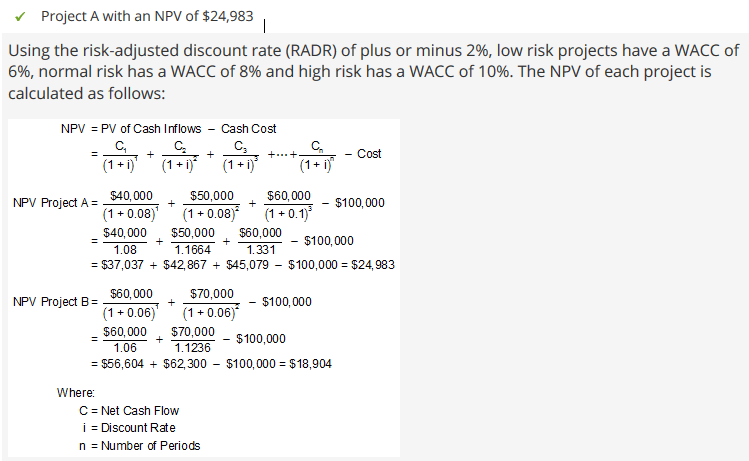
formula/calc example: NPV

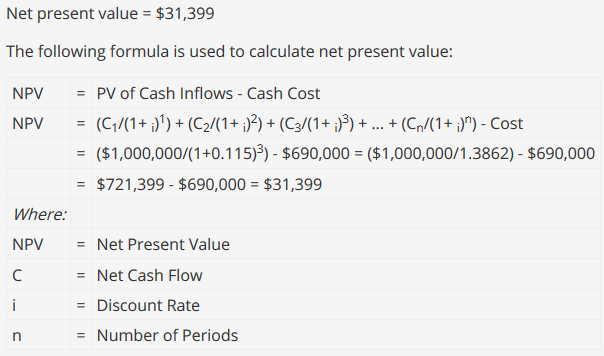
formula: profitability index
formula: internal rate of rtn (IRR)
(aka “hurdle rate”)
discount rate (cost of capital) when NPV = 0
- when PV of cash inflows = initial cost
- good when IRR > WACC
- firm’s required rtn. is considered the minimum return investors expect (i.e. the opportunity cost to its investors for not investing in another company instead); firm must at least “compensate” its investors for this
payback period
qty of yrs. required to recover the
initial investment
formula: payback period
(dumb way– look in CPA flashcards for better)
- add up amts earned each whole yr, until the remainder will be paid back the following yr.
- for the following yr, divide the remaining amount needing for payback by total cash inflow for that yr. year to determine the portion of that year needed to pay back the initial investment.
The payback period is calculated as the yr. that the initial capital outlay is repaid + plus the fractional amount of a year, which indicates at what point in this year the initial investment will be repaid.
investment risk analysis
- sensitivity analysis - determines change in fin value after varying the value of ONE input variable (i.e. recalculate a project’s NPV after changing the value of upfront costs)
- scenario analysis - changes more than 1 variable
- simulation - combines sensitivity and scenario analyses; specifies certain assumptions regarding uncertain variables (multiple)
- monte carlo = most common (many simulations using random quantities selected from a probability distribution of specified variables)
cost of capital
(weighted avg. cost of capital (WACC))
the discount rate, frequently used to discount future cash flows of potential projects
- concept related to opportunity cost,
- Ex: a WACC of 10% implies the firm must earn a return on assets of at least 10% to satisfy investors and protect stock price.
- Aiming to create shareholder value, mgmt. should only invest when ROI >=WACC
risk-adjusted discount rate (RADR)
ex: Company’s WACC is 8%. Using the risk-adjusted discount rate (RADR) of +/- minus 2%, low risk projects have a WACC of 6%, normal risk has a WACC of 8% and high risk has a WACC of 10%.
formula: break even point BEP
BEP = fixed costs / (selling price - variable costs per unit)
or
fixed costs = NI per unit x BEP
qty. req’d to sell in order for fixed costs to equal variable costs
ratio: net profit margin (aka “rtn. on sales”)
= NI / revenues
- amount of after-tax profits generated on a given revenue level
- larger NI relative to revenues = higher net prov. margin = GOOD
e.g. if net prof. margin = 10%, then every $1 in total revenues generates 10 cents of NI
financial leverage
impact of interest exps. on overall profitability (i.e. higher interest exps. = greater financial risk)
formula: firm’s degree of fin. leverage (DFL)
NOTE: % change in anything = (current - prior) / prior

operating leverage
extent to which fixed costs comprise the cost structure
- higher fixed costs = higher ops. leverage = bad)
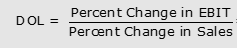
- demonstrates responsiveness of operating profit (EBIT) to changes in sales.
formula: degree of operating leverage (DOL)
NOTE: % change in anything = (curr. - prior) / prior