- Plate Tectonics
the theory that states that the Earth’s crust is separated into plates or pieces that move.
- What are plate boundaries?
Plate boundaries or margins are where plates meet. They are important because this is where most geological processes and many hazards are found.
- 3 types of plate boundaries
Divergent
Transform
Convergent
Divergent Plate Boundary Example
The Mid-Atlantic Ridge that divides iceland is the boundary between the North American and Eurasian plates.
Convergent Plate Boundary Example
Off the West Coast of B.C. : Where the Juan de Fuca Plate subducts under the North American Plate.
Transform Plate Boundary Example
The San Andreas fault zone is a transform boundary between two tectonic plates: the North American plate and the Pacific plate
- Give examples of all 3 types of plate boundaries
CONVERGENT - West Coast of B.C. : Where the Juan de Fuca Plate subducts under the North American Plate.
DIVERGENT: The Mid-Atlantic Ridge dividing Iceland is the plate boundary between the North American Plate and the Eurasian Plate
TRANSFORM: The San Andreas fault zone is a transform boundary between two tectonic plates: the North American plate and the Pacific plate
- Earthquake
A shaking of the ground caused by a release of energy inside the Earth.
- Where do most Earthquakes occur?
At plate margins. Most occur at convergent and transform margins.
Things to list on a wave diagram (draw)
Crest Trough Wavelength Waveheight Amplitude (define: Frequency, Period )
Period
How long it takes for a wave to travel one wavelength distance.
Frequency
Frequency is the number of waves to pass a given point in a given amount of time.
Wavelength
The distance between two corresponding points on any two successive waves. (i.e. distance between adjacent crests or troughs. )
Amplitude
Amplitude is the distance between the top or bottom of the wave and its median point.
- What is a P wave?
- a seismic wave
- faster speed (8km/sec)
- causes objects to move back and forth horizontally.
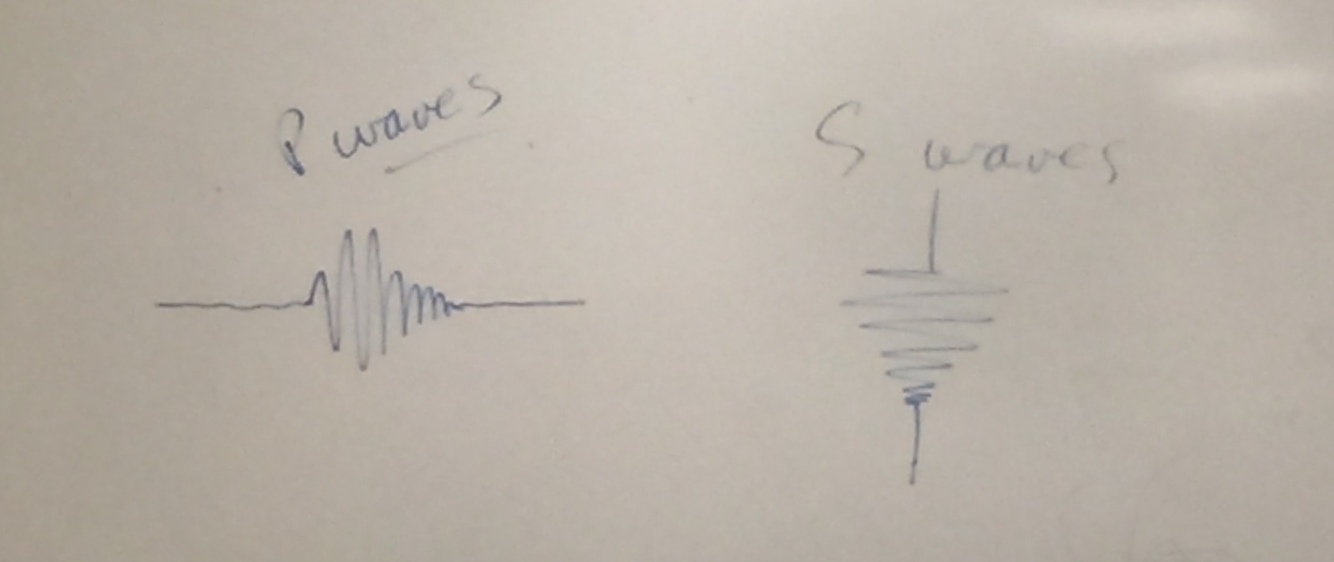
- What is an S wave?
- a seismic wave
- slower speed (5km/sec)
- cause objects to move up and down.
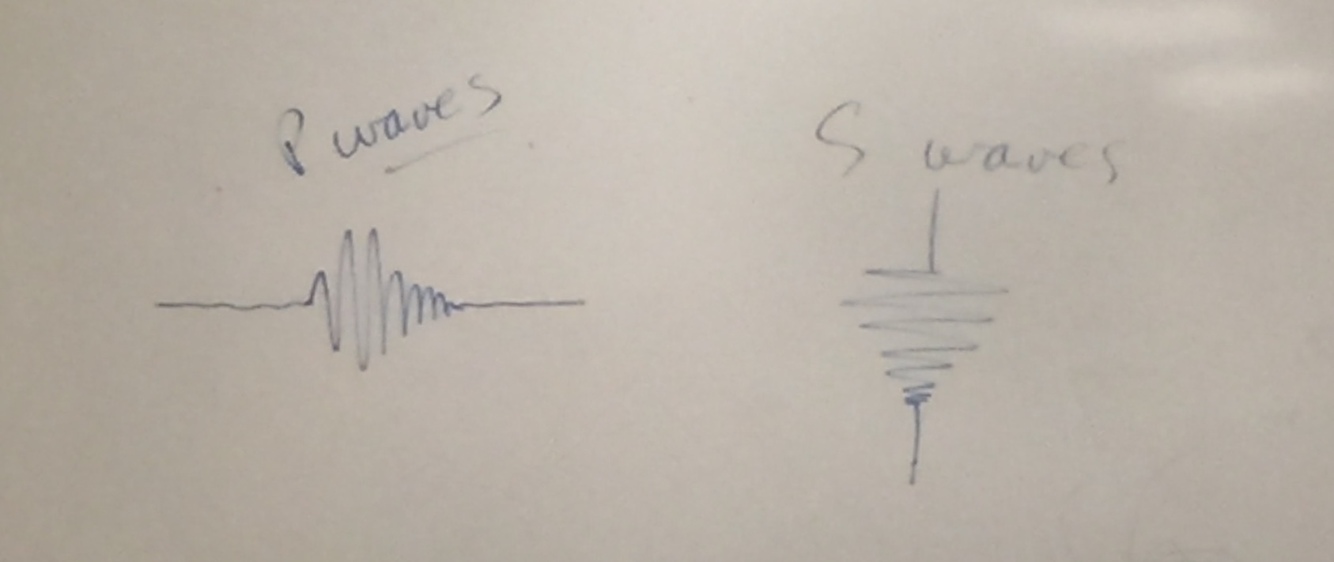
- Body wave
An energy wave that travels through the Earth.
- Surface wave
An energy wave that travels along the surface of the Earth
- How do the velocities of P and S waves differ from one another?
P wave: travels at a faster speed (8km/sec) S wave: travels at a slow speed (5km/sec)
- Seismograph
A sensitive instrument used to measure ground motion.
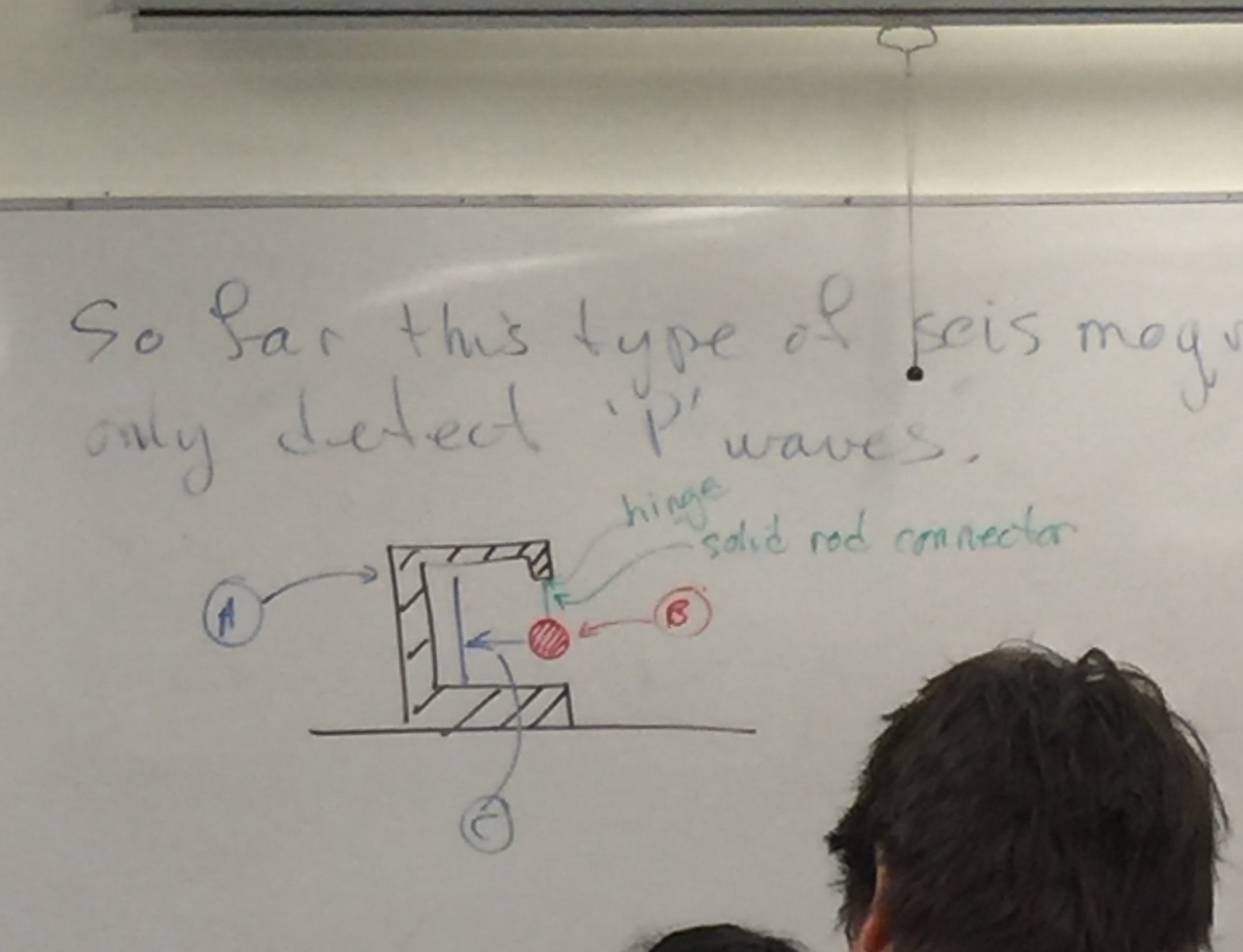
- How does a seismograph work (for P waves)?
A - a frame fixed to the ground. (this part will move with the ground)
B - a heavy weight connected to the frame. This part will not move with the ground.
C - On the weight is a pen that will not move in an earthquake.
On the frame is a writing surface that will move. So far this type of seismograph will only detect ‘P’ waves.
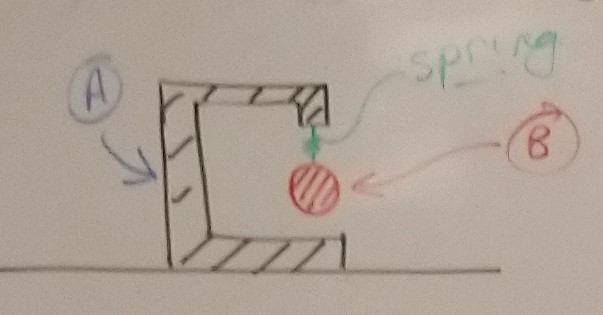
- How does a seismograph (for S waves)?
See photo This type of seismograph will detect S waves.
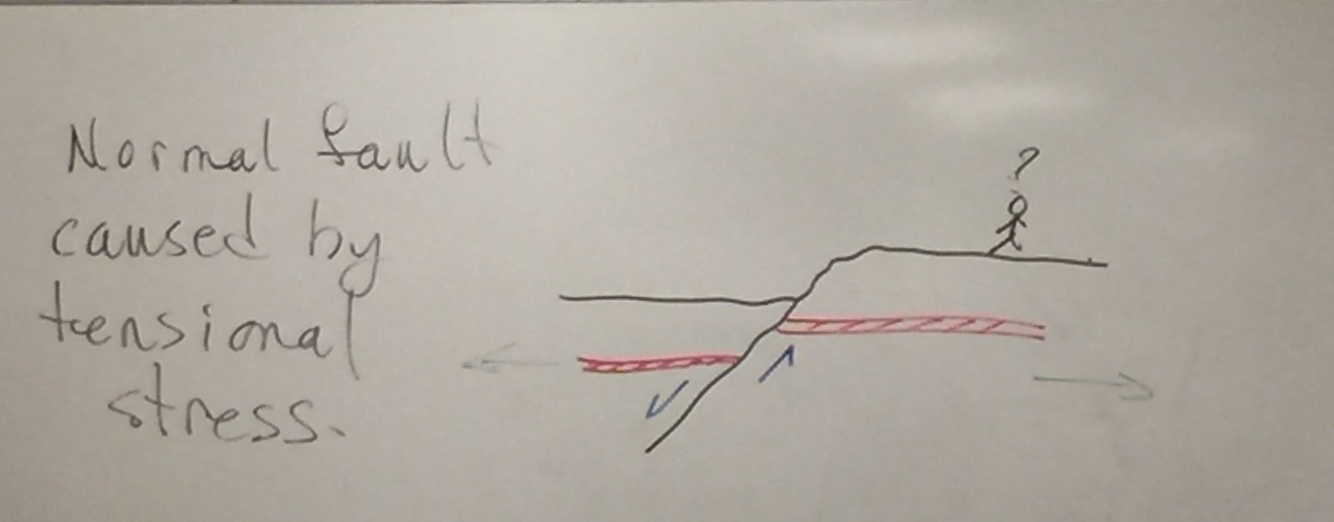
- Fault
A break in the Earth’s crust along which there is movement.
- Normal Fault
caused by tensional stress


-
Chapter 130
-
Chapter 355
-
Chapter 429
-
WTG - Chapter 14
-
WTG - Chapter 28
-
WGT - Chapter 312
-
Chapter 55
-
Chapter 6 and 715
-
Chapter 10 - part 130
-
Chapter 10 - part 219
-
Chapter 1717
-
WTG - Chapter 6, Chapter 74
-
Chapter 44
-
Chapter 218
-
MIDTERM CH. 521
-
Tsunami2
-
Floods/Rivers23
-
Chapter 1015
-
Chapter 43
-
Waking the Giant8



