Define the term
TISSUE
A group of cells.
Has common embryonic origin,
Function together.
Define
CONNECTIVE TISSUE
Protects and supports the body and its organs, binds or holds organs together as a unit, stores energy reserves for the body and provides immunity.
Define
EPITHELIAL
Covers body surfaces (skin), lines hollow organs (stomach) or body cavities and ducts, and forms glands.
Define
MUSCULAR TISSUE
Generates force and is responsible for movement.
Define
NERVOUS TISSUE
Detects changes in the environment
Responds by intitiating nerve signals
Helps coordinate body activities and maintain homeostasis.
Tight Junctions
Has web-like strands of transmembrane proteins that allow the lipid portions of adjacent cell membranes to be tightly bound together to prevent passage of water and solutes between cells. Example: stomach, bladder, intestines.
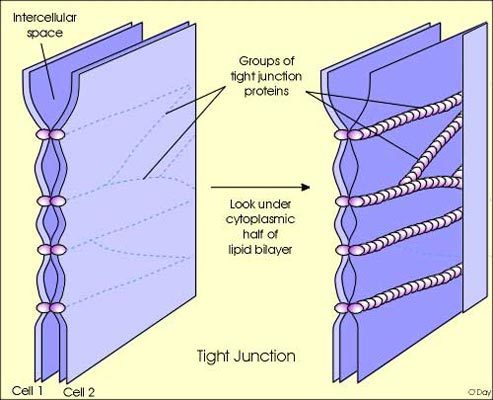
ADHERENS (ANCHORING) JUNCTION
Has a dense layer of protein on the inner surface of the plasma membrane which serves as an attachment point for the cytoskeleton and transmembrane proteins, forming a very tight anchor, holding neighboring cells together.
Found in epithelial tissues lining ducts and hollow cavities.
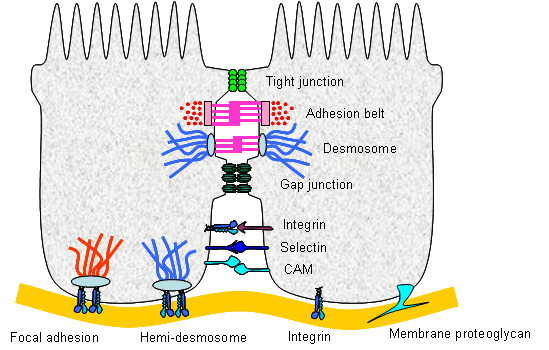
DESMOSOMES & HEMIDESMOSOMES
Very tight junctions that resist stretching or twisting of tissue.
Found between the layers of skin & between cardiac muscle cells of the heart.
GAP (Communicating) JUNCTIONS
Formed by channel proteins thereby permitting small molecules to pass from one cell to another cell quickly and easily.
Found between the cells of the heart and skeletal muscles, intestines and some nerve tissue.
EPITHELIAL TISSUE
- Very little extracellular fluid (ECF)
- Cells are arranged in continuous sheets in single or multi layers:
-The top layer is the APICAL layer.
-The bottom layer is the BASAL SURFACE layer. - The epithelial tissue lies on top and is firmly attached to the:
-Basement Membrane
(basal lamina & reticular lamina) - NO nerve supply
- NO blood supply AVASCULAR.
- The only tissue being constantly RENEWED in large amounts by cells undergoing mitosis.
- General functions: Protection, Filtration, Secretion, Absorbtion and Excretion.
Epithelium Layers
- How many?
- Name and description.
3 Layers
- Simple: Contains only one layers of cells. Found where diffusion, osmosis, filtration, secretion or absorption is needed.
- Pseudostratified: Contains only one layer of cells. Appears to have several layers. All cells are attached to the basement membrane but may not reach the surface. May have cilia and others may secrete mucus. Looks like a pull apart roll. Nucleus are located at different levels.
- Stratified: Two or more layers. Found where protection of underlying tissue is needed, or in areas where there is a lot of wear and tear.
4 SHAPES OF EPITHELIAL CELLS
- Columnar: Cells tht are rectangular in shape. Generally produce secretions, absorb substances and specialized ones may have cilia.
- Cuboidal: Cells that are cube-shaped. Generally produce secretions & are used for absorbtion of substances.
- Squamous: Cells that are flat, plate-like. They are thin, they are used for diffusion & filtration. If found in many layers they can act as protection.
- Transitional: Cells that vary in shape. Can change shape from cuboidal to flat due to stretching, expansion or body movements.
GLANDULAR EPITHILIUM
2 TYPES
Glandular epithelium: glands found throughout the body and are specialized for secreting substances.
- Endocrine Glands: Secrete products directly into the blood stream to be distributed throughout the body. IE: adrenal glands, thyroid gland, pituitary gland…
- Exocrine Glands: Secrete products into ducts which empty onto the surface of the body or into a hollow cavity within the body such as: parts of the digestive tract. Also: sweat or oil glands, skin, tear glands, salivary glands and gall bladder.
CONNECTIVE TISSUE CHARACTERISTICS
- Consists of 2 parts
- Cells & extracellular matrix. - Space between the cells contains PROTEIN fibers in fluid, semi-fluid, gelatinous, fibrous or calcified ground substance.
- Matrix supports cells, strengthens, binds and provides elasticity.
- Has blood supply except for cartilage. VASCULAR.
- Most abundant tissue in body.
CONNECTIVE TISSUE FUNCTIONS
- Binds together/supports and strengthens other tissue types (ligaments/tendons).
- Protect and insulate internal organs.
- Divides organs into smaller sections.
- Help transport substances in the body (blood/lymph).
- Major site of long term energy storage (adipose tissue).
- Provides main site of our immune responses.
- Immature cells end in: _______
- Mature cells end in: _________
- …Blast
- …Cyte
Define
FIBROBLASTS
Cells that secrete the fibers and ground substance that forms the matrix of connective tissue.
- Catrilage tissue fibroblast is called:_______
- Bone tissue fibroblast is called:__________
- Chondroblasts
- Osteoblasts
MACROPHAGES
- Type of white blood cells that are able to eat bacteria by phagocytosis.
- May be fixed position or wandering.
PLASMA CELLS
Type of white blood cells that secrete antibodies, are important to immune function.
MAST CELLS
Found along blood vessels and secrete the chemical called HISTAMINE that dilates small blood vessels to stimulated localized inflammation.
ADIPOCYTES
Cells that store triglycerides for energy reserves, shock absorption and thermal insulation.
WHITE BLOOD CELLS
Found primarily in the blood (especially neutrophils), they can migrate into connective tissues to fight localized infections.
An extracellular matrix component in connective tissue.
GROUND SUBSTANCE CHARACTERISTICS
- Found between the cells & fibers that make up connective tissue.
- Consists of:
- Glycosaminoglycans (GAG) and Proteoglycans are complex combos of poysaccharides & proteins that trap water making the GS more jellylike.
- Hyaluronic Acid: a viscous, slippery substance that binds cells together and lubricates joint surfaces.
- Chondroitin Sulfate: provides support and adhesiveness in cartilage, bone, skin and blood vessels.



