aspect of a testing condition that can change or take on different characteristics with different conditions
variable
How are variables related to theoretical concepts?
- The variables are tangible: duration, frequency, rate, or intensity of bar presses; items checked on a questionnaire; murders committed; books written.
- The theoretical concept is intangible: hunger, love, motivation, anxiety.
- The variables are related to the theoretical concepts by means of the operational definitions used to measure the concepts.
dependent variable:
a measure of the subject’s behavior that reflects the independent variable’s effects
independent variable:
the condition manipulated or selected by the experimenter to determine its effect on behavior
What are the levels of an independent variable?
Levels: Every independent variable has at least two values; otherwise, it wouldn’t be a variable. These values are commonly called levels.
- Frustration or no frustration are the minimum 2 levels
variable of interest:
a variable for which its role in the cause and effect of an observed relationship is not clear
- Does watching violent tav cause aggression or does having a violent tendency predispose you to watching violent tv?
subject variable:
a difference between subjects that cannot be controlled but can only be selected
For e.g.:
- Poverty
- Age
- IQ
- gender
confounded variable:
one whose effect cannot be separated from the supposed independent variable
- For e.g.:
- Lack of exercise (IV) = weight gain (DV)
- You test men at 16 and women at middle age only
- Age is a confounding variable that has an effect on the results
Distinguish between quantitative and categorical variables. Give examples.
A quantitative variable is one that varies in amount - you can measure it, whereas a categorical variable varies in kind.
- Examples of quantitative variables would be weight, height, age
- College major and gender, marital status, political affiliation would be categorical variables: non-numeric though you can assign like a nominal scale
What is the difference between continuous and discrete variables?
If you wanted to get to the top of a mountain: trail or gondola:
gondola stops at 3 places - bottom, middle and top so it’s a discreet variable.
Trail is continuous
continuous variable: one that falls along a continuum and is not limited to a certain number of values - you can measure on a continuum - weight, height
discrete variable: one that falls into separate bins with no intermediate values possible
- I have 2 siblings I cannot have 2.6 siblings
- it is counted and not measured
real limits:
rounding down or up at the .5 mark
the interval defined by the number plus or minus half the distance to the next number
apparent limits:
the point indicated by a number
4 types of measurement with description
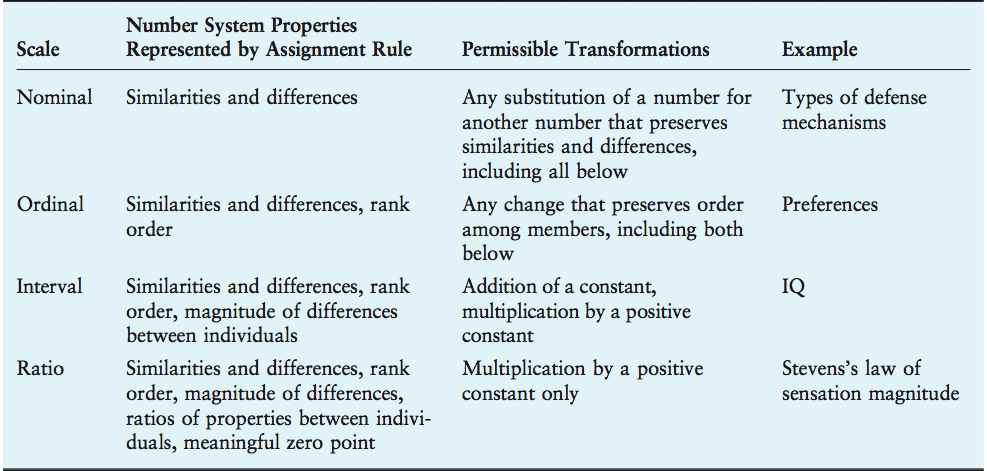
Is a person with an IQ of 120 “twice as smart” as a person with an IQ of 60? Why, or why not?
No because it is an interval scale and not a ratio scale
0reliability:
consistency of a measurement that gives the same result on different occasions
validity:
(of a measurement) the property of a measurement that tests what it is supposed to test
construct validity (of a test):
- First, the test should actually measure whatever theoretical construct it supposedly tests, and not something else
- A test of leadership ability should not actually test extraversion
- Second, it should measure what it intends to measure but not measure theoretically unrelated constructs
- A test of musical aptitude should not require too much reading ability, for example.
- Third, a test should prove useful in predicting results related to the theoretical concept it is measuring.
- A test of musical ability should predict who will benefit from taking music lessons
Face validity
is the idea that a test should appear to any person to be a test of what it is supposed to test
- more a problem of public relations than of true validity
Content validity
test should sample the range of the behavior that is represented by the theoretical concept being measured
- An intelligence test that measured only spatial ability would not have sufficient content validity
Criterion validity
a valid test should relate closely to other measures of the same theoretical construct
- A valid test of intelligence should correlate highly with other intelligence tests.
If the criterion of an intelligence test is how well the test can predict some future performance of the child, such as graduation from college, then it is called –
predictive validity
If the criterion of an intelligence test is whether it correlates with how well a child is doing in school at the time the test is given, it is called —
concurrent validity
Using a bathroom scale as an example, explain why a measurement can be reliable and yet invalid.
- random error may be caused by exactly where I place my feet on the scales, how I lean, whether I just had a drink of water, and so forth. But if we don’t measure these other independent variables, we can lump them all into random error.
I find, however, that I weigh less in the morning, wearing my night clothes, and if I stand on a certain spot on the scales. But this isn’t necessarily my true weight because now I have introduced —
systematic error

-
Chapter 138
-
Chapter 1 FITB28
-
Chapter 2 FITB4
-
Chapter 5 FITB23
-
Chapter 6 FITB18
-
Chapter 7 FITB22
-
Chapter 25
-
Chapter 5: Variables29
-
Chapter 6: Validity19
-
Chapter 7: Control18
-
Chapter 3 FITB10
-
Chapter 8 FITB18
-
Chapter 9 FITB14
-
Chapter 12 FITB16
-
Chapter 3: Ethics12
-
Chapter 8: Non-experimental research: Observational, Case Study, Archive43
-
Chapter 9: Non-experimental_survey39
-
Chapter 12: Single subject design23
-
Chapter 10 FITB11
-
Chapter 11 FITB12
-
Chapter 13 FITB16
-
CHAPTER 10 True Experiments, Part 1: Single-Factor Designs23
-
CHAPTER 11 True Experiments, Part 2: Factorial Designs10
-
CHAPTER 13 Quasi Experiments21
-
quizzes from textbook site89
-
Quiz 112
-
Quiz 212
-
Quiz 38
-
CHAPTER 4 FITB6
-
Epilogue FITB6
-
Chapter 4 writing APA13
-
Epilogue5



