Bodily Growth and Change 3-5 year olds
- 3-5-year-olds grow from 95 to 109cm
- 3-5-year-olds grow from 14 to 18kg
Growth is cephalocaudal
• Limbs lengthen
- Proportion of body fat decreases
- Brain develops
- Skeleto-muscular system strengthens
• Permanent teeth emerge
Impact of size variation
Larger than average child
Smaller than average child
Larger than average children may:
- Be excluded for ‘roughness’
- Lack challenges
- Have more expected of them
Smaller than average children may:
- Be injured by larger children
- Lack mastery in normative tasks of strength and endurance
- Be ‘babied’ — low self-confidence
Health and illness
• Pre-schoolers more likely than adults to get acute infectious diseases such as ear infections and stomach upsets
- Immune system not yet fully developed
- Many infectious diseases eliminated by vaccination in industrialised nations
- Significant differences in developing countries
- UNICEF goal (MDG4) – to reduce child mortality by two thirds by 2015
Child mortality rates
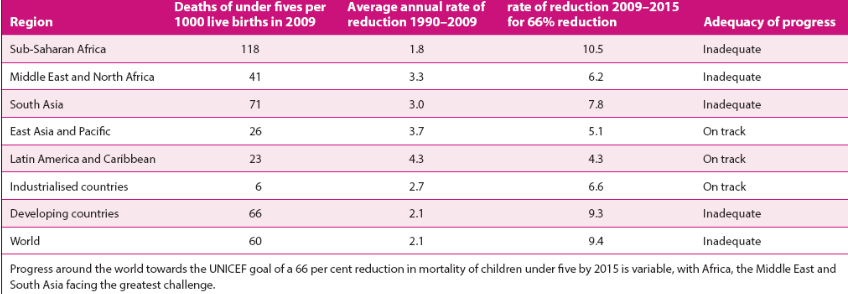
Child injuries
- ‘Unintentional’ injuries more accurate term than ‘accidental’ injuries
- Child factors influencing injury include sex and temperament
- Parental factors: poverty, maternal employment, beliefs about preventability
- Societal conditions play a role (international differences)
- Intentional injury or physical abuse also a serious problem
Deaths and unintentional injuries in Australia
- Overall, a low rate of death
- In 2003, child deaths accounted for 1.3% of all deaths registered
- Most child deaths are of infants aged < 1 year (68% of deaths of 0-14-year-olds in 2003) and are related to perinatal and congenital factors
- However, after infancy period, injury deaths (e.g., transport accidents, drownings, assaults) emerge as leading cause of death for children
- From 1999-2003, 41% of all deaths of children aged 1-14 years were injury deaths (1,260 children)
Motor development
Gross
Fine
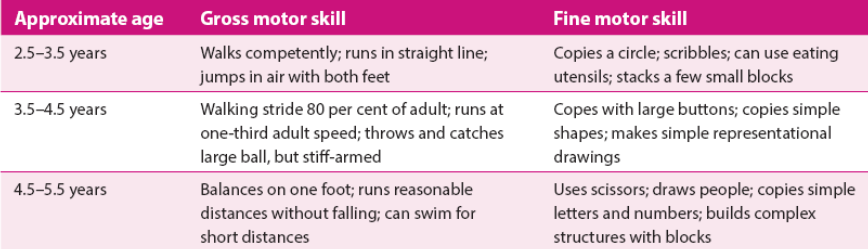
Gross Motor Development
- Large muscle groups
- Centre of gravity moves downward, allowing for new motor skills to develop
- Ball throwing, jumping, running
Fine Motor Development
- Using eye-hand and small muscle coordination
- Buttoning a shirt, drawing
Gross and fine motor skills by age
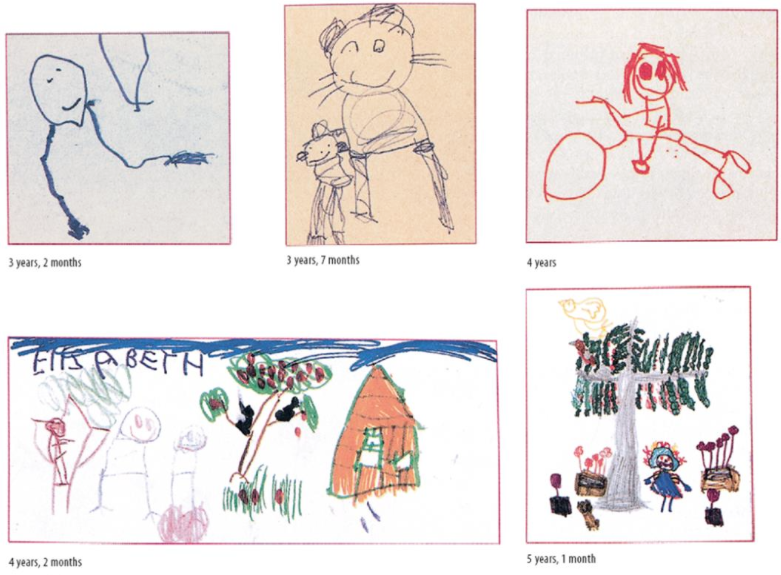
Artistic development
- Scribbles: during 2nd year
- Shapes: circles, squares, triangles (3-4yrs)
- Designs: combine shapes into more complex designs (4yrs)
- Pictorial: draw actual depictions of objects, such as houses and trees (4- 5yrs)
Variations in motor development
sex differences
cultural differences
Sex differences
- Boys slightly stronger than girls
- Girls marginally better at balance and coordination tasks
- May be related to social factors
Cultural differences
- May be related to child-rearing practices
- Cultural and sex differences smaller than individual differences
Piaget’s Cognitive development
Pre-operational stage (2-7 years)
• Symbolic representations supersede sensorimotor activities
—Pretend play
—Language
- Understand constancies as well as object permanence
- Start to internalise functional relationships
Piaget’s cognitive limitations: Conservation
Something remains the same even if its appearance is altered
- Matter/mass
- Liquid
- Length
- Number
- Area
- Volume
preoperational children are not meant to understand conservation
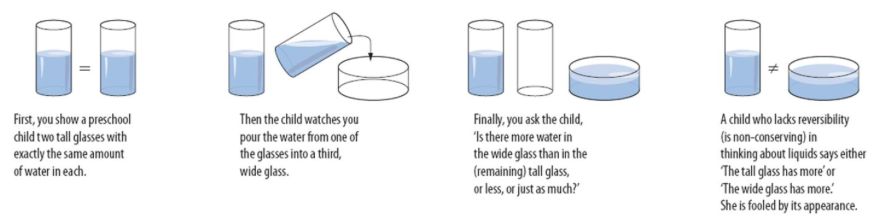
Why Can’t Preoperational Children Conserve?
• Centration: focus on one aspect and neglect others (e.g., height of liquid not volume)
• Irreversibility: Failure to see that an action can go in two or more ways; cannot mentally reverse a set of steps
• Focus on successive states: tendency for preoperational children to focus on the end states rather than the transformations from one state to another
Other cognitive limitations of preoperational children
- Number skills – questions concerning understanding of numerical concepts
- Classification skills – limited to basic level categories and incapable of taxonomic categorisation
- Animism – tendency to apply attributes of living things to inanimate objects
- Magical thinking – attribute inexplicable events to magic or fantasy figures
Egocentrism
Egocentrism: Confusing one’s own perspective with that of another’s
- Not being able to take another’s view/perspective
- Believing the universe centres around the self
- Piaget believed that children under 8 years lack a theory of mind
- Wimmer and Perner (1983): False belief task
- Suggests earlier development of theory of mind
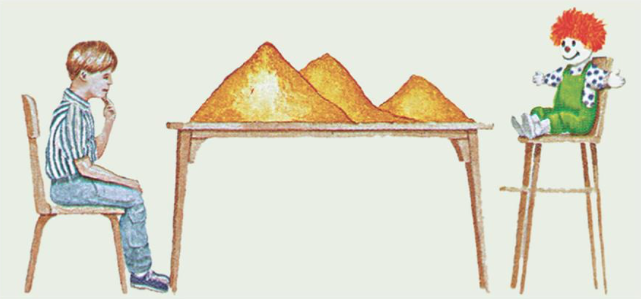
Egocentrism: Piaget’s Three Mountain Task
- The pre-operational child is unable to describe the mountains from the doll’s point of view.
- Four-year-olds always point to photos that show their own view.
- At 7 years they point to the picture that corresponds to the doll’s view.
Theory of Mind
- While Piaget said that children younger that about 8 do not have ToM, research has found that children as young as 2-5 years may have ToM
- Piaget’s methodology flawed:
- Asked abstract questions
- Needed to ask concrete questions
Moral reasoning
- Piaget observed children playing games with rules
- Three phases of moral reasoning:
- Amoral (very young children)
- Heteronomous morality (4-5yrs)
- Autonomous morality (10yrs)
• Later research suggests evidence for earlier advancement
Language acquisition
Expressive language
Receptive language
Phonology
Pragmatics
• Rapid expansion, closely involved in the development of cognitive skills
- Expressive language: words, signs, gestures
- Receptive language: Understanding what is communicated
- Phonology: basic sounds of the language
- Pragmatics: how language is used in context
Semantic development
Semantics: receptive language
- Rapid expansion of vocabulary - nouns generally emerge before verbs
- Overextensions common up to 2 years
- Mispronunciation due to lack of phonemic mastery
Semantic development
Fast mapping
Syntactic bootstrapping
Fast mapping: growth in receptive language
• Child learns the meaning of a word after hearing it only once or twice
- By age 3, average child knows 900-1000 words
- By age 6, they know about 2,600 and understands more than 20,000
Syntactic bootstrapping: use of contextual cues
• Unfamiliar words learnt through grammatical context in which they are found
Grammatical development
Morphemes
Inflection
Intonation
Syntax
Morphemes
• Can be a word ‘pig’ or part of a word ‘(pig)sty’
Inflection
• Prefixes and suffixes that carry meaning of plurality and tense (e.g., ‘s’, ‘ed’)
Intonation
• Pitch or tone
Syntax
• Order of morphemes
Telegraphic speech (18-24 months)
Telegraphic Speech (18-24mths):
• 2-3 essential words expressing an idea
• Competence in syntax gradually increases
Pragmatics
comprehension of when, how and where to use different language forms
Pragmatics of language
- Use in context
- Polite forms of address
Conversational skills develop
• Move from collective monologues
• Conversations where utterances are uncoordinated and not taking into account what the speaker has said
- Start to adopt referential skills
- Ability to communicate information, thoughts, intentions,
feelings accurately to another person
• Use non-verbal cues

-
Chapter 5: Psychosocial Development in the First 2 Years34
-
Chapter 1: Introduction31
-
Chapter 2: theories of development32
-
Chapter 3: biological foundations, genetics and prenatal development36
-
Chapter 4: physical and cognitive development in the first two years30
-
Chapter 6: physical and cognitive development in early childhood30
-
Chapter 7: psychosocial development in early childhood29
-
Lecture 8: physical, cognitive and psychosocial development in adolescence42
-
Lecture 9: physical, cognitive and psychosocial development in early adulthood38
-
Lecture 10: physical, cognitive and psychosocial development in middle adulthood34
-
Lecture 11: physical and cognitive development in late adulthood38



