Complement
Overview
- Named for its ability to complement the killing action of antibody on bacteria.
- Significant role in:
- Promoting inflammation
- Defense against certain forms of extracellular bacteria
- Tissue damage
- Immune complex diseases like systemic lupus erythematous
- Can provide some protection within minutes/hours of an infection ⇒ innate immunity
- Works more efficiently with antigen specific antibodies produced by adaptive immunity
- > 30 proteins found in plasma and tissue fluids
- Concentrations at steady state levels unless system activated
- Made by liver
Complement
Cascade
- Successive proteins are converted from inactive to active forms
- Many are pro-enzymes that require proteolytic cleavage to become active
- Other are activated by a conformation change due to protein binding
- Product of one reaction initiates another
- There are 3 pathways of activation
Complement
Pathways
- Classical
- Prefix “C” followed by a number 1-9
- Lectin
- Descriptive names
- Alternative
- Letters
Classical pathway requires generation of antibodies and requires 1 week or more for activation.
Alternative & Lectin pathways independent of adaptive immunity and are readily available for defense.
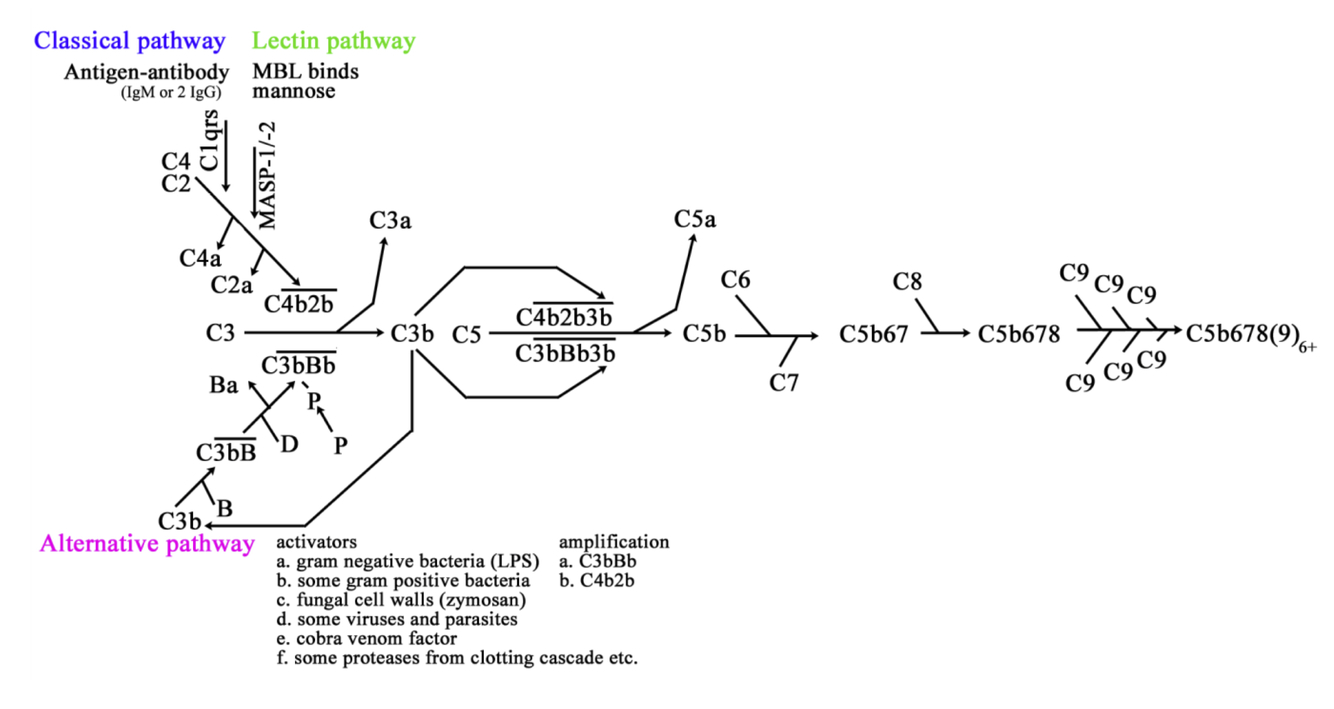
Classical Pathway
1) Activation
(Requires Ca2+)
- IgG or IgM binds antigen causing conformational change exposing specific FC region sequences
- C1q of the C1qrs complex binds to the FC region of a single IgM or at least 2 IgG molecules
- When at least 2/6 knobs of C1q are bound at the same time a conformation change is induced
- Brings active site on C1r into contact with C1s which splits and activates C1s (an esterase)
2) C4 and C2 Cleavage by C1qrs
- C1qrs cleaves C4 into C4a and C4b
- Hundreds of C4 can be cleaved by a single C1qrs ⇒ amplification
- C4a
- Released into local environment
- Very short half-life
- Weak biological activity
- C4b
- Cleavage revealed a thioester bond
- Can be covalently linked to pathogen surface
- Can be rapidly spontaneously hydrolyzed and inactivated by water
- Also revealed a region that binds C2b
- Cleavage revealed a thioester bond
- C1qrs then cleaves C2 into C2a and C2b
- C2a diffuses away
- C2b binds to C4b on membrane surface
- Forms C4b2b = classical C3 convertase
- Half-life of a few minutes
- Forms C4b2b = classical C3 convertase
3) C3 cleavage by C3 convertase
- Classical C3 convertase cleaves C3 into C3a and C3b
- C3 is the most prevalent complement protein in plasma
- A single C3 convertase can cleave thousands of C3’s ⇒ significant amplification
- C3a
- Released into local environment
- Significant biological effects
- C3b
- Most C3b covalently binds to surface membrane and functions as opsonin
- Eventually one C3b fragment binds to the C4b2b complex forming C4b2b3b = classical C5 convertase
4) Terminal Pathway
Common to classical, alternative and lectin pathways.
Acute Phase Proteins
Acute inflammation causes macrophages to produce IL-6.
IL-6 induces liver to produce acute phase proteins including:
Mannose-binding protein (MBP)
C-reactive protein (CRP)
Mannose Binding Protein
(MBP)
aka
Mannan-Binding Lectin
(MBL)
- Similar structure to C1q
- Can bind terminal mannose groups on bacterial and yeast carbohydrates but not human cells
- Associated with 2 serum proteases (MBP-associated serine proteases)
- MASP-1 and MASP-2
- Function similar to C1r and C1s
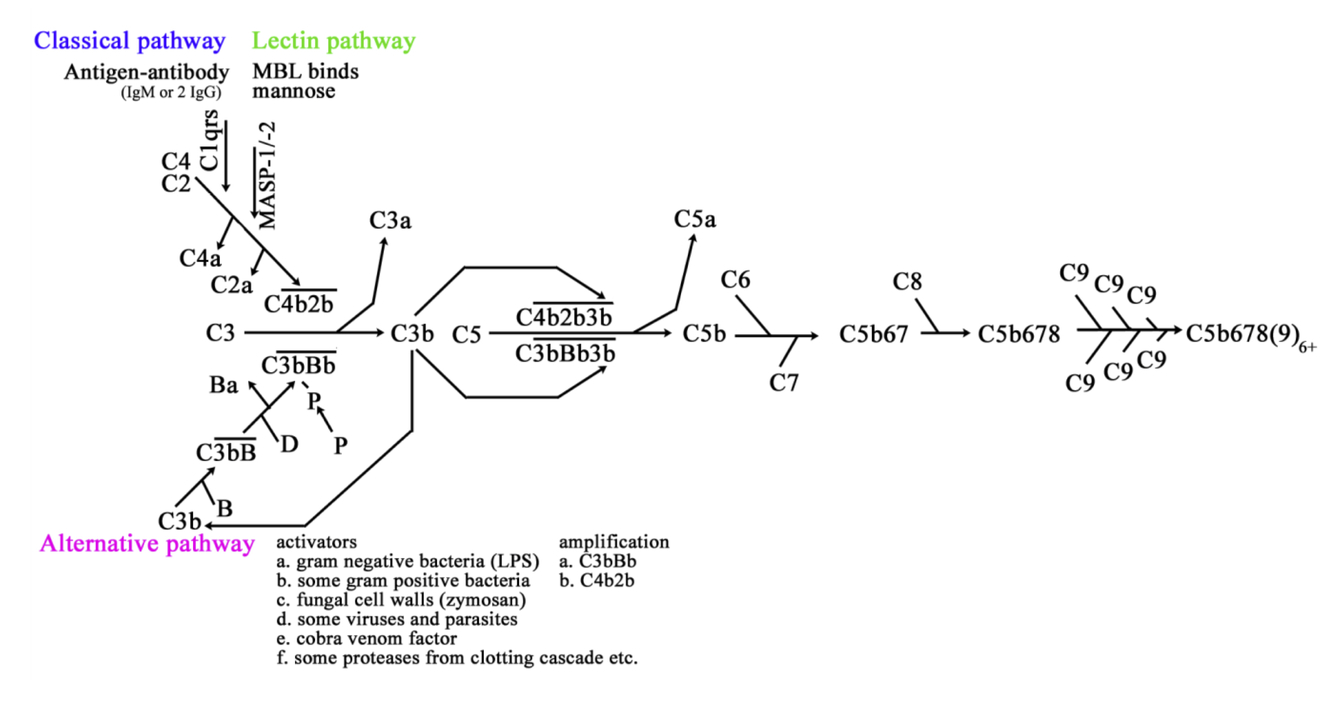
- When bound to a surface, MBP/MASP-1/MASP-2 complex able to cleave C4 and C2 to generate classical C3 convertase
C-Reactive Protein
(CRP)
- Binds to the phosphorylcholine components on bacterial and fungi cell
- Does not bind to phosphorylcholine present in the phospholipids of humans
- Functions like an antibody
- Once bound to a surface, CRP is able to bind C1qrs and activate the classical pathway
Lectin Pathway
- Initiated by binding of MBP or CRP to conserved motifs on the surface of certain bacteria and fungi
- Binding activates the rest of the classical cascade
- MBP functions like C1qrs
- CRP functions like an antibody
Alternative Pathway
Inducers
Promotes the alternative pathway by sheltering C3b from proteolytic cleavage.
- gram-negative bacteria (specifically LPS)
- cell wall components of certain gram-positive bacteria and yeast (zymosan)
- certain viruses and parasites
- cobra venom factor
- depositions of IgA immune complexes
Tickover
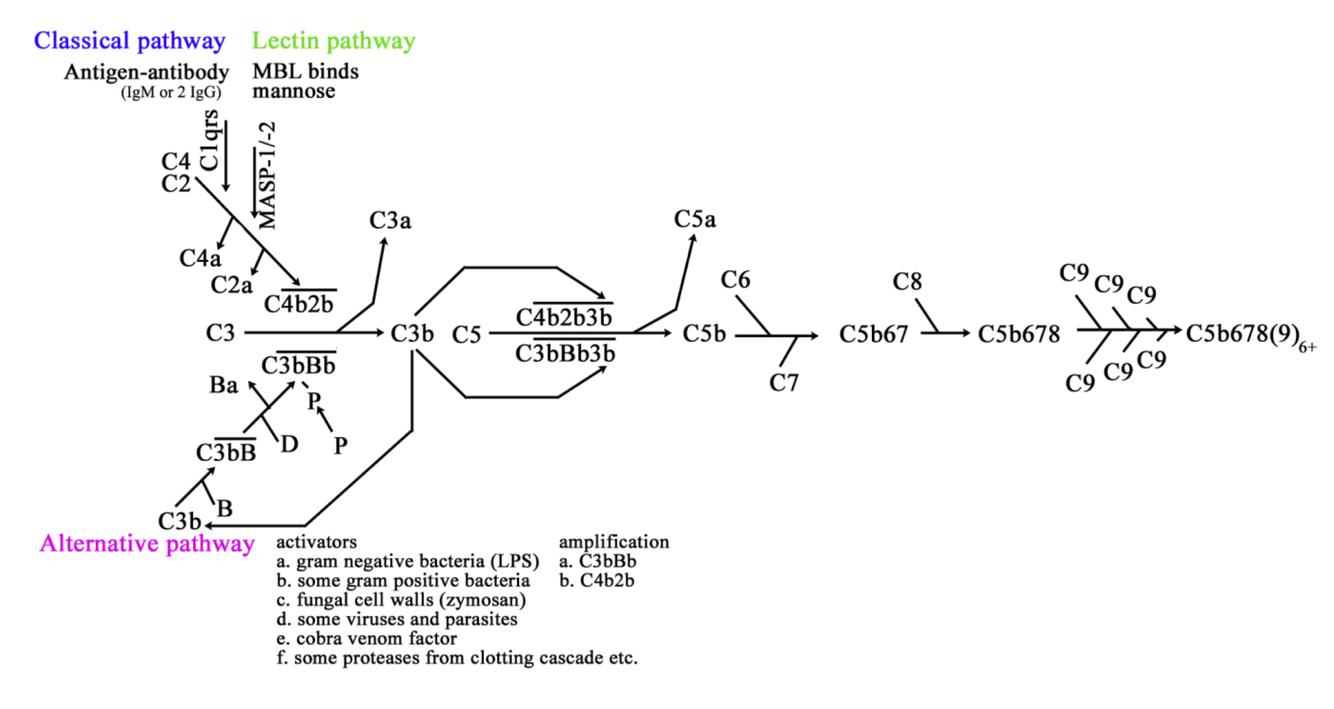
C3 is spontaneously hydrolyzed by H2O into C3a and activated C3b(H2O).
Normally C3b(H2O) is rapidly degraded but protection by an “activator surface” results in a rapid increase of C3b(H2O) concentration
Alternative Pathway
- C3b (from C3 convertase) or C3b(H2O) (from tickover) binds factor B.
- Binding facilitates cleavage of factor B by plasma protease factor D into Ba and Bb.
- Ba diffuses into local environment.
- Bb forms C3bBb or C3b(H2O)Bb
- Both forms can act as the alternative C3 convertase.
- C3bBb bound and stabilized by factor P (Properdin)
- Alternative C3 convertase cleaves C3 into C3a and C3b.
- C3a enters local environment & has significant metabolic effects
- C3b complexes with more factor B and becomes activated by factor D ⇒ amplification
- When a C3b binds to form C3bBb3b it becomes the alternative C5 convertase.
- Alternative C5 convertase cleaves C5 into C5a and C5b.
- C5a with significant metabolic effects.
- C5b enters the terminal pathway.
Terminal Pathway
Common to the classical, alternative, and lectin pathways of activation.
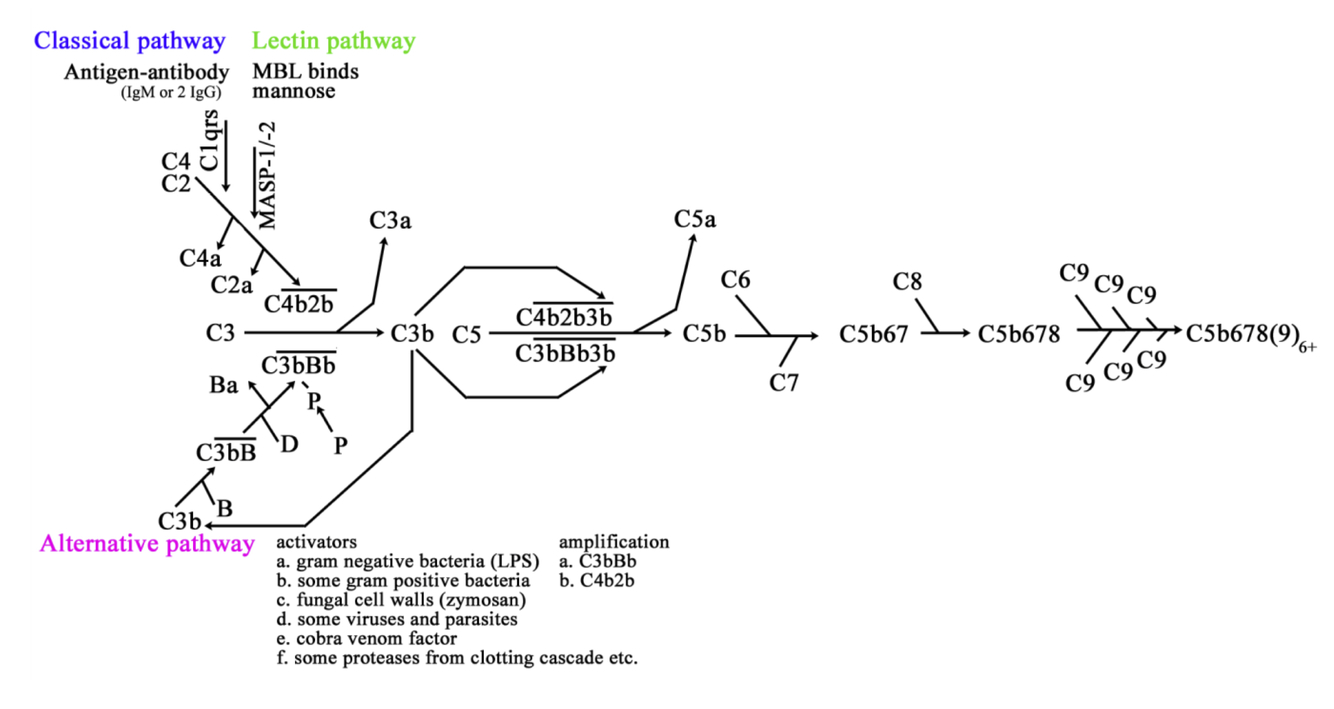
- Activated classical C5 convertase (C4b2b3b) or alternative C5 convertase (C3bBb3b) splits C5 into C5a and C5b.
- C5a released into the local environment
- Proinflammatory effects
- C5b covalently binds to the membrane
- Initiates assembly of the terminal complement components to form the membrane attack complex (MAC)
- C5a released into the local environment
- Remainder of MAC complex is assembled non-enzymatically.
- C5b binds C6, C7, and C8.
- C8 inserts into the membrane.
- C9 polymerization
- 6-16 molecules of C9 bind to the complex, polymerize, and generate a transmembrane pore in the membrane called the membrane attack complex (MAC).
Membrane Attack Complex
(MAC)
- Transmembrane pore formed of C9
- Allows flow of solute & electrolytes across the cell membrane
- Degree of damage depends on cell type
- Typically gram negative more suseptible
- Can lyse RBC’s
- Compromises nucleated cells until lysis
- Some bacteria have developed strategies to inhibit or block complement cascade
- Capsule to prevent MAC formation
- Enzymes in cell wall that inactivate components of cascade
- Even if MAC fails to eliminate the cell, C3b remains intact on membrane & promotes phagocytosis
Complement Cascade
Regulation
- Short half-life of products of complement cleavage
- eg C5a, C3b, C4b2b3b
- Inhibitors
- C1 inhibitor (C1INH)
- Inhibits proteolytic cleavage activity of C1qrs by binding to C1r and C1s causing dissociation from C1q
- Factors H and I
- Found in serum or bodily fluid
- Factor H binds C3b and facilitates binding of factor I forming inactivated iC3b
- C1 inhibitor (C1INH)
- Host cell protection mechanisms
- Complement receptor 1 (CR1)
- Found on RBC, B cells, macrophages, and dendritic cells
- Functions like Factor H binding to C3b making it susceptible to factor I
- Decay accelerating factor (DAF)
- Found on RBC’s
- Promotes dissociation of classical and alternative C3 convertase
- CD59 (Protectin)
- Prevents MAC formation on host cells
- Complement receptor 1 (CR1)
Complement
Effector Activites
- Phagocytic recruitment
- anaphylatoxin: C5a > C3a >>>> C4a
- activation of the vascular endothelium: C5a > C3a
- chemoattractant: C5a most potent
- Phagocytic killing
- activates phagocytes: C5a >>> C3a
- opsonization: C3b (binds CR1 on phagocytes)
- Direct damage/killing
- cellular damage and lysis by MAC (C5b789n)
Anaphylatoxin
C5a > C3a >>> C4a
- Causes mast cell degranulation
- Increase histamine release
- Causes:
- smooth muscle contraction
- increased vascular permeability
- increased plasma protein concentration in tissues (e.g. complement and antibodies)
- facilitates neutrophil migration into tissues
Activation of Vascular Endothelium
C5a > C3a
- C5a/C3a induces expression of adhesion molecules on vascular endothelium
- Promotes WBC binding
- Facilitates diapedesis
Chemoattractant
C5a >>>> C3a
- C5a (and C3a) promotes changes in neutrophils and monocytes that promote their firm adherence to vascular endothelium and diapedesis
- Also creates a chemotaxic gradient in the tissue for cells to follow to site of inflammation
Phagocyte Activation
C5a >>> C3a
- C5a induces the respiratory burst
- Also induces expression of C1 receptors to increase phagocytosis
- C1 receptors enhance opsonization by degrading C3b into iC3b which binds to CR3.
- CR3 induces phagocytosis better than CR1.
Opsonization
C3b primarily
Some C4b
- Phagocytes (monocytes and neutrophils) express complement receptors:
- CR1 binds C3b
- CR3 binds iC3b
Deficiencies in
Early C components
C1q, C1r, C1s, C4, and C2
- increases in immune complex diseases
- glomerulonephritis
- vasculitis
- increases in extracellular bacterial infections
- primarily staph and strep
Deficiency of C3
- increases in all bacterial infections
- abnormalities in MAC formation, opsonization, inflammation, and neutrophil recruitment
- increases incidence of immune complex diseases
- due to decreased clearance by reticuloendothelial system
Deficiencies in the
Late Components
C5, C6, C7, C8
- Increased susceptibility and recurrent bacterial infections with Neisseria
- causes gonorrhea and some forms of meningitis
Hereditary Angioedema
- Deficiency in the C1 inhibitor
- Autosomal dominant
- Can be acquired later in life due to autoantibodies for C1INH
- Results in excessive activation of C4 and C2 by C1
- C2 converted to C2 kinin
- Results in excessive swelling
- C1INH also involved in clearance of clotting, kinin, and plasmin systems.

-
Introduction32
-
Innate Immunity30
-
Complement27
-
Inflammation & Hematopoiesis30
-
Antibody Structure and Function38
-
Antibody Recognition and Generation of Diversity15
-
B-Lymphocyte Development and Antibody Production14
-
Clinical Applications of Ab/Ag Interactions6
-
TCR and MHC14
-
Antigen Processing and T-cell Ontogeny13
-
T Cell Activation and Effector Functions13
-
TC & TH Cells25
-
Immunity to Infection13
-
Cancer30
-
Hypersensitivities46
-
Immune Regulation & Tolerance24
-
Autoimmunity19
-
Transplantation32
-
Immunodeficiencies30



