All of the Enterobacteriaceae appear as _____ on gram staining?
Gram negative rods
What component of the Enterobacteriaceae contributes to septic shock?
LPS
T/F Enterobacteriaceae are obligate anaerobes
FALSE Enterobacteriaceae are facultative anaerobes
When grown anaerobcally, enterobacteriaceae ferment _____
Glucose
What test distinguishes enterobacteriaceae from Pseudomonas?
Oxidase test Reagent remains colorless with enterobacteriaceae, turns colors with pseudomonas
What three surface antigens are used for typing of Enterobacteriaceae?
- O (ohne Hauch) antigen
- Repeating unit of carbs on outermost portion of LPS
- H (Hauch) antigen
- Flagellar antigen
- K (Kapsel) antigen
- Capsular, usually polysaccharide
- Called Vi in Salmonella typhi (due to unique virulence properties
*
In septic shock caused by Enterobacteriaceae, bacterial LPS binds _____, causing generation of pro-inflammatory cytokines
CD14 of macrophages
T/F The presence of 20+ PMN per HPF implies the patient has an inflammatory diarrhea (Shigella)
TRUE
Few or no fecal leukocytes is seen in watery diarrheas (toxigenic cholera/viral)
On blood agar, Enterobacteriaceae appear as _____
Gray, mucoid colonies
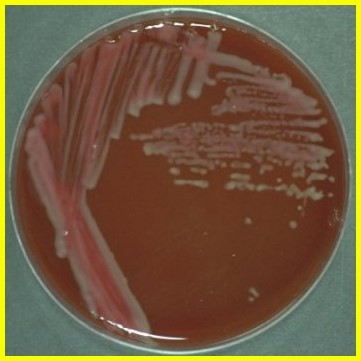
What are the three treatment options for Traveler’s Diarrhea?
- Azithromycin
- Cipro
- Rifaximin
Note: these do not cure the condition, but they shorten the duration of symptoms. Thus, fluid and electrolyte replacement is suggested to prevent bacterial resistance.
Many of the Enterobacteriaceae ferment _____
Lactose
What special agar is used to culture E. coli? How does it look.
- MacConkey’s agar
- Looks cherry pink
- Due to fermentation of lactose, changing pH
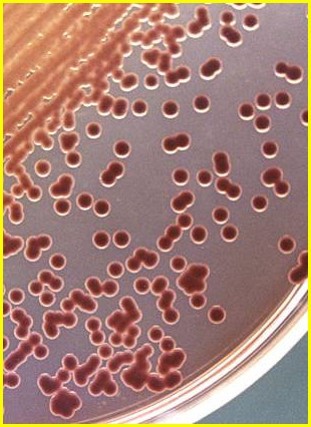
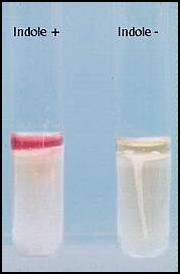
E. coli hydrolyzes tryptophan to _____
Indole (positive indole test)
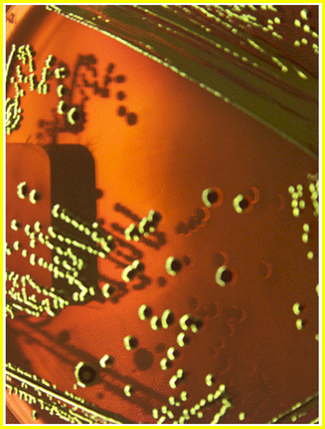
On Eosin Methylene Blue (EMB), E. coli makes acid and creates a _____
Green sheen
Enterotoxigenic E. Coli (ETEC) is transmitted ______, and commonly causes _____.
- Fecal oral transmission
- Commonly causes Traveler’s diarrhea
T/F ETEC invades epithelial cells
FALSE
ETEC only adheres to small intestine via its pili (colonization factor antigens - CFA1 & CFA2)
ETEC stimulates _____ and _____ causing hypersecretion of electrolytes
- Guanylate and adenylate cyclase
What are the two toxins secreted by ETEC?
- Heat stable toxin (ST)
- Heat labile toxin (LT)
- Like cholera toxin, but less potent
_____ E. coli starts off with a watery diarry that eventually becomes bloody and watery
Enteroinvasive E. coli (EIEC)
Treatment for EIEC?
Same as ETEC (Fluoroquinolone, Rifaximin, azithromycin)
What are the symptoms of EIEC?
- Fever
- Cramps
- Malaise
- Toxemia
What is the main reservoir of EHEC?
Cattle
EHEC makes _____ toxin. What does it do?
- Shiga toxin
- Made by both E. coli and Shigella
- A-B toxin
- B subunit binds ganglioside receptor
- A subunit exits golgi → modifies tRNA binding site of 60S
- Stops protein synthesis → death
What occurs when shiga toxin damages blood vessels in the epithelium of glomeruli, with resultant in kidney failure and thrombocytopenia leading to renal failure, neuro. deficits (5-10%), and death (5-10%). What populations does this condition usually effect? How is it treated?
- Hemolytic Uremic Sydrome
- Usually affects older folks and kids
- Tx: Transfusions and dialysis


-
Antiobiotics I47
-
Antibiotics II42
-
Antibiotics III47
-
Staphylococci38
-
Streptococci66
-
Gram Positive Rods60
-
Zoonoses I57
-
Zoonoses II57
-
Mycobacteria31
-
Gram Negative Pyogens (Neisseria, H. Influenzae, Bordatella)77
-
Vibrio, Campylobacter, Helicobacter44
-
Legionella20
-
Enterobacteriaceae I30
-
Enterobacteriaceae II45
-
Anaerobes38
-
Pseudomonas and Related Opportunists17
-
Syphilis19
-
Chlamydia32
-
Mycoplasma10



