Epidemiology: Designing Epidemiological Studies 1 Flashcards

(90 cards)

1
Q

What are the 2 types of epidemiological investigation

A

Descriptive and Analytic

2
Q

Define the descriptive epidemiological investigation

A

Descriptive - Describe the problem often at an aggregated level. Can be used to inform later analytic research. (Eg.day to day public health practice) - does not use hypothesis

first step of disease investigation

3
Q

Define the analytic epidemiological investigation

A

Analytic - Deploy and test hypotheses, often at a person-level through which association can be measured and causation inferred. (often published literature)

4
Q

Types of Descriptive epidemiology

A

Case report Case series Cross-sectional Longitudinal Ecological (although cross sectional and ecological can sometimes take a analytic approach testing hypothesis)

5
Q

Types of Analytic epidemiology

A

Observational Cross-sectional Ecological Case-control Cohort studies Experimental / intervention (Cross sectional and ecological are descriptive epidemiology which can sometimes employs an analytic approach)

6
Q

How does descriptive epidemiology characterise disease

A

Descriptive epidemiology characterises disease in 1 or more of the 3 epidemiological dimensions; person, place and time

7
Q

How does descriptive epidemiology characterise disease in terms of person

A

Person – demography such as age, gender, occupation or disease status.

8
Q

How does descriptive epidemiology characterise disease in terms of place

A

Place – at a hospital, in a geographical area, among a certain community?

9
Q

How does descriptive epidemiology characterise disease in terms of time

A

Time – may be at a point in time or may be over a specified period. (can be a follow up period)

10
Q

What are examples of exposures and outcomes in descriptive epidemiology

A

Exposures Age, gender and occupation would be considered exposures; as would living in a particular area. Outcomes Oftentimes focused on morbidity and mortality NOTE: a single characteristic may be an exposure OR an outcome = (eg. Hypertension state - outcome of salt exposure but risk factor and exposure for stroke)

11
Q

What are the measures of descriptive epidemiology

A

Measures, typically: Incidence Prevalence Often point estimates with a confidence interval around them.

12
Q

Define Parameter in terms of descriptive statistics

A

Parameter – a fixed, often unknown value, which describes an entire population (accurate individual measurements)

13
Q

Define Statistic in terms of descriptive statistics

A

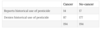
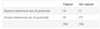
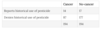
Statistic – a fixed value, derived from a sample that estimates the value in the population (estimates from samples)

14
Q

Define Point estimate

A

a statistic that seeks to estimate the parameter

15
Q

Define confidence intervals in terms of descriptive epidemiology

A

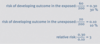
the range of values within which we are 95 % confident that the true value lies

16
Q

Describe the point estimate

A

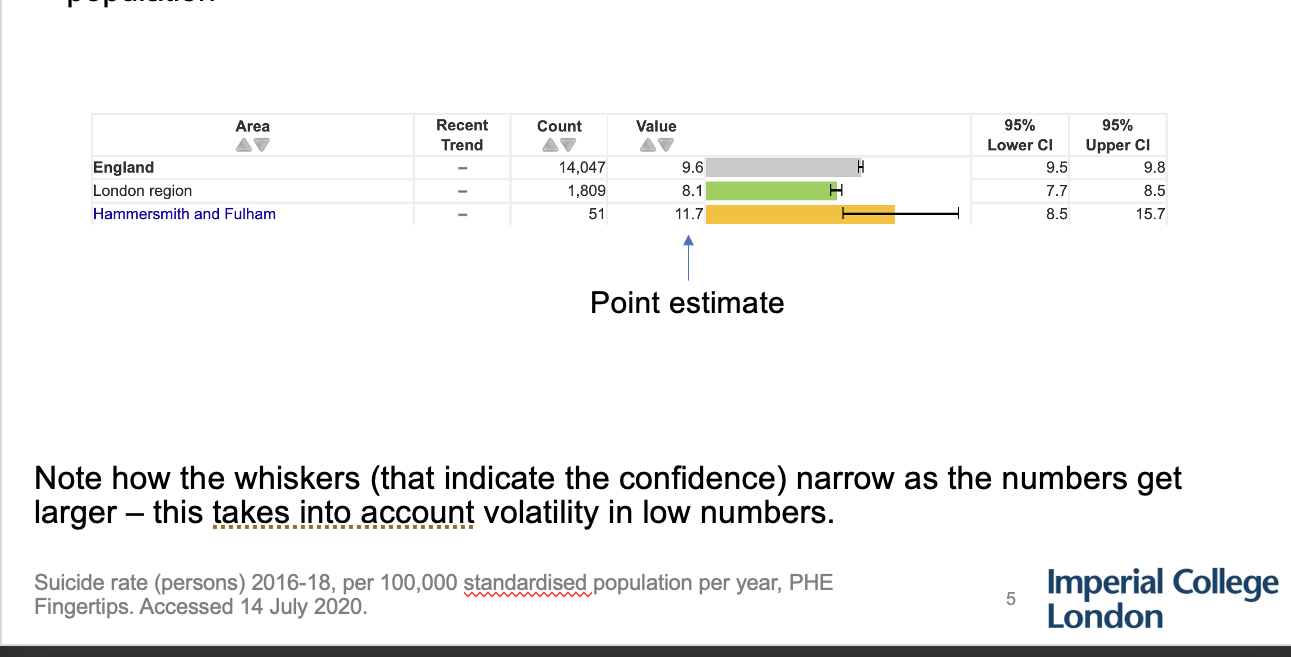
whiskers describe confidence intervals

Note how the whiskers (that indicate the confidence) narrow as the numbers get larger – this takes into account volatility in low numbers.

eg. For Hammersmith and Fulham, we think the suicide rate per year is 11.7 per 100000 and we are 95% confident the value lies between 8.5 and 15.7%

17
Q

Define votality

A

liability to change rapidly and unpredictably, especially for the worse.

18
Q

Why may suicide rate measurements be an underestimate for the true suicide rate

A
  • never truly know if people intentionally took their own life
19
Q

What are case reports/case series in descriptive epidemiology

A
  • Case report – often used to communciate new diseases/presentations/findings
  • case series = collection of case reports in which similarities and differences can be identified

Weakest type of study but still very useful (accessible to medical students)

Today they’re often about unusual findings and can be structured as a bulletin or as a learning opportunity - so-called Continuing Medical Education (CME) or in the UK ‘Continuing Professional Development (CPD).

In new diseases – such as MERS, COVID-19 and other conditions, more than one case reported becomes a case series.

20
Q

What type of study is this?

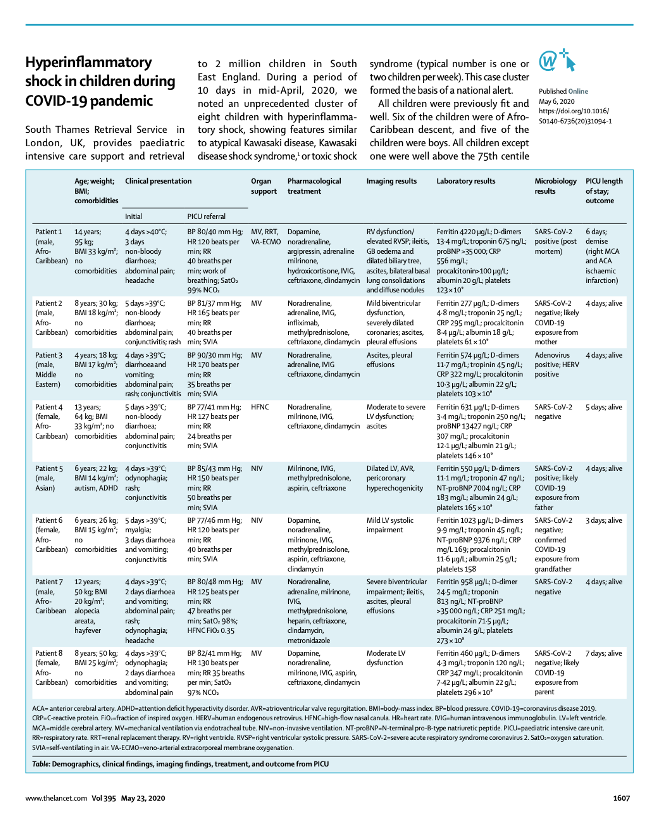
Riphagen S et al. The Lancet. 2020. Available at: https://www.thelancet.com/pdfs/journals/lancet/PIIS0140-6736(20)31094-1.pdf

A

Case Report/series

21
Q

Describe cross-sectional studies

A

Typically describes the prevalence of a condition across a population at a single-point in time.

  • A survey is an example of a cross sectional study. (survey common as cheap, fast and easy to deploy)
  • A snapshot at a single point in time. (eg month or a year)
  • The prevalence measured may be an outcome, exposure or both.
  • Lacks follow-up, so risk or temporal relationships cannot be easily determined.

not useful by itself - employ benchmarking (take point estimate of our population and compare it to a similar area)

SUMMARY: Cross-sectional – describes the prevalence of an exposure/outcome across a pop. at a single point in time (e.g. survey) - No follow up + only prevalence

22
Q

Describe Longitiduinal studies

A

Descriptive longitudinal studies describe the prevalence or incidence of an exposure or outcome over time.

  • It may be made up of more than one cross-sectional analysis. That is aggregated data. (repeat study for same population at a later point in time)
  • Alternatively it may look to follow the same participants over time. That is person-level data. (eg. measure the prevalence of disease in same participants over time at 2 or more points establishing a longitudinal trend)

*The term longitudinal is often quite loosely applied to any study – descriptive or analytic that involves measurement at more than one time-point. (can make longitidunal inference if question has been studied before)

SUMMARY: describes prevalence/incidence of an exposure/outcome over time (may be aggregated/person-level)

23
Q

Describe Ecological studies

A

Ecological – compare groups rather than individuals (can be longitudinal/cross-sectional)

eg. measuring prevalence of disease in a counrtry and comparing it to another

They can be descriptive or analytic in nature.

They can be cross sectional or Longitudinal

24
Q

Which type of epidemiological investigation is Typically used more in public health practice

A

Descriptive

25
Which type of epidemiological investigation is Typically used more in research settings
Analytic
26
Which type of epidemiological investigation Involves hypothesis testing and the use of statistical tests
Analytic
27
Which type of epidemiological study typically provides estimates of morbidity such as prevalence or incidence rate
Descriptive
28
Which type of epidemiologcal investigation Identifies the impact of interventions or specific exposures
Analytic
29
A statistic is an estimate of a......
Parameter
30
A statistic relates to the measure of interest in a ....... (which is drawn from a population)
Sample
31
A sample is always ...... than a population
Smaller
32
A statistic is typically presented as a ........ with associated confidence intervals
Point estimate
33
Which term best describes The range of values within which we are 95% confident the true value lies.
Confidence intervals
34
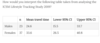
* Data is based on statistics rather than parameters * the ICSM LTS 2019 is merely a dataset. It could be investigated descriptively or analytically. * On average, male medical students in the 2019 ICSM intake **who took part** in the Lifestyle Tracking Study, **reported** travelling a shorter time than their female counterparts. ( it may be that the genders differ in their ability to estimate how long it takes them to get to campus.) * Due to to 95% confidence intervals overlap between genders, we can infer that there is no statistical difference between genders, despite the apparent gap in point estimates. * There are more females than males, and the range of a confidence interval is typically inversely proportional to the number of observations. (CI partially driven by sample size. As observations increase, the confidence interval will typically tighten.)
35
36
What affects the confidence interval length
CI partially driven by sample size. As observations increase, the confidence interval will typically tighten.) more tightly distributed observations will drive tightening of the confidence intervals.
37
What is standard deviation
The standard deviation describes the distribution of observed values.
38
Importance and limitations of ecological studies
**Ecological studies** • Use aggregated data (observation=group) • Useful when limited variability of exposure within a group * size of group can vary (eg. school, work place, country ect) * Allows for more confidence associations between groups * Usually the first step in exploring a research question + can generate a hypothesis * Normally uses secondary data (already available; cheap and fast) * Data may not be for the exact purpose of the study * Useful when variability of observation is limited ``` • Cannot be sure if exposure preceded outcome in eclogical studies • Studies subject to Ecological fallacy/aggregation bias = the assumption that associations between groups hold between individuals (need individual data to observe without bias) ``` REMEMBER: ASSOCIATION DOES NOT ALWAYS EQUAL CAUSATION (group association does not mean individual association)
39
Difference between descriptive and analytic epidemiology? and different between aggregated and person levl data?
Descriptive epidemiology: providing measures of frequency Analytic epidemiology: testing hypotheses and associations Aggregated data: for example, 5% of the population died. Person-level data: for example, participants 1, 7 and 15 died.
40
Define Primary data and its uses
* Primary data are those that are collected by the researcher first-hand. * PROS: collected for a pre-specified purpose: to test the hypotheses or answer the research question(s) set by the researcher. * CONS: Collecting data (and cleaning it) is a hugely time-consuming process and will often take a very large proportion of an overall research project’s duration and budget
41
Define Secondary data in epidemiological research and its uses
* Secondary data is the term applied to data that have been collected for another purpose – and then potentially ‘recycled’ for a different purpose. * PROS: usually faster and cheaper to undertake * CONS: Limitations as have to make many assumptions as data wasn't collected for the new purpose
42
43
What is routinely collected data and examples
Routinely collected data - large administrative datasets that allow us to understand populations and their health. eg. census, electoral register, first language of reception-class school, “Hospital Episode Statistics (HES)”, prescribing data –
44
Define Non routinely collected data
Non-routinely collected data are the corollary to primary data (as termed by academics). Eg. Surveys and other bespoke datasets. Limited use: expensive and time-consuming to operate
45
Define Data linkage and its pros and limitations
• Involves joining 2+ datasets together **Pros** • Can find out more than each dataset separately **Cons** • Technical issues • Privacy concerns
46
What are the limitations of hospital and GP data linkage
Technical issues: multiple attempts to join up health records - failed technological platform and no current solution Privacy concerns: ethical questions and accompanying legal constraints on how we hold, exchange and analyse health information. However, most patients are surprised that health records are not routinely shared and express frustration at having to provide the same information repeatedly to multiple organisations that they regard as being the same NHS.
47
Dr Pinder sets out a research question (and associated hypotheses) in the LTS project proposal to understand the association between physical activity and sleep hygiene among medical students using the ICSM Lifestyle Tracking Study. Students subsequently submitted their baseline data using Qualtrics. ## Footnote **1. Approach employed:** Descriptive _OR_ Analytic **2. Type of research:** Experimental / Interventional OR Observational **3. Using primarily:** Person-level data _OR_ Aggregate data **4. Undertaken as:** Primary data analysis _OR_ Secondary data analysis **5. Derived from:** Non-routinely collected data _OR_ Routinely collected data **6. Linking:** Linked OR Not-linked
**1. Approach employed:** Analytic **2. Type of research:** Observational **3. Using primarily:** Person-level data **4. Undertaken as:** Primary data analysis **5. Derived from:** Non-routinely collected data **6. Linking:** Not-linked
48
2. Dr Harvey is examining cultural variations in sleeping patterns between countries. He identifies fifteen previously reported studies that present quantitatively the average sleeping patterns of people in those countries. He will bring these fifteen studies together and present them in a single paper as a series of statistics. He will then discuss qualitatively why he thinks these differences may exist. **1. Approach employed:** Descriptive OR Analytic **2. Type of research:** Experimental / Interventional OR Observational **3. Using primarily:** Person-level data OR Aggregate data **4. Undertaken as:** Primary data analysis OR Secondary data analysis **5. Derived from:** Non-routinely collected data OR Routinely collected data **6. Linking:** Linked OR Not-linked
**1. Approach employed:** Descriptive **2. Type of research:** Observational **3. Using primarily:** Aggregate data **4. Undertaken as:** Secondary data analysis **5. Derived from:** Non-routinely collected data **6. Linking:** Not-linked
49
3. Dr Bannerman is trying to understand inequalities in older persons’ physical activity and premature mortality in London. She identifies a dataset on physical activity among older persons collected every year by Sport England, and a second dataset on mortality. She draws these two databases together and from them tests a series of hypotheses but recognises that she cannot link the data at person-level. **1. Approach employed:** Descriptive OR Analytic **2. Type of research:** Experimental / Interventional OR Observational **3. Using primarily:** Person-level data OR Aggregate data **4. Undertaken as:** Primary data analysis OR Secondary data analysis **5. Derived from:** Non-routinely collected data OR Routinely collected data **6. Linking:** Linked OR Not-linked
**1. Approach employed:** Analytic **2. Type of research:** Observational **3. Using primarily:** Aggregate data **4. Undertaken as:** Secondary data analysis **5. Derived from:** Routinely collected data **6. Linking:** Linked
50
4. Dr Maile is testing a brief advice (BA) technique that builds on a well-evidenced technique used to identify and signpost alcohol treatment services. He will have two arms to his study: the existing approach as the control, and his new approach that combines the existing approach with a monetary incentive. His null hypothesis is that there is no difference between the two approaches in terms of alcohol consumption at 12 months post intervention. **1. Approach employed:** Descriptive OR Analytic **2. Type of research:** Experimental / Interventional OR Observational **3. Using primarily:** Person-level data OR Aggregate data **4. Undertaken as:** Primary data analysis OR Secondary data analysis **5. Derived from:** Non-routinely collected data OR Routinely collected data **6. Linking:** Linked OR Not-linked
**1. Approach employed:** Analytic **2. Type of research:** Experimental / Interventional **3. Using primarily:** Person-level data **4. Undertaken as:** Primary data analysis **5. Derived from:** Non-routinely collected data **6. Linking:** Not-linked
51
Uses of cross-sectional studies
* Snapshot of the population of interest at a particular time * Both exposure and outcome assessed at the same moment in time. * Each individual is only assessed once and there is no follow up * Therefore can calculate prevalence of a disease but not incidence rate or risk (require a follow up period)
52
53
Describe the pros and cons of cross-sectional studies using the example of a survey
Surveys used for descriptive purposes * No Temporal relationship between exposure and outcome so does not enable inference if exposure preceded the outcome. * With repeated cross-sectional studies changes in prevalence of risk factors may be observed. * To establish a causal relationship another study design is required * Except some exposures are consistent over time (for example ethnicity): so where there are no concerns about temporality then data may be used to infer some level of causality. - no follow up
54
Methods of cross-sectional study
* Blood tests * Diagnostic or laboratory testing * Physical measurements * Surveys Will still be a cross-sectional study if participants are only assessed once
55
Pro and con of not having a follow up in cross-sectional studies
No follow up: Pro: Cheaper and easier to conduct studies Con: Only assess presence of disease at the time of the survey. Those that have died or have been cured of disease are not in the sample which limits the measurement of the true extent of the disease.
56
What are observational studies in analytic epidemiology. Give an example of a study type
Observational studies * Investigator observes the population or individuals * Investigator does not interfere or manipulate exposure in any way eg. Case control studies
57
Describe case control studies
Case control study - compare cases (disease) to controls (non-disease) • Gain information on past exposure to possible risk factors from cases and controls Recall bias = in self reported exposure between cases and controls not comparable **1) Identify cases** •Clear eligibility criteria defined+ representative of everyone with the disease (Case definition eg. age or gender) •No. is limited by rarity of disease – increase statistical confidence by \>1+ control per case **2) Select controls** •Conder Source of controls – same study pop. as the cases + representative of pop. at risk •Assessment of exposure – should be measurable to and similar accuracy to exposure within the cases
58
Pros of Case control studies
Good for studying rare diseases Relatively inexpensive to conduct Quick to obtain data
59
Limitations of case control studies
* There may be bias associated with exposure assessment * Difficulty selecting control group – the ‘matching’ process * Limited to assessing just one outcome * Cannot provide information about temporal relationship between an exposure and disease
60
What is reall bias in case control studies
Self reported recall of usual behaviour may not be comparable in cases and controls. eg. if you have the disease in question (cancer) you might have spent a long time trying to explain it – and therefore be more likely to recall an exposure. (or recall it inaccurately)
61
How many cases are needed per control in a case scontrol study
The number of cases that can be included may be limited by the rarity of the disease being studied. Can increase statistical confidence by increasing the controls to more than one per case.
62
Sources of cases in case-control studies
Cases should be representative of everyone with the disease under investigation souces of cases: hospitals, clicnics and community
63
requirements for controls in case control studies
64
why can you not calculate incidence based on exposure in case-control studies
you already know who has the outcome (begin with disease stages and then estimate exposure in case--control studies)
65
How do we estimate risk in case-control studies
estimating risk - estimate likelihood of havie exposure in those who have disease relative to those who do not use Odds-ratio
66
Define odds ratio
The odds ratio is the ratio of the odds of an event occurring in one group to the odds of it occurring in another group.
67
How to calculate odds ratio
68
A study examined the association between smoking and lung cancer. 200 patients with lung cancer and 200 controls were included in the study. 180 of the patients with lung cancer had used tobacco over the past 20 years and 20 of the controls had used tobacco over the past 20 years. Calculate the odds ratio
81% more likely to smoke if you had lung cancer than if you didn't have lung caner
69
In an odds ratio table where do you display exposure and ouctome (dependant and independent variables)
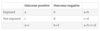
the **exposure** goes on the left and the **outcome** across the top. a + c = cases b + d = controls Algebraically simplified calculation of odds ratio = (ad)/(bc)
70
* Calculate the odds of exposure among cases * Calculate the odds of exposure among controls * Calculate the odds ratio.
* (27/87) = 0.31 * (8/220) = 0.04 * 0.31 / 0.04 = 7.75.
71
Odds ratio - 7.75 What might be some of the limitations of these findings in answering the original research question? The original research question is: “Is working in frontline transport associated with acquisition of and poorer outcomes from novel influenza?”
suggest greater risk of critical disease = all we have done is compare “patients with flu” with “patients without flu” on the ICU and with ARDS. inclusion criteria involved ARDS diagnosis and ICU admission = cannot make any determination on the baseline risk of acquisition or indeed prognosis. It’s possible that lots of transport workers contracted the disease but were never ill enough to make it to ICU. Alternatively it might be that all transport workers fared really badly and ended up on ICU, whereas other professional groups recovered without ICU admission. We can only say that among those testing positive for influenza, occupation appeared to be associated with ARDS and ICU admission. But this suggestion is limited by how our controls were selected. And we cannot answer the question about outcomes at all. These were not considered in the study (unless we’re suggesting that ICU admission itself is an outcome).
72
Why is peer review important
The process of peer review is meant to guard against researchers presenting conclusions that might not be so solid.
73
A new paper is published that suggests an historically widely-used pesticide may give rise to a rare form of lung cancer. The findings are covered extensively in the media and by the cancer patient support group. Your research group is asked to investigate. You conclude that a case-control study is the most appropriate study design. You have access to the national cancer registry – the centrally managed database that records the details and contact information for all patients diagnosed with cancer. You identify 194 contactable patients with the specific type of lung cancer involved. You then select 194 controls drawn from patients admitted to the same hospitals which each of the patients was treated at, matching on the basis of age, gender and ethnicity. Over several weeks, you interview all of them and ask them specifically if they remember having been exposed to the pesticide in question. Calculate odds ratio
1.68
74
Interpret finding off odds ratio of 1.68
Odds ratio = 1.68 Patients suffering with this rare form of lung cancer were about 70% more likely to report exposure to the pesticide in question.
75
Which type of bias will you be concerned about
Recall bias
76
Describe cohort studies
Cohort studies - A Prospective Cohort Study typically involves a group of people without disease who are observed over a period of time to see what happens to them. - some have exposure and some do not and calculate incidence of disease in eac group (type of longitudinal study) • Allows for calculation of relative risk (ratio of risks) 1) Select target pop. • May restrict depending on disease investigated (e.g. older pop. if associated with ageing) • Initially identify as many subjects as possible without restrictions • Can assemble cohort by geography/occupation/disease/risk group/birth etc. 2) Assess exposures • Well defined • Self report/physical measurements/existing records 3) Assess disease status after a period of time • Routine surveillance/death certificates/medical records/participant • Must be identical between exposed and unexposed
77
Relative risk
Relative risk measure likelihood of getting disease if exposed relative to if you are not exposed
78
In Cohort study examining the association between smoking and lung cancer. 200 Smokers and 200 non smokers were followed. Of the 200 smokers, 60 develop lung cancer and of the 200 non smokers, 20 develop lung cancer over 20 years. Calculate the relative risk
3x more likely to develop cancer as a smoker compared to non smokers smoking appears to be a risk factor for lung cancer
79
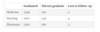
Calculate the absolute risk of not graduating for each of the three professional groups 1. Medicine 2. Nursing 3. Pharmacy
Medicine: 150 / 1501 = 10% Nursing: 435 / 1500 = 29% Pharmacy: 180 / 1503 = 12%
80
Importance of dealing with missing data?
In research, it's important to establish how you deal with missing data. the extent to which you should include or omit them from the denominator is important when loss to follow up is more substantial. (if small will not change stats significantly)
81
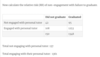
Now let’s look at medical students and divide them by engagement with their pastoral (academic) tutor. In this situation our exposure is going to be ‘not engaged with personal tutor’. Our outcome is ‘not graduating’. Calculate the relative risk and its interpretation
To calculate this we determine: 1. The risk of not graduating when not engaged with the tutor 2. The risk of not graduating when engaged with the tutor This then becomes... Risk(exposed) = 42/137= 0.31 Risk(unexposed) = 108/1361 = 0.08 Therefore 0.31/0.08 is about 3.9 (precisely 3.86). That the relative risk of failing to graduate was almost four times higher among students who did not engage with their personal tutor.
82
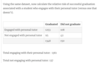
Calculate relative risk and state interpretation
To calculate this we determine: 1. The risk of graduating when engaged with the tutor 2. The risk of graduating when not engaged with the tutor This then becomes... Risk(exposed) = 1253/1361 = 0.92 Risk(unexposed) = 108/137 = 0.69 Therefore 0.92/0.69 is about 1.3 (precisely 1.33). Interpretation: That the relative risk of graduating was about 30% higher among students who engaged with their personal tutor.
83
What is a historical cohort study (retrospective) and how does this differ from a normal cohort study (prospective)
Prospective cohort study identifies a cohort and their exposures and then prospectively follows them up to observe their outcomes. - a variant of a cohort study - a group of individuals form the cohort, with a distribution of exposures and outcomes which are measured contemporaneously or extracted from health records. - typically lower quality than prospective cohort studies because there is a greater risk of both selection and information biases. Cohort: Know only exposure at start of study Historic Cohort: Know both exposure and outcome at start of study
84
How should we deal with lost to follow up participants
Be transparent: it’s critical that participants lost to follow up in a study are reported as such. Loss to follow up is almost unavoidable, but where large proportions of participants are lost, one must consider the quality of the study, and whether the loss represents a potential bias. You’ll learn more about bias later. Be conservative: if there’s the potential for the loss to bias away from the null hypothesis, then reporting the output statistic which biases towards the null is generally the more sensible course of action.
85
Explain the directionality of relative risk
Imagine a baseline risk of X. If we remove a harmful exposure then the risk halves to 0.5X. But likewise, were we to use the exposed status as the baseline, then the risk would double (2.0X). A risk that doubles in one direction, halves in the other. And therefore the quantum of relative risk difference is the same with a RR of 0.5 and 2.0. The null is at 1.0.
86
What is the most appropiate study design for the follow research: ## Footnote Dr Maile identifies 600 intravenous drug users receiving treatment in north west London and wants to follow them up for 10 years to determine their risks of bacteremia and hepatitis C infection relating to their drug use and behaviours.
* Prospective cohort study = as only their exposures are available when starting the study.
87
What is the most appropiate study design for the follow research: Dr Bannerman wants to understand the prevalence of antibodies to infection X among those admitted to hospital between March and July of this year. She receives permission to sample 1 in 10 blood samples from all patients admitted in that time period for elective surgery.
* Cross sectional study = This is called a seroprevalence study. This type of approach is routinely used in epidemiological surveillance to understand the level of various infections at a population-level.
88
What is the most appropiate study design for the follow research: Dr Pinder is trying to establish a clearer relationship between tobacco consumption and prostate cancer. Using patients in a prostate clinic: about half of whom have prostate cancer, and the remainder have benign prostatic hypertrophy (BPH) or another non-cancerous condition, he allocates them to two groups based on their disease status.
* Historical cohort study = as both the exposures and outcomes are known at the start of the study.
89
What is the most appropiate study design for the follow research: Dr Harvey observes a new sleeping syndrome that involves an unusual constellation of symptoms. He suspects it may be related to blue light exposure or another environmental exposure. But he is not 100% sure so devises a checklist of potential exposures. He will compare those with the unusual constellation of symptoms with similar people without the symptoms.
* Case-control study = as the outcome is already determined (and a basis for enrolment) but the exposures are not understood.
90
Key points
Key points a. Descriptive epidemiology is widely used in health services and is the principal means through which performance is monitored and managed. b. Person-level datasets may not be available for a range of logistical and ethical reasons: instead, aggregated datasets can be used pragmatically but with caveats. c. Cross-sectional studies are often the simplest, cheapest and fastest descriptive study design to deploy. d. Case-control studies are useful in identifying possible exposures retrospectively and out-put an odds ratio that describes the relative odds of exposure among cases (compared to controls). e. The (prospective) cohort study follows a group of individuals prospectively before their disease status is determined: such studies out-put a relative risk (RR). This relative risk describes the risk of the outcome when the exposure is present (compared to the risk of the outcome in the absence of the exposure).