What is the Exchange Rate?
- Is the rate at which one currency trades against another on the foreign exchange market
Where are currencies traded?
Foreign Exchange markets
Why in mid 2008 was there a sharp depreciation of the Pound?
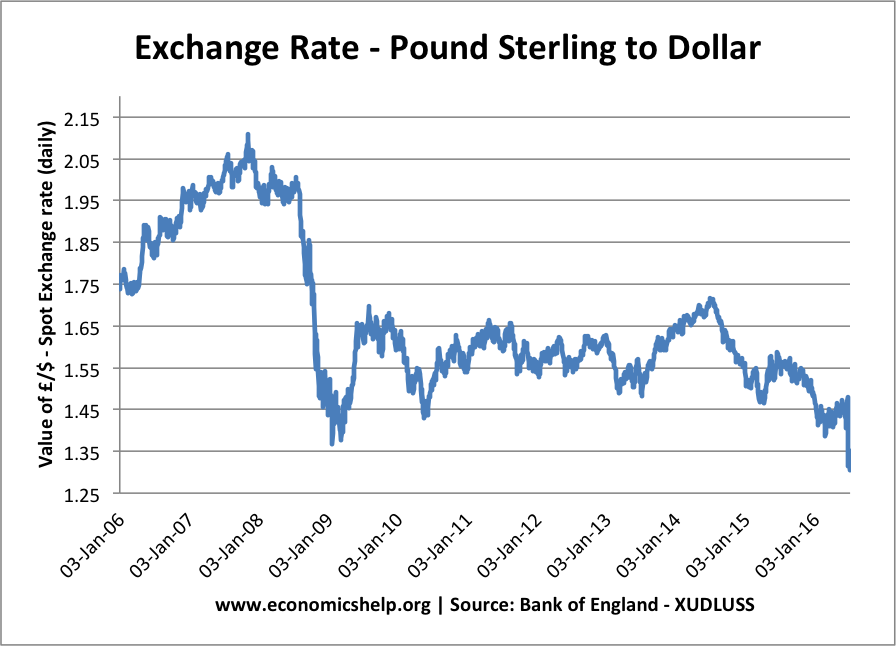
- Hit by the Credit Crunch
Why was the a sharp drop in 2016?
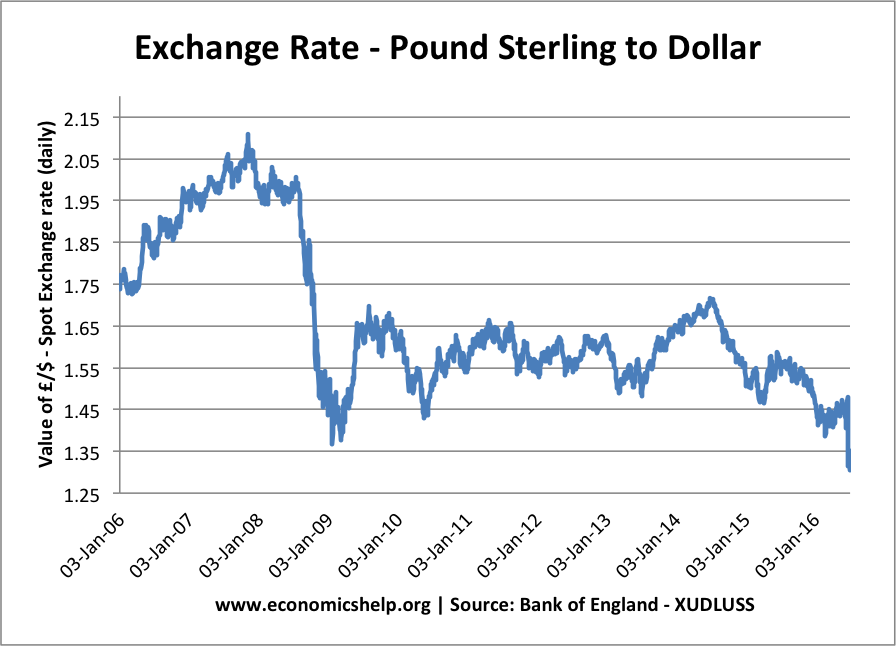
- Because markets were less optimistic about the long-term fortunes of the UK economy outside the EU.
Define the Exchange Rate Index.
This gives a measure of a currency against a trade-weighted basket of currencies.
Define Real Exchange Rate.
- This is the exchange rate after being adjusted for the effects of inflation, it, therefore, more accurately reflects the purchasing power of a currency.
Define the Floating Exchange Rate.
- When the value of the currency is determined by market forces – supply and demand for currency
Define Fixed Exchange Rate.
- Where the government seeks to keep the value of a currency at a certain level compared to other currencies.
Diagram that calculates exchange rates using supply and demand diagram.
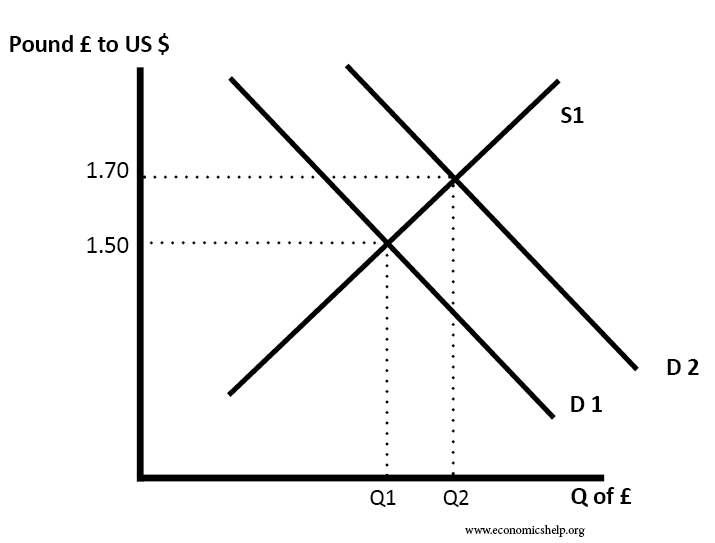
Factors influencing Exchange Rates.
- Interest rates
- Economic growth
- Inflation
- Confidence in the economy/currency.
- Current account deficit/surplus.
How do Interest Rates affect Inflation?
- higher interest rates encourage hot money flows and demand for currency. This causes an appreciation.
What are Hot Money Flows?
Hot money flows refer to capital flows moving to countries with higher interest rates.
How does Economic Growth affect exchange rates?
- Higher economic growth will tend to cause an appreciation in the currency, this is because markets expect higher interest rates – when growth is rapid.
How does Inflation affect Exchange Rates?
- Higher inflation makes exports less competitive and reduces demand for currency. This causes a depreciation.
How does the Current Account Deficit/Surplus affect Exchange Rate?
- A large current account deficit is more likely to cause a depreciation in the value of the currency because money is leaving the economy to buy imports.
What factors will happen if the Pound appreciates in value?
- UK exports more expensive abroad – leading to lower demand.
- Imports into the UK will be cheaper, increasing demand for imports
- An appreciation will tend to reduce inflation,
- Lower economic growth – due to reduced demand for exports.
- Worsening of the current account deficit (because imports are cheaper and quantity of imports rises, but exports are more expensive and quantity falls)
- Strong Pound = Imports Cheaper, Exports Dearer. SPICED
What does SPICED stand for?
- Strong
- Pound
- Imports
- Cheap
- Exports
- Dear (Expensive)
What will happen if the Pound depreciates in value?
- UK exports become more competitive, increasing demand for exports
- Imports become more expensive, leading to lower demand for imports
- A depreciation will tend to increase economic growth but also cause inflation.
Evaluative points on Exchange Rates - Elasticity of Demand.
If there is a depreciation in the exchange rate, exports are cheaper, but the amount quantity increases depend on the elasticity of demand. If demand is price inelastic, then a depreciation will have a limited impact in increasing demand and improving economic growth. If demand for exports is elastic, then there will be a big boost to exports.
Evaluative points on Exchange Rates - Time Lag
In the short term, demand for exports is often inelastic but becomes more price elastic over time.
Evaluative points on Exchange Rates - Reasons for Appreciation/Depreciation.
Often it is most successful economies who see appreciation. The currency appreciates because there is more demand for their exports. Therefore, in this case, a depreciation won’t cause a fall in economic growth – only limit the growth rate. If the currency appreciates due to speculation, during a period of weak economic growth, then the negative effect on growth may be more pronounced.

-
Balance of Payments13
-
2:5:3 Macroeconomic Objectives And Policies - Conflicts And Trade Ofd Between Objectives And Policies17
-
2:5:2 Macroeconomic Objectives And Policies - Supply Side Policies36
-
2:5:1 Macroeconomic Objectives And Policies87
-
2:4:1 - Economic Growth36
-
2:3:1 - National Income41
-
2:2:2 - Aggregate Supply - Aggregate Demand And Supply63
-
2:2:1 - Aggregate Demand - Aggregate Demand And Supply92
-
2:1:4 - Measure Of Economic Performance - Balance Of Payments39
-
2:1:3 - Measures Of Economics Performance - Employment And Unemployment49
-
2:1:2 - Inflation - Measures Od Economic Performance36
-
JSL BOOK106
-
RST BOOK49
-
2:1:1 - Measures Of Economic Performance - Economic Growth70
-
Budget Deficit19
-
Economic Growth11
-
Fiscal Policy23
-
Globalisation6
-
Exchange Rates21
-
European Union16
-
The Euro7
-
Monetary Policy16
-
Inflation29
-
Suppy Side Policies23
-
The characteristics of Aggregate Demand27
-
Consumption1
-
All of Macroeconomics PiXL83



