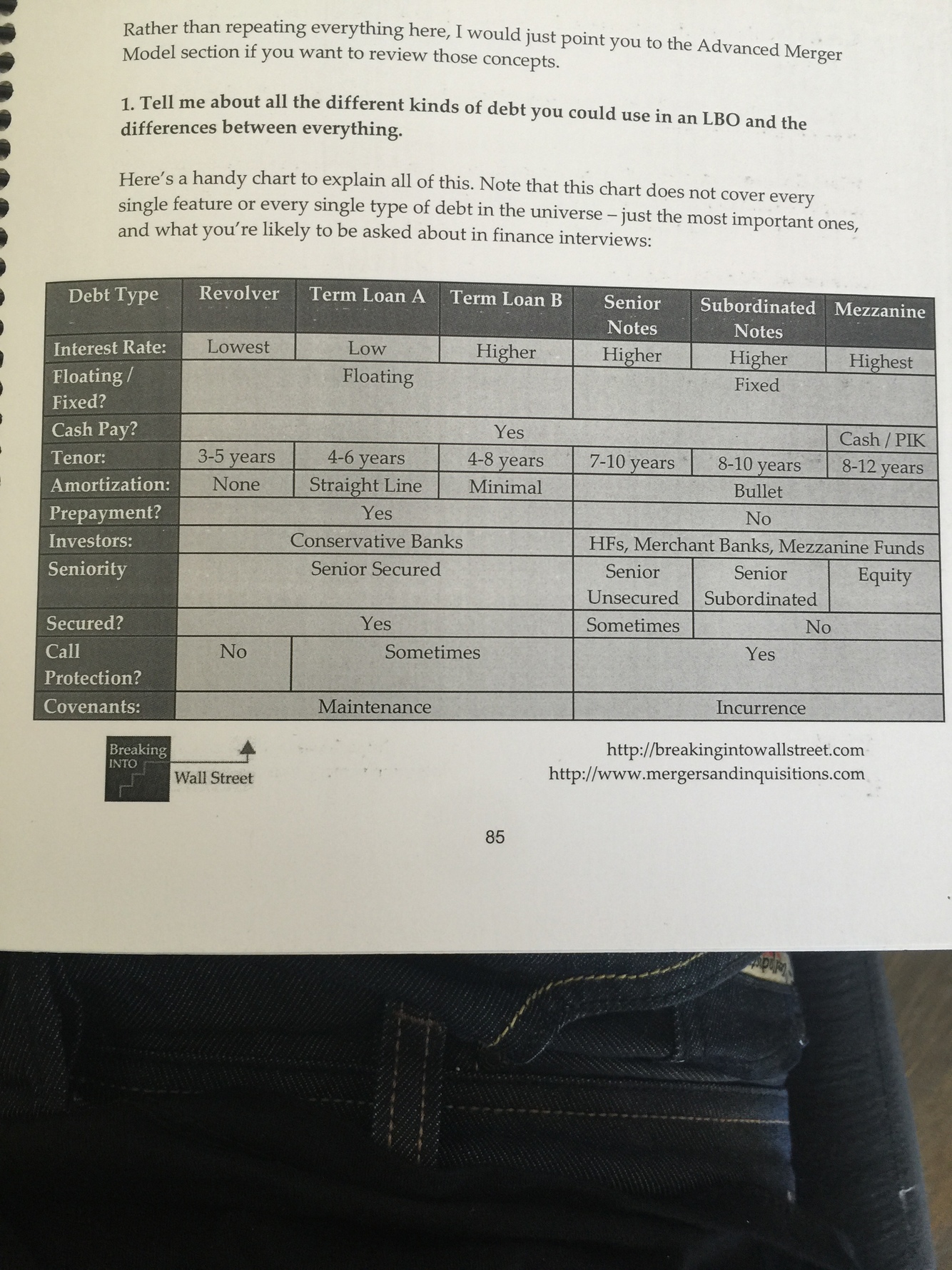
Tell me about all the different kinds of debt you could use in an LBO and the differences between everything.
- REVOLVER: Lowest Int. Rate‚ Floating Cash Int.‚ 3-5 year tenor‚ not amortized‚ prepayment allowed‚ typ. investor: conservative banks‚ Senior Secured‚ Secured‚ No Call Protection‚ Maintenance Covenant
- TERM LOAN A: Low Int. Rate‚ Floating Cash Int.‚ 4-6 year tenor‚ straight-line amortized‚ prepayment allowed‚ typ. investor: conservative banks‚ Senior Secured‚ Secured‚ Sometimes Call Protection‚ Maintenance Covenant
- TERM LOAN B: Higher Int. Rate‚ Floating Cash Int.‚ 4-8 year tenor‚ minimal amortization‚ prepayment allowed‚ typ. investor: conservative banks‚ Senior Secured‚ Secured‚ Sometimes Call Protection‚ Maintenance Covenant
- SENIOR NOTES: Higher Int. Rate‚ Fixed Cash Int.‚ 7-10 year tenor‚ bullet pmt‚ prepayment not allowed‚ typ. investor: HFs/Merchant Banks/Mezzanine Funds‚ Senior Unsecured‚ Sometimes Secured‚ Yes Call Protection‚ Incurrence Covenant
- SUBORDINATED NOTES: Higher Int. Rate‚ Fixed Cash Int.‚ 8-10 year tenor‚ bullet pmt‚ prepayment not allowed‚ typ. investor: HFs/Merchant Banks/Mezzanine Funds‚ Senior Subordinated‚ Not Secured‚ Yes Call Protection‚ Incurrence Covenant
- MEZZANINE: Highest Int. Rate‚ Fixed Cash (or PIK) Int.‚ 8-12 year tenor‚ bullet pmt‚ prepayment not allowed‚ typ. investor: HFs/Merchant Banks/Mezzanine Funds‚ Equity‚ Not Secured‚ Yes Call Protection‚ Incurrence Covenant
NOTES:
- Each type of debt is arranged in order of rising interest rates - so Revolver has the lower interest rates‚ Term Loan A is slightly higher‚ B is slightly higher‚ Senior Notes are higher than Term Loan B and so on.
- “Seniority” refers to the order of claims on a company’s assets in a bankruptcy - the Senior Secured holders are first in line‚ followed by Senior Unsecured‚ Senior Subordinated‚ and then Equity Investors.
- “Floating” or “Fixed” Interest Rates: A “floating” interest rate is tied to LIBOR. For example‚ L + 100 means that the int. rate of the loan is whatever LIBOR is at currently‚ plus 100 basis point (1.00%). A fixed int. rate‚ on the other hand‚ would be 11%. It doesn’t “float” w/ LIBOR or any other rate.
- Amortization: “Straight Line” means the company pays off the principal in equal installments each year‚ while “bullet” means that the entire principal is due at the end of the loan’s lifecycle. “Minimal” just means a low percentage of the principal each year‚ usually in the 1-5% range.
- Call Protection: Is the company prohibited from “calling back” - paying off or redeeming - the security for a given period? This is beneficial for investors b/c they are guaranteed a certain number of interest payments.
How would an Asset Write-Up or Write-Down affect an LBO model?
Walk me through how you adjust the Balance Sheet in an LBO model.
All of this is very similar to what you would see in a merger model
- Calculate Goodwill, Other Intangibles, and the rest of the Write-Ups in the same way you would Merger Model
- Make Balance Sheet adjustments the same way (almost)
- Subtracting Cash
- Adding in Capitalized Financing Fees
- Write Up Assets
- Wipe Out Goodwill
- Adjust the Deferred Tax Assets / Liabilities
- Add in New Debt
The key differences:
- In an LBO model you assume that the existing Shareholders’ Equity is wiped out and replaced by the equity the private equity firm contributes to buy the company; you may also add in Preferred Stock, Management Rollover, or Rollover from Option Holders to this number as well depending on what you’re assuming for transaction financing.
- In an LBO model you’ll usually be adding a lot more tranches of debt vs. what you would see in a merger model.
- In an LBO model you’re not combining two companies’ Balance Sheets.
Normally we care about the IRR for the equity investors in an LBO – the PE firm that buys the company – but how do we calculate the IRR for the debt investors?
- For the debt investors, you need to calculate the interest and principal payments they receive from the company each year.
- Then you simply use the IRR function in Excel and start with the negative amount of the original debt for “Year 0,”
- Assume that the interest and principal payments each year are your “cash flows”
- Then assume that the remaining debt balance in the final year is your “exit value.”
• Most of the time, returns for debt investors will be lower than returns for the equity investors – but if the deal goes poorly or the PE firm can’t sell the company for a good price, the reverse could easily be true.
Why might a private equity firm allot some of a company’s new equity in an LBO to a management option pool, and how would this affect the model?
- This is done for the same reason you have an Earnout in an M&A deal: the PE firm wants to incentivize the management team and keep everyone on-board until they exit the investment.
- The difference is that there’s no technical limit on how much management might receive from such an option pool: if they hit it out of the park, maybe they’ll all become millionaires.
- In your LBO model, you would need to calculate a per-share purchase price when the PE firm exits the investment, and then calculate how much of the proceeds go to the management team based on the Treasury Stock Method.
- An option pool by itself would reduce the PE firm’s return, but this is offset by the fact that the company should perform better with this incentive in place.
Why you would you use PIK (Payment In Kind) debt rather than other types of debt?
How does it affect the debt schedules and the other statements?
- Unlike “normal” debt, a PIK loan does not require the borrower to make cash interest payments – instead, the interest just accrues to the loan principal, which keeps going up over time.
- A PIK “toggle” allows the company to choose whether to pay the interest in cash or have it accrue to the principal (these have disappeared since the credit crunch).
- More risky than other forms of debt and carries a higher interest rate than bank debt or high yield debt
- Adding it to the debt schedules is similar to adding High-yield debt with a bullet maturity – except instead of assuming cash interest payments, you assume that the interest accrues to the principal instead.
- You should then include this interest on the Income Statement, but you need to add back any PIK interest on the Cash Flow Statement because it’s a non-cash expense
What are some examples of incurrence covenants? Maintenance convenants?
Incurrence Covenants:
- Company cannot take on more than $2 billion of total debt.
- Proceeds from any asset sales must be earmarked to repay debt.
- Company cannot make acquisitions of over $200 million in size.
- Company cannot spend more than $100 million on CapEx each year.
Maintenance Covenants:
- Total Debt / EBITDA cannot exceed 3.0 x
- Senior Debt / EBITDA cannot exceed 2.0 x
- (Total Cash Payable Debt + Capitalized Leases) / EBITDAR cannot exceed 4.0 x
- EBITDA / Interest Expense cannot fall below 5.0 x
- EBITDA / Cash Interest Expense cannot fall below 3.0 x
- (EBITDA – CapEx) / Interest Expense cannot fall below 2.0 x
Just like a normal M&A deal, you can structure an LBO either as a stock purchase or as an asset purchase.
Can you also use Section 338(h)(10) election?
- In most cases, no – because one of the requirements for Section 338(h)(10) is that the buyer must be a C corporation
- PE firms as LLCs or Limited Partnerships
- When they acquire companies, they create an LLC shell company for the LBO that “acquires” them on paper
Walk me through how you calculate optional repayments on debt in an LBO model.
You only look at optional repayments for Revolvers and Term Loans – high-yield debt doesn’t have a prepayment option
- First check how much cash flow you have available based on your Beginning Cash Balance, Minimum Cash Balance, Cash Flow Available for Debt Repayment from the Cash Flow Statement
- Second check how much you use to make Mandatory Debt Repayments
- Third if you’ve used your Revolver you pay off the maximum amount that you can with the cash flow you have available
- Fourth, for Term Loan A you assume that you pay off the maximum you can, taking into account that you’ve lost any cash flow you used to pay down the Revolver.
- Lastly, take into account that you might have paid off some of Term Loan A’s principal as part of the Mandatory Repayments
Finally, you do the same thing for Term Loan B, subtracting from the “cash flow available for debt repayment” what you’ve already used up on the Revolver and Term Loan A. And just like Term Loan A, you need to take into account any Mandatory Repayments you’ve made so that you don’t pay off more than the entire Term Loan B balance.
The formulas here get very messy and depend on how your model is set up, but this is the basic idea for optional debt repayments.
Explain how a Revolver is used in an LBO model.
- You use a Revolver when the cash required for your Mandatory Debt Repayments exceeds the cash flow you have available to repay them.
- The formula is: Revolver Borrowing = MAX(0, Total Mandatory Debt Repayment – Cash Flow Available to Repay Debt).
- The Revolver starts off “undrawn,” meaning that you don’t actually borrow money and don’t accrue a balance unless you need it – similar to how credit cards work.
- You add any required Revolver Borrowing to your running total for cash flow available for debt repayment before you calculate Mandatory and Optional Debt Repayments.
- Within the debt repayments themselves, you assume that any Revolver Borrowing from previous years is paid off first with excess cash flow before you pay off any Term Loans.
How would you adjust the Income Statement in an LBO model?
The most common adjustments:
1. Cost Savings – Often you assume the PE firm cuts costs by laying off employees, which could affect COGS, Operating Expenses, or both.
2. New Depreciation Expense – This comes from any PP&E write-ups in the transaction.
3. New Amortization Expense – This includes both the amortization from writtenup intangibles and from capitalized financing fees.
4. Interest Expense on LBO Debt – You need to include both cash and PIK interest here.
5. Sponsor Management Fees – Sometimes PE firms charge a “management fee” to a company to account for the time and effort they spend managing it.
6. Common Stock Dividend – Although private companies don’t pay dividends to shareholders, they could pay out a dividend recap to the PE investors.
7. Preferred Stock Dividend – If Preferred Stock is used as a form of financing in the transaction, you need to account for Preferred Stock Dividends on the Income Statement.
Cost Savings and new Depreciation / Amortization hit the Operating Income line;
Interest Expense and Sponsor Management Fees hit Pre-Tax Income;
and you need to subtract the dividend items from your Net Income number
In an LBO model, is it possible for debt investors to get a higher return than the PE firm? What does it tell us about the company we’re modeling?
- Yes, and it happens more commonly than you’d think. Remember, high-yield debt investors often get interest rates of 10-15% or more – which effectively guarantees an IRR in that range for them.
- So no matter what happens to the company or the market, that debt gets repaid and the debt investors get the interest payments.
- But let’s say that the median EBITDA multiples contract, or that the company fails to grow or actually shrinks – in these cases the PE firm could easily get an IRR below what the debt investors get.
Most of the time, increased leverage means an increased IRR.
Explain how increasing the leverage could reduce the IRR.
• For this scenario to happen you would need a “perfect storm” of:
- Relative lack of cash flow / EBITDA growth
- High interest payments and principal repayments relative to cash flow
- High purchase premium or purchase multiple to make it more difficult to get a high IRR
- This scenario is admittedly rare, but it could happen if the increase leverage increases interest payments or debt repayments to very high levels, preventing the company from using its cash flow for other purposes.
- Sometimes in LBO models, increasing the leverage increases the IRR up to a certain point – but then after that the IRR starts falling as the interest payments or principal repayments become “too big.”

-
Financial Accounting - Basic31
-
Financial Accounting - Advanced15
-
Equity Value & Enterprise Value - Basic15
-
Equity Value & Enterprise Value - Advanced3
-
Valuation - Basic34
-
Valuation - Advanced14
-
Discounted Cash Flow - Basic32
-
Discounted Cash Flow - Advanced7
-
Merger Model - Basic33
-
Merger Model - Advanced22
-
LBO - Basic22
-
LBO - Advanced12



