Describe the Infectious Cycle
A virus is not able to infect every cell it encounters, it must encounter a cell that can support its replication.
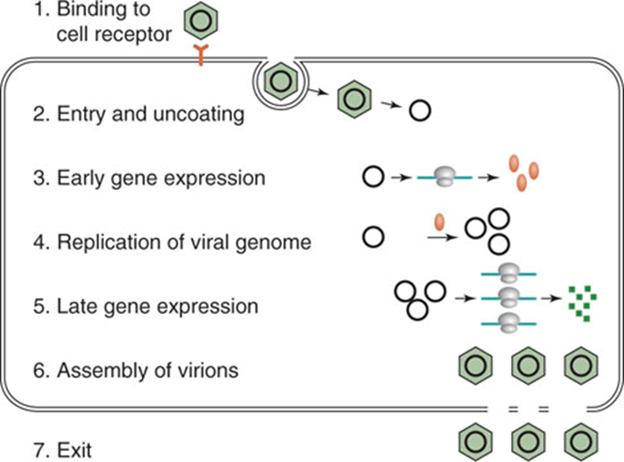
What are the four Host Cell Contraints?
- The host cell must express specific proteins that the virus needs to infect and replicate within the cell.
Eukaryotic machinery only translates monocistronic RNAs.
Viral mRNAs are in direct competition with cellular mRNAs for translational machinery.
The DNA polymerase enzymes needed to replicate the genome of DNA viruses may not be available in a differentiated cell.
What is involved in Host Cell Constraint #1?
- A susceptible cell has the appropriate receptor allowing the virus to enter the cell
- the cell may or may not be able to support viral replication
- cell could be missing a critical cellular protein required for viral tr
- A resistant cell lacks the appropriate receptor allowing the virus to enter the cell
- the cell may or may not be able to support viral replication
A permissive cell has the capacity to replicate virus
A non-permissive cell cannot support or prohibits replication of a particular virus
abortive or nonproductive infection
A susceptible and permissive cell is the only cell that can take up a viral particle and replicate it
Molecular Biology
What is the Central Dogma?
Central Dogma
DNA → RNA → Proteins
Replication, transcription, and translation are localized processes in the cell.
What is involved in Eurkaryotic DNA replication?
- DNA polymerases (a and d)
- High fidelity
- Synthesis is 5′ → 3′ direction
- Additional cellular proteins needed (primases, ssDNA binding proteins, ligases)
What is involved in Eurkaryotic RNA Replication?
RNA polymerases (I, II, and III)
Viral mRNAs must be structurally similar to cellular mRNAs to be recognized
Synthesis is 5′ → 3′ direction
Transcription factors
Enhancers
What is involved in Eurkaryotic Translation?
Initiation of eukaryotic translation uses many eIFs
Viral genomes are too small to carry all of the genes essential to translate their viral mRNAs
What is involved in Host Cell Constraint #2?
- Monocistronic RNAs code for one protein
- Some viruses contain separate mRNAs for each protein
- Some viral genomes are transcribed into one precursor RNA (“polycistronic”) that is translated into a large polyprotein.
What is involved in Host Cell Constraint #3?
Produce abundant amounts of their own proteins
Preferential degradation of host cell mRNAs
What is involved in Host Cell Constraint #4?
- Virus must infect an undifferentiated dividing cell
- Virus must “push” the differentiated cell into the cell cycle

-
Lecture 7 - Diagnosis of Infection31
-
Lecture 1 - Introduction to Viruses15
-
Lecture 2 - Viral Attachment, Entry, and Exit10
-
Lecture 3 - Viral Architecture21
-
Lecture 4 - Viral Nomenclature and Classification11
-
Lecture 5 - Viral Genetics and Replication6
-
Lecture 6 - Viral Entry, attachment and Exit15
-
Unit 2 - Lecture 8 Mechanisms of Viral Entry & Spread of Infection in the Body30
-
Unit 2 - Lecture 9 Overview of the Immune System (Innate Immunity)36
-
Unti 2 - Lecture 10 Adaptive Immunity22
-
Unit 2 - Lecture 11 Anti-viral Immunotherapy and Vaccines16
-
Unit 2 - Lecture 12 Viral Epidemiology47
-
Unit 3 - Viruses and Transplantation16
-
Unit 3 - Viruses and Cancer45
-
Unit 3 - Polio Virus & Other Enteroviruses48
-
Unit 3 - Rabies Virus43
-
Unit 3 - Poxviruses54
-
Influenza Viruses61
-
Unit 4 -Herpesvirus54
-
Unit 4 - Hepatitis Virus48
-
Unit 4- HIV57
-
Flaviviruses20
-
Prions & Viriods52



