What is the most prominent structure in eukaryotic cells?
Nucleus
Where is rRNA synthesised, precisely
Nucleolous
What is the role of the nuclear pores?
allow exchange of material between the nucleus and cytoplasm
What is chromatin?
Uncondensed form of DNA associated with histone proteins (in eukaryotes) and contains some RNA
how many layers of phospholipids does the nuclear membrane have?
4 (2 bilayers) It is a double membrane
What is the nuclear pores lined up with?
a complex of 8 proteins
What is the analog of cytoplasm in the nucleus?
Nucleoplasm
What is the function of genes?
Small sections of DNA that usually code for proteins, sometimes RNA(rRNA)
What is the unit of heredity?
genes
What are the differences in the structure of free and bound ribosomes?
there is no difference in structure
What is the function of free ribosomes?
make proteins that function in the cell (work Intracellularly) Eg; enzymes that catalyze first steps of sugar breakdown
what is the relation between protein synthesis and ribosomal count?
directly proportional
What are the structural differences between ER and Golgi body?
- ER is continuous with nucleus, Golgi body is NOT
- ER are physically connected, Golgi body has separate stacks of 3-20 cisternae (both Have cisternae)
Describe the steps of protein synthesis
- mRNA is synthesised from DNA in the nucleus
- mRNA exits via nuclear pores to the ribosome
- at ribosome mRNA contains the code to make proteins while tRNA comes to the ribosome with the amino acid corresponding to the codon (triplet)-
- polypeptide chain stops building when STOP codon is reached
describe the steps of ribosomal synthesis
- rRNA is synthesised in the nucleolous using DNA
- Combine with protein molecules imported from cytoplasm, now exist as subunits
- small and large subunits exit the nucleus via nuclear pores
- Small and large subunits combine in the cytoplasm
What are the functions of the smooth ER?
- Metabolism of carbohydrates
- synthesis of lipids (including phospholipids and steroids)
- Detoxification of drugs and poison
- storage of Ca2+
*Actual function in the cell depends on requirement and tissue function eg; in liver, detoxification
How does the ER grow?
by adding membrane proteins and phospholipids into it’s own membrane
Describe the ER
- the membrane factory of the cell
- Consists of flattened sacs called cisternae
- interconnected tubules( even rough and smooth)
- Continuous with nuclear membrane
- has a space in middle called ER lumen or cisternal space
which chromosome is larger, X or Y
Female X is larger
what is the function of the Golgi apparatus?
- Modification of products coming from ER such as proteins and phospholipids eg; modification of first carbohydrates attached to protein
- Removes sugar monomers and substitutes others
- makes its own polysaccharides
- may even modify lysosomes in animal cells
What are lysosomes ?
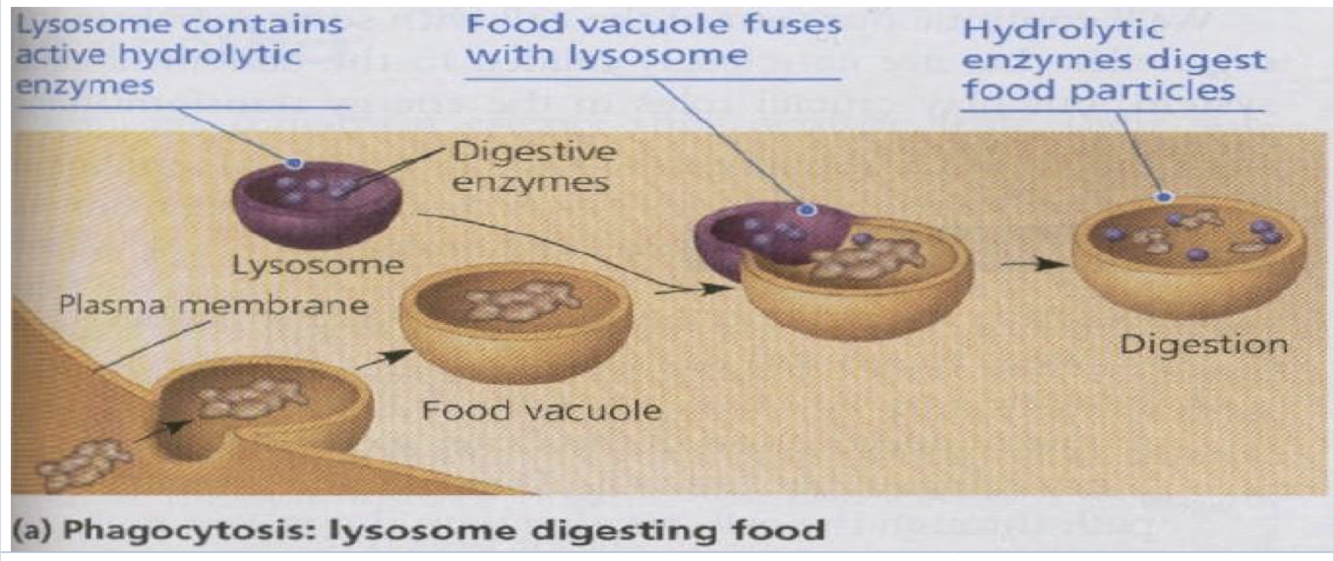
Membranous sac of hydrolytic enzymes that an animal cells use to digest macromolecules Plant cells do not have lysosomes
have very low PH
help out in phagocytosis in cells such as macrophages
What is autophagy?
recycling cell’s own organic material using lysosomes
Which face of the Golgi apparatus points towards the ER?
Cis face

-
Lecture 1&224
-
Lecture 41- Vertebrates30
-
Lecture 40- Evolution Of Eukaryotes22
-
Lecture 39- Pollution And Human Health34
-
Lecture 3821
-
Lecture 37- Ecology33
-
Lecture 36- Fetal Period60
-
Lecture 35- Third Week Of IUL35
-
Lecture 34- Human Development During First 2 Weeks15
-
Lecture33- Fertilization & Pregnancy24
-
Lecture 32- Female Reproductive System56
-
Lecture 31 Male Reproductive Sytem35
-
Lecture 25-Mendel's Law Of Inneritance17
-
Workshop 1- Centrifugation15
-
Lecture24- parasites29
-
Practical 120
-
Lecture 18- Bacterial Structure & Function15
-
Lecture 17- Bacterial Classification & Morphology22
-
Lecture 15 &16- Intro To Human Immunity23
-
Lectures 13&14 Intro To Blood & Blood Cells48
-
Lecture 11&12- Animal Development & Ageing26
-
Chapter 10-Meiosis19
-
Lecture 9- Mitosis23
-
Lecture 8- Cell Division In Prokaryotes17
-
Lecture 7- Prokaryotic Cell Structure And Function30
-
Lecture 3&4- Cell Structure & Function28
-
Lecture 5&6 - Cell Structure & Function23
-
Lecture 19- Bacterial Metabolism, Growth, & Metabolism24
-
Lecture 20- Bacteria & Human/Animal Disease32
-
Lecture 21-Viruses: Structure, Classification & Life Cycles21
-
Lesson 23- Fungi26



