What are 3 port-aggregation L2 protocols?
PAGP
LACP (IEEE standard - 802.3ad)
Static.
LACP is now really the industry standard, great in mixed environments. PAGP is Cisco proprietary.
LACP (802.3ad)
802.3ad IEEE standard. Operates in Active/Passive modes.
Automatic negotiation if one side is set to active.
Etherchannel Theory?
What is it? Why is it used?
It’s a L2 port-aggregation technology, used at layer 2. It logicially bundles links together and can help remove loops within a network.
It is common to have 2 or 4 links in an etherchannel bundle. 8 - 16 is possible but can take up alot of ports.
It is more a ‘load-sharing’ technology than a loan balancing technology. It is useful as it provides redundancy to connecting devices.
It uses a load sharing algorithm, frames tend to always traverse a particular link.
PAGP
Developed by Cisco, common to see in Cisco environments but LACP is now preferred.
Uses modes : desirable or auto
Static Etherchannel
Uses only one mode On.
No negotiation like PAGP or LACP.
Q.
Which two statements about the EtherChannel technology are true? (Choose two.)
- EtherChannel provides increased bandwidth by bundling existing Fast Ethernet or Gigabit Ethernet interfaces into a single EtherChannel.
- STP can block one of the physical links in an EtherChannel to prevent a loop.
- You can configure multiple EtherChannel links between two switches, using up to a limit of 16 physical ports.
- EtherChannel does not allow load sharing of traffic among the physical links within the EtherChannel.
- EtherChannel allows redundancy in case one or more links in the EtherChannel fail.
A.
EtherChannel provides increased bandwidth by bundling existing Fast Ethernet or Gigabit Ethernet interfaces into a single EtherChannel.
EtherChannel allows redundancy in case one or more links in the EtherChannel fail.
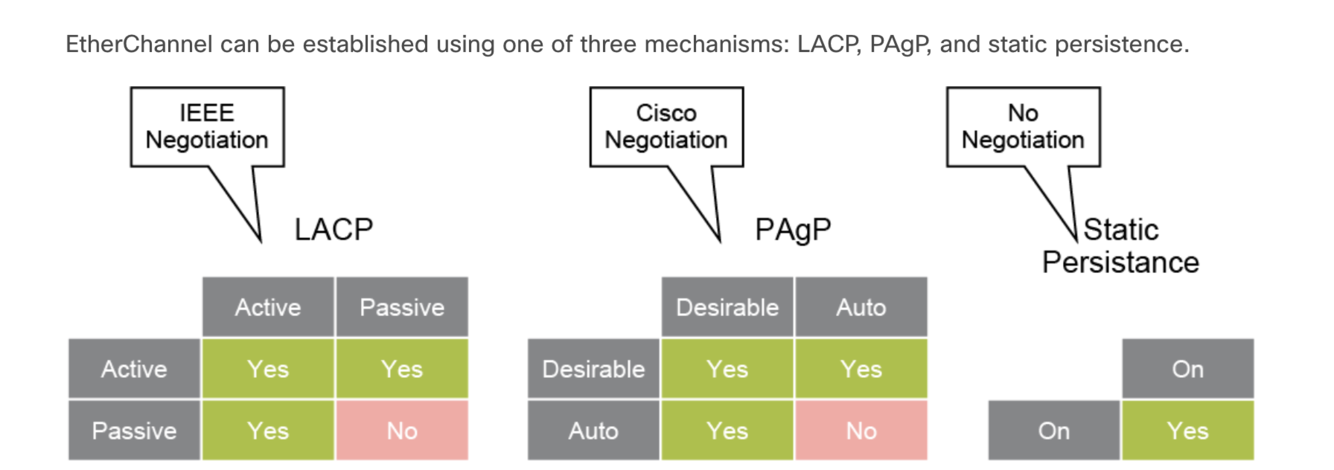
Channel Mode Interactions
LACP
Active/Active - channel-group formed
Active/Passive - formed
Passive/Passive - not formed
PAGP
Desirable/Desirable - channel formed
Desirable/Auto - channel formed
Auto/Auto (not formed)
Static
On - channel formed
Configuring Etherchannel
Make sure that you have an even number of links, that the speed is the same also.
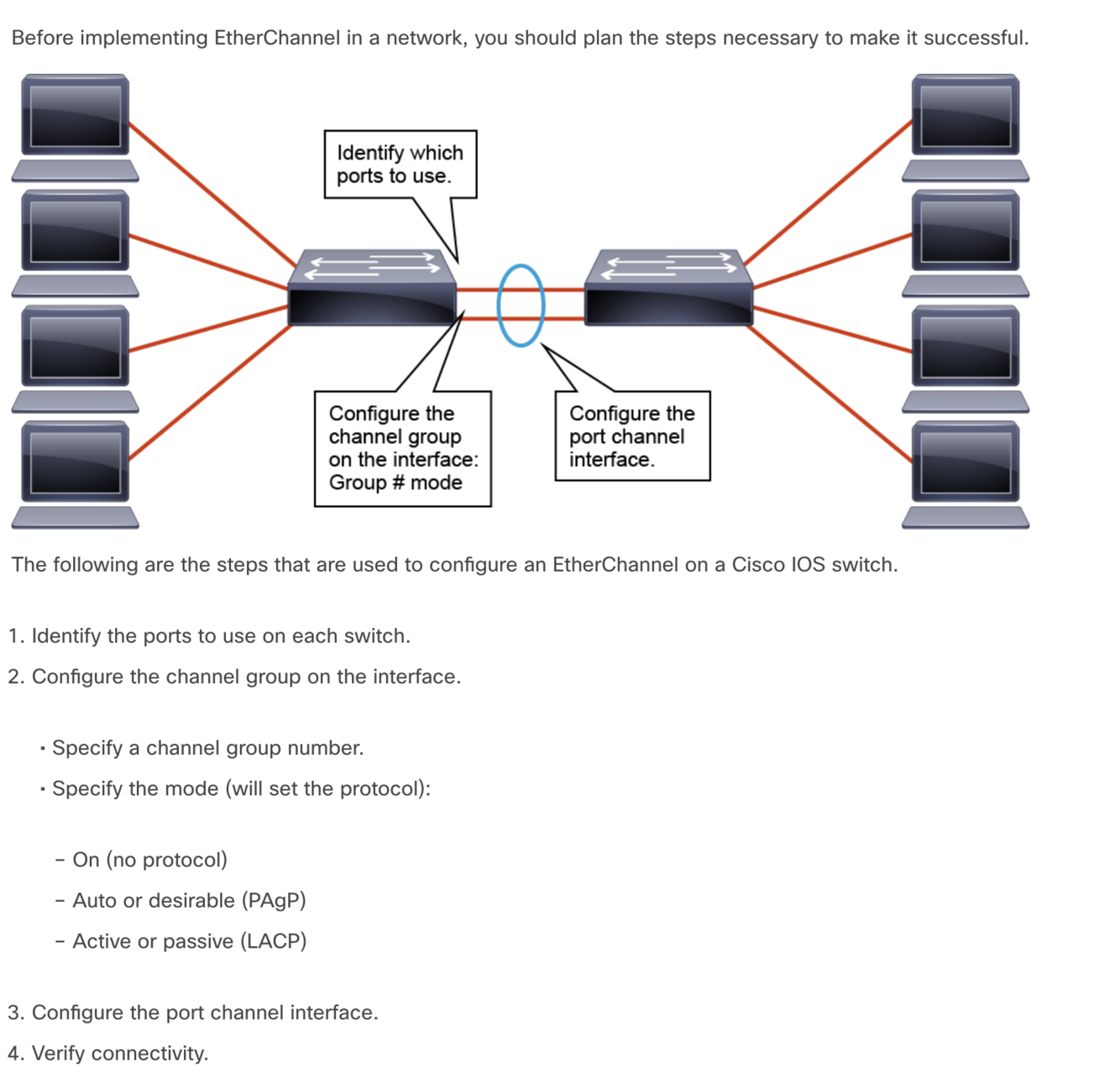
Best practice to configure the channel-group on the interface and the mode. Then create the config on the created port-channel interfaces which will be inherited by the ports.
Note
When Configuring Layer 3 switches for an EtherChannel trunk you must also indicate the encapsulation used with the switchport trunk encapsulation encapsulation command.
Q.
Which is NOT a requirement for EtherChannel configuration?
- interfaces must be the same speed and duplex
- Interfaces must be physically contiguous
- Interfaces must have the same VLAN configuration
- Interfaces must be the same mode
Interfaces must be physically contiguous.
Q
Frames are forwarded over an EtherChannel link that is based on the results of a hashing algorithm. Which of the following two options can a switch use to calculate this hash. (Choose two.)
- Loopback address
- Destination IP address
- Router ID
- Source port number
- VLAN
A.
Source port number
Destination IP address
Troubleshooting Etherchannel
Common issues are speed, duplex, trunking mode or L2/L3 operations. Mistmatched establishment modes… can’t mix PAGP/LACP
You could get issues with suspended interfaces or non functioning port-channel.
Q.
What is the correct command for configuring load balancing on an EtherChannel link?
- Switch(config)# channel-group number load-balance method
- Switch(config-if)# channel-group number load-balance method
- Switch(config-if)# port-channel number load-balance method
- Switch(config)# port-channel load-balance method
A.
Switch(config)# port-channel load-balance method
Q.
Which of the following EtherChannel modes does not send or receive any negotiation frames?
- passive
- active
- on
- desirable
- auto
A.
On
Q.
Which two of the following options correctly defines the characteristics for EtherChannel? (Choose two)
- High bandwidth
- low convergence timing
- Load sharing across links
- multiple logical ports for RSTP+
- Server scalability
A.
High bandwidth and load sharing across links.
Q.
Place the steps to configure EtherChannel in the correct order.
Step 1
Identify the ports to use on each switch
Step 2
Configure the channel group on the interface
Step 3
Configure the port channel interface
Step 4
Verify connectivity
A.
Step 1 Identify the ports to use on each switch
Step 2 Configure the channel group on the interface
Step 3 Configure the port channel interface
Step 4 Verify connectivity
Q.
Which of the following two commands can be used to check the status of the member interfaces and the logical channel interface?
- show etherchannel load-balance
- show etherchannel summary
- show etherchannel traffic
- show etherchannel groupnumber detail
- show ip interface brief
A.
Show etherchannel summary
and
Show etherchannel groupnumber detail
Q.
Which of these is not a load-balancing option on a Cisco Catalyst switch?
- src-dst-ip
- src-dst-mac
- src-dst-name
- src-dst-port
A.
src-dst-name
Q.
Which two protocol choices do you have when you are implementing an EtherChannel bundle? (Choose two.)
- LACP
- PAgP
- LAPD
- dot1Q
- PADP
A.
LACP and PAGP

-
Module 1 - Enterprising Cisco Enterprise Architecture11
-
Module 1 - Campus LAN Design9
-
Module 2 - Understanding Cisco Switching Paths22
-
Module 3 - Implementing Cisco LAN Connectivity24
-
Module 4 - Building a Redundant Switched Topology64
-
Module 5 - Implementing Layer 2 Port Aggregation18
-
Module 6 - Understanding EIGRP17
-
Module 7 - Implementing OSPF12
-
Implementing Network Redundancy9



