What is the immune system composed of?
cells: white blood cells (leukocytes) derived from the hematopoietic stem cell pool
tissues:
organs:
- Peripherpal: spleen (filters blood), lymph nodes (filters lymph), Peyer’s patches (intestine), tonsils, adenoids
- Central: (develops immune cells) thymus, bone marrow
Identify the consequences to the host when effective immune responses are not generated
Dire consequences occur when effective Immune Responses are not made: disease, allergy autoimmunity, death,
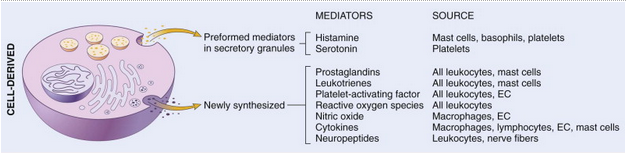
What are the cell derived mediators?
Cell derived: (2 categories)
- Preformed: intracellular granules, pre-formed, secreted
- Histamin, serotonin
- Newly Synthesized: de novo
- prostaglandins
- Leukotrienes
- Platelet activating factor
- ROS
- NO
- Cytokines
- Neuropeptides
Describe Histamine as an inflammation mediator:
source:
action:
Histamine:
- *- Source:** Mast cells, basophils, platelets
- *- Action:** Vasodilation, increased vascular permeability, endothelial activation
- *- Release:** Preformed histamine from mast cell granules in response to:
- physical injury such as trauma or heat
- immune reactions involving binding of IgE antibodies to Fc receptors on mast cells
- C3a and C5a fragments of complement, the so-called anaphylatoxins
- Leukocyte-derived histamine-releasing proteins
- Neuropeptides (e.g., substance P); and certain cytokines (e.g., IL-1, IL-8)
Describe Serotonin as an inflammation mediator: - source: - action:
Serotonin:
- *Source**: Platelets
- *Action**: Vasoconstriction
- *Release**: platelet aggregation
Describe Platelet-activating factor as an inflammation mediator: - source: - action:
Platelet-activating factor
- *Source:** Leukocytes, mast cells
- *Action:** Vasodilation, increased vascular permeability, leukocyte adhesion, chemotaxis, degranulation, oxidative burst (100-10,000x more potent than histamine) Stimulates leukocyte recruitment and activation, synthesis of AAs
Describe Reactive oxygen species (ROS) as an inflammation mediator: - source: - action:
Reactive oxygen species (ROS):
- *- Source:** Leukocytes
- *- Action**: Killing of microbes, tissue damage
- Amplifying the cascade of inflammatory mediators
- Tissue injury by several mechanisms, including
- endothelial damage, with thrombosis and increased permeability;
- protease activation and antiprotease inactivation, with a net increase in breakdown of the ECM; and
- direct injury to other cell types
- countered by protective mechs (anti-oxidants): catalase, superoxide dimutase)
Describe chemokines as an inflammation mediator:
- source:
- action:
Source: Leukocytes, activated macrophages
Action: chemotaxis, leukocyte activation Recruit leukocytes to the site of inflammation and to control the normal anatomic organization of cells in lymphoid and other tissues
Describe nitric Oxide: as an inflammation mediator: - source: - action:
Source: Endothelium, macrophages
Action: Vascular smooth muscle relaxation; killing of microbes
Describe the mediator cytokines (Tumor Necrosis Factor (TNF), Interleukin: IL-1, IL-6):
Source: Macrophages, endothelial cells, mast cells
Action:
- Local: endothelial activation (expression of adhesion molecules).
- Systemic: fever, metabolic abnormalities, hypotension (shock)
- Release: IC, endotoxin, T cells = Pyrogens (fever causing substance) cause macrophages to release IL-1 and TNF and increase COX activity in perivascular cells of hypothalamus, increased PGE2 raises temp set point
What are the plasma derived inflammation mediators?
Plasma derived:
- Complement,
- Factor XII (Hageman) activation
- Kinin system
- Coagulation/fibrinolysis
Describe the complement mediator pathway for inflammation:
Complement: proinflammatory serum proteins, circulate as inactive precursors, “complement inflammation”
- Definition: a set of 9 plasma proteins (C1-9) that act together to eliminate extracellular forms of pathogens
- Major functions: Opsonization (a pathogen is marked for ingestion and destruction by a phagocyte) and Chemotaxis
- Tip: Also involved in adaptive immune mechanisms (classic pathway)
- All roads (3 pathways) lead to Rome or in this case the synthesis of C3 convertase
Activation:
- Classical pathway: C1 binds to IgG or IgM that is bound to antigen pneumonic:“GM makes classic cars”
- Alternative pathway: microbial products directly activate complement Mannose binding lectin pathway - MBL binds mannose on microorganisms and activates complement
- Result: C3 convertase => C5 convertase => formation of MAC (creates hole in organism) C3a and C5a - trigger mast cell degranulation C5a
- chemotactic for neutrophils; helps activates neutrophils C3b
- opsonin for phagocytosis MAC - lyses microbes by creating holes in cell membrane
- Result: C3 convertase => C5 convertase => formation of MAC (creates hole in organism) C3a and C5a - trigger mast cell degranulation C5a
Describe Kinins: as an inflammation mediator:
- source:
- action:
Source: Plasma (produced in liver)
Action: Increased vascular permeability, smooth muscle contraction, vasodilation, pain
Describe Proteases activated during coagulation as an inflammation mediator: - source: - action:
Source: Plasma (produced in liver)
Action: Endothelial activation, leukocyte recruitment
What is inflammation?
Inflammatory cells, plasma proteins, and fluid are allowed to exit blood vessels and enter the interstitial space.
What characterizes acute inflammation and what is it in response to?
Characterized by presence of edema and neutrophils (key inflammatory cell) in tissue Arises in response to infection or tissue necrosis
- *acute inflammation and necrosis therefore 24 hrs after infarction increased WBC count and presence of neutrophils & edema*
- Goal: eliminate pathogen or clear necrotic debris
- Immediate response with limited specificity, part of the innate immunity
What are the steps in the inflammatory response?
The steps of the inflammatory response can be remembered as the five Rs:
- Recognition of the injurious agent
- Recruitment of leukocytes,
- Removal of the agent,
- Regulation (control) of the response
- Resolution (repair)
What are the mediators of acute inflammation?
TLR, arachidonic acid, mast cell, complement, Hageman Factor (Factor XII)
Describe how TLR mediates acute inflammation:
TLR: (toll like receptor) present on cells of the innate immune system. (macrophages and dendritic cells).
- Activated by pathogen associated molecular patterns (PAMPs) that are commonly shared by microbes.
- example: CD14 on macrophages recognizes LPS on the outer membrane of GN bateria (LPS is the PAMP)
- TLR activation results in upreguation of NF-kB (a nuclear transcription factor that activates immune response genes leading to the production of multiple immune mediators.)
- TLR also mediates in chronic inflammation
Compare and contrast the cell types that are active in innate vs adaptive immune responses
Innate: (always immediately available but not specific, first line of defense)
Phagocytes (neutrophils, dendritic cells and macrophages) and Natural Killer cells
Adaptive: specific (can take up to a week) needs sufficient signal to be activated
B and T lymphocytes (CD4 T cells help both B cells and CTL precursors to become effector cells)
Adaptive immune response have two arms: humoral (antibody-mediated) and cell-mediated
Extracellular pathogens are eliminated by Ab & phagocytosis; Intracellular pathogens are eliminated by immune-mediated killing of infected cells
What is the purpose of vascular changes as an inflammatory response?
Designed to bring blood cells and proteins to the sites of infection or injury
Describe the types of vascular changes that occur in an inflammatory response.
- Vasodilation:
- Arteriolar vasodilation
- Causes erythema (redness and warmth)
- Increased Vascular permeability
- Endothelial contraction leads to intercellular gaps (mediators histamine, bradykinin, leukotrienes); rapid
- Direct injury (infections, burns)
- Leukocyte mediated injury
- Endothelial cells are activated
- increased adhesion of leukocytes
- migration of leukocytes through the vessel wall
Descibe cellular events that take place during inflammatory responses.
- Recruitment of leukocytes from circulation and accumulation in the focus of the injury
- Followed by activation of leukocytes to eliminate offending agent
- Phagocytosis
- Destroy phagocytosed microbes or intercellular killing
- Produce mediators which amplify inflammatory response
List the classic signs of inflammation
Dolor - pain
Calor - heat
Rubor - redness
Tumor - swelling
Functio laesa - loss of function

-
Patient Interviewing:23
-
Pathology week 123
-
Microbiology week 110
-
Quizzes26
-
Biochemistry week 1127
-
Histology Week 147
-
Psychology27
-
Histology Week 230
-
Epidemology week 214
-
Pathology week 253
-
Biochem Week 242
-
Microbiology week 334
-
ICR Week 313
-
Histology Week 331
-
Biochem Week 339
-
Principles of Imaging Week 324
-
Epidemiology Week 322
-
Pathology Week 334
-
Epidemiology week 133
-
Quiz week 224
-
Lab 8: The Immune System | Lymphoid Tissues &Organs28
-
Lec 38: Lymphocytes and Lymphoid Organs, I & II26
-
Lec 39: Cell Interaction Molecules22
-
Lec 40: Development of B cells9
-
Lec 42: Development of T Cells14
-
Lec 43: Major Histocompatibility Complex22
-
Lec 44: Adaptive Immunity I16
-
Lec 45: Adaptive Immunity II (NSD)17
-
Lec 45: Adaptive Immunity III21
-
Lec 46: Nucleic Acid Structure/DNA Replication and Repair17
-
Lec 47: RNA Synthesis and Processing15
-
Lec 48: Protein Synthesis14
-
Lec 49: RNA Metabolism30
-
Lec 50: Eukaryotic Gene Regulation24
-
Lec 51:Pharmacology Principles13
-
Lec 52: Pharmacology: Mechanisms of Drug Action21
-
Lec 54: Medical Genetics I: Introduction to Medical Genetics31
-
Lec 55: Pharmacokinetics I12
-
Lec 56: Pharmacokinetics II11
-
Lec 57: Introduction to Hypersensitivity61
-
Lec 58: Introduction to Autoimmune Disease43
-
Lec 59: Medical Genetics II: Modes of Inheritance of Single Gene Disorders13
-
Lec 61: Gene Transfer Mechanism0
-
Lec 62: Basic Virology23
-
Lec: 63: Evidence-Appraisal: Statistical inference21
-
Lec 49: RNA Metabolism1
-
Lec: 60 Medical Genetics III - Atypical patterns of inheritance and multifactorial disease28
-
Lec: 64 Early Embryogenesis13
-
Lec 65: Cell Cycle18
-
Lec 66: Drug Absorption and Distribution and Drug Metabolism I17
-
Lec 67: Drug Metabolism II50
-
Lec 68: Clinical Genetics31
-
Lec 69: Introduction to Ethical Analysis22
-
Lec 70: Stress and Social Support23
-
Lec 71/72: Neoplasia I/II50
-
Statistical Inference: practice questions18
-
Lec 77: Quality and Patient Safety10
-
Lec 68: Part Two: Clinical Genetic Techniques19
-
Probability practice questions:16
-
quiz 328
-
Military Leadership2
-
Lec 78: Evidence-Appraisal: Hypothesis testing9
-
Stats: evidence appraisal practice questions17
-
Lec 53: Cognition2
-
Lec Pharmacogenetics17
-
Viral Pathogenesis8



