What is the atom?
+A positively charged nucleus surrounded by negatively charged electrons, with the nuclear radius much smaller than that of the atom and with almost all of the mass in the nucleus.
+A whole atom is mostly empty space
Give the relative mass and relative charge of electrons, protons and neutrons.
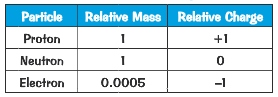
Where did the idea of atoms come from?
+Democritus
+“The world around us is made of atoms - things that cannot be split”
What was the “Plum Pudding” model?
- In 1804 John Dalton agreed with Democritus that matter was made up of tiny spheres (“atoms”) that could not be broken up.
- He reckoned that each element was made up of a different type of “atom”
- Nearly 100 years later J J Thomson discovered that electrons could be removed from atoms. So Dalton’s theory was not quite right that atoms could not be broken up.
- Thomson suggested that atoms were spheres of positive charge with tiny negative electrons stuck in them like plums in a plum pudding.
What was the Rutherford scattering experiment?
[I.e Gold foil/Michelson-Morley] expermiment?
- The “plum pudding” theory did not last very long though as in 1909 Hans Geiger and Ernest Marsden tried firing alpha particles at thin gold foil.
- Most of them went straight through, and were detected when they hit a zinc sulphide screen and gave off a tiny flash of light (a scintillation)
- However some were knocked a bit off course but a very small proportion (about 1 in 8000) actually seemed to bounce off the gold foil.
What were the implications of the Rutherford scattering experiment?
- If the plum pudding model was right then all alpha particles would just pass straight through the gold foil - but this was not the case.
- Rutherford realised that most of each gold atom must be empty space, but he knew atoms did have a mass.
- Therefore the rare event of a rebound meant that an alpha particle had run into something very dense and so he realised that the mass must be concentrated in a very tiny volume at the centre of the atom (the nucleus).
- The fact that some of the alpha particles bounced back meant that inside the atoms there must be a small positively charged nuclei, which repel the positive charges of the alpha particles.
What does Rutherford’s nuclear model of the atom say?
- Most of the mass must be concentrated at the centre of the atom, and most of the atom must be empty space
- The nucleus must be small since very few alpha particles are deflected by it
- It must be positively charged to repel the positively charged alpha particles
What is the relative charge of an atom? Why?
Neutral because the number of positive charges carried by the protons in its nucleus is balanced by the number of negative charges on the electrons in the electron “energy levels” around the nucleus.
Who was Niels Bohr and what was his proposal?
- A Danish physicist who proposed a model of the atom that is similar to the solar system.
- The electrons go around the nucleus [like planets orbit around the sun] - but all electrons have their energy levels - a certain distance from the nucleus.
- Each energy level can hold a certain number of electrons: Level 1 [2], Level 2 [8], Level 3 [18] and level 4 [32].
- +When electrons abosrb [gain] energy, they go to a higher energy level
- +When electrons release [lose] energy they go down a level.
What is an isotope?
- Isotopes are atoms with the same number of protons but a different number of neutrons
- They have a different number of nucleons and therefore a different mass.
- Usually each element only has one or two stable isotopes [e.g. Carbon 12]
- The other isotopes tend to be radioactive (the nucleus is unstable, so it decays and emits radiation) e.g. Carbon 14 is an unstable isotope of carbon
How does the nucleus of each element differ?
+The nucleus of each element has a characteristic postitive charge - but the elements differ in mass by having different numbers of neutrons.
Where do the electrons orbit the nucleus from?
+From different set distances from the nucleus
When do electrons change orbit?
+When there is absorption or emission of electromagnetic radiation
What is excitation?
+When an electron gains energy large enough to move to the next energy level
What is de-excitation?
When an electron loses enough energy to move down to the energy level below
How is an emission spectrum created?
+It is created when an electron is de-excited and moves towards the nucleus, it gives out energy in the form of an em wave.
How is an absorbtion spectrum created?
+It is created when an electron is excited and moves away from the nucleus, and needs to take in energy from the EM spectrum.
What is ionisation?
+When an electron is excited so much that it leaves the atom.
How do atoms form positive ions?
+By losing outer electrons through ionisation
+This means there will be more protons than electrons - which results in a positive charge.
+An atom can lose more than one electron - there more electrons it loses the greater its positive charge.
What happens when the nucleus of an atom is unstable?
+When the nucleus of an atom is unstable, it tries to throw out some of the particles or energy that is making it unstable [it emits radiation].
+This radiation is very high energy and so is “ionising” to other atoms and cells.
What are the three types of ionising radiation that can be emitted?
+Alpha radiation
+Beta radiation
+Gamma radiation
What is background radiation?
+The low-level radiation that is around us all the time
N S H
Where does background radiation come from?
+Radioactivity of naturally occuring unstable isoptopes which are all around us - in the air, some foods, building materials and some of the rocks under our feet.
+Radiation from space - cosmic rays. They mostly come from the sun.
+Radiation due to human activity - [eg fallout from nuclear explosions]
How can you detect nuclear radiation?
Photographic film or a Geiger-Muller detector

-
Yr 9 End of Year Revision21
-
Forces0
-
Waves0
-
Distance, Speed, Velocity & Acceleation graphs14
-
Energy transfers19
-
Forces and energy22
-
Electromagnetic spectrum30
-
Light Waves25
-
Sound Waves11
-
Radioactivity54
-
EQUATIONS21
-
Topic 3 - Conservation of energy23
-
Topic 2 - Motion And Forces44
-
Topic 1 - Key Concepts in Physics10
-
Topic 1 - Key Concepts Of Physics17
-
Topic 2 - Motion And Forces COPY46
-
Topic 3 - Conservation of energy COPY30
-
Topic 4 - Waves32
-
Topic 5 - Light and the Electromagnetic Spectrum44
-
Topic 8 - Energy - forces doing work16
-
Topic 9 - Forces and their effects24
-
Topic 10 - Electricity and Circuits134
-
Topic 11 - Static Electricity54
-
Topic 14 - Particle Model84
-
Topic 12 - Magnetism And The Motor Effect15
-
Topic 13 - Electromagnetic Induction13
-
Topic 15 - Forces and Matter51



