Response
A single instance of behavior (the measurable unit of analysis in the science of behavior)
Behavior vs. Response
Behavior: Larger set/class of responses that share physical dimensions or functions
Response: a single instance of behavior
Response Class
- A group of behaviors that compromise an operant (i.e. have the same function)
- OPERANT: response-consequence relationship. Similar behaviors that are strenthened or weakened collectively as a result of operant conditioning
- Members of the same response class may have varying forms (how to open a bag of chips), whereas topographical variations among members of other response classes are limited (your signature).
Repertoire
- All the behaviors that an individual can do
- A collection of kowledge and skills an individual has learned that are relevant to a particular task
Environment
A comple, dynamic universe of events that differs from instance to instance. All behavior occurs within an environmental context.
Stimuli
- Physical events that affect the behavior of an individual
- may be internal or external to the individual
- A stimulus is an energy change that affects an organism through its receptor cells.
- May occur prinor to, during, or after a behavior (temporal locus of stimuli)
- May be described formally (phyiscal features), temporally, or functionally
3 Types of Nervous Systems
PIE
- Proprioceptive- stimulation from joints, tendons, muscles, etc, necessary for posture, balance, and movement (Ex. feeling dizzy after getting off a roller coaster)
- Interoceptive- stimulation from organs (Ex. headache, hunger pains)
- Exteroceptive- the 5 senses (Ex. smelling smoke)
Stimulus Class
- .A group of antecedent stimuli that has a comment affect on an operant class
- Group members of a stimulus class tend to evoke or abate the same behavior or response class
- May vary across physical dimensions
3 + 2 Types of Stimulus Classes
FTF: For the Fun
- FORMAL- physical features (topography)- size, color, spatial relations (prepositions), intensity, weight
- TEMPORAL- Stimulus changes that exist or occur prior to (antecedents) the behavior of interest and stimulus changes that follow (consequences) the behaviors
- FUNCTIONAL- the effect of the stimulus on behavior–there can be mulitple functions (Ex. hearing a buzz may mean a text message or your laptop battery is low)
FEATURE STIMLUS CLASS
- share common topographies
- common relative relations (spatial arrangements)
- INFINITE number of stimuli
- Developed through stimulus generalization
- Ex: dog, house tree, bigger than, on top
ARBITRARY STIMLUS CLASS
- stimuli may evoke the same response but they do NOT share any common features
- LIMITED number of stimuli
- Developed through stimulus equivalence
- Ex: 0.5, 1/2, half, and 50%
- Ex: fruits, vegetables, houses
Consequences
- only affect future behavior
- Consequences select response classes, not individual responses
- they select any behavior–the timing of reinforcement and punishment matters and it can hit any behavior (e.g. superstitious behavior)
- Immediate consequences that the greatest effect
Automaticity of Reinforcement and Punishment
- operant conditioning occurs automtically
- the person does not have to know what a consequence means for it to work
Automatic Reinforcement
- (Sensory; Self-Stimulatory Behaviors; Stereotypy**)*
- Reinforcement occurs independent of the social emdiation of others–others do not deliver the consequence
Example of Negative Automatic Reinforcement
Putting lotion on your dry skin relieves the dryness. In the future, when you have dry skin, you will put lotion on to escape that dryness.
Example of Positive Automatic Reinforcement
You taste salty caramel brownies for the first time and now you bake them all the time at home.
Automatic Punishment
- Punishment that occurs independent of the social mediation of others–others do not deliver the consequenxe
Example of Negative Automatic Punishment
You want to reduce cursing, so every time you curse, you have to put money in a jar. In the future, you are less likely to curse because you don’t want to lose money.
Example of Positive Automatic Reinforcement
You wear a rubber band around your wrist and smack yourself whenever you say a curse word
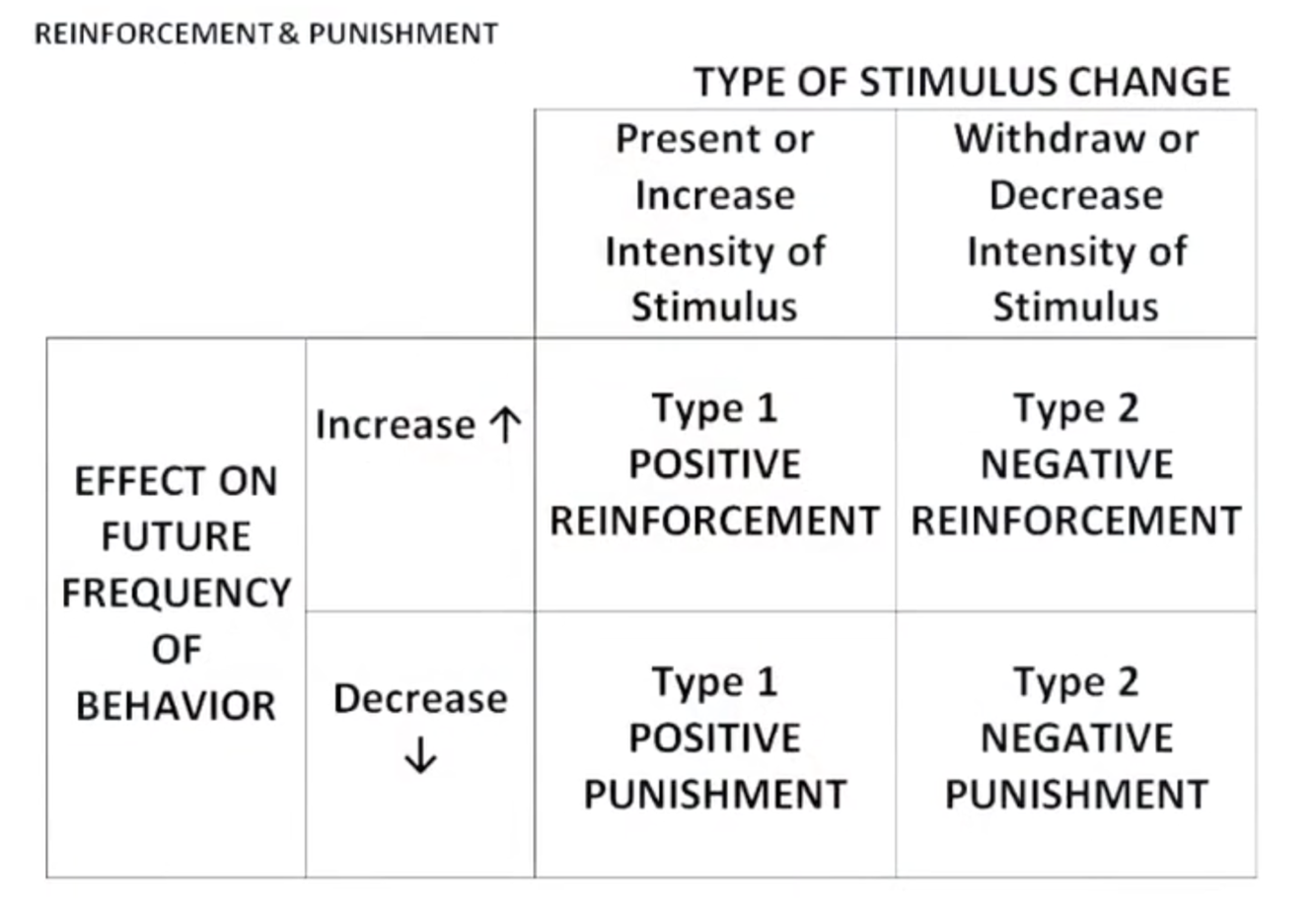
Reinforcement and Punishment–Type of Stimulus Change & Effect on Future Frequency of Behavior Table
Reinforcement
- occurs when a stimulus change immediately follows a response and increases the future frequency of that theype of behavior in similar conditions
- Reinforcement can also strengthen:
- Duration
- Latency
- Magnitude
- Topography
- a response becomes more frequent in the future if the reinforcer has followed it within 0-60 seconds (the immediacy of the reinforcer is critical) [Delayed consequences = rule goverened behavior]
What reinforcement does
- makes antecedent stimulus conditions relevant
- changes antecedents and consequences
- creates stimulus control
- when the SD is added, the 2 term contingency becomes the 3 term contingency of the DISCRIMINATED OPERANT
- MOs alter the current value of stimulus changes as reinforcement
Possible Unwanted Effects of Reinforcement
- Effects can temporary
- ETHICS: concerns about the use of of positive and negative reinforcement are similar and arise from the severity of the EO that occasions the behavior (ie extremely noxious events as aversive stimuli can generate behaviors that compete with the acquisition of the desire behavior
- Relying on the use of contrived reinforcers (as opposed to natural)
- Using reinforcers that are potentially harmful (ie cigarettes) or that may require excessive MOs
- Behavioral Contrast- When the rate of responding to a stimulus in one setting changes when the condition of reinforcement in the other settings gets modified
Public Misconceptions About Reinforcement
- Using contrived external reinforcers will result in a loss of intrinsitc motivation–NOT TRUE
- Reinforcement is bribery–NOT TRUE. Bribery is an artificial reward that is not related to the act and is given before the behavior occurs.
Behavioral Contrast
- When the rate of responding to a stimulus in one setting changes when the condition of reinforcement in the other setting gets modified
- It is also an unwanted effect of punishment, extenction, and DROs
- Positive Behavioral Contrast:
- Behavior INCREASES for a potentially more favorable reinforcer after being exposed to a reinforcer that has become less favorable
- Ex: Skinner’s pigeons had a blue key and a yellow key that delivered food at an equal rate for each key after a certain number of pecks. The blue key’s food tasted better. When Skinner stopped the yellow key from delivering (less favorable) food, the pigeon increased pecking of the blue key even though the rate of reinforcement did not change.
- Negative Behavioral Contrast:
- Behavior DECREASES for a less favorable reinforcer after being exposed to a reinforcer that is clearly more favorable
- Ex. You’ve just moved in with your girlfriend and you pick up her socks. One day you stop doing so–now the rate at which she picks up her socks decreases even lower than it was at baseline
Positive Reinforcement
(Type 1 Reinforcement; Sr+)
- a PROCESS that occurs when a behavior is followed immediately by the presentation of a stimulus that INCREASES the FUTURE frequency of the behavior in similar conditions
- This is the most important and widely used concept in ABA


-
Section 1: Foundational Knowledge: Easy42
-
Section 2: Foundational Knowledge: Hard97
-
Section 3: Foundational Knowledge: Super Hard81
-
Section 4: Assessment61
-
Section 6: Measurement52
-
Section 5: Experimental Design61
-
Section 7: Displaying and Interpreting Behavioral Data23
-
Section 8: Behavior Change Procedures77
-
Section 9: Ensuring Staff Competence25
-
Section 10: Ethics110



