Properties of proteins
Mass Charge – pH Hydrophobic/Hydrophilic Properties Differential Solubility Mobility in Applied Fields
Sep science
- Centrifugation
- Mass – acceleration
- Density – mass to volume ratio
- Dialysis
- Mass transport
- Size exclusion
- Lyophilisation
- Freeze-drying
- Precipitation
- Differential solubility
Centrifugation
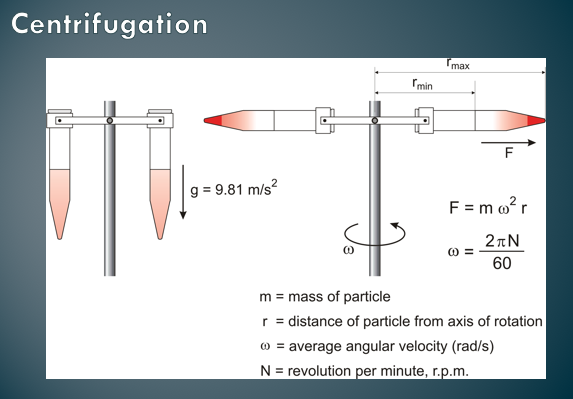
Centrifuge g-value – Relative Centrifugal Force (RCF)
•The ‘g-force’ of a centrifuge is calculated from the following formula:
g=11.18 ×r × (n/1000)2
- where g is the equivalent gravitational force (1 ×g = 9.8 ms-2)
- ris the length of the rotor, cm
- nis the number of revolutions per minute, RPM
Centrifugation field
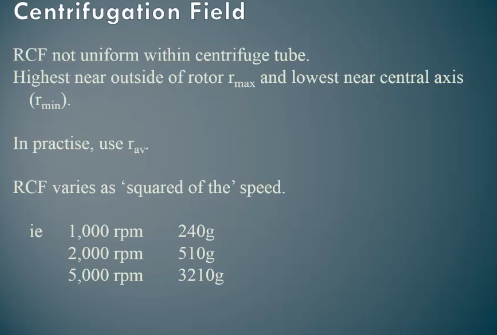
Principles of centrifugation
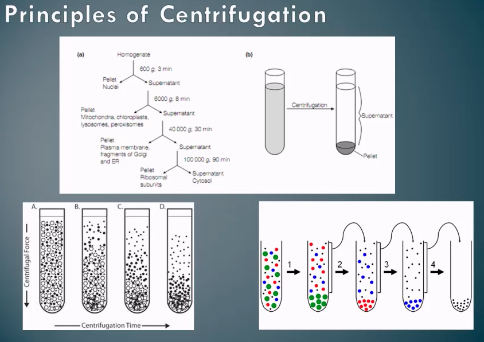
Centrifuge classes
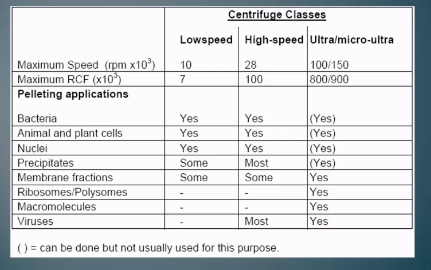
Differential centrifugation
•Differential Sedimentation (standard pelleting)
•
•Change the properties of the centrifugation medium to provide differential mobility of target proteins or organelles.
•
- DensityGradientCentrifugation
- RateZonal Centrifugation –eg. Sucrose
- IsopycnicCentrifugation –eg. CsCl
- Isopycnic– fluid of the same density
Preparation of the Density Gradient
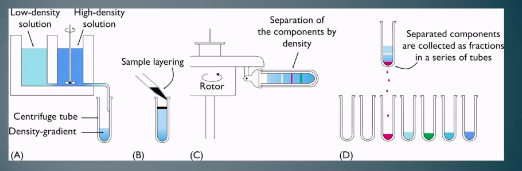
Sucose density gradient
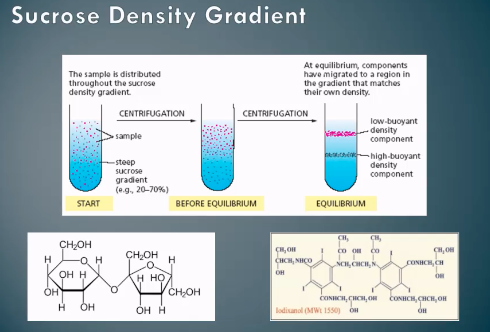
Isopycnic centrifugation
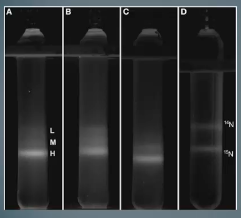
Isopycniccentrifugation of 15N
labelled community DNA in
CsCl/ethidiumbromide densitygradients.
A mixture of labelled(15N)
and unlabelled (14N) DNA,
extracted from Nitrosomonaseuropaea.
L, M, H in (A) indicate the positions of light,
medium, and heavy DNA bands, respectively
Gradient centrifugation
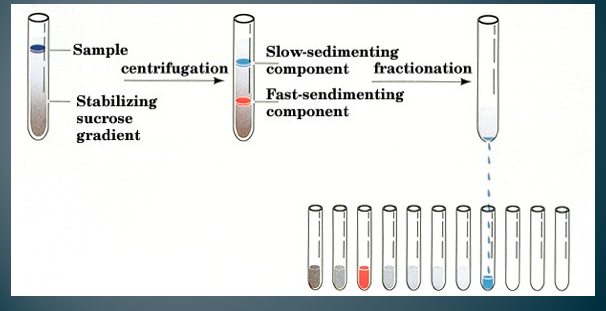
Sedimentation Coefficients
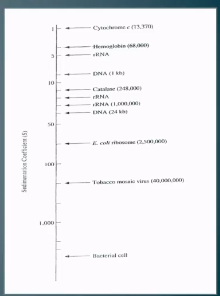
- Depends on the Mass and shape
- Transport property
- Svedberg Unit (non-SI unit)
- Molecule of 26 S will travel
- 26 µm per second in 106g
Ribosome Subunits
- Nobel Prize in Chemistry 2009
- “for studies of the structure and function of the ribosome
- The two eukaryotic ribosomal subunits have sedimentation coefficients of 40 x 10-13 and 60 x 10-13. As one Svedberg (S) unit is 10-13, the two ribosomal subunits are referred to as the 40S and the 60S ribosomal subunits.
Dialysis Membranes
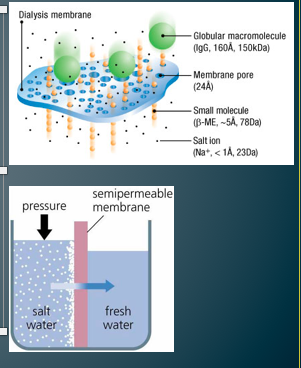
- Pore sizes in the membrane
- Size separation
- Porous to small molecules
- Size cut-off
- Semi-permeable membranes
- Desalination
- Chemical Potential
- Partial Molar Free Energy
Dialysis
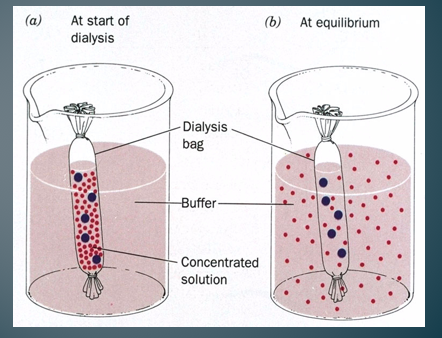
Dialysis examples
- Membranes–collodion, cellophane and cellulose. ‘Viskingtubing’. Needs to be boiled and treated with EDTA to remove contaminating materials eg. Heavy metals before use. Usual tubing 10-14,000 MW cut-off.
- Ultrafiltrationdevicesuse a membrane (polycarbonate or cellulose esters) and rely on pressure or centrifugation to force liquid through.
These are used toconcentrate protein to smaller volume remove turbidity or insoluble material
Lyophilisation - phase diagram
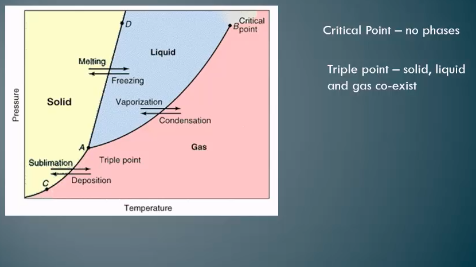
- Freeze-Drying- removal of solvent from frozen sample.
- Often used for storage of material.
- Can cause protein denaturationand aggregation.
- Good for temperature sensitive material.
- Freeze sample and then put under a vacuum to remove water.
- Need to control since if you remove all of the water from a protein it will denature.
- Protein protectants– sugars polyols, glocols
Separation by precipitation
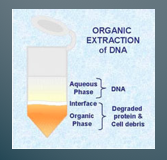
•Precipitation with organic solvent:
- Not used much today since it can result in protein denaturation.
- Solvents used ethanol or acetone.
- Principal effect is reduction of water activity.
•DNA Extraction:
•Base sequence is preserved
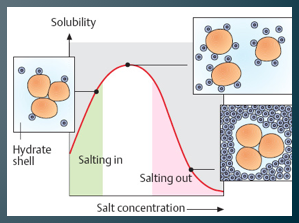
Salting out
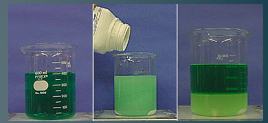
- Salts compete for the solvation shell of the protein and destabilise solution
- Multivalent cations
- phosphate and sulfate
- Usually potassium, sodium or ammonium.
- Salt used most commonly is ammonium sulfate.
- Needs to be ‘enzyme grade’ as often contaminated with heavy metals which interact with cysteine residues
Solubility Stability
•Proteins are usually least soluble around their isoelectricpoints (electrically neutral)
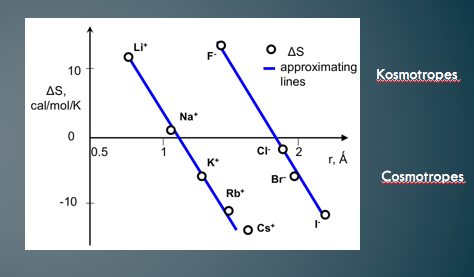
•Kosmotropes and Chaotropes
- Kosmotropes– order maker
- Chaotropes– disorder maker
- Entropy – fundamental measure of order and disorder
- Small ionic species that cover the surface of a charged protein
Kosmotropes and Chaotropes
Kosmotropes increase the interactions order within the water by increasing or making order
Chaotropesdecrease the interactions within the water decreasing the order
Ammonium Sulfate Fractionation
- Ammonium Sulphate Saturation Table
- Quantities of ammonium sulphate required to reach given degrees of saturation at 20oC
- Work out how much ammonium sulphate you need to add depending on your volume of extract. Add slowly while stirring on ice.
- Centrifuge, separate pellet and supernatant and add further ammonium sulphate to supernatant to reach next required concentration and repeat above.
Ammonium Sulphate Precipitation
Procedure
- Take sample in a beaker containing a stir bar and place on magnetic stirrer
- While sample is stirring, slowly add ammonium sulfateof a desired saturation level (Can refer ammonium sulphate precipitation chart)
- Add ammonium sulfatevery slowly to ensure that local concentration around the site of addition does not exceed the desired salt concentration.
- Once total volume of ammonium sulfateis added, move beaker to 4°C for 6 hours or overnight.
- Collect the precipitate from the beaker and centrifuge the precipitate at 5000g for 20 minutes.
- Carefully remove and discard supernatant. Invert the tube and drain well
- Give two or three wash with distilled water
- Dissolve the precipitate in phosphate buffer saline and dialyze protein solution at low temperature overnight to get removed salt
- Determine the concentration and store at -10°C for long term storage.



