how is
hardware support for virtualistaion acheived
To achieve this there must be hardware support for it. More specifically the processor must support it.
the processor does this by introducing a new mode that can be used along with user mode and kernel mode. Called hypervisor mode
this view from the containers perspective
it will only be able to see the parts of the system it has access to
running any system commands will only reveal the parts of the system it has been allocated to use
describe the
system view
that a container will have
describe the
file system view
of a container
this view of a container can be summarised as:
it will share the file system of the base OS however any changes made are not made to the base OS instead a layer known as the overlay file system will keep track of any changes and present it to the container with a merged view of the OS file system and the overlay file system
give 1 advantage that an
overlay file system brings for containers
an advantage of this is:
- A simultaneous Shared and separate file system - Only file changes made by the container are held here. any files that are used but unchanged from the underlying file system can be shared directly from the underlying file system to the container
describe the term
merged view file system
this is the view of the file system that the container will see
it is a combination of:
- base file system - held on the host OS
- overlay file system - which reflects any changes or added data that has been made by the container
describe the term
copy on write
a method for modifying files while maintaining the original file.
This is software that can emulate hardware.
It is able to perform very much like an OS in that it will share resources between the different virtual machines that run on top of it and ensure that each gets its fair share of time to process
describe a
hypervisor
This is also known as a hosted hypervisor and is software that will run as a device driver on the host OS.
describe a
type 2 hypervisor
this is software that can imitate hardware.
One use of this is emulating old hardware so that old applications and games can be bought into the modern age and ran on new hardware.
describe
Hardware/machine emulation
describe
Application virtualisation
where an application offers functionality but is able to virtualise that functionality between different instances.
One example is Apache web server that can host many websites within its application but resources between the websites must be kept isolated
software that can emulate hardware and present it to a virtual machine
describe the term
hypervisor
describe the term
overlay file system
a file system used by a single container that allows it to:
- Share the underlying file system
- make changes to the shared underlying file system. Without changing the host file system
these include:
- Virtual runtime environments
- Hardware/machine emulation
- Application virtualisation
- Network virtualisation
name 4
types of virtualisation which are not in relation to the OS
a file system used by a single container that allows it to:
- Share the underlying file system
- make changes to the shared underlying file system. Without changing the host file system
describe the term
overlay file system
an action carried out by the hypervisor that allows it to switch between the different virtual machines by saving and restoring there state.
This is a similar behaviour of an OS context switch
describe a
vm switch
each of these actions are summarised below
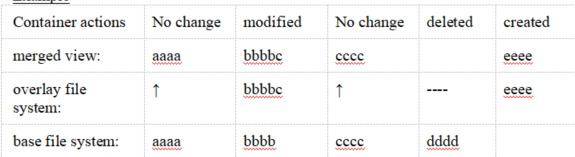
describe how a containers merged view of a file system would look when there is
- no change made by the container
- a modification by the container to the original file on the host file system
- a deleted file by the container
- a created file by the container
where an application offers functionality but is able to virtualise that functionality between different instances.
One example is Apache web server that can host many websites within its application but resources between the websites must be kept isolated
describe
Application virtualisation
how can an
overlay file system for a container be implemented
This can be achieved by the container creating its own mounted file system and writing changes to the mounted file system using the method known as copy-on-write
To achieve this there must be hardware support for it. More specifically the processor must support it.
the processor does this by introducing a new mode that can be used along with user mode and kernel mode. Called hypervisor mode
how is
hardware support for virtualistaion acheived
describe
containerisation
This is a virtualisation solution that will create what are known as containers.
Each container can run one or more applications and shares the underlying kernel and file system.
However each container is unaware that it is a container and believes it has sole control of the system
upon a
VM switch
what information would be saved/restored
when this occurs the following information would be saved/restored
- The hardware view for the VM
- Whether the VM is in an active state or a inactive state
- The values of the registers
this requires a linux kernel as a base OS this problem is solved by:
- Linux - the already installed linux kernel is used as the base OS
- macOS - a linux kernel is installed and that is used as the base OS instead of the macOS
- Windows - the Windows Subsystem for Linux (WSL) is installed that is a customized version of the linux kernel that is and will integrate with the windows OS
what does docker require in order to run and how is this problem solved for:
- linux
- macOS
- windows
describe a
hypervisor
This is software that can emulate hardware.
It is able to perform very much like an OS in that it will share resources between the different virtual machines that run on top of it and ensure that each gets its fair share of time to process
properties of this include:
- Isolation - Applications or even full operating systems can be ran alongside each other without any knowledge of the others existence
- Has the benefit of protection from malware or system corruption
- Different instances of the same application can be run but serve separate purposes
- Each can mange there own files
- Upgrades can be achieved on a container or vm basis and only affect that instance
- Management - can be easily managed without any disturbance to other running processes
- Start, stop or pause
- Add/remove resources such as memory or processing time
- Encapsulation - any data created can be encapsulated into a file and imported and exported to different systems
- Flexibility - the ability to quickly create and destroy different environments is a great benefit in development of applications or for testing purposes
give 4
properties that virtualisation has


-
Topic 1 - What is an operating68
-
Topic 2 - Installing an operating32
-
Topic 3 - Installing and running software28
-
Topic 4 - Shells52
-
Topic 5 - The command-line interface138
-
Topic 6 - Scripting and archiving106
-
Topic 7 – Structure of an operating system68
-
Topic 8 – Processors and hardware68
-
Topic 9 – Processes and scheduling92
-
Topic 10 – Services and daemons92
-
Topic 11 – Context switching92
-
Topic 12 – Memory management116
-
Topic 13 – Input/output Contents140
-
Topic 14 – Files and directories82
-
Topic 15 – Disk management124
-
Topic 16 – Users and security84
-
Topic 17 – Booting and configuration62
-
Topic 19 – The operating system zoo40
-
Topic 20 – Virtualisation68



