Why do we chew?
Prolong taste experience
Break up food so we dont choke and have resp failure
How is chewing controlled?
Both somatically and through reflexes…
Somatic nerves - control skeletal muscles of the mouth and jaw
Reflex - this works in a cycle:
- Contraction of jaw muscles –> pressure of food on gums, hard palate and tongue
- Activates mechanoreceptors which inhibit jaw muscle contraction
- Relaxation –> mouth opens causing a loss of pressure –> which causes contraction again
What is saliva made up of?
- Water (99%) containing:
- Mucins
- a-Amylase (salivary amylase)
- Electrolytes
- Lysozyme
What are mucins?
Major protein component of saliva
Mucin + water = mucous
Forms a viscous solution which lubes everything up
Why is there A-amylase in saliva?
Catalyses breakdown of polysaccharide (starch, glycogen) into disaccharide (maltose) + glucose
Basically just starts digestion of carbs a wee bit earlier
Why are there electrolytes in saliva?
Maintain the tonicity/pH of the mouth
This is important for maintaining our enamal and dentition etc
What is lysozyme and why is it in saliva?
Enzyme which acts against bacteria (bacteriocidal)
Cleaves polysaccharide component of bacterial cell wall
Where is saliva secreted from?
Parotid glands
submandibular glands
sublingual glands
(3 pairs of glands)
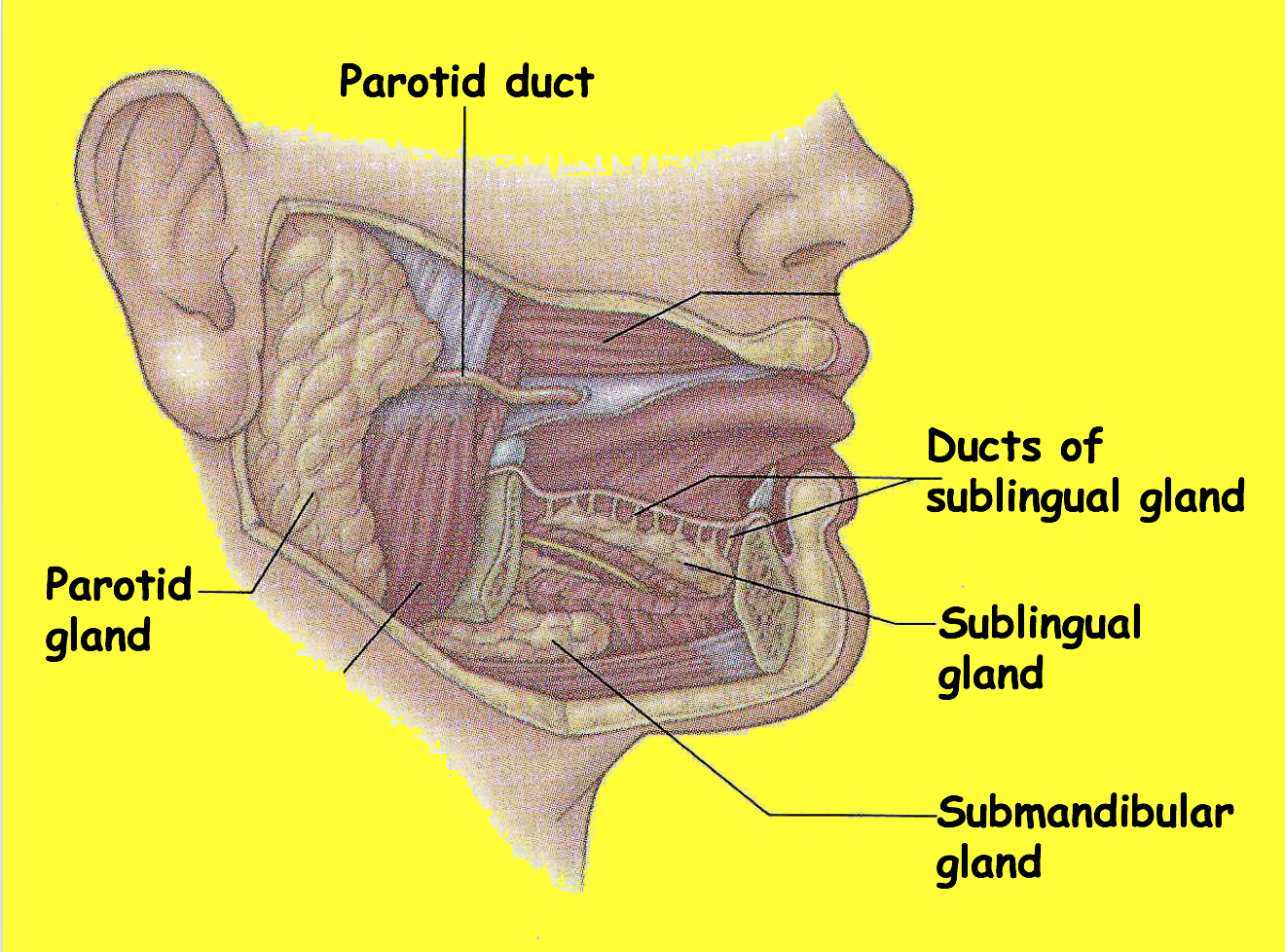
Which salivary gland is largest?
Parotid gland
Its duct enters from the hard pallet of the mouth
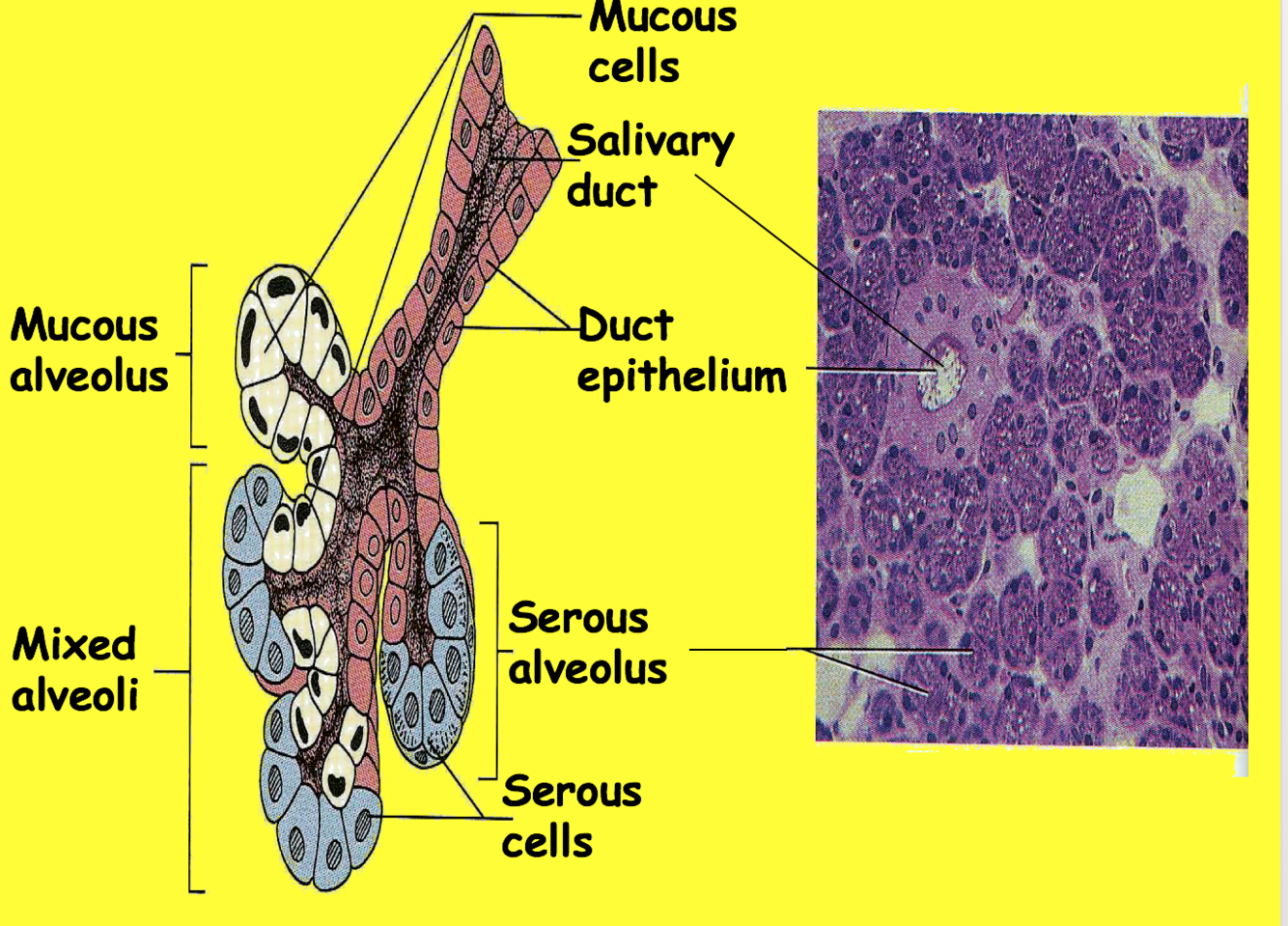
What is the general structure of salivary glands?
Gland composed of ‘alveoli’ of exocrine cells
3 types:
- Mucous alveolus
- Serous alveolus
- Mixed alveolus
What regulates salivary secretion?
Controlled by both Sympathetic and parasympathetic nervous systems (both stimulatory) and also by Reflexes
ANS control (as with all things) is in response to fight/flight or rest/digest states
How does parasympathetic stimulated work for salivary glands?
Cranial nerves:
- Facial nerve (VII)
- Glossopharyngeal nerve (IX)
Stimulation => profuse watery salivery secretion
(ideal for lots of chewing)
How does sympathetic stimulation of salivary glands work?
Secretion of small volume, viscous salivary secretion (dry mouth). Why?
Sympathetic stimulation (via superior cervical ganglion) causes release of NA which binds to a1 adrenoceptors and B2 adrenoceptors
Effect:
- a1 adrenoceptors => High mucus content
- B2 adrenoceptors => High amylase content
How does reflex control of salivary secretion work?
Presence of food in mouth stimulates chemoreceptors and pressure receptors on the walls of mouth/tongue
(i assume this causes a similar effect to parasympathetic stimulation)
What are the four layers of the oesophagus?
Mucosa
Submucosa
Muscularis externa
Adventitia
How long is the oesophagus?
25cm
What type of epithelium is found on the mucosa or the oesophagus?
Non-keritonised Stratified squamous
What is found in the submucosa in the oesophagus?
Sub-mucosal mucous glands
Their secretion reaches the oesophagus through ducts which pass through the mucosa
What types of muscle are found in the muscularis externa in the oesophagus?
Upper 1/3 (superior) = skeletal muscle
Middle 1/3 = transition to smooth muscle (mixture of both)
Lower 1/3 (inferior) = smooth muscle
(Some lectures etc say the middle third is just smooth muscle)
What happens in the oral (voluntary) stage of swallowing?
Tongue moves bolus (food) to back of mouth
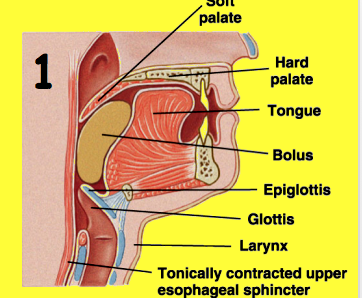
What happens in the pharyngeal phase of swallowing?
- Presence of bolus initiates sequence of reflex contractions of pharyngeal muscles
- This is co-ordinated by swallowing centre (medulla)
- The Soft palate reflects backward and upward to close off the nasopharynx
What happens in swallowing when the bolus approaches the oesophagus?
- Upper oesophageal sphincter (UOS) relaxes and opens
- Epiglottis covers the opening to the larynx
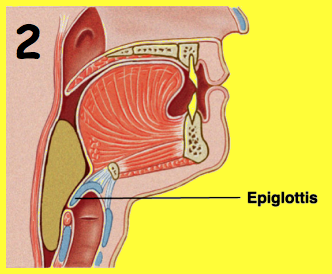
What happens once the bolus has entered the oesophagus?
Upper oesophageal sphincter (UOS) closes to prevent any reflux
Peristaltic waves in the oeophagus propell the bolus towards the stomach in about 10seconds
What happens once the bolus reaches the bottom of the oesophagus?
Lower oesophageal sphincter (LOS) relaxes so bolus enters stomach
LOS relaxation and entry of bolus to stomach causes vagal reflex to relax the elastic smooth muscle in the fundus and body of the stomach (so it expands)


-
Anatomy overview0
-
Embryology0
-
Digestion of carbs and protein21
-
Grand tour of the alimentary canal14
-
Digestion of Fats, minerals and vitamins25
-
Upper GI tract structure & function31
-
Gastric secretion37
-
Gastric motility and pancreatic function24
-
Liver structure and function31
-
Histology of the GI tract10
-
Upper GI tract pathology28
-
Small intestine structure and function30
-
Large intestine structure and function29
-
Inflammatory bowel disease (colon pathology)55
-
Hepatitis (liver symposium)32
-
Liver symposium ( - hepatitis )31
-
Large bowel neoplasia (colon pathology)19
-
Jaundice and chronic liver disease (not done)36
-
Functional bowel disorders41
-
Hepatobilliary pathology44
-
H.pylori & gastric disease40
-
Pancreatic disease57
-
Colorectal cancer and screening49
-
Microbiota of the GI tract (not done)19
-
Alcoholic liver disease35
-
Upper GI surgery27
-
Oesophageal disorders41
-
Acute GI bleeding37



