Give the anatomical overview of the visual pathway
- Light information reaches the back of the eyes in the retina.
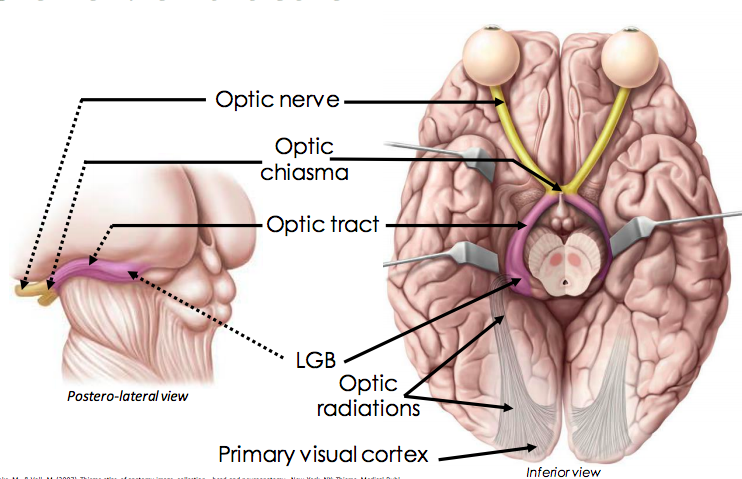
- The optic nerves (CN II) emerges from back of retina and travels back until it reaches the optic chiasma (where the 2 optic nerves converge).
- The optic tracts then pass towards the back of the midbrain until they hook upwards to connect with the lateral geniculate body of the thalamus (this includes the lateral geniculate nucleus).
- From the LGB, there are the optic radiations; the fibres that bring visual information from the thalamus to the primary visual cortex in the occipital lobe.
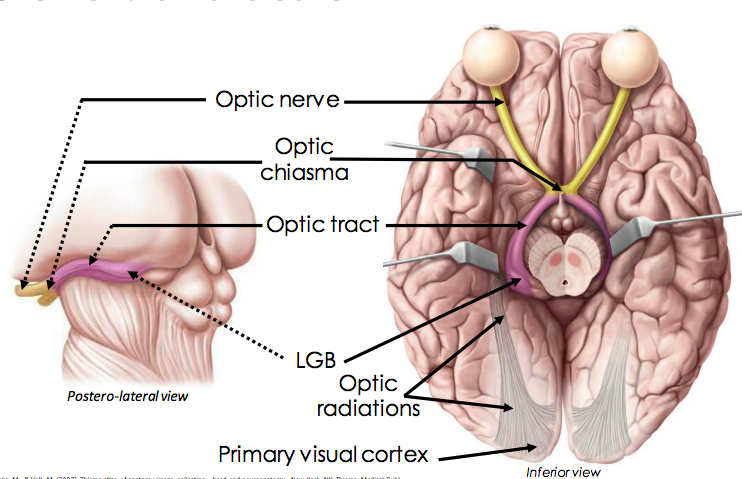
Where do the optic nerves emerge from?
The retina
After converging at the optic chiasma, where do the optic tracts then pass?
To the lateral geniculate body of the thalamus (this includes the lateral geniculate nucleus)
What is the lateral geniculate nucleus important for?
This is an important nucleus in the thalamus; important in relaying visual information.
From the lateral geniculate body of the thalamus, how is information brought to the primary visual cortex?
From the LGB there are the optic radiations
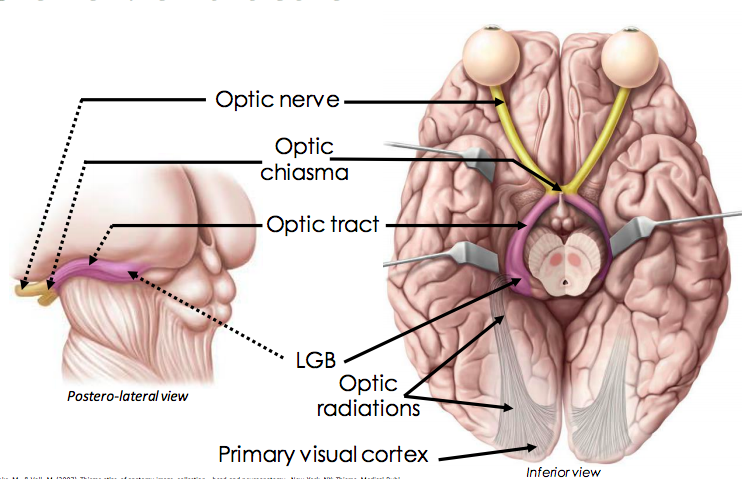
Where is the primary visual cortex?
Occipital lobe
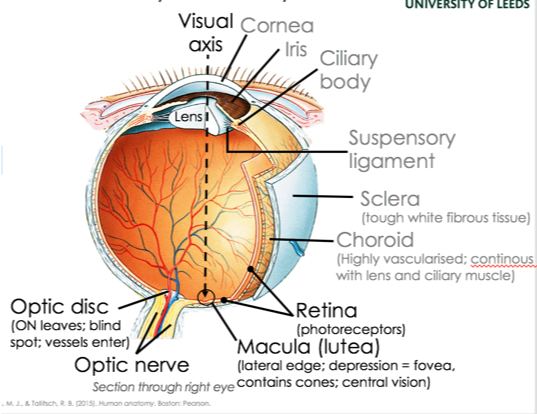
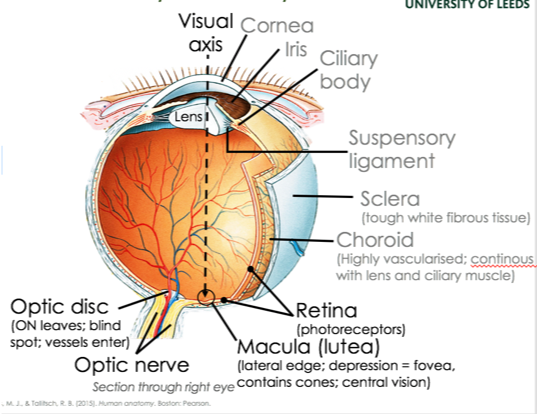
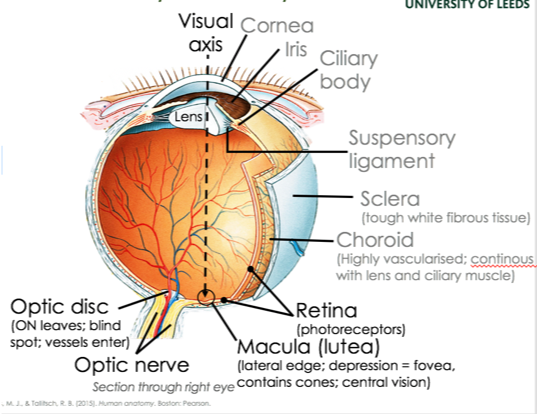
There are 3 layers encircling the eye. What are they composed of?
- Outer layer; cornea and sclera (these are continuous)
- Middle (vascular) layer; choroid
- Inner layer; retina
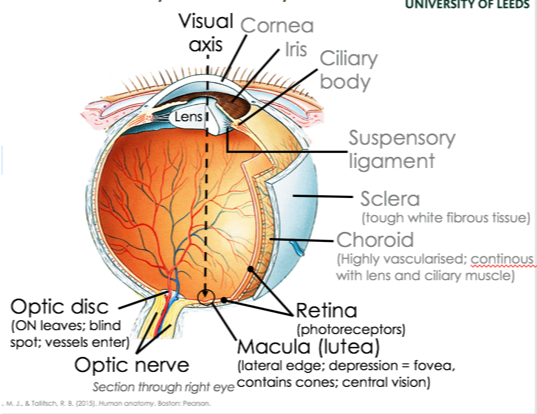
Describe the cornea. Main function?
- Description:
- Transparent part of the eye that covers the front portion of the eye (pupil and iris)
- Thick, transparent, avascular.
- Function: major area of refraction
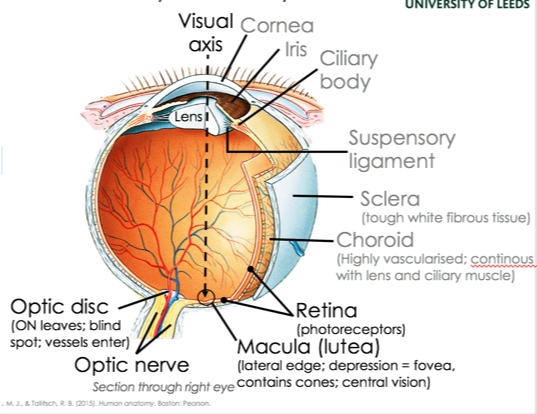
Describe the sclera. Main function?
- Description:
- Covers most of the ocular surface, “white of the eye”.
- Continuous with the cornea
- Tough, white, fibrous tissue
- Function: Insertion point for muscles that move the eyeball.
Describe the choroid. Function?
- Description:
- Vascular
- Continuous with the lens and ciliary muscle.
- Functinon: Nourishes the cornea and retina
Describe the iris. Function?
- Description: Pigmented, vascular.
- Function:
- Eye color is defined by that of the iris
- Muscles of the iris control the amount of light entering the eye by controlling the diameter of the pupil (the central opening of the iris).
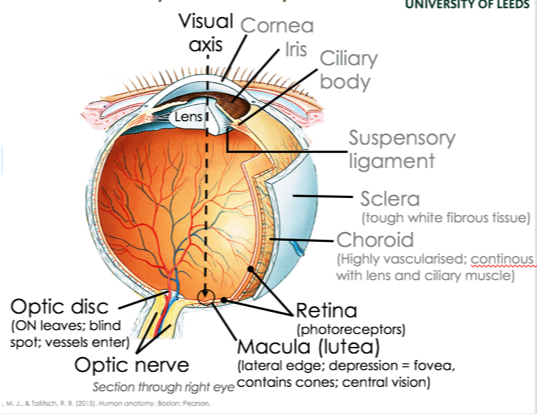
Function of the ciliary body?
Controls the shape of the lens by pulling on the suspensory ligaments.
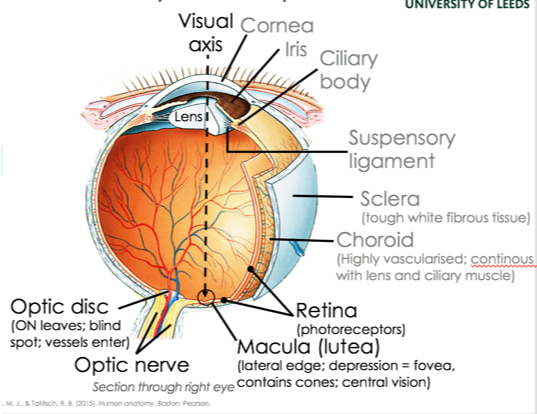
Describe the lens. Function?
- Description: Biconvex, avascular. Light passes through the lens after passing through the pupil.
- Function: changes shape (due to ciliary body)
- When rounded, can focus on objects which are near.
- When flattened, can focus on distant objects
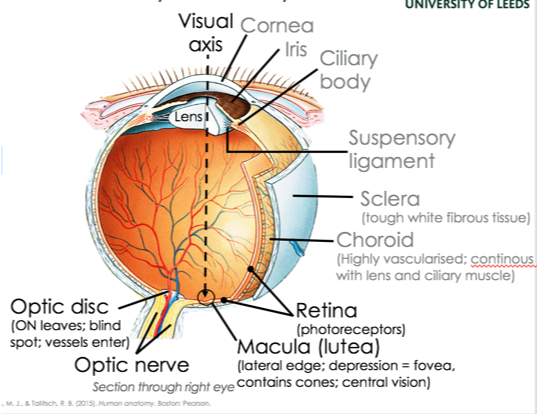
When rounded, what can the lens focus on?
can focus on objects which are near
When flattened, what can the lens focus on?
distant objects
What is the retina an extension from?
Diencephalon
How many layers is the retina composed of?
2
What are the 2 layers of the retina?
- Non-neuronal layer:
- Consists of pigmented epithelium.
- Sits against the choroid and is light absorbing
- Neural layer:
- Nerve tissue; photoreceptors, bipolar cells, ganglion cells
- Ganglion cell axons form the optic nerve –> This allows transmission of light information (photons) into electrochemical information
What is the optic disk?
Where the optic nerve exits –> this is a blind spot
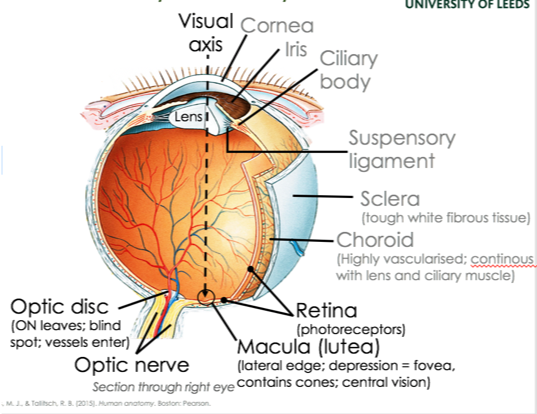
Why is the optic disk a blind spot?
we do not perceive any light information that falls in this region as there are no photoreceptors
What is the macula? Where is it located? Function?
- Region at very back of retina that falls right in middle of visual axis (peripheral vision not as clear)
- Found medial to optic disk
- Any light rays that travel directly in this region and fall upon the macula, this information is interpreted with high visual acuity –> as the macula contains a high density of photoreceptors
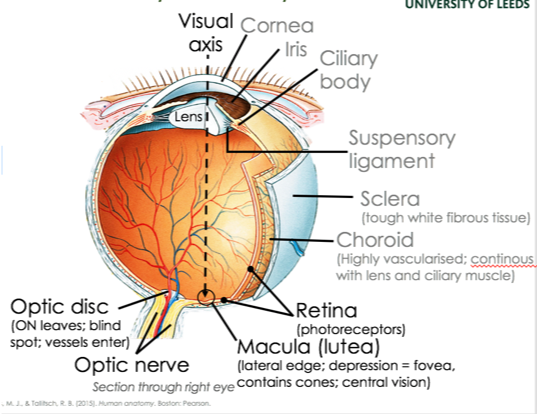
Why does the macula have a high visual acuity?
as the macula contains a high density of photoreceptors
Where is the fovea located? Function?
- Found in centre of macula
- Contains some specialised photoreceptors called cones –> highest point of visual acuity
What are ‘cones’? Where are they located?
Cone cells, or cones, are photoreceptor cells in the retinas (in the fovea) of vertebrate eyes


-
Development of CNS53
-
Intro to Human Brain78
-
The Skull146
-
Head and Neck 1: Front of Neck SDL124
-
Meninges and Ventricles106
-
Blood Supply128
-
Head and Neck Practical 1111
-
Head and Neck 2: Face and Skull93
-
Head and Neck Practical 284
-
Braindeath29
-
Brainstem and Cerebellum118
-
Neuroanatomy 1 SDL59
-
Neuroanatomy Practical 1113
-
Cranial Nerves83
-
Forebrain (Cerebrum)61
-
Control Week 1 MCQs16
-
Neuroanatomy Practical 2112
-
Neuroanatomy 2 SDL: Brainstem, Cerebellum and Cranial Nerves130
-
Localisation91
-
AFL 522
-
Muscles of Mastication12
-
Facial Nerve Revision30
-
Arteries of the Head and Neck29
-
Vertebral Column89
-
Spinal Cord and Nerves90
-
Backpain32
-
Ascending Sensory Pathways122
-
Descending Motor Pathways91
-
Contents of the Vertebral Canal SDL45
-
Vertebral Column and Contents Practical71
-
Revision - Different Regions of the Spine23
-
Control Week 2 MCQs11
-
AFL 624
-
Neuroanatomy 3 SDL: Forebrain, Ventricles and CSF40
-
Neuroanatomy Practical 3107
-
Autonomic Nervous System76
-
Skin Histology0
-
Somatosensory Disorders - Sensory Loss1
-
Headache60
-
Skin SDL44
-
Somatosensation Revision49
-
Epilepsy - Clinical Lecture85
-
Clinical - Tumours of the CNS44
-
Spinal Reflexes54
-
Muscle Weakness37
-
Trigeminal Nerve Revision27
-
Control Week 3 MCQs17
-
Pain & Somatosensory Disorders45
-
Peripheral Somatosensory System17
-
Cerebellum90
-
Head Injuries SDL33
-
AFL 726
-
Pain49
-
Local Anaethesia85
-
General Anaesthesia60
-
Visual Pathway112
-
Visual Defects119
-
Visual Defects40
-
SDL - Eye and Ear70
-
Auditory Pathway95
-
Clinical - Multiple Sclerosis0
-
Control Week 5 MCQs15
-
Control Week 6 MCQs32
-
NeuroAnatomy Revision57
-
ANS Revision97
-
Skin and Sensory Receptors MCQs10
-
Basal Ganglia73
-
Limbic System62
-
AFL 825
-
Physiology of Vision27
-
AFL 925



