Week 226
What are the 6 P’s that indicate Peripheral vascular disease (severe)?
- Pain
- Paraesthesia
- Paralysis
- Pallor
- Perishingly Cold Limb
- Pulselessness
- (Punched out - AKA Arterial - Ulcers)
Week 226
Pain from Claudication in say, the leg, is worsened if you do what to the limb?
Raise it. OUch!
Week 226
What is the name given to this Clinical sign? What does it indicate?
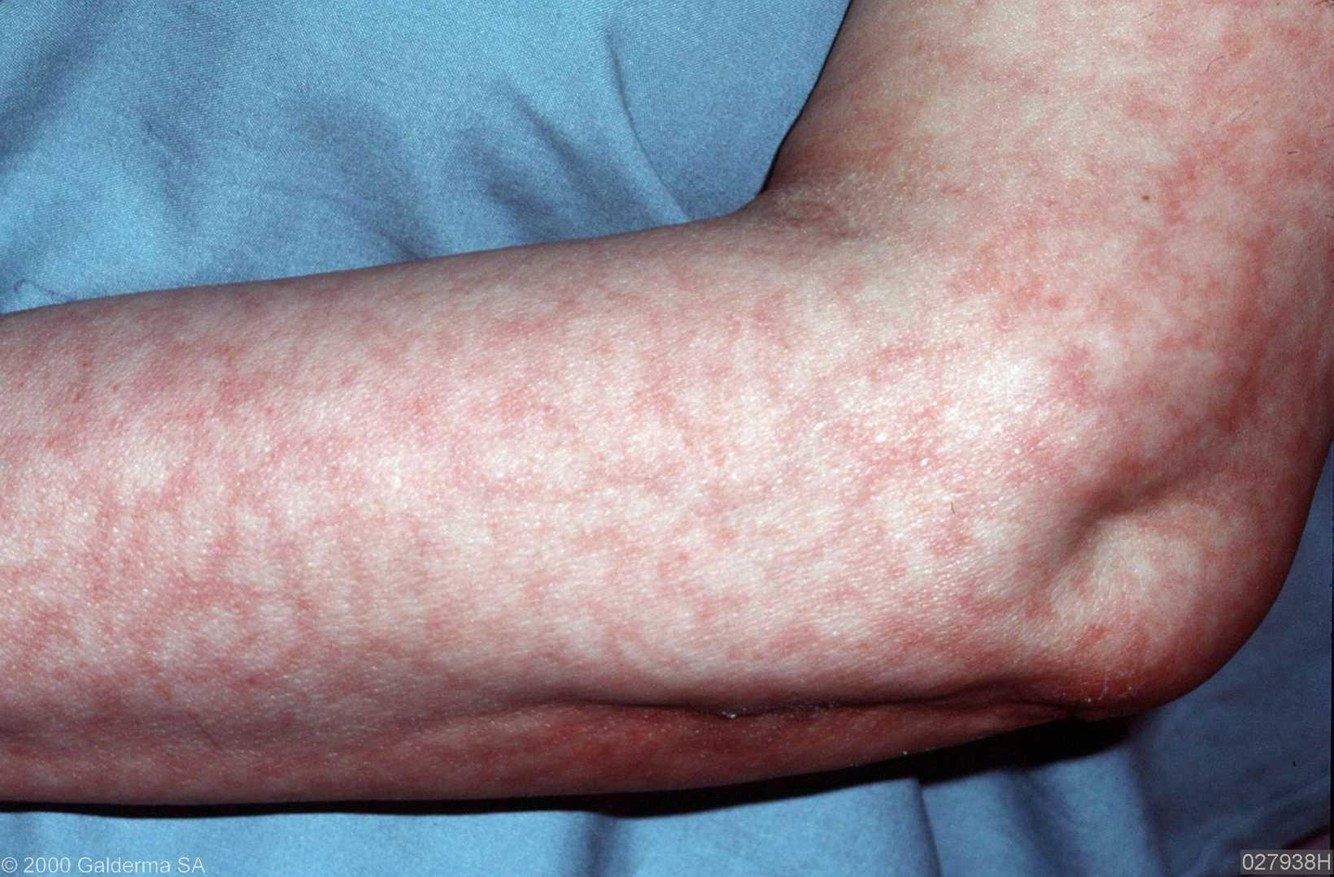
This is levido reticulares (lace like purplish discolouration)
This is a sign of atherosclerotic stenosis and occlusion.
Week 226
Describe the key characteristics of Arterial ulcers.
- Over bony prominences
- Smaller than venous ulcers
- Sharply demarcated border
- Punched out
- Necrotic centre
- Blanched appearance of surrounding skin
Week 226
What are the key characteristics of venous ulcers?
- Over soft tissue or bone
- Most common in gaiter region
- Larger than arterial
- Relatively painless
- Ireegular, poorly defined border
- Superficial appearance
- Granulating centre
- Increased exudate
- Hyperpigmented surrounding skin
Week 226
What is Buerger’s test? What is it used for?
With pt lying on back, perform a straight leg raise
(to a maximum of 45 ̊), and
note the angle at which leg becomes pale
o
After 2 mins, swing legs over edge of bed. A diseased leg will turn a ‘sunset red’ due to
reactive hyperaemia.
This is a sign of atherosclerotic occlusion and stenosis.
Week 226
What is the ABPI? Why is it useful in peripheral vascular disease diagnosis?
- Ankle Brachial Pressure Index
- Ratio of: Highest of Dorsalis pedis/Post. Tibial BP: Highest of Brachial BP
- Calculated for EACH leg.
- Health = 0.9-1.1
- In arterial ulceration it’s less than 0.5
Week 226
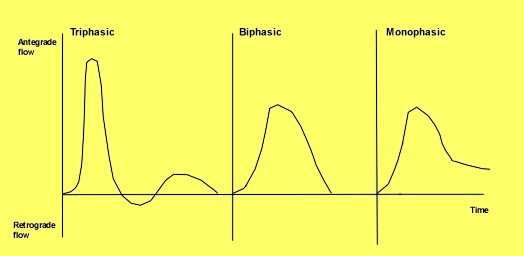
In a healthy person, what do doppler pulse studies of the leg show?
- A triphasic waveform.
- FWD flow in systole, rebound and reverse in early diastole, and forward in late diastole
Week 226
In a patient with peripheral vascular disease, what do you expect to see on a Doppler Pulse study?
Monophasic waveform.
Week 226
What are the treatment options for peripheral vascular disease?
- Surgical restorartion (balloon, stenting, bypass graft)
- Keep dry and clean
- Analgesia
- Antiplatelets and statins
Week 226
What is the primary cause of venous hypertension?
Valvular incompetence
Week 226
What causes venous Eczema?
Inflamation and fibrosis of skin due to chronic venous oedemam which causes haemosiderin deposition.
Week 226
What is Lipodermatosclerosis?
This is a symptom of venous hypertension. Brown, smooth, tightened skin. Caused by scarring of skin and underlying fat. Results in inverse champagne bottle shape.
Week 226
When is the venous refill test used? What is it?
Pt asked to use calf muscle pump to empty superfic veins. Pt then stood still to allow refill.
Venous refill time should be >120secs in healthy pts
Symptomatic pts will have VRT <40s.
Ulceration likely in pts with VRT <10
Week 226
What is the Trendelenburg test?
Used to determine which incompetent valves are responsible for varicose veins. Elevate leg and compress SFJ. Slow filling suggests problem at SFJ, fast filling suggests incompetent perforators.
Week 226
Are compression stockings suitable with an ABPI of less than 0.5?
No! This suggests arterial insufficiency. Nooooooooo
Week 226
How wide are capillaries?
4-8 micrometres
Week 226
How wide are post-capillary venules?
15 micrometres. Permeability is increased in inflammation.
Week 226
How wide are AV anastomoses?
100 micrometres
Week 226
What are continuous capillaries, and where do they occur?
- Occur in skin, muscle, lungs, connective tissue, CNS
- Contain small pores (not existent in CNS = blood brain barrier)
Week 226
What are fenestrated capillaries, and where are they found?
- These occur in areas of increased fluid filtration out of the capillaries. I.E kidneys, choroid plexus, ciliary bodies, GI mucosa, endo/exocrine glands
- They contain small pores = 15NM wide
Week 226
Sinusoids are a type of capillary. Where are they found?
These occur in areas of increased cellular exchange i.e. spleen, liver, bone marrow. They form endothelium with large gaps (100nm wide), forming a discontinuous basement membrane.
Week 226
What is photoplethysmography?
BP of the toe.
Week 226
What is peak systolic velocity ratio?
This = PSV in stenosis/PSV in vessels next to stenosis
PSV 2 = 50% stenosis
PSV 3 = 70% Stenosis

-
Week 201 - International Health138
-
Week 202 - Stroke145
-
Week 203 Puberty150
-
Week 205 Addiction (Alcoholism & Hepatitis)253
-
Myocardial Infection (M.I)274
-
Chest wall - OCT??134
-
Week 208 - ENT/Paeds Ear Disease231
-
Week 209 - IBS/Constipation175
-
Week 210 - Asthma124
-
Week 232 - Epilepsy119
-
Week 236 - Alzheimers6
-
Radiology125
-
Week 204 - gynaecology187
-
Week 218 - Fractured Hip128
-
Week 219 - Haemoptysis 2 (pulmonary circulation)107
-
Week 220 - Gynaecolocial Cancers48
-
Week 231 - Anaemia93
-
Week 221 - Meningitis45
-
Week 222 Cerebral Palsy/autism64
-
Week 224 - Rheumatoid arthritis60
-
Week 225 Malignant Melanoma77
-
Week 226 Peripheral Vascular Disease25
-
Week 227 Acute Renal Failure87
-
Week 228 - Fungal Disease42
-
Week 229 - Nutrition37
-
Week 230 - Pain33
-
Week 235 - Pregnancy 252
-
Week 236 - Alzheimers/Dementia35
-
Week 237 - Malabsorption/Chronic Diarrhoea44
-
Week 238 - Heart failure54



