Which skull bone does the ear sit around?
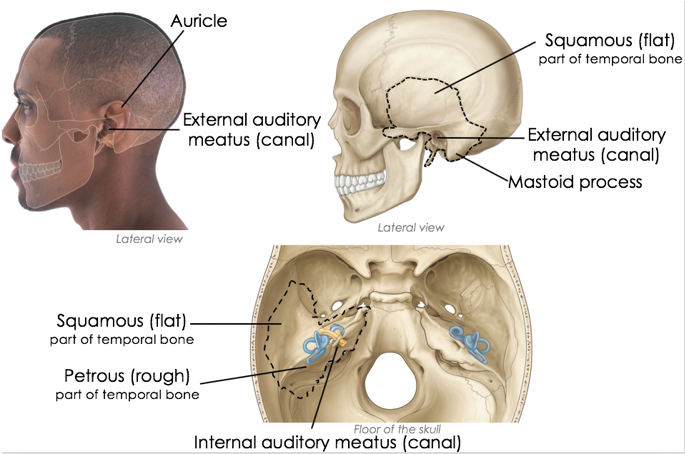
Temporal bone
What 2 parts can the temporal bone be divided into?
- Squamous; lateral, flat portion
- Petrous; rough portion
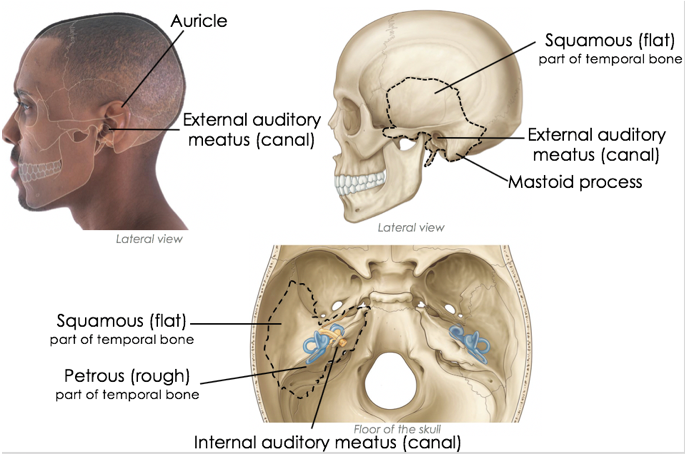
The ear is divided into 3 portions. What are they?
- External
- Middle
- Inner
The external ear can be divided functionally and structurally into two parts. What are they?
- Auricle (or pinna)
- External acoustic meatus
In the middle of the auricle is a hollow depression. What is it called? What does it continue into the skull as?
Concha - continues into the skull as the external acoustic meatus
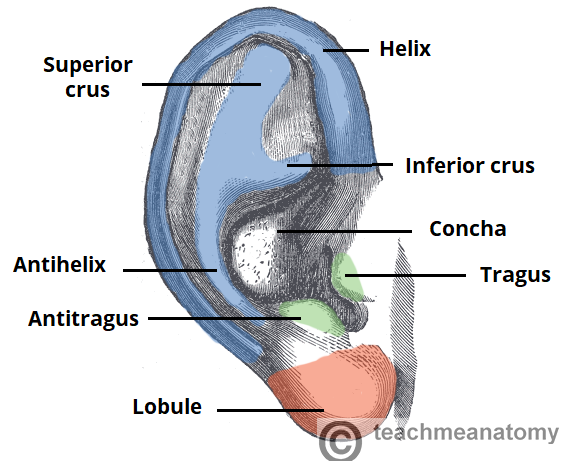
Function of the concha/auricle?
funnels sound waves into the ear canal via the external acoustic meatus
Where does the external acoustic meatus end?
Tympanic membrane
Function of the
a) external ear
b) middle ear
c) inner ear?
a) receives sound waves
b) transmits sound waves into mechanical waves
c) transmits sound waves into electrical waves
Describe the composition of the external acoustic meatus
- Lateral 1/3rd of the canal is cartilaginous
- Medial 2/3rds of the canal is bony, made up of temporal bone
In the middle ear, how are sound waves transmitted into mechanical waves?
Vibration of ossicles
What are the ossicles? Names?
3 bones of the middle ear are the auditory ossicles that link the tympanic membrane to the oval window of the internal ear.
- Malleus (most lateral)
- Incus
- Stapes (most medial)
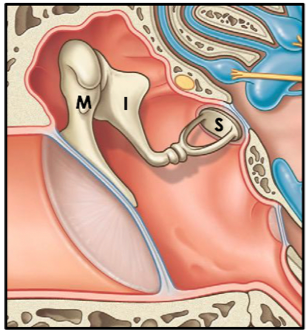
What are the smallest bones in the body?
Ossicles
What is the middle ear? Location?
Air filled space in the petrous part of the temporal bone
What separates the middle from the external ear?
Tympanic membrane
Which ossicle is in contact with the middle ear?
Stapes
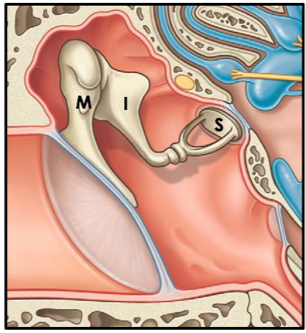
Function of the ossicles?
- Vibrate to transmit/amplify sound waves into cochlea ear
- Bones vibrate to amplify sound
Ossicles can can calcify with age, becoming less flexible and less able to vibrate. What can this cause?
This can cause conductive hearing loss. May be progressive or complete.
How is the middle ear in contact with the nasopharynx?
Via the Eustachian (auditory tube)
What is the Eustachian tube? What does it connect?
Tube that connects nasopharynx to the middle ear
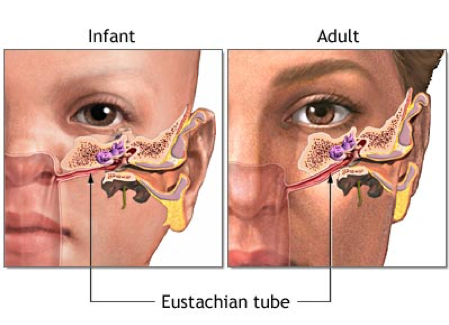
3 major functions of the Eustachian tube?
- Drains fluids into nasopharynx
- Ventilates the middle ear
- Equalise pressure between external environment and pressure on the inside
Why are infants more prone to ear infections than adults?
As they have a smaller and more horizontal Eustachian tube –> more direct route for infections to access the tube and therefore the middle ear
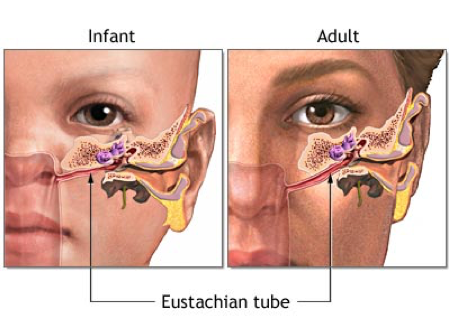
As we grow, how does our Eustachian tube change shape?
Becomes more vertical with age
Is the Eustachian tube typically held open or closed?
Open
How is the Eustachian tube affected when there is a big change in atmospheric pressure e.g. airplane, scuba diving?
In certain situations when there is a big change in atmospheric pressure, then the tube is held more tightly closed e.g. airplane, scuba diving (why your ears hurt)




-
Development of CNS53
-
Intro to Human Brain78
-
The Skull146
-
Head and Neck 1: Front of Neck SDL124
-
Meninges and Ventricles106
-
Blood Supply128
-
Head and Neck Practical 1111
-
Head and Neck 2: Face and Skull93
-
Head and Neck Practical 284
-
Braindeath29
-
Brainstem119
-
Neuroanatomy 1 SDL59
-
Neuroanatomy Practical 1113
-
Cranial Nerves83
-
Forebrain (Cerebrum)61
-
Control Week 1 MCQs16
-
Neuroanatomy Practical 2112
-
Neuroanatomy 2 SDL: Brainstem, Cerebellum and Cranial Nerves130
-
Localisation91
-
AFL 522
-
Muscles of Mastication12
-
Facial Nerve Revision30
-
Arteries of the Head and Neck29
-
Vertebral Column89
-
Spinal Cord and Nerves90
-
Backpain32
-
Ascending Sensory Pathways122
-
Descending Motor Pathways91
-
Contents of the Vertebral Canal SDL45
-
Vertebral Column and Contents Practical71
-
Revision - Different Regions of the Spine23
-
Control Week 2 MCQs11
-
AFL 624
-
Neuroanatomy 3 SDL: Forebrain, Ventricles and CSF40
-
Neuroanatomy Practical 3107
-
Autonomic Nervous System76
-
Skin Histology0
-
Somatosensory Disorders - Sensory Loss1
-
Headache60
-
Skin SDL44
-
Somatosensation Revision49
-
Epilepsy - Clinical Lecture85
-
Clinical - Tumours of the CNS44
-
Spinal Reflexes54
-
Muscle Weakness37
-
Trigeminal Nerve Revision27
-
Control Week 3 MCQs17
-
Pain & Somatosensory Disorders45
-
Peripheral Somatosensory System17
-
Cerebellum90
-
Head Injuries SDL33
-
AFL 726
-
Pain49
-
Local Anaethesia85
-
General Anaesthesia60
-
Visual Pathway112
-
Visual Defects119
-
Visual Defects COPY40
-
SDL - Eye and Ear70
-
Auditory Pathway95
-
Clinical - Multiple Sclerosis0
-
Control Week 5 MCQs15
-
Control Week 6 MCQs32
-
NeuroAnatomy Revision57
-
ANS Revision97
-
Skin and Sensory Receptors MCQs10
-
Basal Ganglia73
-
Limbic System62
-
AFL 825
-
Physiology of Vision27
-
AFL 925



