What are the 3 types of memory?
- sensory, short term/working and chronic memory
- visual, short term/working and long term memory
- sensory, short term/working and long term memory
- feeling, short term/working and long term memory
- sensory, short term/working and long term memory

What is explicit memory, which is part of your long term memory?
- ability to recall of previously learned information
- unconscious and unintentional recall of things
- consciously have to think to perform activities
- ability to consciously forget irrelevant things
- ability to recall of previously learned information
- requires conscious effort to receive
What is implicit memory, which is part of your long term memory?
- ability to recall of previously learned information
- unconscious and unintentional recall of things
- consciously have to think to perform activities
- ability to consciously forget irrelevant things
- unconscious and unintentional recall of things
- implicit just means happens automatically
- skills such as how to ride a bike
- unconscious and unintentional recall of things
What are the 3 basic steps of memory process in order?
- encoding, retrieval, storage
- encoding, retrieval, 2nd encoding
- storage, encoding, retrieval
- encoding, storage, retrieval
- encoding, storage, retrieval
Encoding is the first of the 3 basic steps of memory process. What is encoding?
- your senses are stimulated by something
- you pay attention to this and use perception to put this into the encoding process to memorise it
Storage is the second of the 3 basic steps of memory process. What is storage?
- storing of somewhat permanent record of stimulus
- we form mental representation in our brains
Retrieval is the third of the 3 basic steps of memory process. What is retrieval?
- ability to call back and remember information
- behaviours are generated by this
What is the multistore model of memory?
- model suggesting stages of memory are combined as 1
- model suggesting stages of memory are all unique processes
- model suggesting stages of memory are all unique processes
- assumes there are 3 separate memory stores where memories can be transferred between them in a linear sequence
- sensory memory then short term memory and finally long term memory

The multistore model of memory is a model that assumes there are 3 separate memory stores where memories can be transferred between them in a linear sequence:
1 - sensory memory
2 - short term memory
3 - long term memory
Using the example of remembering the letters GTFB, how would this work?
- you see GTFB and this is passed to sensory memory
- if we pay attention** GTFB flows into our **short term memory
- in short term memory** we rehearse GTFB and this enters our **long term memory
- GTFB can then be retrieved back into short term memory (temporary working) if needed
In sensory memory, does the sensation from the stimulus disappear immediately?
- no
- they can persist even though sensory stimulus has finished
How long do sensory memories generally last?
- last only milliseconds or seconds
- very rapid decay
- essentially if asked to recal with a gap >1 second, the recel will decline
What is short term memory often referred to as?
- working memory
- workspace memory for solving problems, such as trying to memorise someones telephone number
- can generally hold 7 items
What is the working memory (short term memory) model?
- model suggesting stages of memory are combined as 1
- model suggesting stages of memory are all unique processes
- model that splits memory into multiple components
- model that splits primary memory into multiple components
- instead of a single, unified construct
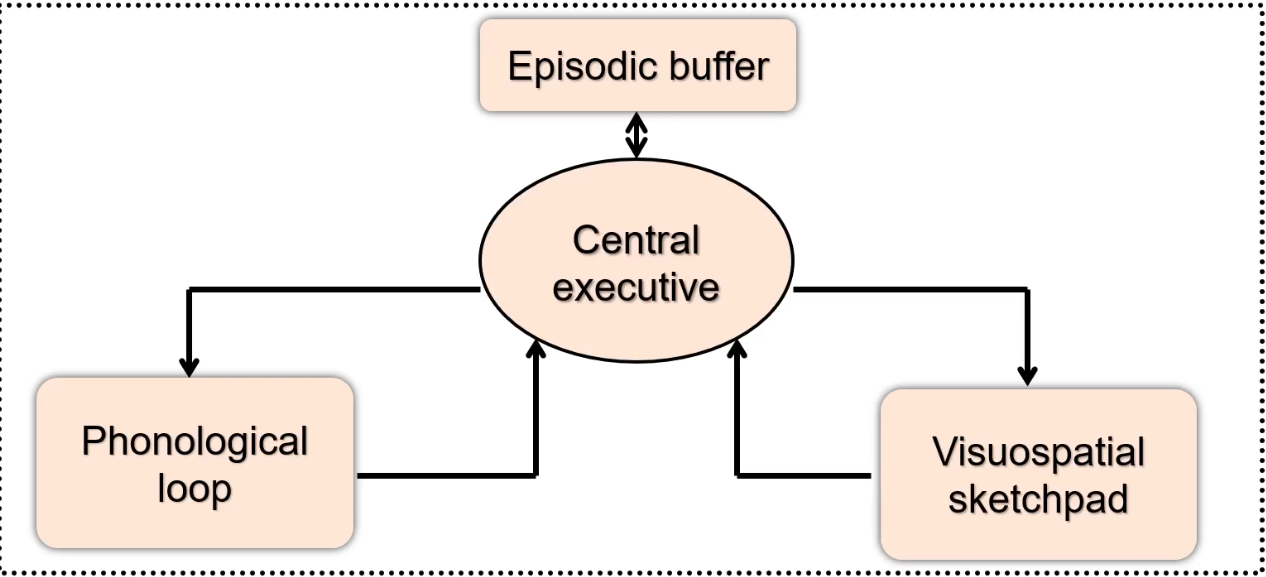
The working memory (short term memory) model (Baddeley & Hitch, 1974), which essentially is a model that shows how we are able to use working memory. It is important for reasoning, learning and comprehension. What is the phonological loop, which is part of the working memory mode?
- memory that is heavily involved in remembering thing through speech and sound
- acts as an inner ear and holds information in a speech-based form
- like when trying to remember a phone number

The working memory (short term memory) model (Baddeley & Hitch, 1974), which essentially is a model that shows how we are able to use working memory. It is important for reasoning, learning and comprehension. In the working memory model the central executive is placed in the middle as in the image below. What is the central executive?
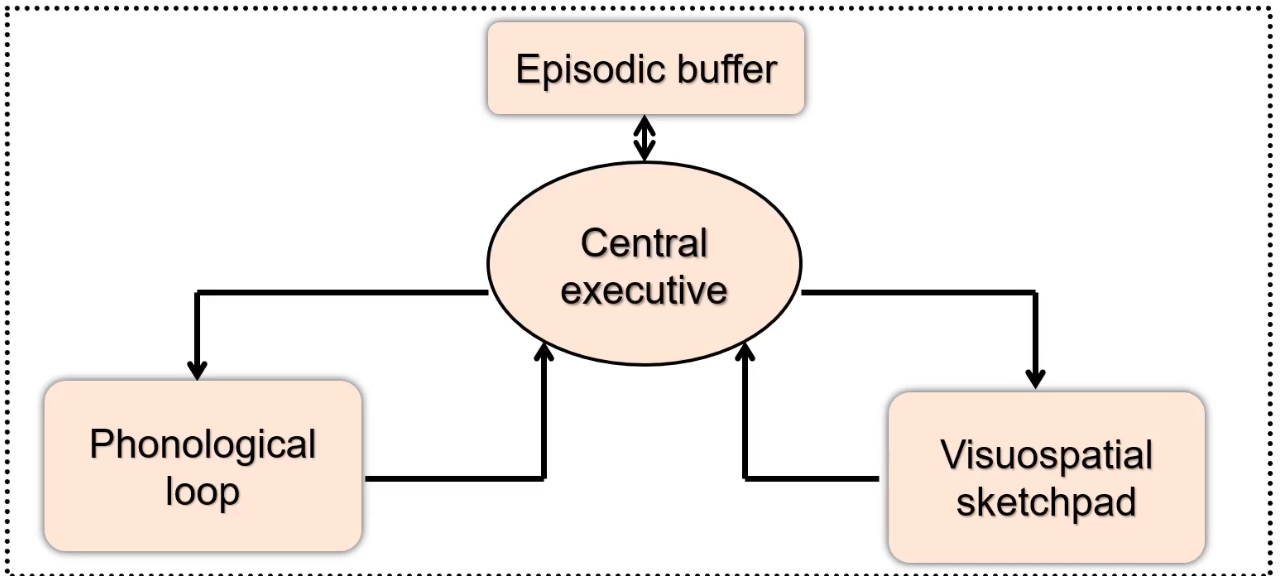
- drives the whole working memory system, allocating data to phonological loop or visuospatial sketchpad depending on the stimulus (sound or visual)
- important for cognitive tasks such as problem solving, maths or managing where information will move to next
The working memory (short term memory) model (Baddeley & Hitch, 1974), which essentially is a model that shows how we are able to use working memory. It is important for reasoning, learning and comprehension. In working memory model the central executive is placed in the middle as in the image below, acting as a central boss. It is able to divert data to each other aspect of the model and is important for cognitive functions. What is the episodic buffer that was added to the model at a later state?
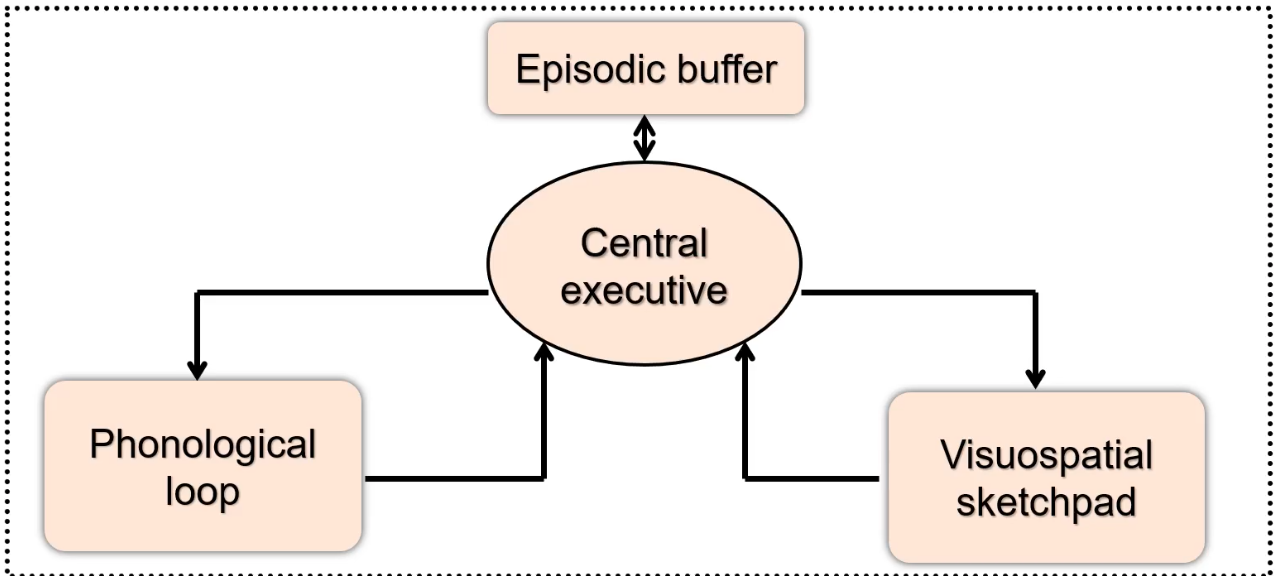
- temporary store integrating information from the other components and maintains a sense of time
- ensures events occur in a continuing sequence
The working memory (short term memory) model (Baddeley & Hitch, 1974), which essentially is a model that shows how we are able to use working memory. It is important for reasoning, learning and comprehension. What is the visuospatial sketchpad, which is part of the working memory model?

- the section of one’s normal mental facility
- provides a virtual environment for physical simulation, calculation, visualisation and optical memory recall
If we are given a task to complete, for example use the letter C, a square, a rectangle and 2 letters Vs that can be rotated or moved to make an image, such as the example image below, would we be using the Visuospatial Sketchpad or the phonological loop as part of the working memory model?
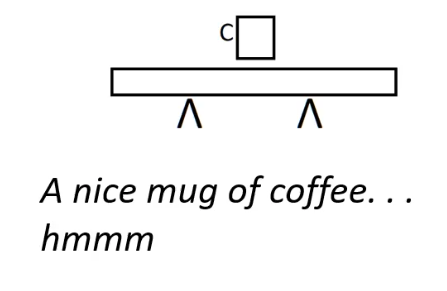
- used a little phonological loop
- BUT mainly the visuospatial sketchpad
- putting them together will help retain the information
When we are given tasks to complete in the working memory model, the practice and thought process that we use in both the Visuospatial Sketchpad (component of working memory responsible for handling visual and spatial information) or the phonological loop (component of working memory responsible for dealing with written and spoken material) is part of something that we do in an attempt to retain the information in our long term memory, what is this called?
- rehearsal
- long term memory
- shadowing
- mirroring
- rehearsal
- like in revision for exams
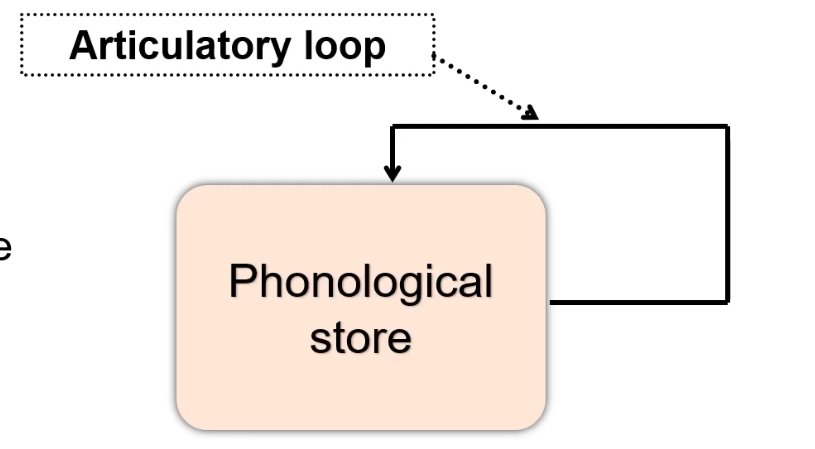
The phonological loop is the part of the working memory model that holds speech and written material in our memory for a few seconds in an attempt to rehearse and remember it. Attached to the phonological process is the articulatory loop, what is the purpose of this?
- ensures when speaking you use the correct terminology
- ensures that you can retrieve relevant verbal information
- allows you to speak and memorise things
- helps vocalise things in out head to memorise them
- helps vocalise things in out head to memorise them
- vocally rehearse things in our heads, the so called inner speech
- if damaged then phonological loop is impaired
- like practicing a speech where you speak in your head
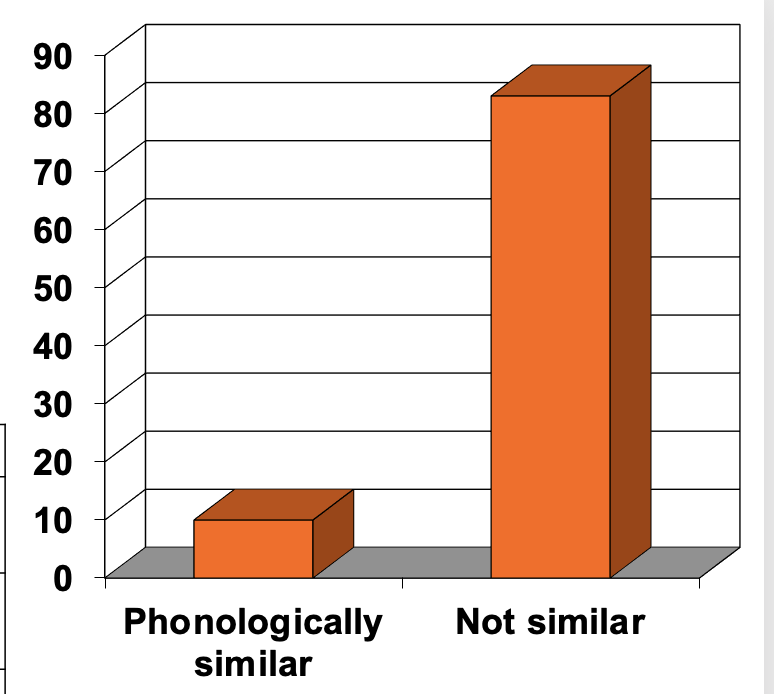
When we think about the phonological loop, does the phonological similarity indicate that we will remember more if the words are similar or different from one another?
- we remember more if the word are different because this requires further processing
- man, mad, cap, can, map = poor recal
- pen, rig, day, bar, sup = better recal because we need to process this more
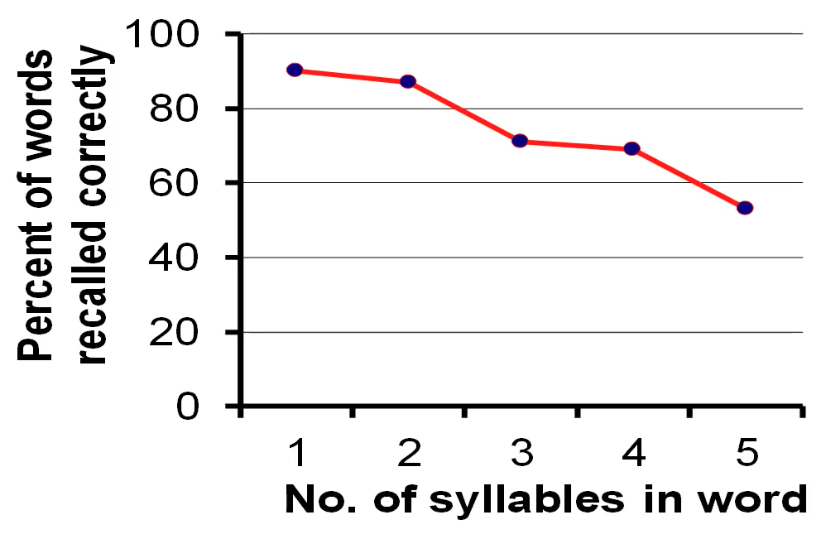
When we think about the phonological loop, there is evidence supporting it surrounding the ‘word length effect’. What does this mean in relation to the phonological loop?
- longer words with more syllables = poorer recal
- shorter words with less syllables = better recall
- articulatory loop (inner rehearsal) is easier with fewer syllables because the time we can remember is shorter
What is the difference between fluid intelligence and crystallised intelligence?
- fluid intelligence = comprehension, reasoning and problem solving
- crystallised intelligence = recalling stored knowledge and past experiences
Why is working memory important?
- need it to function daily
- need it to use inner voice in our head to process information
- associated with learning outcomes
- associated with learning to speak
- associated with learning outcomes in literacy and numeracy, especially reading comprehension
- working memory at 5 y/o has been shown to be better predictor of success than IQ
- impaired working memory are linked to low learning outcomes


-
Neural Tissue57
-
Physiology of Neurons21
-
Chemistry and Physiology of the Synapse28
-
Synaptic Transmission32
-
The Skull and Cranial Cavity62
-
Chemicals in the brain37
-
Chemicals in the brain part 248
-
Describing the brain79
-
CPCP2 Lectures65
-
Topography of the Brain87
-
Global Brain Activity45
-
Basic Principles of Memory33
-
Anatomy of Memory and Emotion56
-
The ventricular system and circulation of cerebrospinal fluid48
-
Synaptic Plasticity39
-
Plasticity and regeneration54
-
Face, Temporal, and Infratemporal Fossa65
-
Introduction to Neuropathology90
-
Cognitive impairment and confused states89
-
Introduction to demyelinating disorders69
-
Structure and Function of the Spinal Cord99
-
Physiology of the Spinal Cord63
-
Imaging the Brain & Spinal Cord24
-
ORAL CAVITY and NECK89
-
Autonomic Nervous System63
-
Analgesics and Sedative drugs67
-
Consciousness40
-
Physiology of Pain75
-
Anaesthetic Drugs31
-
The Psychiatric History and Mental state Examination31
-
Ear and Auditory Pathway65
-
The cerebellum and motor learning54
-
Physiology of chronic stress35
-
Parkinson’s disease and drug therapy of basal ganglia disorders56
-
Physiology of Balance, Taste and Smell78
-
Physiology of Hearing42
-
Personality, development & attachment39
-
Neuropsychology of memory42
-
Motor Learning and neurological Syndromes70
-
Neurobiology and neurochemistry of reward and addictive behaviours51
-
Physiology of sleep51
-
Epilepsy - aetiology and management54
-
Introduction to Stroke74
-
Clinical features of anxiety and stress-related disorders54
-
Anxiety disorders: Neurobiology, neurochemistry and treatment38
-
THE EYE AND THE VISUAL PATHWAYS67
-
Physiology of vision47
-
Neurobiology and clinical features of psychosis41
-
Treatment of psychosis and psychotic disorders53
-
Neurobiology and clinical features of affective (mood) disorders62
-
Treatment of affective disorders48
-
Applied Anatomy46
-
The Association Cortices and Complex Brain Functions41



