Although CSF is similar to plasma, there are 2 key differences, where the concentrations are lower in CSF than in plasma. What are these 2 differences?
- CSF has higher K+ and amino acid concentration than plasma
- CSF has lower K+ and a higher amino acid concentration than plasma
- CSF has higher K+ and a lower amino acid concentration than plasma
- CSF has lower K+ and amino acid concentration than plasma
- CSF has lower K+ and amino acid concentration than plasma
- K+ (plasma = 4.7 and CSF = 2.9mEq)
- amino acids (plasma = 2.6 and CSF = 0.03mEq)
What is the glymphatic system?
- a waste clearance in the CNS, essentially a lymphatics system of the brain
- CSF flows into the paravascular space around cerebral arteries, combining with interstitial fluid and parenchymal solutes, and exiting down venous paravascular spaces

What are the 2 methods by which CSF is able to leave the brain?
- diffuse into veins and ventricles
- arachnoid granulation and diffusion into veins
- arachnoid granulation and glymphatic system
- glymphatic system and ventricles
- arachnoid granulation and glymphatic system
1 - arachnoid granulation (into venous sinus and out through internal carotid artery), likely superior sagittal sinus
2 - through glymphatic system (brains lymphatic system)

What does hypertonic (relative to extracellular fluid) mean?
- fluid outside of the cell has a high osmolarity
- solute concentration in the cell is lower than fluid surrounding it
- cations/anions leave the cell to dilute and water follows
- cell shrinks
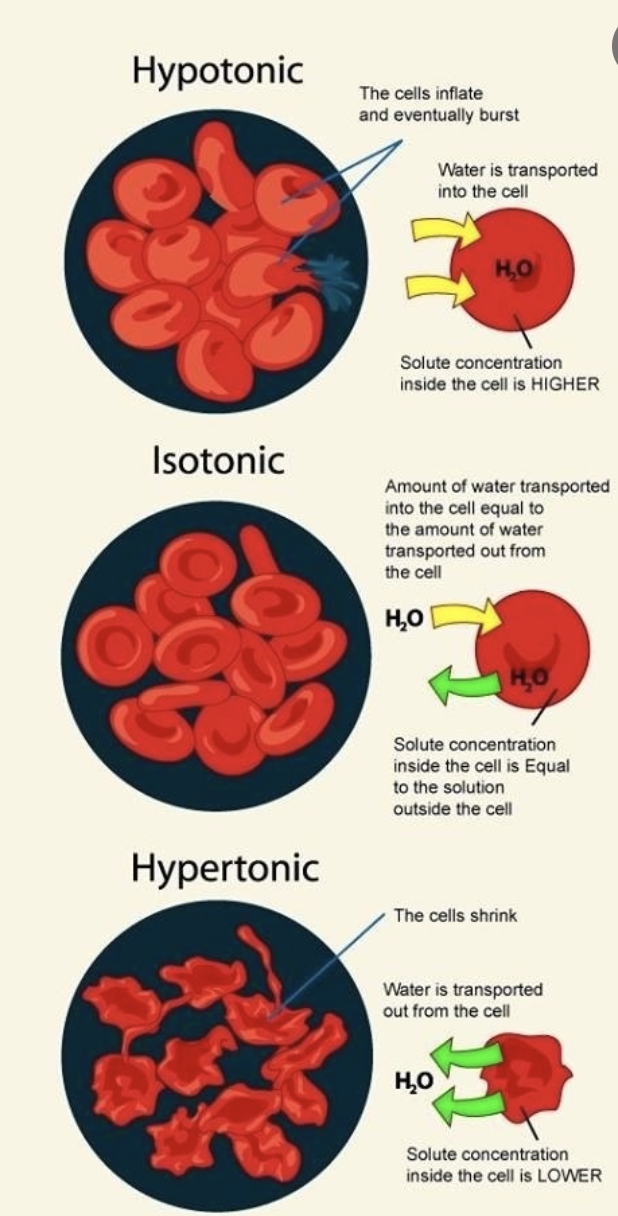
What does hypotonic (relative to extracellular) mean?
- fluid outside of the cell has a low osmolarity
- solute concentration in the cell is higher than fluid surrounding it
- cations/anions enter the cell to dilute and water follows
- cell expands and can rupture
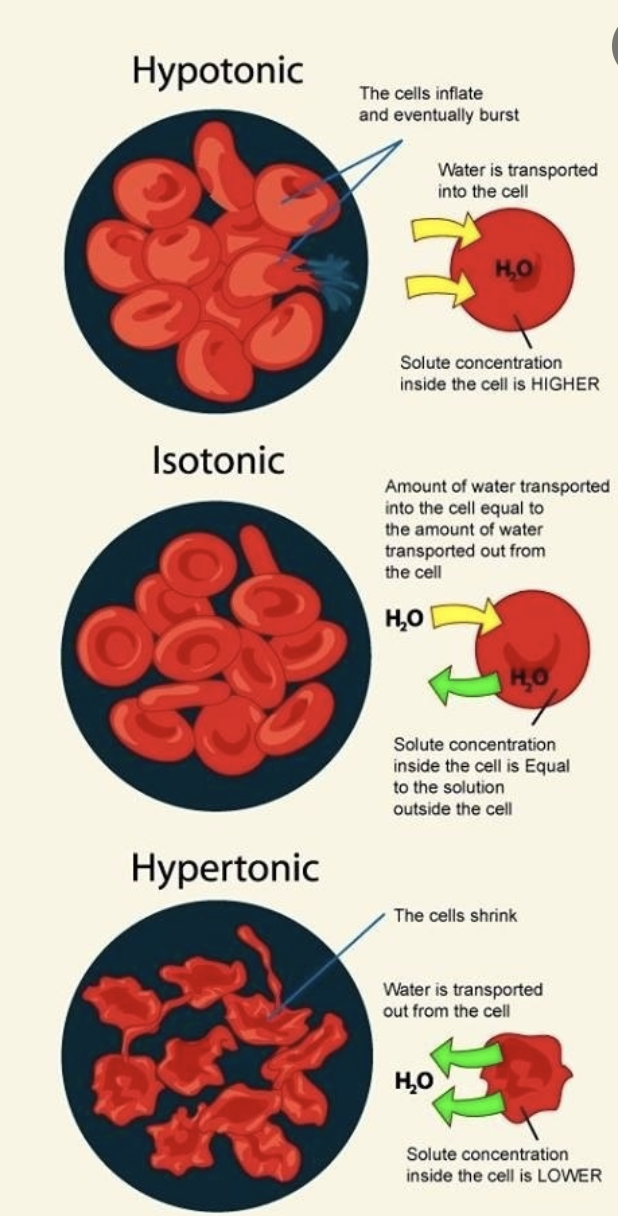
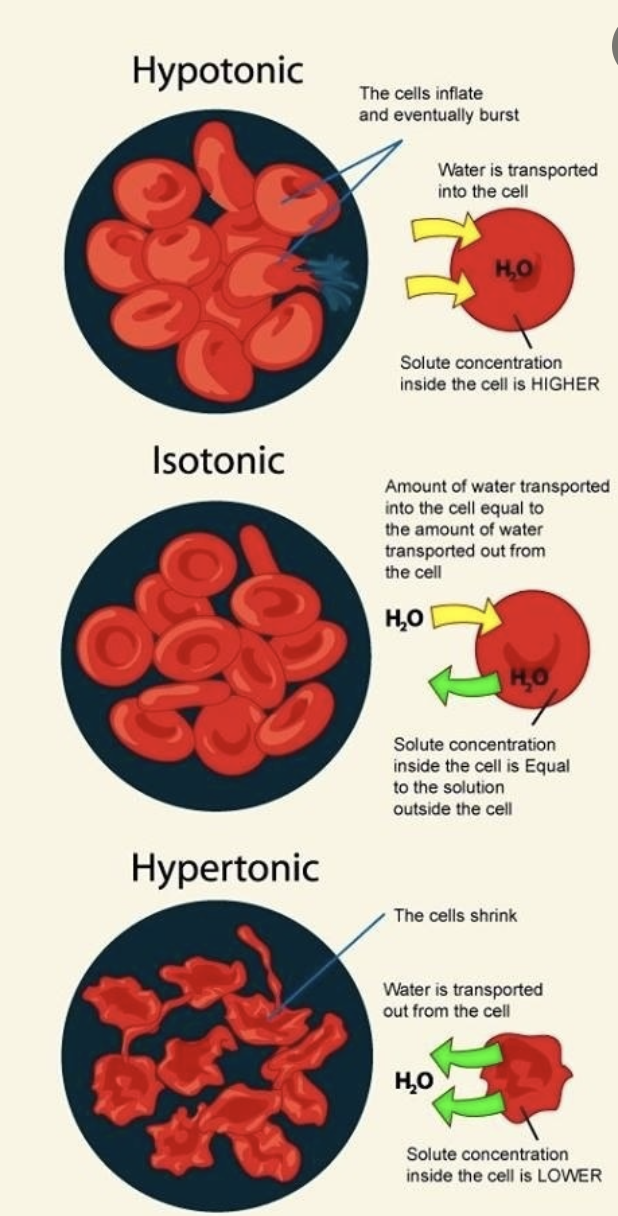
What does isotonic mean?
- solute concentration in the cell is equal to outside the cell
- cations/anions do not move
- cell remains stable
What is hypernatremia and hyponatremia?
- hypernatremia = high levels of Na+
- hyponatremia = low levels of Na+
Cells of the brain tend to operate at isotonic states. What will happen if there is a sudden decrease in Na+ concentration in the extracellular fluid in the brain?
- fluid will flow into the intracellular compartments of the brain to dilute Na+ concentration inside the cell
- cells in the brain will swell as water follows Na+
- causes cerebral oedema
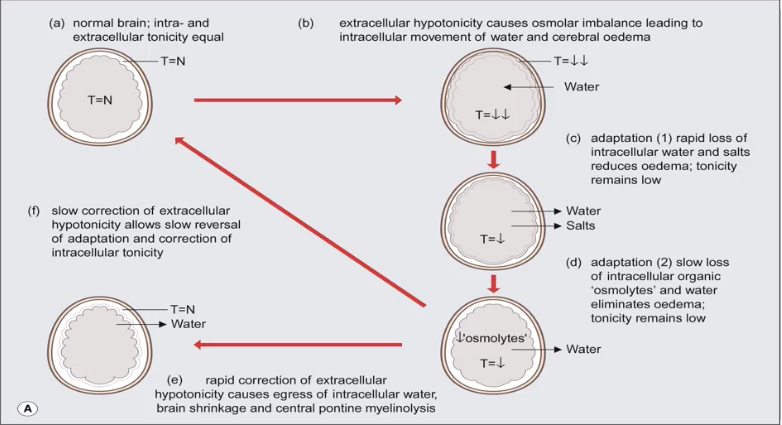
Cells of the brain tend to operate at isotonic states. If there is a sudden decrease in Na+ concentration in the extracellular fluid the fluid will flow into the intracellular compartments of the brain and the cells in the brain will swell, which will causes cerebral oedema. If the brain swells what can happen to the blood vessels of the brain?
- they become compressed
- blood flow will be decreased
- causes cerebral compression
Cells of the brain tend to operate at isotonic states. If there is a sudden decrease in Na+ concentration in the extracellular fluid the fluid will flow into the intracellular compartments of the brain and the cells in the brain will swell, which will causes cerebral oedema. If the brain swells the can compress blood vessels in the brain, blood flow will be decreased and this will cause cerebral compression. There is a safety system in place in the brain that can help to remove excessive CSF if there is too much fluid in the brain, what is this safety system?
- plug release
- pressure stop valve
- pressure compressor
- pressure stop valve
- CSF is removed through arachnoid granulations
- CSF then enters the venous system and out through internal jugular vein

If there is too much fluid in the brain, the pressure stop valve is able to remove CSF through arachnoid granulation, into the venous sinus and then out of the brain via the internal jugular vein. In addition to this what 2 other charged molecules can cells secrete in an attempt to increase the hypo-osmotic concentrations in the extracellular fluid?
- Na+ and K+
- K+ and amino acids
- Ca2+ and amino acids
- K+ and Cl-
- K+ and amino acids
- amino acids (AA) (glutamine, glutamate, taurine)
- pumping out K+ and AA reduces osmolality inside the cell
- reduces the risk of fluid flowing into the cells causing cerebral oedema
- THIS is a slow process by the body to maintain homeostasis
Cerebral oedema is when there is too much fluid in the brain, and is generally due to hyponatraemia (low Na+) in the extracellular space. This can cause cause fluid to flow into cells, which is dangerous in the brain as the brain can swell causing nerve death. What are a few of the most common symptoms patients may present with if they are hyponatraemic?
- nausea
- vomiting
- anorexia
- headaches
- lethargy
- disorientation
- muscle cramps
Cerebral oedema is when there is too much fluid in the brain. What are the most common signs that clinicians can see in patients?
- seizures
- coma
- hyporeflexia
- Cheyne-Stokes respiration (gradual increase, decrease, apnea then stop)
- respiratory depression
- hypothermia
What does central pontine myelinolysis, also referred to as osmotic demyelineation syndrome) mean if we break down the name?
- pontine = refers to pons of the brain stem
- myelin = refers to myelin that covers axons
- sis = indicates destruction
- so destruction of myelineated axons in the pons due to osmotic changes
The following can occur in patients who are hyponatremic (low Na+):
- low extracellular Na+ = fluid flows into the cells to maintain osmosis (dilute intracellular concentration), causing oedema.
- cells of the brain try to mediate this by secreting K+ and other osmolites (amino acids and glucose) to lower intracellular concentrations. This will stop water entering cells and maintain osmosis, but can take up to 48 hours.
- clinician may attempt to correct the Na+ imbalance too quickly and give the patient high Na+ fluids. The cells do not have sufficient time to correct the osmotic balance as Na+ cannot easily enter the cell and it takes time for K+ and osmolites to re-enter the cell.
- patient becomes hypertonic = high Na+ extracellularly, meaning water leaves the cell to dilute extracellular Na+ and maintain osmosis and the cells shrink
This can damage the cells and even cause cell death. What is this called if this occurs in the pons of the brain?
- Central Pontine Myelinolysis
- myasthenia gravis
- multiple sclerosis
- neural infarct
- Central Pontine Myelinolysis, also called osmotic demyelination syndrome

Central Pontine Myelinolysis, also called osmotic demyelination syndrome is damage to the myelineated axons located centrally in the pons. This can be very serious, given how important the pons are in communication between the spinal cord and the cerebral cortex. What can this lead to for the patient?
- quadriplegia (paralysis from the neck down)
- pseudobulbar palsy (inability to control muscles)
- seizures
- coma
- death
Cells of the brain tend to operate at isotonic states. What will happen if there is a sudden increase in Na+ concentration in the extracellular fluid in the brain?
- fluid will flow out of the extracellular compartments of the brain to equalise Na+ concentrations
- fluid will leave cells to reduce hypertonic Na+ extracellularly
- cells in the brain will shrink
- causes haemorrhage from veins and arteries and reduced cerebral blood flow
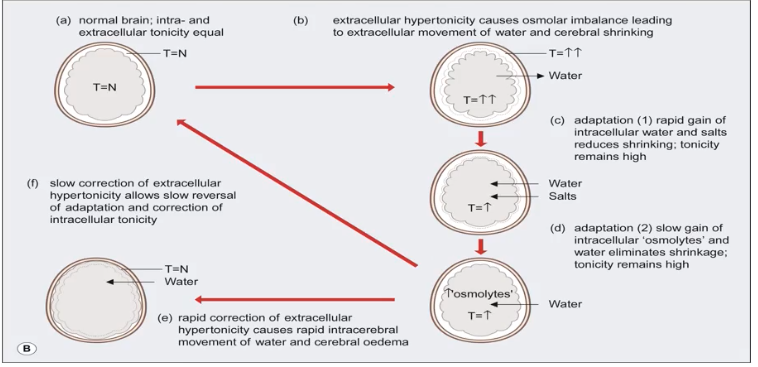
Cells of the brain tend to operate at isotonic states. If there is a sudden increase in Na+ concentration in the extracellular fluid in the brain, water will flow out of the cell to maintain osmosis. Thus can cause the cells to shrink causing haemorrhage in veins and arteries. What do the cells of the brain try to do in an attempt to compensate for this?
- cell increase K+ and amino acid uptake to achieve equilibrium with outside of the cell, so water will not leave the cell, causing the cells to shrink
- aim is to maintain osmosis with outside of the cell
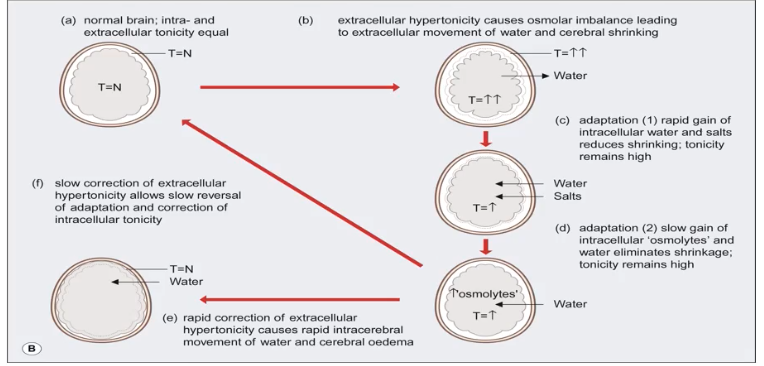
Cells of the brain tend to operate at isotonic states. If there is a sudden increase in Na+ concentration in the extracellular fluid in the brain water will flow out of the cell to maintain osmosis. Thus can cause the cells to shrink causing haemorrhage in veins and arteries. The cells of the brain try compensate for this by increasing K+ and amino acid uptake with the aim of maintaining osmosis with outside of the cell. However, if we overcorrect this with treatment what can happen?
- outside of the cell becomes hypotonic
- fluid rushes into cells to maintain equilibrium with outside of the cell causing cerebral oedema
What is the Henderson Hasselbach equation?
- pH is a relationship between an acid and a base ratio
- low pH = acidemia
- high pH = alkalosis
What gas is the main contributor to have cerebral blood flow is regulated?
- CO2
- O2
- H2
- CO2
- because it is able to cross the blood brain barrier
What is the relationship between arterial PCO2 and cerebral blood flow, keeping in mind that CO2 in the body is a powerful vasodilator.
- increase in arterial PCO2 = increase in cerebral blood flow
- decrease in arterial PCO2 = decrease in cerebral blood flow
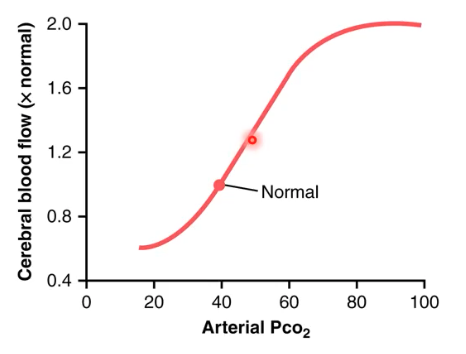
The relationship between arterial PCO2 and cerebral blood flow is as follows:
- increase in arterial PCO2 = increase in cerebral blood flow
- decrease in arterial PCO2 = decrease in cerebral blood flow
Therefore if we hyperventilate, which is an increase in breathing rate and/or volume we will expel more CO2, causing a reduction PCO2. This in turn will cause vasoconstriction in cerebral blood flow. What can this cause in patients?
- lightheadedness
- syncope (fainting)
- seizures
- cramps
- parasthesias (burning or prickling sensation, generally in hands)
- chvosteks sign (low Ca2+ causes muscle twitches in face upon tapping)
The relationship between arterial PCO2 and cerebral blood flow is as follows:
- increase in arterial PCO2 = increase in cerebral blood flow
- decrease in arterial PCO2 = decrease in cerebral blood flow
Therefore if we hyperventilate, increase in breathing rate and/or volume we will expel more CO2, causing a reduction in cerebral blood flow. This cause lightheadedness, syncope (fainting), seizures, cramps, parasthesias (burning or prickling sensation) and/or chvosteks sign (low Ca2+ that causes muscle twitch in the face with touched). What is a simple way to treat this?
- breathe into a paper bag
- CO2 is trapped and you will re-breathe in more CO2
- PCO2 levels increase and thus increase cerebral blood flow


-
Neural Tissue57
-
Physiology of Neurons21
-
Chemistry and Physiology of the Synapse28
-
Synaptic Transmission32
-
The Skull and Cranial Cavity62
-
Chemicals in the brain37
-
Chemicals in the brain part 248
-
Describing the brain79
-
CPCP2 Lectures65
-
Topography of the Brain87
-
Global Brain Activity45
-
Basic Principles of Memory33
-
Anatomy of Memory and Emotion56
-
The ventricular system and circulation of cerebrospinal fluid48
-
Synaptic Plasticity39
-
Plasticity and regeneration54
-
Face, Temporal, and Infratemporal Fossa65
-
Introduction to Neuropathology90
-
Cognitive impairment and confused states89
-
Introduction to demyelinating disorders69
-
Structure and Function of the Spinal Cord99
-
Physiology of the Spinal Cord63
-
Imaging the Brain & Spinal Cord24
-
ORAL CAVITY and NECK89
-
Autonomic Nervous System63
-
Analgesics and Sedative drugs67
-
Consciousness40
-
Physiology of Pain75
-
Anaesthetic Drugs31
-
The Psychiatric History and Mental state Examination31
-
Ear and Auditory Pathway65
-
The cerebellum and motor learning54
-
Physiology of chronic stress35
-
Parkinson’s disease and drug therapy of basal ganglia disorders56
-
Physiology of Balance, Taste and Smell78
-
Physiology of Hearing42
-
Personality, development & attachment39
-
Neuropsychology of memory42
-
Motor Learning and neurological Syndromes70
-
Neurobiology and neurochemistry of reward and addictive behaviours51
-
Physiology of sleep51
-
Epilepsy - aetiology and management54
-
Introduction to Stroke74
-
Clinical features of anxiety and stress-related disorders54
-
Anxiety disorders: Neurobiology, neurochemistry and treatment38
-
THE EYE AND THE VISUAL PATHWAYS67
-
Physiology of vision47
-
Neurobiology and clinical features of psychosis41
-
Treatment of psychosis and psychotic disorders53
-
Neurobiology and clinical features of affective (mood) disorders62
-
Treatment of affective disorders48
-
Applied Anatomy46
-
The Association Cortices and Complex Brain Functions41



