1
Q
- Electron Transport Chain
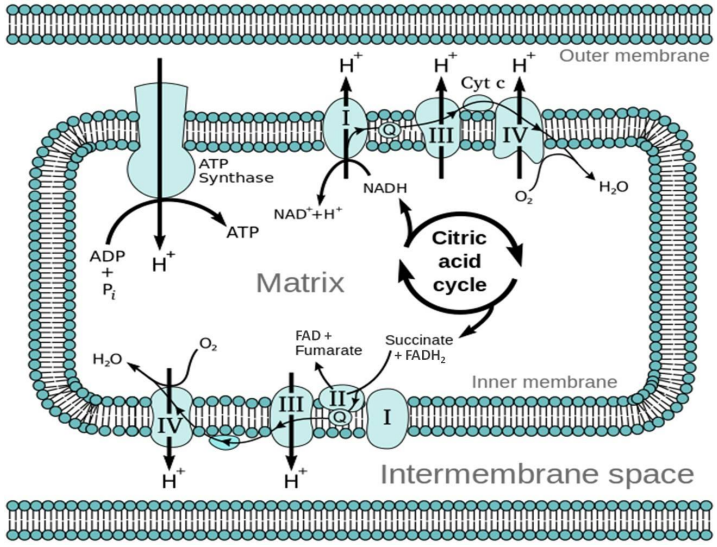
- Explain why the oxidation of FADH2 produces fewer ATP than the oxidation of NADH (2 as opposed to 3)
- What does ATP synthase require to function?
- How does the proton gradient affect the rate of ATP synthase?
A
- When NADH is oxidized, the electrons flow through:
- Complexes 1, 3, and 4
- Complex 1 pumps 4 electrons
- Complexes 1, 3, and 4
- When FADH2 is oxidized, the electrons flow through:
- Complexes 2, 3, and 4
- Complex 2 pumps 0 electrons
- Complexes 2, 3, and 4
- Because Complex I pumps 4 electrons and Complex II pumps 0 electrons…
- oxidation of FADH2 results in fewer protons being pumped.
- ATP synthase requires the proton gradient to function
- so fewer protons pumped will result in fewer ATPs generated.
1
Q
- Organism-Level Regulation of Metabolism
- Metabolic States
- Describe Well-Fed State
- a.k.a., “Postprandial”, “Absorptive”
- Describe Well-Fed State
- Metabolic States
A
- = First few hours after eating a meal
- High insulin levels; low glucagon levels
- High relative rate of anabolism (vs. catabolism)
- High rate of glycogen synthesis
- High rate of fatty acid synthesis
1
Q
- Pentose Phosphate Pathway (PPP)
- How many NADPH are produced per G6P molecule by the PPP?
- How many glutathione molecules are produced per G6P by the PPP?
A
NADPH:
For each G6P molecule:
- two NADPH molecules are generated
- Both come from G6P converting to Ribulose 5-phosphate
Glutathione:
- The PPP does not DIRECTLY generate glutathione molecules.
- However, the NADPH generated in the PPP can be used to:
- reduce the oxidized form of glutathione
- …to protect the cell from reactive oxygen species.
- reduce the oxidized form of glutathione
- However, the NADPH generated in the PPP can be used to:
- To regenerate glutathione, the reaction is:
- 1 glutathione disulfide + NADPH → 2 glutathione + NADP+
- This means that for each G6P, four glutathiones are generated
- because two NADPHs are generated
- This means that for each G6P, four glutathiones are generated
- 1 glutathione disulfide + NADPH → 2 glutathione + NADP+
2
Q
- Citric Acid Cycle
- All-in-all, how much of the following is produced?
- ATP
- NADH
- FADH2
- CO2
- How much total NADH and FADH2 have been produced at this point (including Glycolysis)?
- All-in-all, how much of the following is produced?
A
- CAC produces:
- 2 ATP
- 6 NADH
- 2 FADH2
- 4 CO2
- Total (CAC + Glycolysis):
- 10 NADH
- 2 FADH
2
Q
- Bioenergetics & Thermodynamics
- Noteworthy Differences between “Lab Thermodynamics” and Bioenergetics in Living Systems
- What must “Living Systems” maintain?
- Noteworthy Differences between “Lab Thermodynamics” and Bioenergetics in Living Systems
A
- Living systems must maintain a NON-equilibrium state!
- Many aspects of a living system require a large, negative ΔS due to all macromolecules and systems being highly ordered compared to their precursors.
- ΔG for many anabolic and metabolic biochemistry reactions is positive
2
Q
- Bioenergetics & Thermodynamics
- Noteworthy Differences between “Lab Thermodynamics” and Bioenergetics in Living Systems
- Three students are reviewing a chart in their biochemistry text showing that many of the individual steps of glycolysis have a positive ΔG°’ value.
- Discuss the accuracy and merits of their competing explanations for why glycolysis still occurs readily in living systems:
- Student A) Enzymes are the solution! Enzymes drastically lower the free energy change to be more negative.
- Student B) Food energy is the solution! Many biochemical reactions are unfavorable and that is why we must eat—to provide external energy to drive these reactions and maintain disequilibrium.
- Student C) Reaction coupling is the solution! While some reactions are unfavorable, they are coupled to reactions that are favorable.
- Noteworthy Differences between “Lab Thermodynamics” and Bioenergetics in Living Systems
A
- Several steps in glycolysis have positive ΔG’s, but the pathway still occurs spontaneously in cells.
- The first student hypothesizes that this is due to enzymes lowering the free energy of the equation.
- However, the ΔG listed for the steps of glycolysis take the enzymes into account, and so the enzymes themselves cannot account for the spontaneity of the overall pathway.
- Student B thinks that food energy is the solution, and that eating will give the energy needed to drive glycolysis.
- However, glycolysis is the process through which the body breaks down glucose, which is how the body gains energy from starchy food, so eating more wouldn’t drive the reaction forward.
- It would instead put more glucose into the system, requiring even more glycolysis action.
- Student C is correct, reaction coupling will drive the entire pathway forward.
- Some steps in glycolysis have positive ΔG’s, but other steps have very negative ΔG’s.
- Those steps require the products of previous steps.
- Because the reactions are linked by the product of one reaction providing the substrates of the following reactions, the very negative ΔG’s will pull the pathway forward, even though the positive ΔG’s are earlier in the pathway than the very negative ΔG’s
2
Q
- Carbohydrate Metabolism
- Give a general definition for “Carbohydrate Metabolism”
- Also, define “Respiration” in this context
A
- General Definition:
- The sum (Σ)of all chemical reactions in the body
- Respiration:
- “the breakdown of macromolecules into smaller species to harvest energy in the form of ATP”
3
Q
- Carbohydrate Metabolism
- Clarify the difference between aerobic and anaerobic respiration
- Which one do humans use? When would we use the other?
- What happens as a result of using the other?
- What does “Anaerobic respiration” typically refer to?
A
- Respiration is a process in which an inorganic compound serves as the ultimate electron acceptor
- …in order to generate ATP
- Aerobic respiration:
- uses oxygen as the final electron acceptor
- Anaerobic respiration:
- uses a molecule other than oxygen
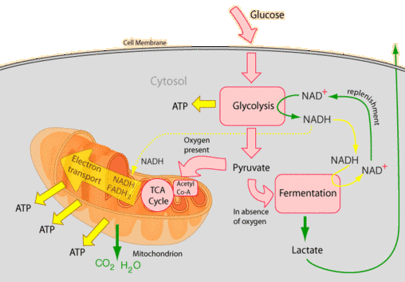
- For question purposes, aerobic respiration involves all the reactions involved in:
- the citric acid cycle (CAC)
- electron transport chain (ETC)
- Humans use aerobic respiration to generate the vast majority of our ATP
However, we use anaerobic respiration in our muscles during exercise- which results in a buildup of lactic acid
- Anaerobic respiration will typically refer to fermentation:
- using glycolysis in the absence of oxygen
- or the lactic acid cycle in muscles
- Many bacteria and yeast use anaerobic respiration, including during fermentation
4
Q
- Lipid Metabolism
- Ketone Bodies
- Describe
- Ketone Bodies
A
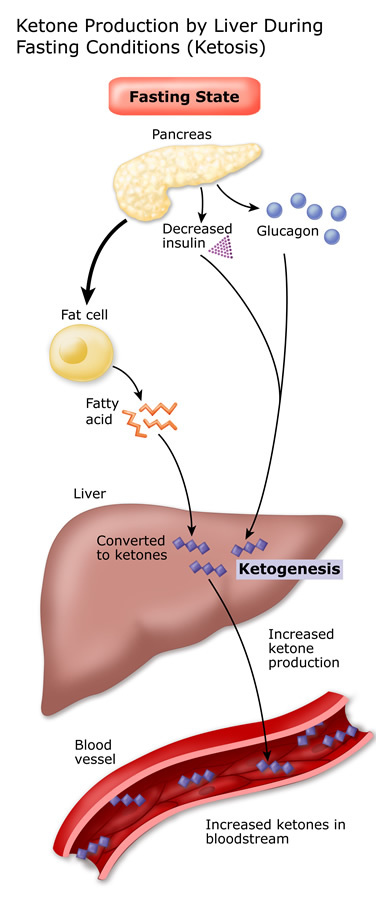
- Formed by the liver
- during prolonged fasting periods
- as byproducts of increased fatty acid metabolism
- Two of the three can be used for energy during fasting periods by the heart and brain.
- Ketone bodies CANNOT be used by the liver during fasting
- because it lacks β-ketoacyl-CoA transferase
4
Q
- Organism-Level Regulation of Metabolism
- Metabolic States
- Name the 3 kinds of Metabolic States
- Metabolic States
A
- Well-Fed State
- a.k.a., “Postprandial”, “Absorptive”
- Fasting State
- a.k.a., “Postabsorptive”
- Starvation
4
Q
Feeder Pathways for GLY
- FRUCTOSE Metabolism In the LIVER
- Fructose⇒___⇒___+____⇒___
- Describe the 3 sequential rxns
- Fructose⇒___⇒___+____⇒___
What step of Glycolysis does this funnel into?
A
LIVER:
- Fructokinase converts:
- Fructose⇒Fructose-1P
- Fructose-1-P ALDOLASE converts:
- Fructose-1P ⇒Glyceraldehyde 3-Phosphate (GAP) + DHAP
- Triose Phosphate Isomerase converts:
- DHAP⇒ GAP
⇒5th step GLY
(Will get converted to 1,3 Bisphosphoglycerate by GAPDH)
5
Q
- Biochemical Shuttles
- Citrate-Acetyl-CoA Shuttle (Tricarboxylate Transport System, TTS)
- What is the Problem & Solution?
- During what periods is this shuttle needed?
- Citrate-Acetyl-CoA Shuttle (Tricarboxylate Transport System, TTS)
A
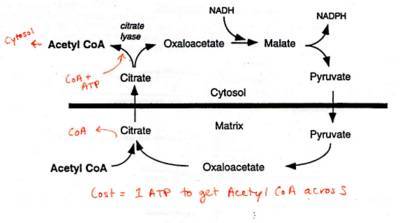
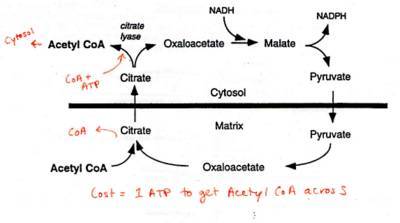
- PROBLEM:
- During periods of energy abundance, Acetyl-CoA groups in the mitochondria are redirected from the CAC to fatty acid synthesis
- However, fatty acid synthesis occurs in the cytosol and Acetyl-CoA cannot pass through the inner mitochondrial membrane
- SOLUTION:
- Acetyl-CoA is combined with OAA to form citrate
- (this is the normal 1st step of CAC)
- Citrate IS able to pass through the membrane
- and is then converted back to OAA and Acetyl-CoA in the cytosol.
- Acetyl-CoA is combined with OAA to form citrate
5
Q
- Principles of Bioenergetics
- ΔG=?
- What does each part represent?
- Here, how should you think of ΔG and ΔG°’?
- ΔG=?
A
- ΔG = ΔG°’ + RTlnQ
- R =Universal Gas Law constant
- T=temperature
- Q=reaction quotient
- Think of ΔG°’ as:
- the fixed, unchangeable value
- ΔG°’ is fixed and predetermined for a given reaction at a given temperature
- It ONLY represents the reaction under all of those strictly standardized criteria
- the fixed, unchangeable value
- Think of ΔG as:
- the variable one
- ΔG can be measured anywhere, at any time during a reaction
- Pause the reaction at any precise moment of your choosing, subtract the sum of the free energy of the reactants present at that moment from the sum of the free energy of the products present at that moment
- The resulting value will be ΔG
- the variable one
6
Q
Lipid Metabolism
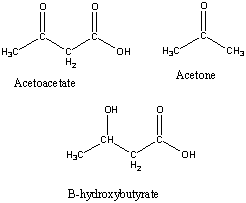
- Name the 3 types of KETONE BODIES
- which DO have energy value, which DONT?
A
- Acetone
- NO energy value
- Acetoacetate
- HAS energy value
- 3-Hydroxybutyrate
- HAS energy value
6
Q
- Organism-Level Regulation of Metabolism
- What does the Brain, Adipose Tissue, and Erythrocytes (RBC’s) use for fuel during well-fed states and during fasting states?
A
- Brain
- Glucose during well-fed state
- Glucose if fasting
- Ketones if prolonged fast or starvation
- Adipose Tissue
- Glucose in well-fed state
- Fatty acids during fasting
- Red Blood Cells
- Glucose in ALL states
- ALWAYS via ANAEROBIC glycolysis!!!
- aka FERMENTATION
- Glucose in ALL states
7
Q
- Regulation of Carbohydrate Metabolism
- Hormonal Control
- Pentose Phosphate Pathway
- Identify all molecules that:
- upregulate the process
- downregulate the process
- Specify the exact enzyme or step with which the regulatory molecule interacts.
- Pentose Phosphate Pathway
- Hormonal Control
A
- The pentose phosphate pathway is primarily controlled by the levels of NADP+ .
- The first enzyme, glucose 6-phosphate dehydrogenase (G6PDH), is inhibited by:
- NADP+
- because NADP+ is needed as the electron acceptor for the reaction.
- NADP+
7
Q
- Lipid Metabolism
- β-Oxidation
- Location=? (except for?)
- What are the Problem & Solution?
- β-Oxidation
A
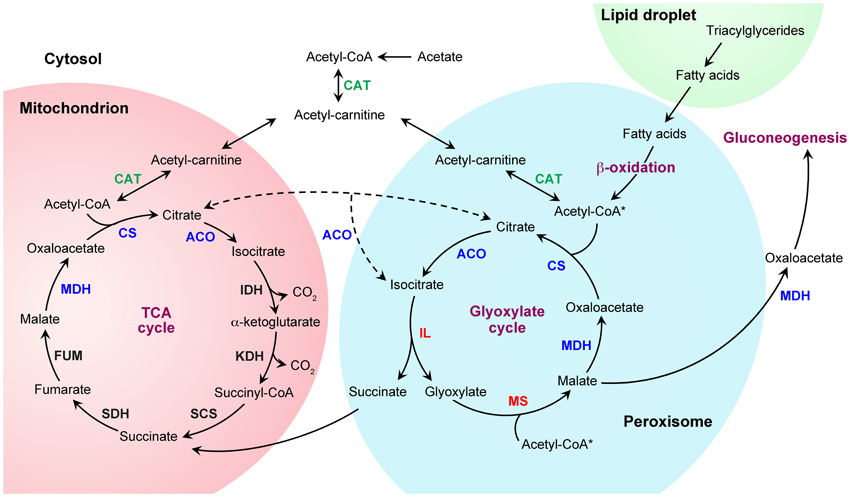
- Location
- Mitochondrial matrix
- Exception:
- Extra-long-chain fatty acids first enter a peroxisome and are catabolized into smaller pieces
- These pieces can then be oxidized in the mitochondria
- Extra-long-chain fatty acids first enter a peroxisome and are catabolized into smaller pieces
- PROBLEM:
- Activated fatty acids cannot cross the inner mitochondrial membrane to reach the matrix
- SOLUTION:
- Carnitine Shuttle (Carnitine-acylcarnitine translocase)
7
Q
- Adenosine Triphosphate (ATP)
- Consumption of ATP
- Name the 3 ways ATP is consumed (that we need to know for MCAT)
- Consumption of ATP
A
- Hydrolysis
- Phosphoryl Group Transfers
- Phosphorylation using ATP
8
Q
- Bioenergetics & Thermodynamics
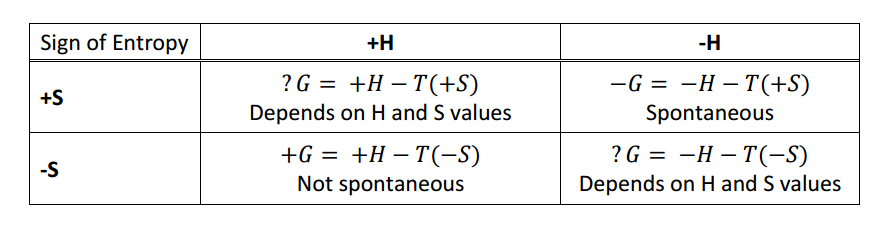
- Describe the “Fundamental Thermodynamic Relation” that correlates enthalpy, entropy and Gibbs free energy.
- Draw a four quadrant chart showing all possible combinations for the signs of ΔS and ΔH for a reaction.
- For each scenario predict the sign of ΔG and whether or not the reaction will be spontaneous
A
- The fundamental thermodynamic=
- ΔG=ΔH-TΔS
- Spontaneous if…
- ΔG is less than 0
- Non-spontaneous if…
- ΔG is greater than 0
- At equilibrium if…
- ΔG is = 0
- A reaction is favorable if…
- ΔH is negative and/or ΔS is positive.
- When ΔH is negative and ΔS is positive, the reaction will be spontaneous
- When ΔH is positive and ΔS is negative, the reaction will not be spontaneous
- ΔH is negative and/or ΔS is positive.
- In any other situation, the result will depend on the values of H and S
9
Q
- Lipid Metabolism
- β-Oxidation of fatty acids
- In β-Oxidation, where on the FA are double bonds created?
- What happens if you come across a double bond that isnt in that position?
- What enzyme do you need to fix it?
- β-Oxidation of fatty acids
A
- Normal β-oxidation includes the creation of a double bond in the 2-3 position
- As successive rounds of oxidation occur, if a double bond ends up in this position, things may proceed as normal
- If double bond is in another position (like 3-4), β-oxidation cannot occur
- Enoyl-CoA isomerase catalyzes the movement of double bonds to the 2-3 position
- Oxidation can again proceed
- Enoyl-CoA isomerase catalyzes the movement of double bonds to the 2-3 position
10
Q
Lipid Metabolism
- What are some potentially confusing LOCATION ISSUES wrt lipid metabolism and FA synthesis?
A
LIPIDS
- metabolized for energy in
- the mitochondria
- synthesized
- in the cytosol
- (mostly hepatocytes)
- in the cytosol
- modified
- at the SER
FATTY ACID SYNTHESIS
- occurs in the cytosol
- stops at the 16-carbon palmitic acid
- technically, it ends by forming palmitoyl-CoA
- stops at the 16-carbon palmitic acid
- Elongation and modification (e.g., desaturation)
- occur at the Smooth ER
10
Q
- Carbohydrate Metabolism
- What is the difference between an obligate aerobe and a facultative aerobe?
- Between an obligate and a facultative ANAEROBE?
- Which one are you?
A
- “Obligate”
- implies that there is no other option, so obligate aerobes must use aerobic respiration and cannot survive without oxygen, while obligate anaerobes must use anaerobic respiration and cannot survive in the presence of oxygen.
- “Facultative”
- implies that the organism will use WHICHEVER RESPIRATION IS AVAILABLE
- So if oxygen is present, the organism will use aerobic respiration, and if oxygen is absent, the organism will use anaerobic respiration.
- Facultative anaerobes prefer anaerobic respiration but will use aerobic if needed.
- Facultative aerobes prefer aerobic respiration but will use anaerobic if needed
- ∴ HUMANS ARE “FACULTATIVE AEROBES”
11
Q
- Bioenergetics & Thermodynamics
- Define “Bioenergetics”
- What is it analogous to?
A
- Bioenergetics
- The thermodynamics of biological systems
- is analogous to biochemistry being the “chemistry” of biological systems
12
Q
- Adenosine Triphosphate (ATP)
- Formation of ATP
- Substrate-Level Phosphorylation
- Define. What must be coupled to this process in order to proceed?
- LOCATION this happens?
- Give an EXAMPLE of this
- Substrate-Level Phosphorylation
- Formation of ATP
A
- Substrate-Level Phosphorylation
- Formation of ATP from ADP in which the source of the necessary phosphate is a phosphate bound to another molecule (i.e., the “substrate”)
- To proceed, this process MUST be coupled to an EXERgonic reaction
- LOCATION:
- Primarily in the cytosol
- as part of glycolysis
- Also in the matrix of the mitochondria
- where GTP is formed during the CAC
- Primarily in the cytosol
- EXAMPLE:
- The ATP formed during glycolysis is an example of substrate-level phosphorylation
12
* Glycolysis
* Enzyme mnemonic=?
* Hot
* Hexokinase
* Pussy
* Phosphoglucose isomerase
* Practically
* PFK-1
* Always
* Aldolase
* Takes
* Triose Phosphate Isomerase
* Great
* G3P Dehydrogenase (G3PDH)
* Patience
* Phosphoglycerate Kinase
* Preparing
* Phosphoglycerate Mutase
* Eventual
* Enolase
* Penetration
* Pyruvate Kinase
12
* Anabolism of Fats & Carbohydrates
* Describe Non-Template Synthesis
* Why is the moniker "Non-Template" used to describe it?
* **_Non-Template Synthesis:_**
* Biosynthesis of lipids and polysaccharides (carbohydrates)
* The moniker “non-template” is used because *the synthesis of fats and carbohydrates does not follow a template*
* ...as do **protein** and **nucleic acid** synthesis
13
* Regulation of Carbohydrate Metabolism
* Hormonal Control
* ***GLUCONEOGENESIS:***
* identify all molecules that:
* upregulate the process
* downregulate the given process.
* Specify the exact enzyme or step with which the regulatory molecule interacts
* Gluconeogenesis is needed when energy levels are high and glucose levels are low
* the **opposite** of when glycolysis is needed.
* As such, the enzymes are regulated oppositely to those in glycolysis such that when one pathway is activated, the other is being actively inhibited, and vice versa.
* _Fructose 1,6-bisphosphatase_
* inhibited by AMP
* stimulated by ATP
* exactly **opposite** of its glycolysis counterpart
* phosphofructokinase.
* Both:
* pyruvate carboxylase and
* phosphoenolpyruvate
* are inhibited by **ADP**
* These enzymes are the **counterpart to pyruvate kinase** in glycolysis
14
* Principles of Bioenergetics
* Describe the difference between ΔG, ΔG°, and ΔG°'
* What should you remember about the last two?
It is important to remember that ***_a reaction is almost never going to be in these conditions!!!_***
* ΔG
* Free energy change at some present, non-standard set of conditions.
* ΔG°
* Free energy change at ***standard conditions:***
* 25°C
* 1 atm
* [1M] of ***all*** species
* ΔG°’
* Free energy change at standard physiological conditions, ***pH = 7***
* For the MCAT, think of ΔG° and ΔG°’ as essentially the **same thing**
* They both represent a standard state “from-the-textbook-table” value for Gibbs free energy calculated at a point where we have the exact same concentrations of all species, both products and reactants (i.e., Q = 1).
* Just remember that the prime (’) symbol means it is ***at physiological pH,*** too
15
Differences between “**LAB** Thermodynamics” and Bioenergetics in **LIVING** Systems
* Describe the **Dynamic Steady State (aka...?)**
* Give a real-life example of it
**The Dynamic Steady State**
(a. k.a., Homeostasis)
* Describes the **ability** of living things to **maintain a constant, steady internal environment** that is **NOT** in equilibrium with its *surroundings*.
**_EXAMPLE: BODY TEMP_**
* For example, your body temperature remains a fairly constant 98.6°F, and yet the room you are in right now is probably about 75°F.
* Further, the environment around you is in _constant decay_—moving organized, complex, high-energy states toward disorganized, simpler, low-energy states.
15
* Standard Free Energy Change (ΔG°’) and the Equilibrium Constant (Keq)
* Spontaneous Reactions or Processes
* Differentiate b/t ***ENDERgonic*** & ***EXERgonic***
* Endergonic
* ΔG is **positive** = **nonspontaneous**
* Exergonic
* ΔG is **negative** = **spontaneous**
15
**Pentose Phosphate Pathway (PPP)**
Describe the ***Oxidative*** Phase
* \_\_--\>\_\_--\>\_\_--\>\_\_?
* Since the first **2 steps** are **UN**favorable, what EXERgonic reaction are they coupled to?
* What do NAD**P**H and R5P each do in this phase?
_OXIDATIVE PHASE:_
***Glucose-6-P ⇒***
***6-Phosphogluconate ⇒***
***Rib**_ulose_**-5-P ⇒***
***Ribose-5-P***
_The *first two steps* outlined above are both coupled to:_
* the conversion of NADP+ to NAD**P**H
_**NADPH** is used to:_
1. **REDUCE** glutathione disulfide (GSSH) to glutathione (2GSH)
2. Act as a **COFACTOR** for reductive biosynthesis
**_R5P_**
* is funneled into **NT synthesis**
16
* Citric Acid Cycle
* Diagram
* Include:
* species that enter and exit the cycle
* including where they originated from and where they will go next
* the starting substrate and final product of each step,
* when and where **CO2** is produced
* changes to the carbon skeleton
* any points in the cycle where **NAD+ , NADH, FAD, FADH2, ADP, GDP, ATP or GTP** are either **required** or **produced**.

16
Glycolysis
## Footnote
**Aldolase** catalyzes the breakdown of **Fructose 1,6-bisphosphate (F1,6BP)** into:
* one molecule of glyceraldehyde-3-phosphate **(G3P)**
* one molecule of dihydroxyacetone-phosphate **(DHAP)**
*If the **2’ carbon** of **F1,6BP** is radioactively labeled, aldolase is allowed to turnover a large number of molecules, and isomerase activity is **blocked**, how will the radio label be **distributed**?*
* a) **equally** between F1,6BP and DHAP molecules
* b) only on F1,6BP molecules
* c) only on DHAP molecules
* All the radiolabeled molecules ***will be dihydroxyacetone phosphate (DHAP)***
* This is because when fructose 1,6-bisphosphate is cleaved, it is cleaved **the same way** every time
* Carbons **1**, **2**, and **3** become:
* dihydroxyacetone phosphate (DHAP)
* Carbons **4**, **5**, and **6** become:
* Glyceraldehyde 3- phosphate (G3P)
* ∴ if carbon **2** is labeled, the labeled molecule will always be DHAP
* If the isomerase is active, some of the DHAP will be converted to GAP, so the label will be distributed between the two
* But **without the isomerase**, all labeled molecules will be DHAP

17
* Electron Transport Chain
* Using the NADH and FADH2 equivalents given,demonstrate for the ***complete oxidation of one glucose molecule:***
* ******where *each* high energy molecule is **created**
* how they add up to ***_36 ATP per glucose_***
* HINT: Two common errors are
1. not considering the “net” ATP from glycolysis
2. ignoring the ATP required for the transport of NADH into the mitochondria
* The overall reaction for ***GLYCOLYSIS*** is
* **glucose** + 2 NAD+ + 2Pi + 2 ADP⇒2 **pyruvate** + 2ATP + 2NADH + 2H+
* The overall reaction for the ***CITRIC ACID CYCLE*** (including ***PDC***) is:
* **pyruvate** + 4 NAD+ + FAD + GDP + Pi + 2 H20 ⇒3 CO2 + 4NADH + 4H+ + GTP + FADH2
* Keep in mind that you’ll need to ***DOUBLE*** the citric acid cycle equation
* because glycolysis results in ***TWO (!)*** pyruvates
* This means that from complete oxidation of one glucose, we get:
* (see attached)
* NADH = 3 ATP
* FADH2 = 2 ATP
* NADH from glycolysis = 2 ATP
* (because it costs 1 ATP to transport it in)
* Total, we have (2 x 2) + (8 x 3) + (2 x 2) + 4 = 36 ATPs

17
* Organism-Level Regulation of Metabolism
* Tissue-Specific Metabolism
* Different tissues use different ____ \_\_\_\_ preferentially
* What does the **Liver** prefer during well-fed & fasting states?
* Different tissues use different fuel sources preferentially
* in the Liver:
* Glucose in well-fed state
* Fatty acids during fasting
* but **NO** ketones (lacks enzyme)
19
* Biochemical shuttles
* What are the 4 shuttles we need to know for the MCAT?
1. Malate-Aspartate Shuttle
2. Glycerol-3-Phosphate Shuttle
3. Carnitite Shuttle
4. Citrate-Acetyl-CoA Shuttle
* aka Tricarboxylate Transport System, "TTS"
20
* Lipid Metabolism
* β-Oxidation
* Draw a mechanism for the beta-oxidation of a fatty acid
* Indicate the point at which FADH2 and NADH are produced

20
* Lipid Metabolism
* β-Oxidation of fatty acids
* What happens in β-Oxidation when you have a *conjugated* double bond?
* What enzymes (2) are needed to continue β-Oxidation?

* β-Oxidation *cannot proceed* through conjugated DB's
* Needs 2 enzymes:
1. **2-4 dienoyl-CoA *_reductase_***
* converts 2 DB's to 1 DB
2. **Enoyl-CoA *_isomerase_***
* to move the DB's to the 2-3 position

22
* Regulation of Carbohydrate Metabolism
* Hormonal Control
* Catecholamines (3)
* Describe the 3 types and what they do wrt metabolism
* Catecholamines are derived from tyrosine and have an amine side group
* 3 Types:
* ***_Dopamine, Epinephrine, and Norepinephrine_***
* Dopamine
* is a CNS neurotransmitter
* Epinephrine (Adrenaline) and Norepinephrine (Noradrenaline)
* are the two metabolic hormones
* Catecholamines also have a “glucagon-like” effect (like Cortisol)
* ...but should be thought of as **causing a more rapid “mobilization” of energy stores**
* ****which are necessary for the “fight or flight” response
* Fatty acids are mobilized for oxidation and *glycogenolysis is **increased***
24
* Regulation of Carbohydrate Metabolism
* Hormonal Control
* ***GLYCOGENESIS***
* ******identify all molecules that:
* upregulate the process
* downregulate the process
* Specify the exact enzyme or step with which the regulatory molecule interacts
* Glycogenesis, the synethesis of glygogen, is regulated **oppositely** to glycogenolysis.
* When glucagon and epinephrine are present in the bloodstream
* ...the **cAMP cascade is stimulated**
* Protein kinase A phosphorylates glycogen synthase
* this phosphorylation **inhibits** the enzyme (instead of activating, as it does with glycogen phosphorylase)
* When the cAMP cascade is withdrawn, protein phosphorylase I will **dephosphorylate glycogen synthase**
* stimulating glycogen synthesis
* This way, the same stimulus will simultaneously **shut down** one pathway and **turn on** the other
25
* Regulation of Carbohydrate Metabolism
* Allosteric Control
* Describe an Allosteric Enzyme
* ALLOSTERIC ENZYMES
* Enzymes that **change conformation and/or affinity** for their substrate *upon binding of an allosteric regulator* molecule

26
Obesity and Regulation of Body Mass
* What 3 things go into "**Body Mass Regulation**?"
* What 3 hormones are involved in obesity?
* Threshold for weight ***GAIN*** is ____ than for weight ***LOSS***
* Healthy individuals burn ___ first, then \_\_\_, then \_\_\_
**_Body Mass Regulation_** is a combination of:
1. Hormones
2. Food intake
3. Activity level
**_Hormones_**:
1. Leptin
2. Ghrelin
3. Orexin
* Threshold for weight gain is **LOWER***
* than for weight loss*
_Healthy individuals burn:_
1. *Carbohydrates* first
2. then *fats*
3. then *proteins*
27
* Gluconeogenesis
* Redraw a simplified glycolysis chart and demonstrate the alternative pathways used to accomplish gluconeogenesis
* Identify any enzymes that are **_NOT_ part of glycolysis**

29
For ***GLYCOLYSIS***, identify :
* All molecules that **INHIBIT**
* Specify the **exact enzyme or step** with which the regulatory molecule interacts
*Hint: There are 3 regulated enzymes in glycolysis*
***GLYCOLYSIS***
* three (3) reactions are regulated.
* Keep in mind that glycolysis is needed **when energy in the cell is low**
* so regulation will be such that enzymes are *activated* by a **lack of** energy and *inhibited* when energy is **abundant**
**1) PFK-1**
_*INHIBITED BY:* *ATP*_
* AMP **reverses** the inhibition of ATP
* Thus, the **ratio of ATP to AMP is crucial** to determining the activity of glycolysis*
**2) Hexokinase**
_*INHIBITED BY: **G6P** (ITS PRODUCT)*_
* Because glucose and glycogen are both converted to **G6P**
* ****When this molecule is at high concentration, **hexokinase is inhibited,** because the cell has plenty of access to energy
* Glucose will stay at **higher** concentrations in the blood or
* Be converted to **glycogen** for storage
**3) Pyruvate Kinase**
*_INHIBITED BY: ATP, ALANINE_*
* Alanine also inhibits pyruvate kinase
* because **pyruvate** is used as a building block for **AAs**
*a high concentration of alanine signals that **building blocks aren’t needed***
30
* Fermentation (*Anaerobic* Glycolysis)
* Why is fermentation important in *bacteria*?
* When is the only time fermentation is used by animals?
* What kind of cell also uses fermentation?
* For most bacteria, this is the ***sole route*** of metabolizing glucose
* Fermentation is used by animals only during:
* **oxygen debt** (aka periods of *prolonged exercise*)
* Also used by:
* **erythrocytes**
31
Regulation of Carb Metabolism
* Hormonal Control
Describe **"****Glucocorticoids"**
* What kind of effect do they have on **metabolism**?
* What 3 things do they **stimulate?**
* Glucocorticoids also **reduce** \_\_\_\_\_\_\_\_\_
* Most significant **example** of a glucocorticoid is \_\_\_\_\_\_
Glucocorticoids have a “**GLUCAGON-LIKE**”
effect on metabolism
* Stimulating:
1. Gluconeogenesis
2. Glycogenolysis
3. Fatty acid oxidation
* Glucocorticoids also reduce inflammation
***Cortisol*** _is the most significant example_
* Recall that cortisol is produced by the adrenal cortex
* **in response to ACTH** from the anterior pituitary
*
31
Formation of ATP
* Describe **OXIDATIVE** Phosphorylation
* In what LOCATION does this happen in?
* Give an EXAMPLE of this
***_Oxidative Phosphorylation_***
* Formation of ATP out of ADP and Free Organic Phosphate (Pi) by harnessing the energy of the **proton gradient** across the inner mitochondrial membrane.
This proton gradient is created as a result of coupling:
1. the **oxidation of high-energy molecules**
* such as NADH and FADH2
2. ...to the **pumping of protons**
* out of the complexes in the ETC
LOCATION:
* ***EXCLUSIVELY*** in the **MITOCHONDRIAL MATRIX**
EXAMPLE:
* The ATP formed by **ATP Synthase** in the mitochondria

32
* Protein Metabolism
* Transamination
* Describe
* Give an example
* What role does transamination play in Protein Metabolism?
* A key step in protein metabolism for energy is transamination of amino acids--
* or the **exchange of an amine group** on one molecule **for a carbonyl group** on another.
* For example, transamination of **Glu** forms **alpha-ketoglutarate**
* **...**which is an intermediate in the Citric Acid Cycle
* Transamination is what helps AA's that are unable to be broken down into pyruvate or acetyl-CoA ***GET INTO THE CITRIC ACID CYCLE***

33
* Protein Metabolism
* Differentiate between ketogenic and glucogenic amino acids.
* Which amino acids are **exclusively** ketogenic?
* Which are ***both*** ketogenic and glucogenic?
* A ketogenic amino acid is degraded into:
* acetyl CoA or
* acetoacetyl CoA (ketone bodies)
* ...through *ketogenesis*
* The **carbons** of ketogenic amino acids are ultimately **converted to CO2** in the citric acid cycle
* because acetyl CoA carbons are converted to CO2
* ***_Leucine and lysine are both ketogenic_***
* Glucogenic amino acids ***can be converted to glucose***
* ...through *gluconeogenesis*
* They are converted:
* first to **alpha keto acids**
* and then to **glucose** in the liver.
* Some amino acids are **both** ketogenic **_and_** glucogenic:
1. isoleucine
2. phenylalanine
3. tryptophan
4. tyrosine
5. threonine
* If you can remember those 5 and the 2 that are ketogenic, ***all the rest are glucogenic***
35
* Regulation of Carb Metabolism
* Allosteric Control
* What role does the eventual target molecule have with regards upstream events?
* What allosteric effect does ATP have on PFK-1?
* What about AMP & ADP?
* The eventual target molecule, or logical goal of the process, is often a **major inhibitor** that downregulates upstream production.
* For example,
* **ATP** acts as an allosteric *inhibitor* of **Phosphofructokinase-1 (PFK-1)**
* the enzyme for the rate-limiting step of glycolysis.
* That makes perfect logical sense!
* When ATP levels are high the process will be downregulated.
* Meanwhile, **AMP** and **ADP** are allosteric *activators* of **PFK-1**
36
* Gluconeogenesis
* Describe
* Where does it occur?
* When you see "*Gluconeogenesis*,"***THINK???***
* **_Gluconeogenesis:_**
* Conceptualized as the **reversal of glycolysis** to produce:
* **glucose** from **pyruvate**
* However, **three** glycolytic enzymes are substituted for **four** unique enzymes specific to gluconeogenesis
* **_When you see gluconeogenesis, THINK:_**
* **__**Gluconeogenesis = LIVER, fasting, and the need to increase blood sugar
37
When you see:
* NADH/NAD+
* NADPH/NADP+ (in PPP)
* FADH2/FAD
* FMNH2/FMN
* semiquinone (an FMNH\* radical)
* ubiquinone ( aka "coenzyme Q/Q complex" in ETC)
* cytochrome (also in ETC)
***_THINK:_*** _______ ***_RXNS_***
***REDOX REACTIONS***
## Footnote
* These are *_soluble electron carriers_*
* As they pass from one form to the other there is **ALWAYS electron transfer**
* and ∴ oxidation-reduction
39
* Biochemical Shuttles
* Carnitine Shuttle
* What is the Problem & Solution?
* ***PROBLEM***:
* Fatty acids cannot pass through the inner mitochondrial membrane
* which is where they need to be in order to go through β-oxidation.
* ***SOLUTION***:
* The enzyme *Carnitine acyltransferase* **attaches the fatty acyl group** from an *acyl-CoA* to the **OH- group** of carnitine.
* A **translocase enzyme** on the inner mitochondrial membrane moves one acyl-carnitine **into** the matrix and one carnitine back **out**

40
* Fermentation (*Anaerobic* Glycolysis)
* What makes fermentation ***IMPORTANT??***
Fermentation is IMPORTANT because it:
***REGENERATES NAD+***
*_so that glycolysis can continue!_*
* NAD+ regeneration is necessary for both:
* human fermentation **during oxygen debt**
* and yeast/bacterial fermentation
42
* ATP Synthase
* The translocation of a proton through the F0 moiety of ATP synthase is associated with a ***very large negative ΔG***
* Suppose a localized change in temperature ***decreased*** the free energy released by this reaction.
* What would be the likely effects on:
* a) ATP production
* b) ETC function
* c) the strength of the electrochemical gradient
* d) the Citric Acid Cycle
* (Note: Assume other metabolic processes and enzymes do not experience the same temperature change.)
* A decrease in the free energy released by a reaction will, in general, **decrease** **the rate** of the reaction.
* In this case, decreasing the free energy released of translocating a proton through ATP synthase will:
* A) **decrease** ATP production
* because the equilibrium will be shifted such that the phosphorylation of ADP to ATP will happen at a *slower* rate.
* B) Electron transport chain function will **decrease**
* because there won’t be as many protons to pump out by Complexes I, III, and IV if they aren’t being pumped in at the same rate by ATP synthase.
* ETC function will **not decrease as much or as quickly as ATP production**
* because the enzymes involved are not **directly** affected by the free energy decrease.
* C) The electrochemical gradient will **increase** slightly
* because protons will be pumped out by Complexes I, III, and IV, but ATP synthase won’t be pumping them back in as quickly.
* D) The citric acid cycle will still function **normally**
* because it does not depend on ATP synthase

44
* Lipid Metabolism
* β-Oxidation of FA's
* β-oxidation for ***ODD-NUMBERED*** fatty acids
* Fatty acids with an odd number of carbons will result in a 3-carbon residue:
* propionyl-CoA
* This reacts via multiple steps to form **succinyl-CoA**
* ...which is then fed back into the Krebs Cycle
* You do NOT need to memorize these names, just remember that with odd-chain fatty acids **there is a leftover residue**
44
* Location Review
* Which metabolic substrates, enzymes, or products are **“trapped” in a single cellular compartment?**
* For example, are some found *only* in the cytosol?
* Are others trapped in the mitochondrial matrix and cannot leave?
* In general, most metabolic **substrates** are able to *move freely or be transported around the cell*
* **_Enzymes_, however, are often “trapped” in one location**
* Consider the enzymes of the ETC
* All of them are **membrane** proteins, which means that they are **always embedded in the inner mitochondrial membrane**
* Also trapped within the mitochondrial membrane are the **cofactors of the ETC**
* such as ubiquinone and cytochrome c
* Glycolysis occurs in the cytoplasm
* as such, the enzymes for glycolysis are located in the cytoplasm.
* The citric acid cycle occurs in the matrix of the mitochondria
* where the enzymes are “trapped”
* The ***_products_*** of glycolysis and the citric acid cycle **can** be transported across the membrane and are **not** trapped.
46
Electron Transport Chain
* What is the approximate number of protons pumped by each complex?
* What is the approximate number of protons pumped by each:
* NADH molecule?
* FADH2 molecule?
* How many protons are associated with the generation of one ATP at the ATP Synthase molecule?
Complex I
* pumps 4 H+s
Complex II
* pumps 0 H+s
* because it **does not** traverse the membrane, ∴ it **can’t pump** protons
Complex III
* pumps 4 H+s
Complex IV
* pumps 2 H+s
_Utilizing electrons from an **NADH** molecule will result in **10** H+s pumped_
* because the electrons go through Complex I, III, and IV (So 4 + 4 + 2=10)
_Utilizing electrons from **FADH2** will result in **6** H+s pumped_
* because the electrons go through Complex II, III, and IV (so 0 + 4 + 2=6).
_To generate **1** **ATP** molecule at the ATP Synthase:_
**3 protons** are needed
* This means that every **NADH** generated will result in **3** ATPs
* and every **FADH2** will generate **2** ATPs

46
* Bioenergetics & Thermodynamics
* What do ATP and ADP look like?

46
* Pyruvate Dehydrogenase Complex (PDC)
* Converts ___ to ___ using a set of _#_ \_\_\_\_\_s
* Think of the PDH complex as?
***Pyruvate⇒Acetyl-CoA***
* Think of the PDH complex as:
* ***the linkage between glycolysis and the Citric Acid Cycle***
* It is a set of three enzymes that convert pyruvate to acetyl-CoA
* which is the first substrate of the Citric Acid Cycle
48
Biochemical Shuttles
* **Glycerol-3-Phosphate Shuttle**
* What is the Problem & Solution?
***PROBLEM:***
*****Same as with the Malate-Aspartate Shuttle*
* **NADH** **can't enter mitochondria** to participate in ETC
***SOLUTION:***
* NADH **donates** two electrons to **DHAP**
* to form **G3P**
***G3P** is converted **back into DHAP***
* by **MITOCHONDRIAL G3P***
* ...which is an enzyme **bound** to the **cytosolic surface** of the **IMM**
The **G3PDH** enzyme *passes the electrons* to **FAD**
*to form **FADH2***

49
* Lipid Metabolism
* β-Oxidation
* Draw a diagram showing the mechanism by which the carnitine shuttle moves fatty acids from the ***intermembrane space into the matrix*** of the mitochondria.
* Include the following:
* ATP
* AMP
* PPi
* CoA
* fattyacyl-CoA
* fattyacyl-carnitine

49
* Lipid Metabolism
* β-oxidation of fatty acids
* Net Results of each 2-carbon cycle of β-oxidation results in?
* Include how many ATP *the above products* *yield*
* 1 FADH2
* =2 ATP
* 1 NADH
* =3 ATP
* 1 Acetyl-CoA
* =12 ATP
50
Fermentation (*Anaerobic* Glycolysis*)*
* ****Ethanol** vs. **Lactic Acid** Fermentation
* In each:
* What does each route **produce**
* What is the **final electron acceptor?**
*****What changes in **Ethanol** fermentation that **doesnt** change in Lactic Acid Ferm?*
**_LACTIC ACID FERMENTATION:_**
* **LACTATE** is produced
* **LACTATE** is the final electron acceptor
**_ETHANOL FERMENTATION:_** *(in **yeast**, a few bacteria)*
* _**ETHANOL** is produced_
* _**ETHANOL** is the final electron acceptor_
* Ethanol fermentation is **unique** compared to lactic acid fermentation in that:*
* the **_CARBON SKELETON CHANGES!_***
Pyruvate (3C) ⇒ethanol (2C) and CO2

51
* The Pentose Phosphate Pathway (PPP)
* When you see "PPP," ***THINK???***
* What are its two phases?
* ***THINK***:
* PPP=
* 1) NAD**P**H synthesis
* 2) Ribose-5-Phosphate (R5-P)
1. Oxidative Phase
2. Non-Oxidative Phase
52
What **STRUCTURAL** aspects of ATP account for its ability to serve as an effective **energy storage molecule**?
* THE **PHOSPHO-ANHYDRIDE BONDS***
* (THAT **CONNECT** THE PHOSPHATES )***
* are what make ATP an effective energy store for the cell*
_This type of bond is ***HIGHLY energetic***_
At physiological pH, the phosphate groups lose their protons and become **negatively** charged
* The negative charges **repel** one another
* and with **3** charged phosphate groups, there is a much **greater** repulsion occurring
_Also, ADP and Pi are much **MORE STABLE** than ATP_
* due to **less** repulsion (less negative charges)
* **more** resonance stabilization
*Therefore the ΔG of converting ATP to ADP and Pi is **very NEGATIVE***

54
* ATP Synthase
* is where ___ occurs
* Does ^this^ occur in the CAC or ETC?
* The Citric Acid Cycle is ***NOT*** oxidative phosphorylation
* NEITHER is the ETC
* Those are ***PREPARATORY*** steps:
* to create the electrochemical gradient across the inner mitochondrial membrane
* so that oxidative phosphorylation ***CAN*** occur
55
* Gluconeogenesis
* The four enzymes specific to gluconeogenesis replace three glycolytic enzymes which all catalyze _________ reactions
* The four enzymes specific to gluconeogenesis replace three glycolytic enzymes which all catalyze ***PHOSPHORYLATION REACTIONS***
* Those three steps that are replaced are all **irreversible** as well
56
Different tissues use different ____ \_\_\_\_ preferentially
* What source of energy do **Cardiac & Skeletal Muscle** prefer during well-fed & fasting states?
*Different tissues use different energy sources preferentially*
Muscle: Differs by muscle type and duration of use
* **_Cardiac_**
* **Fatty acids** during well-fed state
* **Fatty acids** and **ketones** if fasting
* **_Skeletal_**
* **Glucose** during well-fed state
* **Fatty acids** and **ketones** if fasting
57
* Electron Transport Chain
* Diagram and describe:
* the flow of electrons through the ETC from the arrival of an NADH or FADH2 molecule
* (diagram **both** of them)
* ...all the way through to the production of ATP and
* the delivery of electrons to the final electron acceptor.
* Include the names of each complex and each electron carrier
* (i.e., cytochrome c, quinone, etc.)

58
Consumption (**NOT** PRODUCTION!) of ATP:
**Phosphoryl Group Transfers**
* How does this **differ** from ATP Hydrolysis?
* Give an example of this form during **Glycolysis**
**ATP⇒ADP + energy**
***_Differs from Hydrolysis b/c:_***
The phosphate is transferred **ONTO** **ANOTHER MOLECULE**, rather than being released as **Pi**
* EXAMPLE: Glucose + ATP ⇒Glucose-6-Phosphate + ADP
* (occurs during glycolysis)

60
* Organism-Level Regulation of Metabolism
* Metabolic States
* Describe Starvation State
* VERY HIGH glucagon and epinephrine levels
* VERY HIGH rate of gluconeogenesis
* High rate of fatty acid oxidation
* resulting in:
* ketone bodies &
* acidosis
61
* Bioenergetics & Thermodynamics
* What do AMP, cAMP, and Pi (inorganic Phosphate) look like?

63
* Location Review
* In which cellular compartment would each of the following be found in ***GREATEST*** abundance?
* Some have more than 1 correct answer!
* l) carnitine-acylcarnitine translocase
* m) fatty acids undergoing β-oxidation
* n) citrate
* o) ketolysis
* p) argininosuccinate (the urea cycle)
* q) carbamoyl phosphate (the urea cycle)
* r) citrulline (the urea cycle)
* s) ornithine (the urea cycle)
* t) malate
* l) ***OUTER (!!!)*** mitochondrial membrane
* m) mitochondrial matrix
* fatty acids are activated in the cytosol
* very long chain fatty acids are oxidized first in peroxisomes
* So you might find traces of radioactivity there, but the question asks for where it will be in **abundance**, which would be in the *matrix*
* n) mitochondrial matrix
* o) mitochondrial matrix of cells throughout the body during fasting or starvation,
* **NEVER** In the liver
* it lacks the necessary enzymes
* ***ketogenesis*** occurs only in the matrix of liver cells, though
* p) cytosol
* primarily of liver cells
* to some extent in the kidneys
* NOTE:
* This is ONLY true because we specified argininosuccinate, which is the product of a cytosolic enzyme that participates in the urea cycle.
* Of the five enzymes in the urea cycle, two are mitochondrial and three are cytosolic
* q) mitochondrial matrix
* from carbamoyl phosphate synthetase 1, one of the two mitochondrial urea cycle enzymes),
* r) mitochondrial matrix ***AND*** the cytosol
* Matrix
* is a product of the second mitochondrial urea cycle enzyme
* Ctyosol
* citrulline is transported from the matrix to the cytosol
* as part of the **urea cycle**
* s) ***_BOTH_*** the mitochondrial matrix and the cytosol
* ornithine is transported from the **cytosol to the mitochondrial matrix**
* ...as part of the urea cycle
* t) **BOTH** the cytosol and the matrix
* Matrix
* malate is part of the **TCA cycle** (in the matrix)
* Cytosol
* participates in the **Citrate shuttle** (in the cytosol)
64
* Glycolysis
* Draw a simplified glycolysis chart
* Include the species that enter and exit the cycle
* including where they **originated** from and where they will go **next**
* The starting substrate and
* The final product of each step
* The three steps that are irreversible
* Any points in the cycle where:
* NAD+ , NADH, ADP, or ATP
* ...are either *required or produced*
* Mnemonic:
* **G**irls
* Glucose
* **G**et
* Glucose-6-Phosphate
* **F**ree
* Fructose-6-Phosphate
* **F**ood
* Fructose 1,6-Bisphosphate
* **G**uys
* Glyceraldehyde 3-Phosphate (G3P)
* **D**ont
* Dihydroxyacetone Phosphate (DHAP)
* **B**oys
* 1,3-Bisphosphoglycerate
* **P**refer to
* 3-Phosphoglycerate
* **P**ay for
* 2-Phosphoglycerate
* **P**ricey
* Phosphoenolpyruvate
* **P**eople
* Pyruvate

65
**Carbohydrate Metabolism**
Hormonal Control
* ***GLYCOGENOLYSIS***
* Is the breakdown of ___ into \_\_\_
* What 2 hormones **STIMULATE** glycogenolysis?
* What in particular is stimulated by these hormones?
* What ultimately **SHUTS DOWN** Glycogenolysis?
*Much as glycolysis and gluconeogenesis are reciprocally regulated, **glycogenolysis and glycogen synthesis** are regulated in **opposite** ways*
**_Glycogenolysis_**
* is the breakdown of **glycogen** into **G6P**
* is stimulated by the presence of **GLUCAGON** and **EPINEPHRINE** in the bloodstream*
_In both cases, the hormones stimulate a **cAMP cascade**_
* ...which ultimately activates **protein kinase A**.
* This phosphorylates **phophorylase kinase**
* ****which **activates glycogen phosphorylase**
_Glycogenolysis is **shut down** when the stimulating **HORMONES ARE GONE** from the blood stream_
* **Without** the stimulating hormones, the cAMP cascade is **withdrawn**
* and protein phosphatase I dephosphorylates glycogen phosphorylase
66
* Adenosine Triphosphate (ATP)
* Hydrolysis
* What does rxn look like?
* What should you remember wrt the Pi group?
* What is ATP hydrolysis almost always coupled to? Why?
* Give an example of this
* ***ATP + H2O ⇒ADP + Pi + energy***
* Note that inorganic phosphate (Pi) is **created** rather than a phosphate group being **added** to another molecule
* ATP hydrolysis *is almost always coupled to **another** reaction or process*
* this is so that the free energy **released** can be utilized to **drive another reaction** or do work
* (e.g., cocking the myosin head)

68
* Biochemical Shuttles
* General definition of a "biochemical shuttle"
* How do you activate one?
* Does it always shuttle the *entire* molecule?
* Shuttles are used to ***TRANSPORT MOLECULES*** across *impermeable* membranes.
* In some cases, the molecule is simply activated by *adding a functional group* that **increases** its **solubility**.
* In other cases, ***only a portion*** of the membrane-impermeable parent molecule (such as functional group) is passed through the membrane.
* Sometimes, **only electrons are passed through** the membrane and the entire parent molecule *remains outside*.

69
* Regulation of Carbohydrate Metabolism
* Hormonal Control
* T3 & T4
* Describe their effect on metabolism
* These thyroid hormones **increase *BASAL* metabolic rate**
* Both are secreted by the *thyroid*
* in response to **TSH** from the anterior pituitary
70
* ATP Synthase
* Chemiosmotic Coupling
* Describe "Uncoupling"
* It may be said that Drug X “uncouples” the ETC or the electrochemical gradient from oxidative phosphorylation.
* ***This means the gradient is no longer directly driving ATP production at the ATP synthase.***
* ******For example, this could be because a drug *_inserted proton channels_* into the inner mitochondrial membrane.
* The ETC would continue to pump protons, but because protons have an alternate route back into the matrix, **the two processes would no longer be directly or fully “coupled.”**

71
* Anabolism of Fats & Carbohydrates
* Fatty Acid (Lipid) Synthesis
* Where does this primarily occur?
* FA synthesis is always the construction of \_\_\_\_\_\_, which is the only FA the human body can synthesize **from** **scratch**
* Where does the synthesis of phospholipids and steroids occur?
* Where does the Acetyl-CoA used in FA synthesis come from?
* Which shuttle helps here?
**_Fatty-Acid Synthesis:_**
* _LOCATION_:
* Occurs primarily in the **cytosol of liver cells**
* Fatty-Acid synthesis is always the construction of **16-carbon palmitic acid**
* ****the **only** fatty acid the human body can synthesize from scratch
* This occurs in the cytosol
* Other forms of lipid synthesis (such as synthesis of phospholipids and steroids)
* occurs on the **smooth ER**
* Acetyl-CoA come from the mitochondria, but get THROUGH the cytosol via...
* the **Citrate Shuttle**

73
* Regulation of Carbohydrate Metabolism
* Describe "Allosteric Regulation"
* Refers to the process of allosteric regulators binding to enzymes to either:
* upregulate or
* downregulate their activity.
* Allosteric effects almost always result from **conformational changes**
* Allosteric regulator molecules always binds ***AWAY*** FROM THE ACTIVE SITE.
* In other words, the effect is *a change in the enzyme itself...*
* ***NOT inhibition by competing with the substrate*** for the active site
75
Protein Metabolism
* Differentiate between **KetoGENESIS** and **KetoLYSIS**
* Where does each **occur**?
*HINT: Where are ketones MADE and BROKEN DOWN (for energy)*
* How are they linked?
* What is the importance of ketolysis to CNS function during prolonged periods of fasting?
**_Ketogenesis_**
* Is the process by which ketone bodies are **produced**
* through the breakdown of fatty acids
This occurs in the **liver**
* This occurs during periods of **starvation**
* when blood glucose levels drop
* And no further source of carbohydrate fuel is available.
* Ketogenesis is able to provide energy
* by **generating acetyl CoA** to be fed into the citric acid cycle
**_Ketolysis_**
* is the **utilization** of ketone bodies for **ENERGY**
* by converting them to acetyl CoA for energy
* This occurs in organs **OTHER** than the liver
* ****mainly the **heart** and **brain**
The liver is **LACKING** an essential enzyme for the utilization of ketone bodies for energy
_When blood glucose is **low**:_
* β-oxidation and
* ketogenesis occur in the liver
* Ketone bodies are transported out of the liver to key tissues
* where they can be used for energy through ketolysis
* The brain (and CNS) in particular relies on ketone bodies when glucose is not abundant.
* Most other tissues and organs can use fatty acids for energy when glucose is low, but...
The **CNS** relies on **GLUCOSE** primarily, and **KETONE** bodies during periods of starvation
77
* Electron Transport Chain
* Each NADH=\_\_ ATP
* Each FADH2=\_\_ ATP
* Each NADH=
* **3 ATP**
* Each FADH2=
* **2 ATP**
78
Glycolysis
* **Feeder Pathways** for GLY
* What do these pathways **DO**?
* What is the **MAIN** pathway we need to know, and the 2 steps that comprise it?
_Feeder Pathways:_
***These other pathways funnel into glycolysis***
**MAIN PATHWAY:** _Glycogen Metabolism_
* Glycogen =
* glucose **polymer**
* Mostly in Liver (also high in muscle)
1. *Glycogen phosphorylase:*
* **removes glucose residues** from the reducing ends of glycogen polymers
* Glycogen⇒Glucose-1P
2. *Phosphoglucomutase:*
* **converts** Glucose-1P ⇒Glucose-6P
* (2nd step of GLY)

79
* Bioenergetics & Thermodynamics
* Describe the difference b/t "Equilibrium" and "Steady State"
* Equilibrium is ***NOT*** the same as a steady state!
* **_Equilibrium:_**
* is a dynamic state existing at the **lowest possible entropy and energy** for that system.
* If you were at complete equilibrium *with your environment*, you would be ***dead!!***
* Living systems must constantly **invest** energy to **maintain a steady homeostatic state**
* ...that is **FAR away from equilibrium!!**
81
* ATP Synthase
* Proton Motive Force
* Proton Motive Force
* The driving force of the electrochemical gradient established by the electron transport chain **that is harvested by ATP synthase to produce ATP**
* The energy released as protons move:
* **down** their concentration gradient AND
* **down** their electrical gradient toward the mitochondrial matrix
* ...is used by ATP synthase **to add a free organic phosphate to ADP**
* thus creating ATP

82
* Standard Free Energy Change (ΔG°’) and the Equilibrium Constant (Keq)
* Explain why the following equality is invalid:
* **"ΔG = -RTlnKeq"**
* ΔG ≠ ΔG°’
* ΔG°’ is dependent on the concentrations of reactants and products
* ΔG is **not** dependent on the concentrations of the reactants or products
* ΔG°’ can be considered for **any** point of a reaction, not just the end point
83
* Regulation of Carbohydrate Metabolism
* Allosteric Control
* How do downstream products interact (regulate) with upstream enzymes?
* Metabolic regulation often ***involves a downstream product inhibiting an upstream enzyme***
* That makes perfect sense because the first few product molecules synthesized are very unlikely to immediately interact with the enzyme—*meaning it won’t be shut off too early*
* However, **as that product builds up**, the upstream enzyme will begin to interact with that product frequently, and **the enzyme will be inhibited**.
* In this way production is slowed ***only after*** the necessary amount of a biomolecule has been produced.

84
* ATP Synthase
* Describe Oxidative Phosphorylation
* What happens?
* Where does the energy come from to carry this out?
* What is the final e- acceptor?
* ATP Synthase is where oxidative phosphorylation occurs
* Oxidative phosphorylation
* is the phosphorylation of ADP, using:
* **energy** from the *gradient* (created by CAC & ETC)
* and **oxygen** as the ***FINAL ELECTRON ACCEPTOR***

85
* Regulation of Carbohydrate Metabolism
* Hormonal Control
* ***CAC (& PDH)***
* identify all molecules that:
* upregulate the process
* downregulate the process
* Specify the exact enzyme or step with which the regulatory molecule interacts
* The citric acid cycle is tightly regulated
* because without regulation, **large amounts of NADH and ATP could be wasted**
* The PDH complex, the entry point to the CAC, is **inhibited by its products**
* ****acetyl CoA and NADH.
* PDH is also inhibited by:
* phosphorylation *stimulated by high levels of NADH and ATP*
* When NADH and ATP are low, PDH is **dephosphorylated and activated.**
* The citric acid cycle itself is regulated at many points.
* Isocitrate dehydrogenase
* stimulated by ADP
* inhibited by ATP and NADH.
* α-ketoglutarate dehydrogenase
* inhibited by its products
* succinyl CoA and NADH
* also inhibited by ATP
86
Organism-Level Regulation of Metabolism
* Obesity and Regulation of Body Mass
* How many calories are in **one gram** of:
1. fat
2. protein
3. carbohydrate
**Fat**
* **9** kcal/g
**Protein**
* **4** kcal/g
**Carbohydrate**
* **4** kcal/g
87
**Feeder Pathways** for Glycolysis
* Fructose Metabolism
* Muscle & Kidneys
* ___ converts Fructose into F6P
*What **step** of Glycolysis does this funnel into?*
_MUSCLE & KIDNEYS:_
* ***Hexokinase*** converts:
* Fructose⇒Fructose-6P (F6P)
***⇒3rd step of glycolysis***
*(gets converted into F1,6BP by PFK-1)*
89
* Lipid Metabolism
* Ketone Bodies
* Can cause what?
* What else can cause ^this?^
* Cause ketoacidosis
* or *_excess acidity of the blood._*
* Diabetes can also cause ketoacidosis
* because a lack of insulin available for sugar uptake from the blood **forces the liver to switch to fatty acid metabolism** almost *as if the person were fasting*

90
* Fatty-Acid Synthesis
* Draw a schematic of the **Citrate Shuttle**
* Include the process by which:
* pyruvate is converted to citrate in the mitochondria
* how citrate is converted back to pyruvate in the cytosol
* how citrate is used to create Acetyl-CoA and activate it for fatty acid synthesis

92
* Regulation of Carbohydrate Metabolism
* Hormonal Control
* ETC & ATP Synthase
* Identify all molecules that:
* upregulate the process
* downregulate the process
* Specify the exact enzyme or step with which the regulatory molecule interacts
**_ETC_**
* Stimulated by
* high levels of ADP and
* inhibited by
* high levels of ATP.
* Additionally, there are many ***POISINS*** that inhibit ETC
* Rotenone (an **insecticide),**
* **** blocks electron transfer in NADH-Q oxidoreductase
* Cyanide, azide, and carbon monoxide
* block electron flow in **cytochrome c oxidase**
* Oligomycin (an **antifungal agent**),
* prevents proton flow through ATP synthase
93
* Lipid Metabolism
* β-Oxidation
* Describe (generally) the process
* What does β-Oxidation ***REQUIRE?*** (for every 2-carbon cycle)
* **_Process_**:
* Carbons are removed two at a time to form Acetyl-CoA
* which is then fed into the Citric Acid Cycle
* REQUIRES (per 2-carbon cycle):
* 1 FAD
* 1 H2O
* 1 NAD+
* 1 CoA-SH
* Note:
* An *activated* fatty acid will a**lready have an –S-CoA group** on the carbonyl end of the chain.
* The CoA-SH required here is added to the 2-carbon acetyl group that is the product of the oxidation,
* thus creating an Acetyl-CoA ***rather than acetic acid***
95
* Organism-Level Regulation of Metabolism
* Metabolic States
* Describe Well-Fed State
* a.k.a., "Postabsorptive"
* High glucagon levels; low insulin levels
* Higher relative rate of catabolism (vs. anabolism; **reversal of the well-fed state**)
* Glycogenolysis = Immediate increase
* Gluconeogenesis = Delayed increase (~12 hrs)
96
* Anabolism **of Fats & Carbohydrates**
* Non-Template Synthesis
* What is "Anabolism?"
* What is it analogous to?
* Compare it with Catabolism
* Anabolism is the **opposite** of catabolism
* is more often referred to as "synthesis"
* Anabolic processes
* **Construct** macromolecules out of smaller precursors
* Catabolic processes
* **Break down** macromolecules into smaller precursors or monomeric units
We have already discussed **glycogen synthesis** because it is an integral part of Glucose metabolism
**The body also synthesizes fats and carbohydrates**
98
* ATP Synthase
* Describe "Chemiosmotic Coupling"
* Chemiosmotic Coupling
* The direct **coupling of the energy** inherent in the electrochemical gradient *across* the inner mitochondrial membrane to the phosphorylation of ADP
* ...to **form ATP**
99
* Consumption of ATP
* Phosphorylation using ATP
* Compare Phosphorylation with Dephosphorylation
* Dephosphorylation can also turn a molecule on or off, but it does not usually result in the re-formation of ATP.
* Phosphorylation and dephosphorylation are **opposite regulatory functions**, but they are ***_NOT_*** a reversal of the *same reaction*
* Phosphorylation uses:
* protein kinases and ATP
* dephosphorylation uses:
* phosphatases and produces free Pi
100
* Pyruvate Dehydrogenase Complex (PDH Complex)
* What are the "***3 FATES OF PYRUVATE?"***
* _3 Destinations:_
1. ***PDH Complex⇒Acetyl-CoA***
* (Feeds into the Citric Acid Cycle)
2. ***Lactate Dehydrogenase⇒Lactate***
* (Fermentation)
3. ***Pyruvate Carboxylase⇒Oxaloacetate***
1. (1st step of gluconeogenesis)
101
* Biochemical Shuttles
* Malate-Aspartate Shuttle
* What is the Problem & Solution?
* ***PROBLEM:***
* NADH cannot pass through the inner mitochondrial membrane :(
* ∴, NADH produced from glycolysis **can't enter the ETC** without this shuttle
* ***SOLUTION:***
* NADH donates two electrons to oxaloacetate (OAA), converting it to **malate**.
* Malate passes into the matrix
* via the *MALATE-α-KETOGLUTARATE ANTIPORTER*.
* Inside the matrix, malate is converted back into **OAA**
* *regenerating* NADH
* OAA is then converted into **asparate**
* so that it can be pumped back into the cytosol
* via the *GULATAMATE-ASPARTATE SHUTTLE*.

102
* Glycolysis
* Feeder Pathways for GLY
* Galactose Metabolism
* is complex, but what ***should*** you focus on?
* _Galactose Metabolism:_
* The **entire** pathway is a bit too complex for the scope of the MCAT
* Focus on the following:
* In multiple steps:
* Galactose is converted ⇒Glucose-1P
* **(UDP = coenzyme)**
* Phosphoglucomutase converts:
* Glucose-1P⇒Glucose-6P (2nd step GLY)
103
* Carbohydrate Metabolism
* Fructose Metabolism
* What is Fructose?
* Primary sugar in many fruits
* Also a product of sucrose hydrolysis
105
* Electron Transport Chain (ETC)
* What is the difference b/t:
* **Substrate-level** phosporylation, and
* **oxidative** phosphorylation
* Which of these processes occurs during the CAC?
* **_Substrate level phosphorylation_**
* is the process by which a phosphate group is transferred to ADP or GDP from a phosphorylated intermediate.
* *The Citric Acid Cycle uses substrate level phosphorylation.*
* **_Oxidative phosphorylation_**
* occurs in **ATP synthase** in the electron transport chain.
* This process combines ADP and inorganic phosphate to generate ATP
* ...through the generation of a *proton gradient* by transporting electrons
106
* Pentose Phosphate Pathway (PPP)
* Describe NAD**P**H
* What is its most important role?
* What does it produce as well?
* What does ^this^ do?
* NADPH is an important ***REDUCING AGENT*** used during “Reductive Biosynthesis”
* —a general term referring to a large number of reactions used to synthesize fatty acids and sterols.
* NADPH is also necessary for :the ***production of Glutathione***
* which is the most important **antioxidant**
* ****which counteracts the damaging impact of:
* the peroxide and
* radical byproducts of oxidative respiration
107
* Standard Free Energy Change (ΔG°’) and the Equilibrium Constant (Keq)
* Spontaneous Reactions or Processes
* ***_TRUE OR FALSE?_***
* a) If Keq = 1, ΔG = 0
* b) If Keq = 1, ΔG = 0
* c) If Keq = Q, ΔG = 0
* d) If Keq = Q, ΔG° = 0
* e) If Q = 1, ΔG = 0
* f) If Keq = 1, ΔG = ΔG°
* g) If Q = 1, ΔG = ΔG°
* h) If Keq \> 1, ΔG° must be negative
* i) If Keq \> 1, ΔG must be negative.
* A) False
* ΔG° **can** be calculated if Keq is known
* B) False
* ΔG **can** be calculated if Keq is known
* C) True
* If Keq = Q, **the reaction is at equilibrium**, and ΔG = 0
* D) False
* The reaction **is** at equilibrium
* ...but **ΔG° is not 0 at equilibrium**
* E) True
* If Keq is greater than 1, the reaction will favor the **products** and ΔG°’ will be **negative**.
* F) True
* For the same reason E is true^
108
* Pentose Phosphate Pathway (PPP)
* Describe R5-P
* R5-P is used to:
* **synthesize nucleotides**
* It is the oxygen-bearing ring of all nucleotides
* *including* the famous DNA
* The “5” in R5-P refers to the 5’ carbon
109
* Adenosine Triphosphate (ATP)
* Consumption of ATP
* Phosphorylation using ATP
* =Major Human Body ___ Mechanism
* Where does the phosphate group come from for phosphorylation to occur?
* What type of enzymes catalyze phosphorylation to ATP cleavage?
* Give an example of phosphorylation using ATP in the body
* Phosphorylation using ATP =
* Major Human Body ***_Regulatory Mechanism_***
* Many enzymes, proteins, and signaling molecules are turned “on” or “off” by the process of phosphorylation via a phosphoryl group transfer
* **ATP acts as the donor** of the phosphate group needed for phosphorylation
* **Protein Kinases** are the enzymes that catalyze phosphorylation coupled to ATP cleavage
* EXAMPLE: Glycogen Phosphorylase-A (GPA) is the enzyme that catalyzes the breakdown of glycogen to glucose:
* ***GPA# + 2ATP ⇒GPA-PP\*\* + 2ADP***
* ******\*\* = active
* # = inactive
110
Regulation of Carb Metabolism
* Allosteric Control
* Which step in a metabolic pathway is most likely to be regulated?
* What caveat is there for this?
* Use Glycolysis to illustrate your answer
* The most likely step to be regulated in a metabolic pathway is**** the **first non-reversible** reaction step
* If the pathway has **multiple ALTERNATIVE pathways,** it is usually the first irreversible step **AFTER** which the molecule is **COMMITED** to finishing the pathway
_For example, the first non-reversible step in glycolysis is ***hexokinase***_
* However, Glucose-6-P has possible **alternative fates** other than completing glycolysis
* (e.g., glycogen synthesis, PPP)
_The **NEXT** irreversible step is catalyzed by **PFK-1 *(very highly regulated!!!)***_
* **After this step, all molecules will complete glycolysis**
* And it is thus the **main** regulatory point for glycolysis
111
* Protein Metabolism
* Most AAs can be broken down into either __ or __ and fed into \_\_\_\_
* also: Where can these 2 things be *derived*? (3 sources)
* What about the *remaining AAs?* How do they get in?
* Most amino acids can be broken down into either **pyruvate** or **acetyl-CoA**
* and fed into the Citric Acid Cycle
* The remaining amino acids can be **transformed** into various other Citric Acid Cycle ***intermediates***
* often alpha-ketoglutarate
* Step and enter into the cycle at the appropriate point.
* Notice that we have now seen that the **pyruvate/acetyl-CoA** that feed into the Krebs cycle can be ***derived from:***
1. carbohydrates
2. fats, or
3. proteins
112
* Location Review
* In which cellular compartment would each of the following be found in ***GREATEST*** abundance?
* a) pyruvate
* b) oxaloacetate
* c) phosphofructokinase-1
* (glycolysis enzyme)
* d) PDH complex
* e) phosphoenolpyruvate
* f) glycogen synthase
* g) pyruvate carboxylase
* h) transketolase/transaldolase
* i) α-ketoglutarate
* j) succinate dehydrogenase
* k) ATP synthase
* a) cytosol
* b) mitochondrial matrix
* c) cytosol
* d) mitochondrial matrix
* e) cytosol
* f) cytosol
* primarily of liver cells
* in kidney cortex cells (to a lesser degree)
* g) mitochondrial matrix of liver cells/some kidney cells
* NOTE: First, pyruvate carboxylase converts oxaloacetate to pyruvate in the matrix, gluconeogenesiss then continues in the cytosol
* h) cytosol—primarily of liver cells
* i) mitochondrial matrix,
* j) inner mitochondrial membrane (part of the ETC)
* k) inner mitochondrial membrane
113
* Bioenergetics & Thermodynamics
* Describe ATP
* ΔG°' for ATP hydrolysis is...?
* What changes ATP to ADP and AMP?
* What changes AMP to cAMP?
* Why should you give 2 shits about cAMP?
* What kind of ΔG°' do the above transitions have? (ender or exergonic?)
* Adenosine Triphosphate (ATP)
* ATP = The primary energy currency of the human body
* ***ΔG°’ for ATP hydrolysis***
* Sequential loss of one phosphate group changes ATP⇒ADP ⇒AMP
* Cyclization takes AMP⇒cAMP
* You’ll want to be familiar with cAMP because it is the **most common second messenger molecule** encountered on the MCAT
* The ATP⇒ADP⇒AMP transitions all have a negative ΔG°’
* are ∴ **exergonic**
* The AMP⇒cAMP transition is **endergonic**.
* Surprisingly, cAMP is actually a *_higher-energy molecule than ATP_*
114
* Principles of Bioenergetics
* Suggest two reasons biochemists do not use ΔG° ***directly*** to describe biochemical reactions in the human body
1. ΔG°, or standard free energy, is the ΔG of a reaction at “standard” conditions, when each reactant is at a concentration of 1.0 M.
* In the body, ***this is almost never the case***
2. Further, reactions in the body are typically at near-equilibrium, when ΔG is very close to 0.
* ΔG° of a single reaction in the body is typically **not** very useful, as reactions are often coupled or regulated in some way such that something may appear to be **non-spontaneous**, but in the body it occurs **spontaneously**
115
* Standard Free Energy Change (ΔG°’) and the Equilibrium Constant (Keq)
* What is the formula that shows the relationship between ΔG°’ and Keq?
* *Show how the above reaction is derived from ΔG = ΔG°’ + RTlnQ*
* Explain or justify each algebraic step conceptually
* ΔG°’ = -RTlnKeq
* At equilibrium:
* Q = Keq
* ΔG = 0
* Starting with **_ΔG = ΔG°’ + RTlnQ_** we have:
* ΔG = ΔG°’ + RTlnKeq and
* 0 = ΔG°’ + RTlnKeq
* Subtracting "RTlnKeq" from **both** **sides**, we get:
* ΔG°’ = -RTlnKeq
117
Citric Acid Cycle
* Acetyl-CoA
1. **CARBOHYDRATE** origin=?
2. **LIPID** origin=?
3. **PROTEIN** origin=?
*Acetyl CoA= The **FIRST** substrate of the Citric Acid Cycle*
1. **CARBOHYDRATE ORIGIN:**
* glycolysis⇒pyruvate⇒Acetyl-CoA
* .....by the **PDH Complex**
2. **LIPID ORIGIN:**
* β-oxidation of fatty acids
3. **PROTEIN ORIGIN:**
* amino acid metabolism

118
* Lipid Metabolism
* β-oxidation of fatty acids
* How many cycles of β-oxidation will be required to completely oxidize a *14-carbon fatty acid?*
* How many cycles will be required to oxidize a *17-carbon fatty acid?*
* Rounds of β-oxidation is required to oxidize an **_even numbered_** fatty acid:
1. simply divide the number of carbons by 2
2. subtract 1.
* So for a 14-carbon fatty acid, **_6 rounds_** of β-oxidation are needed.
* This is because every round cleaves 2 carbons off
* At the end, a final round cleaves the 4-carbon fatty acid into two 2-carbon fatty acids,
* finishing the oxidation.
* Rounds of β-oxidation is required to oxidize an **_odd numbered_** fatty acid:
1. **subtract 1**
* ****to get to an *even* number
2. Then divide by 2, and
3. subtract 1
* So for a 17-carbon fatty acid, ***_7 rounds_*** of β-oxidation are needed (17-1=16. 16/2=8. 8-1=7).
* This is because every round cleaves off two carbons, but at the end of an odd numbered fatty acid, the final round cleaves the **5-carbon** fatty acid into **one** **2-carbon** fatty acid and **one 3- carbon** fatty acid
119
* Principles of Bioenergetics
* ΔG vs ΔG°'
* ***TRUE OR FALSE?***
* a) For Reaction X, ΔG = -30.78 kJ. For Reaction Y, ΔG = 22.5 kJ.
* It can be concluded that Reaction Y is **closer** to its equilibrium than is Reaction X,
* b) At equilibrium, ΔG°’ = 0,
* c) At equilibrium ΔG = 0
* d) For a given reaction at a given temperature, there are an **infinite number of different ΔG°’ values** associated with different ratios of products to reactants
* e) For a given reaction at a given temperature, there are an infinite number of different ΔG values associated with different ratios of products to reactants,
* f) ΔG°’ represents the free energy change for a complete conversion of all reactants to products
* A) True
* Reaction X, ΔG = -30.78 kJ
* Reaction Y, ΔG = 22.5
* ∴ Reaction Y is closer to equilibrium.
* B) False
* ΔG°’ = 0 does not represent equilibrium
* At equilibrium, ***ΔG°'=-RT ln[C][D]/[A][B]***
* ******because ***ΔG=ΔG°'+RT ln[C][D]/[A][B]***
* At equilibrium, ΔG = 0
* C) True
* ΔG = 0 at equilibrium
* D) True
* ΔG°’ ***is*** dependent on the concentrations of reactants and products.
* E) False
* ΔG is **not** dependent on the concentrations of the reactants or products
* F) False
* ΔG°’ can be considered ***for any point*** of a reaction, not just the end point
120
* Pentose Phosphate Pathway (PPP)
* Describe the ***NON-***oxidative pathway
* What ***DO*** you need to know wrt the "Sugar Pool?"
_NON-OXIDATIVE PHASE:_
* ***Rib**_ulose_**-5-Phosphate ⇔ SUGAR POOL ⇔ Glucose-6-Phosphate***
* SUGAR POOL =
* Erythrose-4-P
* Sedoheptulose-4-P
* Xylulose-5-P, and
* A number of other carbohydrates you do **NOT** need to know for the MCAT
* _KNOW THIS:_
1. That...
* Conversion into the SUGAR POOL from Ribulose-5-Phosphate
* interconversions between sugars *within* the pool, and
* conversion to Glucose-6-P
* ***are all catalyzed by either :***
* ***_Transketolase_ or***
* ***_Transaldolase_***
2. All of the reactions into, out of, and inside of the pool are ***REVERSIBLE***
121
In **Skeletal** muscle:
* Energy source used during exercise is "**DURATION DEPENDENT?"**
* ******What is used for:
* **shorts bursts** of energy
* Endurance athletes doing **prolonged** exercise?
* **CREATINE PHOSPHATE** is a very-short-lived energy source for short bursts of action
* **FATTY ACIDS** for very prolonged exercise (i.e., endurance athletes like Dad)
_The ***MAIN FUEL*** is:_
* **GLUCOSE** from the glycogen stores
* switching from **oxidative use** of glucose to **lactic acid fermentation** during prolonged exercise
* if exercise continues even longer
* ... the muscles must use ***only fatty acids!!!***
122
*WHERE ARE **LIPIDS:***
Metabolized
Synthesized
Modified
**LIPIDS**
**metabolized** in
* the mitochondria
**synthesized** in
* in the cytosol
* (mostly hepatocytes)
**modified** in
* the SER

ALTIUS
flashcards
Decks in class (27)
# Cards
-
Biology 2170
-
Group Session Missed57
-
Sociology 1155
-
Psychology 1198
-
Physics 135
-
Mnemonics32
-
Biology 1299
-
Chemistry 1122
-
Strategy & Math174
-
Chemistry 1136
-
Physics 271
-
Ochem 1148
-
Psychology 2169
-
Physics 2129
-
Chemistry 368
-
Biochem 1163
-
Chemistry 2160
-
Biology 3126
-
Biochem 2122
-
Ochem 2143
-
Prefixes & Suffixes143
-
Sociology 298
-
Psychology 3142
-
Reactions Overview20
-
EQUATIONS91
-
THINK OF...7
-
FLE Missed128



