What does Atherosclerosis mean?
Athero – soft or porridge-like. Sclerosis – hardening. Atherosclerosis is a combination of atheromas (fatty deposits in the artery walls) and sclerosis (the process of hardening or stiffening of the blood vessel walls).
Which arteries does Atherosclerosis affect?
Atherosclerosis affects the medium and large arteries. It is caused by chronic inflammation and activation of the immune system in the artery wall. This causes deposition of lipids in the artery wall, followed by the development of fibrous atheromatous plaques.
What affects does atherosclerosis cause on the arteries
These plaques cause:
- Stiffening of the artery walls leading to hypertension (raised blood pressure) and strain on the heart trying to pump blood against resistance
- Stenosis leading to reduced blood flow (e.g. in angina)
- Plaque rupture giving off a thrombus that blocks a distal vessel leading to ischaemia, for example in acute coronary syndrome)
Atherosclerosis Risk Factors can be classed as modifiable and non-modifiable
Name them
Non-Modifiable Risk Factors
- Older age
- Family history
- Male
Modifiable Risk Factors
- Smoking
- Alcohol consumption
- Poor diet (high sugar and trans-fat and reduced fruit and vegetables and omega 3 consumption)
- Low exercise
- Obesity
- Poor sleep
- Stress
Medical co-morbidities increase the risk of atherosclerosis and should be carefully managed to minimise the risk:
- Diabetes
- Hypertension
- Chronic kidney disease
- Inflammatory conditions, such as rheumatoid arthritis
- Atypical antipsychotic medications
TOM TIP: Think about risk factors when taking a history from someone with suspected atherosclerotic disease (such as someone presenting with chest pain) and ask about their exercise, diet, past medical history, family history, occupation, smoking, alcohol intake and medications. This will help you score highly in exams and when presenting to seniors.
What are the End Results of Atherosclerosis
- Angina
- Myocardial Infarction
- Transient Ischaemic Attacks
- Stroke
- Peripheral Vascular Disease
- Mesenteric Ischaemia
What is QRISK 3 score?
This will calculate the percentage risk that a patient will have a stroke or myocardial infarction in the next 10 years.
If they have more than a 10% risk of having a stroke or heart attack over the next 10 years (i.e. their QRISK 3 score is above 10%)
then you should offer a statin (current NICE guidelines are for atorvastatin 20mg at night).
All patients with _____ _______ _______ or _______ __ ______ for more than 10 years should be offered atorvastatin 20mg.
All patients with chronic kidney disease (CKD) or type 1 diabetes for more than 10 years should be offered atorvastatin 20mg.
For Primary Prevention of Cardiovascular Disease
What do you check in 3 months times?
NICE recommend checking lipids at 3 months and increasing the dose to aim for a greater than 40% reduction in non-HDL cholesterol. Always check adherence before increasing the dose.
NICE also recommend checking LFTs within 3 months of starting a statin and again at 12 months. They don’t need to be checked after that if they are normal. Statins can cause a transient and mild rise in ALT and AST in the first few weeks of use and they often don’t need stopping if the rise is less than 3 times the upper limit of normal.
What is the Secondary Prevention of Cardiovascular Disease
A – Aspirin (plus a second antiplatelet such as clopidogrel for 12 months)
A – Atorvastatin 80mg
A – Atenolol (or other beta-blocker – commonly bisoprolol) titrated to maximum tolerated dose
A – ACE inhibitor (commonly ramipril) titrated to maximum tolerated dose
What are some Notable Side Effects of Statins
- Myopathy (check creatine kinase in patients with muscle pain or weakness)
- Type 2 diabetes
- Haemorrhagic strokes (very rarely)
Usually, the benefits of statins far outweigh the risks and newer statins (such as atorvastatin) are mostly very well tolerated.
What is Angina?
Radiation?
A narrowing of the coronary arteries reduces blood flow to the myocardium (heart muscle)
. During times of high demand such as exercise there is insufficient supply of blood to meet demand. This causes symptoms the symptoms of angina, typically constricting chest pain with or without radiation to jaw or arms.
Angina is “_____” when symptoms are always relieved by rest or _____ _________.
Angina is “stable” when symptoms are always relieved by rest or glyceryl trinitrate (GTN).
What is unstable angina
It is “unstable” when the symptoms come on randomly whilst at rest, and this is considered as an Acute Coronary Syndrome.
Investigations of Angina
CT Coronary Angiography
All patients should have the following baseline investigations:
- Physical Examination (heart sounds, signs of heart failure, BMI)
- ECG
- FBC (check for anaemia)
- U&Es (prior to ACEi and other meds)
- LFTs (prior to statins)
- Lipid profile
- Thyroid function tests (check for hypo / hyper thyroid)
- HbA1C and fasting glucose (for diabetes)
What is CT Coronary Angiography
This involves injecting contrast and taking CT images timed with the heart beat to give a detailed view of the coronary arteries, highlighting any narrowing.
WHat is Medical Management of Angina
There are three aims to medical management:
- Immediate Symptomatic Relief
- Long Term Symptomatic Relief
- Secondary prevention of cardiovascular disease
Explain Immediate Symptomatic Relief
- Their GTN spray is used required. It causes vasodilation and helps relieves the symptoms.
- Take GTN, then repeat after 5 minutes. If there is still pain 5 minutes after the repeat dose – call an ambulance.
WHat is Medical Management of Angina
There are three aims to medical management:
- Immediate Symptomatic Relief
- Long Term Symptomatic Relief
- Secondary prevention of cardiovascular disease
Explain Long Term Symptomatic Relief ?
is with either (or used in combination if symptoms are not controlled on one):
- Beta blocker (e.g. bisoprolol 5mg once daily) or;
- Calcium channel blocker (e.g. amlodipine 5mg once daily)
Other options (not first line):
- Long acting nitrates (e.g. isosorbide mononitrate)
- Ivabradine
- Nicorandil
- Ranolazine
WHat is Medical Management of Angina
- There are three aims to medical management:
- Immediate Symptomatic Relief
- Long Term Symptomatic Relief
- Secondary prevention of cardiovascular disease
Explain Secondary Prevention of cardiovascular disease ?
- Aspirin (i.e. 75mg once daily)
- Atorvastatin 80mg once daily
- ACE inhibitor
- Already on a beta-blocker for symptomatic relief.
Procedural / Surgical Interventions for Angina
Percutaneous Coronary Intervention (PCI) with coronary angioplasty
Coronary Artery Bypass Graft (CABG)
Explain the Percutaneous Coronary Intervention (PCI) with coronary angioplasty procedure
(dilating the blood vessel with a balloon and/or inserting a stent) is offered to patients with “proximal or extensive disease” on CT coronary angiography.
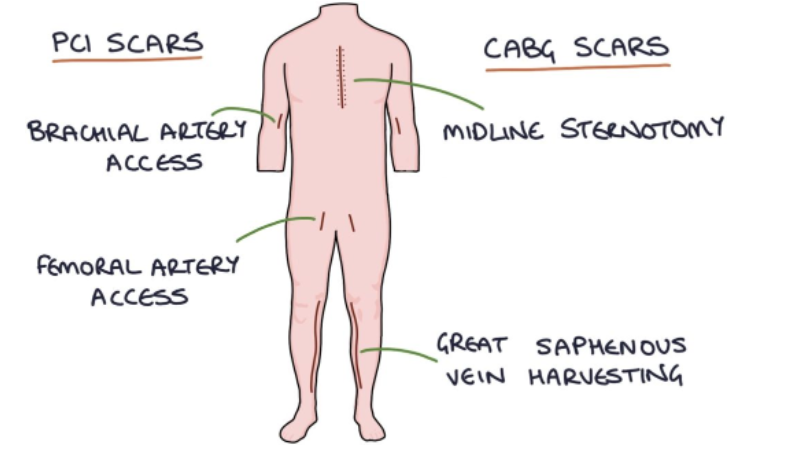
This involves putting a catheter into the patient’s brachial or femoral artery, feeding that up to the coronary arteries under xray guidance and injecting contrast so that the coronary arteries and any areas of stenosis are highlighted on the xray images. This can then be treated with balloon dilatation followed by insertion of a stent.
Explain Coronary Artery Bypass Graft (CABG) procedure
surgery may be offered to patients with severe stenosis. This involves opening the chest along the sternum (causing a midline sternotomy scar), taking a graft vein from the patient’s leg (usually the great saphenous vein) and sewing it on to the affected coronary artery to bypass the stenosis. The recovery is slower and the complication rate is higher than PCI.
TOM TIP: When examining a patient that you think may have coronary artery disease what should you check for?
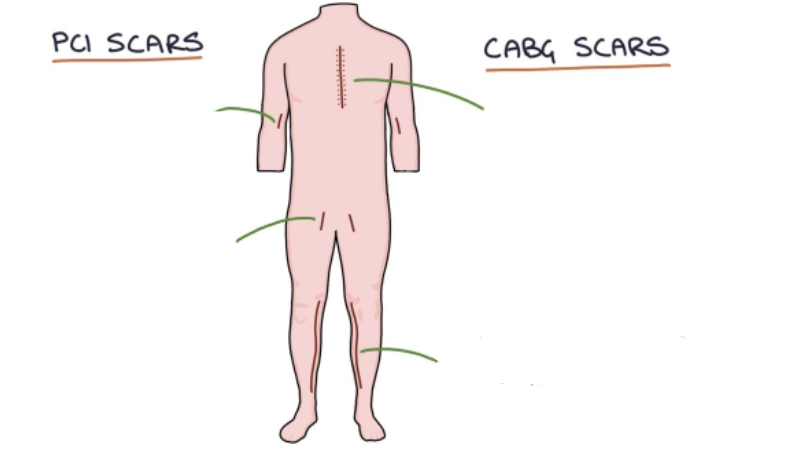
heck for a midline sternotomy scar (previous CABG), scars around the brachial and femoral arteries (previous PCI) and along the inner calves (saphenous vein harvesting scar) to see what procedures they may have had done and to impress your examiners.


-
Gastroenterology356
-
Gastroenterology 2220
-
Respiratory148
-
Respiratory 2118
-
Cardiology203
-
Cardiology 2170
-
Dermatology175
-
Gynaecology147
-
Gynaecology 295
-
Obstetrics143
-
Obstetrics 2157
-
Breast Surgery139
-
Orthopaedics Surgery178
-
Urology Surgery218
-
Rheumatology215
-
Vascular Surgery126
-
Paediatrics- Cardio, Resp183
-
Paediatrics- Neuro, Development160
-
Paediatrics- Gastro115
-
Paediatrics- Genetics + Endo77
-
Infectious diseases82
-
Endocrine139
-
Genetics46
-
Ophthalmology172
-
Opthalmology 257
-
Medicine - Neurology173
-
Medicine Neurology 2142
-
Neurology - CBLs/Safe prescribing103
-
Surgery - Ears, Nose and Throat167
-
Surgery ENT 2190
-
Surgery C - Oral & Maxillofacial77
-
Surgery C - Burns and Plastics78
-
Surgery - Anaesthetics146
-
Psychiatry213
-
Child and Adolescent Mental Health CAMH76
-
Psychiatry: Antipsychotics, Anxiolytics, Antidepressants105
-
Med C - Renal128
-
Med C - Geriatrics60
-
Med D - Haemotology124
-
Med D - Haemotology39



