Water vapor imagery is derived from
radiation emitted in water vapor (WV) wavelength channels (e.g., 6.2 um, 6.3 um, 6.7 um, 7.3 um)
Within the WV channels ………………………………… will be emitted by …………………………. such as ……………………
infrared (thermal) radiation
solid objects
cloud elements, precipitation, and the surface of the Earth
Within the WV channels, infrared (thermal) radiation will be emitted by solid objects such as cloud elements, precipitation, and the surface of the Earth.
For that reason,
the channels in the water vapor absorption bands, are sensitive to the profiles of both the temperature and the humidity.
From the radiances in different WV channels, the ……………………………….usually are
presented in image format
6.2, 6.3, 6.7 um
From the radiances in different WV channels, the 6.2, 6.3 and 6.7ߤ݉usually are
presented in image format, since these wavelengths are
more highly absorbed by water vapor and are more sensitive to variations in humidity than is the 7.3ߤ݉ channel.
The common convention is that lighter shades on the WV imagery indicate
colder brightness temperatures or lower energy measurements
an area of darker gray shades indicates
radiation arriving from a warmer source.
If the temperature decreases monotonically with height
the result of an increase in humidity is a decrease in the measured radiance
The basis for synoptic‐scale applications of WV imagery is that
moist (bright) and dry (dark) regions and the boundaries between them often relate to significant upper‐level flow features
The basis for synoptic‐scale applications of WV imagery is that moist (bright) and dry (dark) regions and the boundaries between them often relate to significant upper‐level flow features such as
troughs, tropopause dynamic anomalies (e.g., subsidence), and jet streams.
define Dark Region
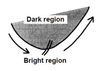
A portion that looks black in the WV imagery is called a dark region
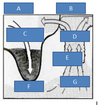
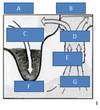
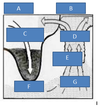
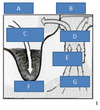
what does A indicate
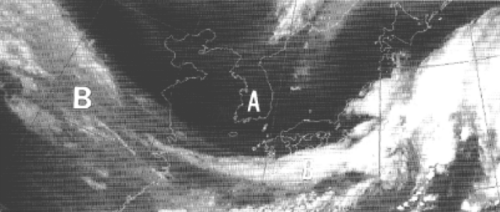
A dark region (A in Figure) indicates an area of high temperature and the dryness of the upper and middle air there.
define Bright Region
A portion that looks white or gray is called a bright region
what does B indicate
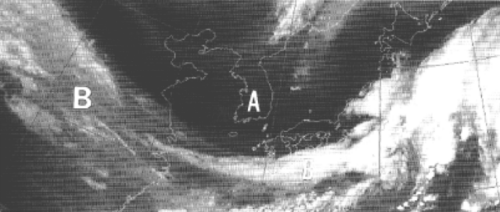
- A bright region (B in Figure) indicates an area of low temperature and shows that the upper and middle air are humid or
- There is a tall cloud area having the cloud tops in the upper or middle level
define Boundary
The border between bright and dark regions in the water vapor imagery is simply called a boundary.
Boundary‐ The border between bright and dark regions in the water vapor imagery is simply called a boundary.
• A boundary in this sense is
the boundary between air masses having different humidity in the upper and middle level.
If the humidity varies noticeably in space, the contrast between bright and dark regions becomes
distinct and a boundary appears clearly
If the humidity varies noticeably in space, the contrast between bright and dark regions becomes distinct and a boundary appears clearly.
The boundaries become oriented in
the direction of the upper flow of slow moving weather systems
The boundaries become oriented in the direction of the upper flow of slow moving weather systems; usually dark regions on the imagery tend to be associated with
middle‐tropospheric troughs
The boundaries become oriented in the direction of the upper flow of slow moving weather systems; usually dark regions on the imagery tend to be associated with middle‐tropospheric troughs and light shades with
thermal ridges
Upper level troughs (………..) and ridges (…………………) are associated with
convergence
divergence
sinking and rising motions respectively
When air is sinking it is going to
force moisture to stay closer to the surface and not convect or move up into the upper troposphere.
When air is sinking it is going to force moisture to stay closer to the surface and not convect or move up into the upper troposphere.
Thus, an upper level trough, which indicates a ………………… appears as …………………… on WV imagery
dry upper troposphere
dark regions
Thus, an upper level trough, which indicates a dry upper troposphere appears as adark regionon WV imagery.
Similarly, vertically rising ……………………………………………..
this …………………………. will be ………………….. and appears as ……………………………..
(in upper level divergence areas) advects moisture into the upper troposphere.
This layer of moisture will be cold and appears as a bright regionon WV imagery.