Define intestinal obstruction?
obstuction of the normal movement of bowel contents- mechanical blockage of bowel due to structural blockage
what are the classification of intestinal obstruction?
small or large bowel
partial or complete obstruction
simple or strangulated
what is the typical presentation for intestinal obstruction?
diffuse pain, constipation, and v abdo distension, tinkling BS
if abdo tenderness-> suspect strangulation
what are the different causes of bowel obstruction- classfying to extramural, intramural, intraluminal?
Extramural (beyond walls/ boundaries)
- Hernia
- Adhesions - small bowel
- Bands
- Volvulus(twisting)
Intramural (within boundaries/wall)
- Tumours
- Single site
- Multifocal – usually peritoneal met (nodules pressing from the outside)
- Inflammatory strictures(e.g. Crohn’s strictures, diverticulitis)
- Gallstone ileusoccurs when a stone erodes through the gallbladder into the duodenum, forming a cholecysto-duodenal fistula - mechanical obstruction caused by an impacted gallstone in the small bowel
Intraluminal (inside lumen)
- Pedunculated tumours
- Foreign body (e.g. bezoars, gallstones)
- Faecal impaction
outline the epidemiology of intestinal obstruction?
common
more common in elderly-> increasing incidence of adhesions, hernias and malignancy
what are the presenting symptoms of intestinal obstruction?
- Severe gripping colicky pain with periods of ease
- Abdominal distension– more marked as obstruction progresses
- Frequent vomiting(it may be bile-stained or faeculent)
- Absolute constipation
- Anorexia
In small bowel obstruction, the pain tends to be colicky (cramping and intermittent) in nature, with spasms lasting a few minutes. The pain tends to be central and mid-abdominal. Vomiting may occur before constipation in small bowel ob. In large bowel obstruction, the pain is felt lower in the abdomen and the spasms last longer.
what is the difference between the pain and contraction in a small and large bowel obstruction?
small bowel obstruction
- pain is colicy ( crampy and intermittent)
- spasms last few mins
- pain is centrsal and mid- abdominal
- vomiting before constipation
Large Bowel obstruction
- pain felt over lower abdomen
- spasms last longer
what are the signs of intestinal obstruction on physical examination?
Abdominal distension with generalised tenderness
May see visible peristalsis
Tinkling bowel sounds
Peritonitis - absent bowel sounds, guarding and rebound tenderness
Inspect for hernias
palpable rectal mass
Look for abdominal scars- previous abdominal surgery increases the risk of adhesions
Inspect for abdominal mass(e.g. intussusception, carcinoma)
what are the appropriate investigations for intestinal obstruction and what are the results?
AXR (also do a erect CXR and a PR exam)
FBC – increased WBC (rarely decreased RBC)
U&Es - Hyponatraemia, hypokalaemia, met alkalosis
CT scan – more sensitive
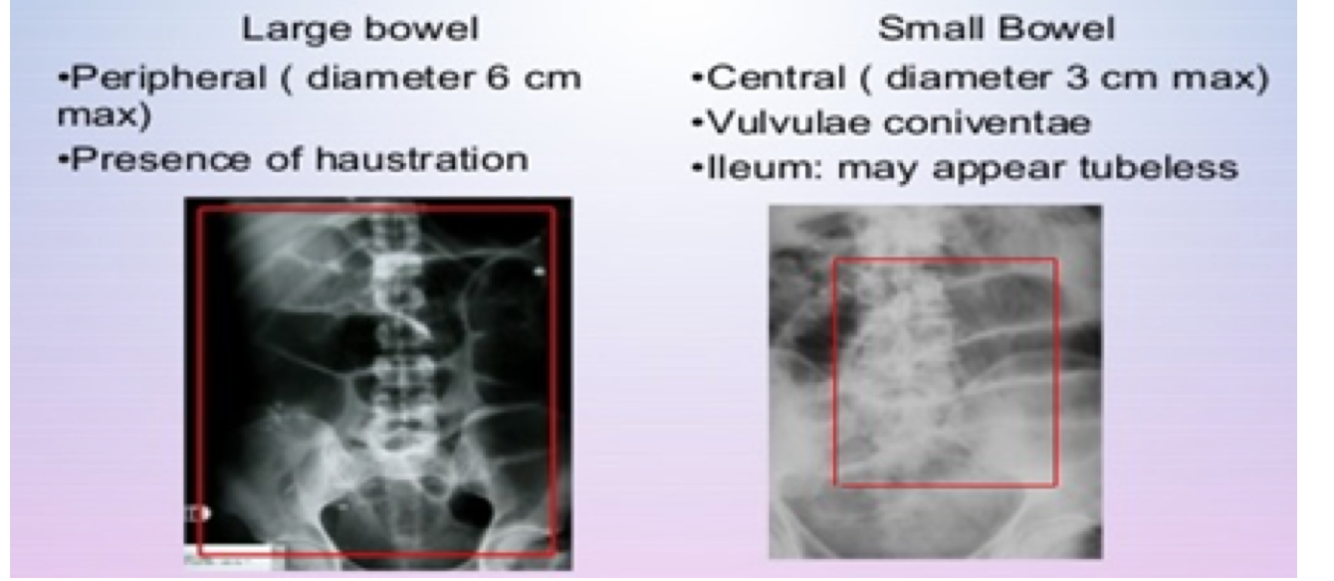
compare the abdominal x ray in large and small bowel obstruction?
Small bowel obstruction:
- dilated bowel >3cm
- central gas shadows with valvulae conniventes that completely cross the lumen and no gas in large bowel
Large bowel obstruction
- dilated bowel >6cm or >9cm if at caecum,
- peripheral gas shadows proximal to the blockage with haustra which do not cross whole lumen width
outline the general management of intestinal obstruction?
drip and suck management
NBM, insert NG tube
Gastric aspiration via NG tube if the patient is vomiting
IV fluids to rehydrate
Electrolyte replacement
Analgesia
Urinary catheter and fluid balance
Monitor vital signs, fluid balance and urine output
what are the indications for the surgical management of intestinal obstruction?
considered in patients who have not improved with conservative management after 48 hours, have signs of peritonism, a palpable mass or a virgin abdomen (no previous surgery)
Strangulation and large bowel obstruction require surgery. Ileus and incomplete small bowel obstruction can be managed conservatively, at least initially.
Emergency laparotomy in acute obstruction
what are the possible complications of intestinal obstruction?
Dehydration
Bowel perforation
Peritonitis
Toxaemia (blood poisoning by toxins from a local bacterial infection)
Gangrene of ischaemic bowel wall
summarise the prognosis of intestinal obstruction?
Variable
Dependent on the general state of the patient and the prevalence of complications

-
Alcohol Hepatitis18
-
Pancreatitis-A16
-
Non Alcoholic Steatohepatits14
-
Achalasia8
-
Acute cholangitis12
-
Alcohol Withdrawal13
-
Anal Fissures14
-
Coeliac21
-
Mallory Weis Tear12
-
Haemochromatosis10
-
Wilson Disease16
-
Primary Biliary Cholangitis14
-
Pancreatitis Chronic21
-
Primary Sclerosing Cholangitis14
-
Barret's oesophagus13
-
Cholangiocarcinoma9
-
Cirrhosis35
-
Peptic Ulcer Disease (PUD and gastritis)19
-
Gastric cancer9
-
GORD15
-
Oesophageal cancer8
-
Haemorrhoids16
-
Colorectal Cancer18
-
Pancreatic Cancer12
-
Gallstones and Biliary colic14
-
Acute Cholestystitis13
-
Autoimmune hepatitis15
-
Appendicitis12
-
Procedures37
-
GI perforation16
-
Liver Abscesses and cysts12
-
Vitamin Deficiency56
-
Hepatocellular Carcinoma14
-
Crohn's18
-
Ulcerative Colitis21
-
Intestinal Obstruction14
-
Diverticular Disease18
-
Gastroenteritis28
-
Portal Hypertension28
-
Peritonitis19
-
Perineal Abscess and fistulae16
-
Volvulus7
-
Rectal Prolapse8
-
Liver failure16
-
Viral Hepatitis69
-
Hernias ( femoral, inguinal, miscellaneous)57
-
Hiatus Hernia16
-
primary biliary cirrhosis11
-
Intestinal Ischaemia23
-
Pilonidal sinus10
-
Hepatocellular carcinoa13



