What are the bones forming the cranium
8 pieces:
1) Frontal bone
2) Parietal bone x 2
3) Occipital bone
4) Temporal bone x 2
5) Sphenoid bone
6) Ethmoidal bone
What are the skull sutures?
- *1) Coronal sutures**
- divide frontal bone from parietal bone
- *2) Sagittal suture**
- divide parietal bones in midline
- *3) Lambdoid suture**
- divide parietal bone/temporal bone from occipital bone
- *4) Squamosal suture**
- divide temporal bone from parietal and sphenoidal bone
- *5) Metopic suture**
- divide the frontal bone in midline
- completely fuses before 1yo, and will be replaced by bone tissue thus usually not found in adults
What are the brain fontanelles?
Brain fontanelles are “soft spots” between the refused cranial bones in infancy. It allow deformity of the skull during birth. Including:
- *1) Anterior fontanelle**
- diamond shaped, at the junction of coronal and sagittal sutures
- closed around 1-2yo
- known as “bregma” after closure
- *2) Posterior fontanelle**
- triangular, at the junction of sagittal and lambdoid sutures
- closed around 2-3 months
What are the layers of meninges?
Meninges have 3 layers:
- *1) Dura mater**
- an outer endosteal layer, inner meningeal layer
- attached to skull at the cranial sutures
- 2 layers separate to form dural venous sinuses
- *2) Arachnoid mater**
- thin, loose layer of meninges
- arachnoid granulations (projection of arachnoid at the superior sagittal sinus) reabsorbs CSF
- the subarachnoid space extends down the spinal canal terminating at sacrum; contains CSF and major blood vessels
- *3) Pia mater**
- thin layer of meninges closely related to cortical surface, conforming to the contours of sulci and gyri (except in cerebellum)
What are the dural folds?
The cranial vault is divided by 3 reflections of the dura mater (“dural folds”):
- *1) Falx Cerebri**
- divides the two cerebral hemispheres
- attach anteriorly to crista galli, posteriorly to tentorium cerebelli
- *2) Tentorium cerebelli**
- attach to the anteriorly to the anterior and posterior clinoid processes
- separates cerebellum from cerebral hemispheres
- *3) Falx cerebelli**
- divides the cerebellum along the sagittal plane
What are the different cranial fossa?
- *1) Anterior cranial fossa**
- (Superior view) floor is formed by frontal bone’s orbital plate, the ethmoid bone, and the sphenoid bone
- Anterior and lateral boundary: Frontal bone
- Posterior boundary: Sphenoidal bone:
- sella turcica’s tubercle i.e. tuberculum sellae (medial)
- anterior clinoid process
- Posterior margin of the lesser wing (lateral)
- *2) Middle Cranial Fossa**
- (Superior view): floor is formed by the body and greater wing of the sphenoid bone, the squamous part of the temporal bone
- Anterior boundary (see posterior boundary of anterior fossa)
- Posterior boundary:
- sella turcica’s dorsum sellae
- crest of the petrous temporal bone
- *3) Posterior Cranial Fossa:**
- Floor is formed mainly by the occipital bone, with petrous part of temporal bone
- Anterior margin: Clivus medially, and petrous part of temporal bone laterally
What is the Crista Galli
It is a raise portion of the ethmoid bone (medially located, at the anterior cranial fossa)
It is the anterior attachment of the falx cerebri
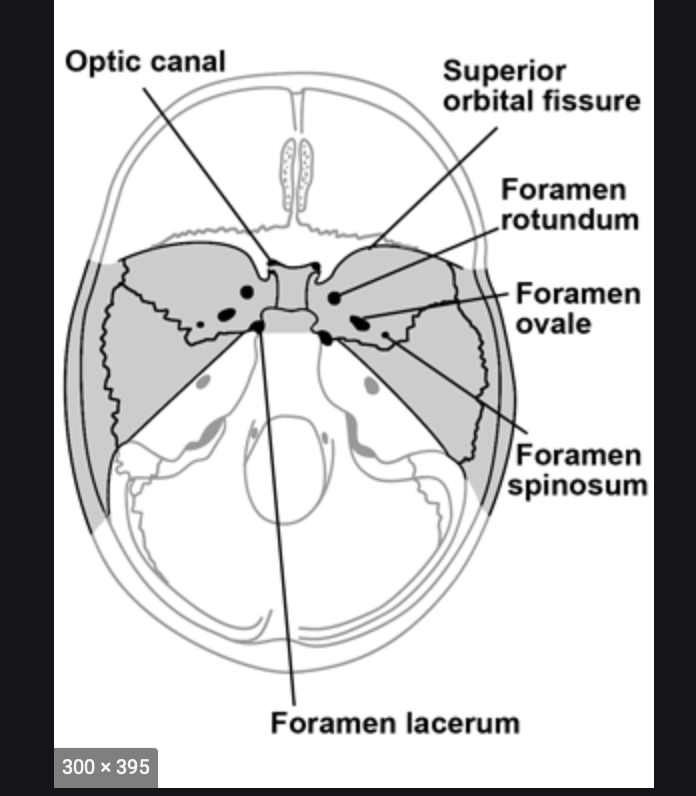
Foramina of cranial base - Superior view
眼超超 圓橢圓轉轉
爛耳Jer
舌大
Two diagonal rows:
- *0) Cribiform plate**
- olfactory nerve (CN I)
- *1) Optic canal**
- optic nerve (CN II)
- opthalmic artery
- *2) Superior orbital fissure (LFT SOV NASO2)**
- Superior and inferior opthalmic vein
- oculomotor nerve (CN III)
- Trochlear nerve (CN IV)
- abducens nerve (CN VI)
- Lacrimal, frontal, nasociliary branches of opthalmic nerve (V1)
- Sympathetic fibres
- *3) Foramen rotundum**
- Maxillary branch of trigeminal nerve (CN V2)
- *4) Foramen ovale (mandy access smallstone)**
- Mandibular branch of trigeminal nerve (CN V3)
- Accessory meningeal artery
- Lesser petrosal nerve
- Otic ganglion
- Emissary vein
- *5) Foramen spinosum (MM,MM)**
- Middle Meningeal Artery
- Meningeal branch of mandibular nerve (CN V3)
- *6) Foramen Lacerum -> Carotid Canal**
- Greater petrosal nerve
- Internal carotid artery
- *7) Internal acoustic meatus**
- Facial nerve (CN VII)
- Vestibulocochlear nerve (CN VIII)
- Labyrinthine arteries
- *8) Jugular foramen**
- CN IX - XI
- Sigmoid sinus
- Inferior petrosal sinus
- Posterior meningeal artery
- *9) Hypoglossal canal**
- CN XII
- *10) Foramen Magnum**
- Medulla oblongata
- Meninges
- Vertebral arteries
- Spinal roots of accessory nerves
Foramina of cranial base - inferior view
Difference from superior view:
- start with Ovale
- Lacerum splits into lacerum and carotid canal
- add Stylomastoid foramen
- *1) Greater palatine foramen**
- greater palatine nerve and vessels
- *2) Lesser palatine foramen**
- lesser palatine nerve and vessels
- *3) Foramen ovale (Mandy access smallstone)**
- Mandibular branch of trigeminal nerve (CN V3)
- Accessory meningeal nerve
- Lesser petrosal nerve
- *4) Foramen spinosum**
- Middle meningeal artery
- Meningeal branch of mandibular nerve (CN V3)
- *5) Foramen Lacerum**
- Greater petrosal nerve
- *6) Carotid canal**
- Internal carotid artery, carotid autonomic plexus
- *7) Stylomastoid foramen**
- facial nerve (CN VII)
- *8) Jugular fossa**
- CN IX - XI
- internal jugular vein
- *9) Mastoid foramen**
- Posterior meningral artery
- *10) Foramen magnum**
- Medulla oblongata
- Verbetral arteries
- Spinal roots of accessory nerves (CN XI)
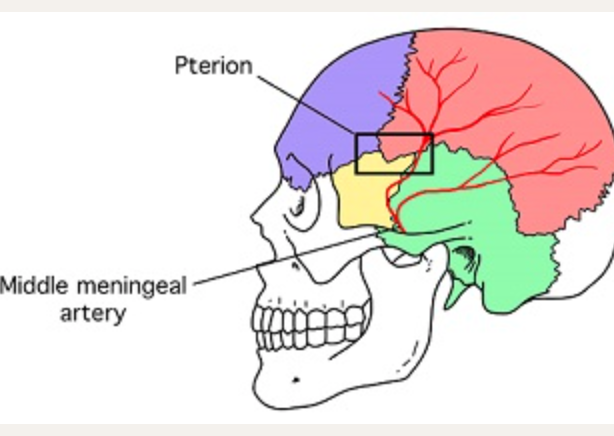
Course of middle meningea artery
What is its clinical significance?
- MMA is a branch of maxilary artery (from ECA)
- Enters the middle cranial fossa through foramen spinosum
- Forms a groove in the inner aspect of temporal bone as it goes up to supply the meninges
- *Clinical significance**: Common cause of Extradural Haematoma due to:
- Pterion fracture (injury to the anterior division of MMA)
- Temporal bone fracture
Where is the pterion?
What is the clinical significance?
The pterion is made up of the frontal, temporal, sphenoid, parietal bones, it is where these bones meet. Clinical significance being:
1) the weakest point of the skull
2) Fracture can cause injury of anterior division of MMA, thus extradural haematoma
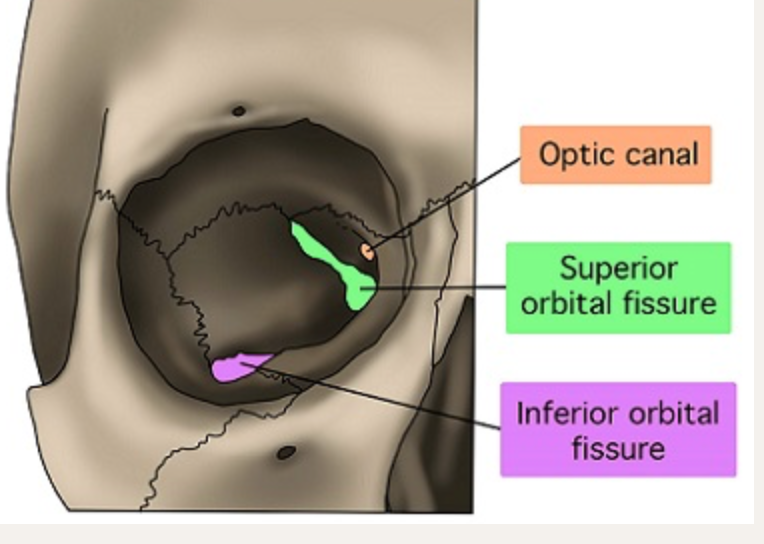
Where is the superior orbital fissure?
What is its contents?
Superior orbital fissure is between the greater and lesser wings of the sphenoidal bone. It contains:
- Superior and inferior opthalmic vein
- oculomotor nerve (CN III) - Trochlear nerve (CN IV)
- abducens nerve (CN VI)
- Lacrimal, frontal, nasociliary branches of opthalmic nerve (V1)
- Sympathetic fibres
Arrangements from superior to inferior:
LFT SOV NASO2
What structures pass through the foramen rotundum and foramen ovale?
Foramen rotundum:
1) maxillary division of trigeminal nerve (CN V2).
Foramen ovale (Mandy Access smallstone, OVALE)
1) Mandibular division of the trigeminal nerve (CN V3)
2) Accessory meningeal artery
3) Lesser petrosal nerve
4) Otic ganglion
5) Emissary vein
What structures run through the jugular foramen?
1) Cranial nerve IX to XI
2) Internal jugular vein
3) Sigmoid sinus, Inferior petrosal sinus
Cranial Nerve PE
- *CN1**
- ask about change in smell
- test with coffee, soap etc
- *CN2**
- Use spectacles
- Visual acuity with Snellen’s chart & Finger
- Visual field by confrontation test
- Pupillary light reflex (if palsy, no direct & consensual with stimulating affected side)
- *CN3, 4, 6**
- Test pupillary reflex & accomodation reflex; PERRLA (pupils equal, round and reactive to light and accommodation)? Anisocoria?
- Any ptosis or nystagmus
- Test eye movements
- *CN5**
- Corneal reflex
- Facial sensation (ophthalmic, maxillary, mandibular) OMM
- Clench teeth to palpate masseter & temporalis
- Open jaw to look for ipsilateral jaw deviation (pterygoids)
- Jaw jerk (if UMN lesion)
- *CN7**
- Inspection for facial asymmetry, nasolabial folds
- Look up for forehead wrinkles (Frontalis; temporal)
- Shut eyes to resist opening (Obicularis oculi; zygomatic)
- Show teeth (Levator anguli oris, Zygomatic major and minor, Depressor anguli oris, Buccinator, Risorius)
- Puff up chin (Buccinator, obicularis oris)
- Clench teeth & depress mouth angle (platysma)
- (sensory by taste of anterior 2/3 of tongue)
- *CN8**
- Occlude one ear and whisper numbers, patient repeats
- Rinne’s Test, Weber’s test
- *CN9, 10**
- Say AHH & observe soft palate (deviates to normal side)
- Test for gag reflex
- *CN11**
- Shrug shoulders to resist force (Trapezius)
- Test right SCM by asking patient to turn neck left, vice versa
- *CN12**
- Look for tongue fasiculation & wasting
- Stick out tongue (deviates to lesion side)
- Test tongue power through cheek
Olfactory nerve
Function and course
Function: special sensory of smell
- *Course:**
- exits the cranium through cribiform plate of ethmoid bone
- nerve endings (olfactory bulbs) lie on epithelial surface
Optic nerve
Function and course
Optic nerve (CN II):
Function: Purely special sensory: vision
- *Course:**
- arises from retina
- enters cranium through the optic canal (also passes opthalmic artery and central vein of retina)
- two optic nerves meet at optic chiasm in middle cranial fossa
- becomes optic tracts and terminates at the lateral geniculate body in the thalamus
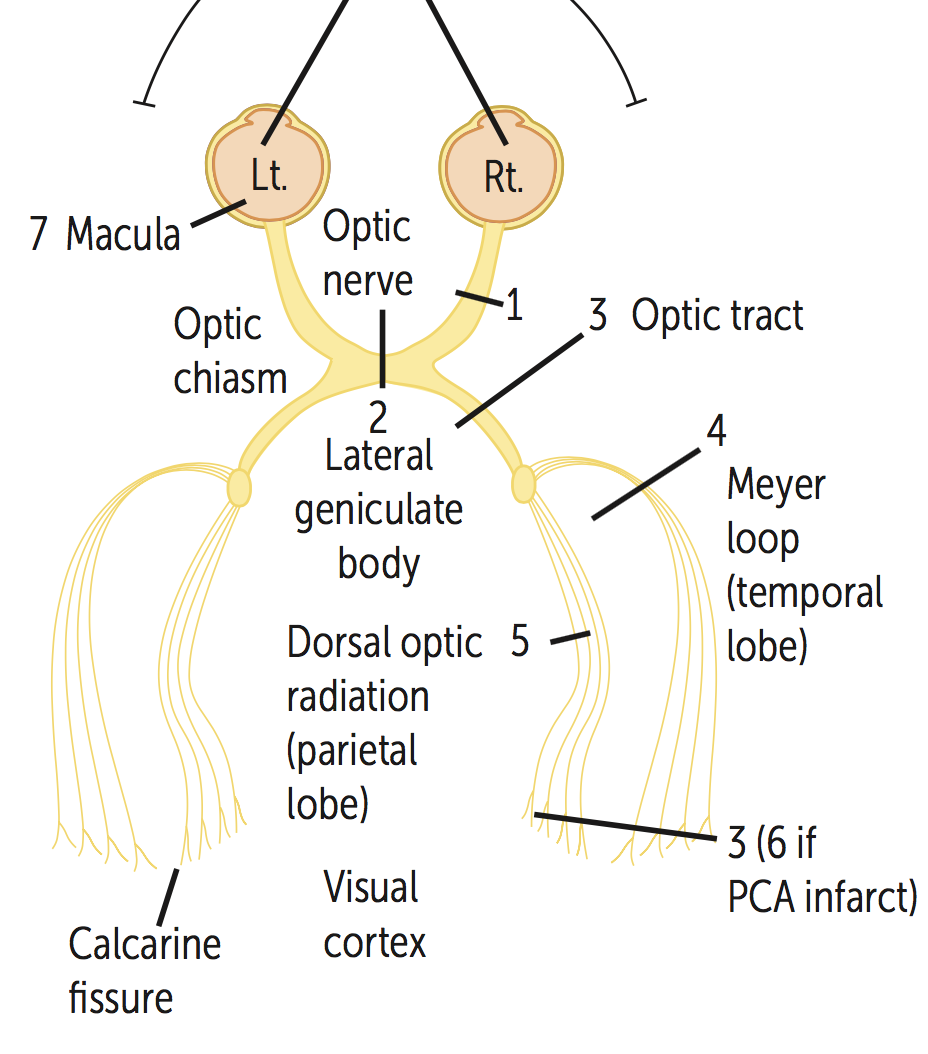
Match lesion with visual field defect
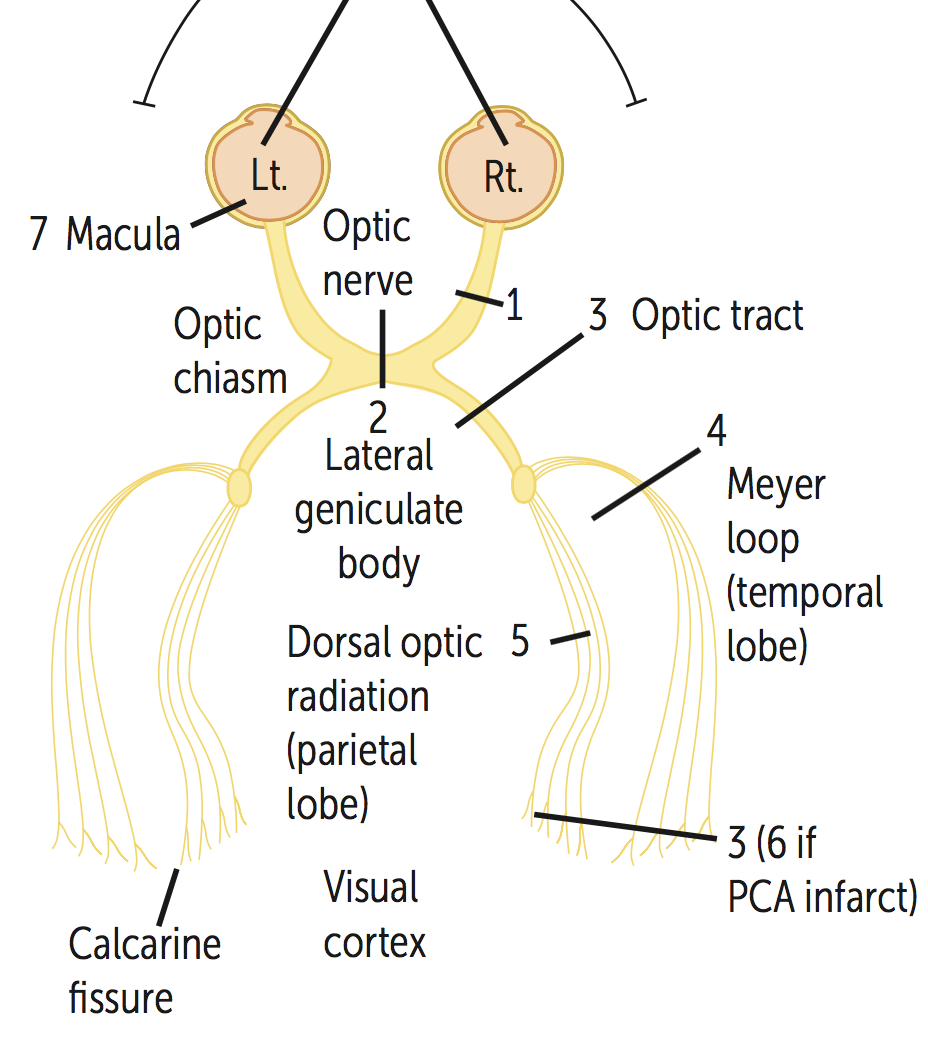
1 - @ optic nerve
= Monocular loss of vision
2 - @ optic chiasma
= bitemporal hemianopia
3 - @ optic tract
= contralateral homonymous hemianopia
4 - @ temporal lobe optic radiation
= contra upper quadrantic homo hemianopia
5 - @ parietal lobe optic radiation
= contra lower quadrantic homo hemianopia
6 - @ occipital lobe (PCA infarct)
= contra homo hemianopia with macular sparing
7 - @ macula, retina
= Central scotoma
Occulomotor nerve
Function and course
Occulomotor nerve
Function:
- *1) Somatic Motor**
- superior, medial and inferior rectus muscles, inferior oblique muscle, Levator palpebrae superiorus
- *2) Parasympathetic**
- via ciliary ganglion to supply sphincter pupillae (pupil constriction) and ciliary muscles (lens accomodation)
Course:
- Exits cranium via superior orbital fissure
Trochlear nerve and Abducens nerve
(function and course)
Function: Both somatic motor
- Trochlear nerve: supply superior oblique (abduct, depress)
- Abducens: supply lateral rectus muscle
Course:
- Both exits cranium from superior orbital fissure
Ocular motility nerve palsy presentations
Depends on which nerve:
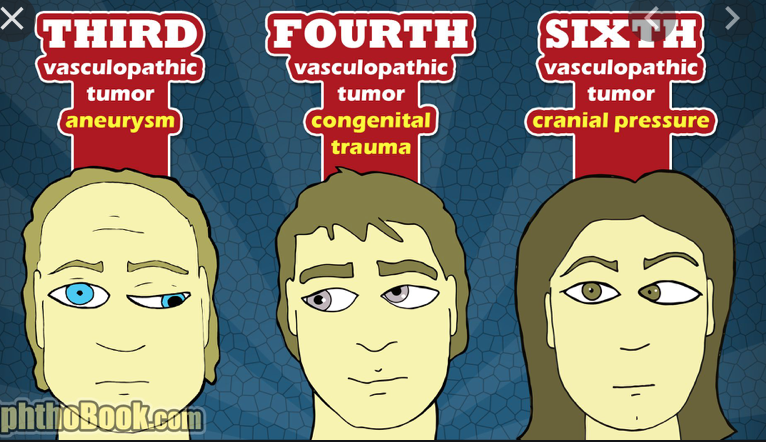
- *3rd nerve palsy**
i) down and out (unopposed lateral rectus & superior oblique)
ii) ptosis (dysfunctional levator palpebrae superioris)
iii) mydriasis (dysfunctional pupillary constrictor) -> more common in surgical CN III palsy - *4th nerve palsy (opposite of CN III)**
i) “nasal upshoot”
ii) Dysfunctional depression & abduction (function of superior oblique)
iii) Compensate by “chin down” (for unopposed elevation) & contralateral head tile (unopposed extorsion) - *6th nerve palsy**
i) Esotropia (worse for distance than near) with limited abduction
ii) Compensate by “face turn” to the affected side
Occulomotor nerve palsy DDx
Should divide into medical & surgical:
Medical CN3 palsy (pupil sparred)
- *1) Microvascular infarction**
- e.g. DM, HTN, atherosclerosis
Surgical CN3 palsy (fixed dilated pupils)
- *1) PComm artery aneurysm**
- compression arising from aneurysm from posterior communicating artery
2) Uncal herniation (temporal lobe)
3) Cavernous sinus syndrome, orbital apex syndrome
- *4) Brainstem lesion** (rare)
- affecting the oculomotor nuclei and EW nuclei
- e.g. midbrain vascular syndromes, multiple sclerosis and tumours
Explain pupil involvement in CN III palsy
In occulomotor nerve palsy:
- *1) If Isolated pupil involvement (dilated)**
- more likely surgical cause (esp compressive lesions)
- The fibres of the oculomotor nerve innervating the pupillary constrictor muscle are located superomedially near the nerve surface, thus more prone to nerve damage
- *2) If pupil sparring**
- more likely medical cause (microvascular infarct)
- central fibres of the oculomotor nerve are more vulnerable to microvascular infarction
Trochlear nerve palsy DDx
1) Microvascular infarction (e.g. DM, HTN)
2) Congenital anomaly
3) Closed head trauma
4) Cavernous sinus syndrome, orbital apex syndrome


-
ANATOMY - Lower limbs218
-
Paeds47
-
BREAST114
-
ANATOMY - MALE REPRODUCTIVE SYSTEM179
-
Endocrinology - Diabetes127
-
CARDIOLOGY - ACS and Angina112
-
CARDIOLOGY - Valvular Heart Disease and Bacterial Endocarditis61
-
UROLOGY - Bladder + Prostate52
-
ANATOMY - PELVIS154
-
Neuro - Neurological emergencies72
-
Neuro - stroke, MMA, VST + brain haemorrhages80
-
Neurosurgery183
-
Endocrine Surgery141
-
NEURO - Headache, neuro-oncology and CNS infections91
-
Head & Neck, ENT233
-
MaxFax9
-
ANATOMY - Lower limbs p2232
-
ANATOMY - head205
-
ANATOMY - Neck p1205
-
ANATOMY - Thorax p1199
-
ANATOMY - thorax p2155
-
ANATOMY - Upper limb p1205
-
Miscellaneous28
-
ANATOMY - Head part 299
-
ANATOMY - Upper limb p2205
-
ANATOMY - Abdomen p1209
-
ANATOMY - Abdomen p2215
-
ANATOMY - Abdomen p3127
-
ANATOMY - head part 3190
-
Miscellaneous stuff I get wrong p1200
-
ANATOMY - Neck p2122
-
Vascular from eMRCS1
-
Miscellaneous stuff I get wrong - part 2106
-
ANATOMY - upper limb p392
-
Burns/Grafts/Organ Transplants73
-
Surgeries key facts14



