Suggest reasons why opportunities for female elite performers are still restricted in many sports when compared with male performers. (5 marks)
Award one mark for each of the following points (max 5 marks):
- Stereotypical image of feminine activities / not wanting to appear aggressive / competitive
- Physical / health concerns about participation / physical ability to perform certain activities
- Emphasis on cosmetic fitness rather than competitive sports
- Discrimination / sexism / membership restriction to clubs
- Limited media coverage / role models / promotion of opportunities
- Less funding via sponsorship allows progression / lower prize money / less financial support
- Religious / cultural restrictions
- Limited legislation to ensure equal opportunity
- Male dominated organisations
The number of women taking part in sport at a recreational and elite level has increased in recent years.
Using your knowledge of the factors affecting the emergence of elite female performers, analyse the graph and suggest reasons for the results shown.
(Total 8 marks)
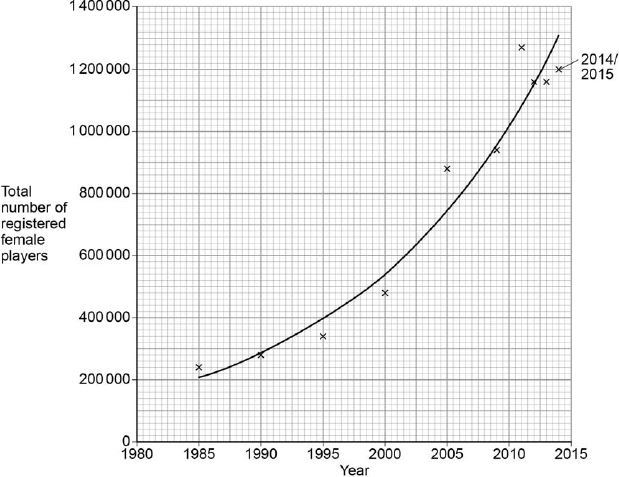
AO1 − Knowledge of factors affecting the emergence of elite female performers
E.g. there has been an emergence of elite female performers in the late 20th century and early 21st century. Although they don’t have the same amount of media coverage as male sports performers, the amount of media coverage has increased. This has led to fewer female role models. There has been more opportunities for women to join sports clubs. These opportunities have been made more attractive, eg by introducing female only classes or teams. Women’s sport has been boosted by initiatives, e.g. Sport England, which again has raised awareness. Work has been done to deconstruct traditional gender stereotypes, eg women stay at home to look after children.
AO2 − Application to the graph
E.g. the number of females registered has risen significantly, with an increase from just over 200000 in 1985 to 1300000 in 2015, which could have come from an increase in equal opportunities. There has been a steady rise year on year with no drops in the rate of the rise, which could be facilitated by greater media coverage of the women’s game, which in turn has led to more female roles models. The rise has increased since 2005 which indicates the momentum has increased, eg due to more female provision / clubs.
AO3 − Analysis of the reasons for the results shown in the graph
E.g. football is more available and socially acceptable so more women are likely to start playing. Media coverage of women’s football has increased, eg women’s world cup / Champions League so more women are aware and likely to play and improve. There are more female footballers and therefore more people have heard of the big names, eg Kelly Smith. This can inspire younger players to play. Women who were encouraged to take up sport in the 20th century might encourage their children to do the same, which could lead to an increase.
There are presumably more clubs to cater for the increase in registered players, therefore more opportunities for the growing numbers to play competitively. FIFA / UEFA / governing bodies are more likely to fund women’s football and the increase in the number of coaches and clubs allows and inspires more to play.
As domestic stereotypes and women’s rights have improved, more cultures / religions / countries have allowed women to play.
Accept any other relevant analytical point about the graph and suggestions for the results shown in the data.
Suggest how the role of working class women changed between the late 19th century (1890) and the middle of the 20th century (1950) and how this affected their participation in recreational and sporting activities.
(Total 5 marks)
Award one mark for each of the following points (max 5 marks):
Role change
(sub max 3 marks)
- Suffragettes / women’s rights/ get the vote / more political say
- WW1 status increased / did men’s jobs e.g.factories / proved their worth
- Less emphasis on domestic role
- Got more education via state schools
- Began to earn more personal money
- More freedom – mobility / clothing / leisure time
Sporting opportunities
(sub max 3 marks)
- Still very restricted compared to middle classes and men
- Accepted firstly by middle class ladies – later working classes
- But more schools / provision of PE / clubs / teams / became available
- More competitive opportunities
- Sporting organisations established
- Achievements of women athletes / role models
Explain how lawn tennis helped the emancipation of women in the late 19th century. [4 marks]
Award one mark for each of the following points (max 4 marks):
- Women able to be energetic / involved in non-violent game
- Acceptable by middle classes
- Whole families / men and women played together
- Removed some stereotypes / myths
- Women able to join clubs
- Played in (girls) schools
- Fully clothed
- In privacy / walled gardens
- Social rather than sporting occasion
Suggest why there has been a recent surge in interest in female football. [4 marks]
Award one mark for each of the following points (max 4 marks):
- Equal opportunities
- Increased media coverage
- More female role models
- School PE programmes
- Support / encouragement form FA
- More clubs / opportunities
- More funding to increased participation
- Increased free time
Suggest why female athletics was quite slow to embrace equality of opportunity. [3 marks]
- Men deemed athletics too strenuous for women
- No women athletes in early Olympics
- Maintained distinction between male and female events
e.g. No events over 400m until 1960 / marathon until 1984 / Hammer and pole vault introduced 1996
- Equal opportunities led by title IX
- 2012 Olympics - women in every event
Account for the development of female tennis players since the 19th century. [4 marks]
- Equal opportunities
- Middle class women playing
- Fully-clothed
- In own gardens / hidden from view
- Early opportunities to play in private clubs / Wimbledon championships
- Increased media coverage
- More female role models
- Early professional circuit
The table below shows the winning times for the men’s 100 metres final from previous Olympic Games.
Year Time completed (s)
1952 10.40
1964 10.00
1976 10.06
1988 9.92
2000 9.87
2012 9.63
2016 9.81
Consider how commercialisation and the improvement in technology for sports analytics have affected performance in the 100 metres at the Olympic Games.
Use the data in the table to support your answer.
(Total 8 marks)
AO1 – Knowledge of commercialisation and technology for sports analytics
Commercialisation
Eg, This is the selling of a product for profit. In order to sell a product, commercial enterprises need access to as many people as possible; this is achieved through the media. The link between the media and commercialisation and sport is often referred to as the golden triangle, each corner of the triangle impacting on the others.
With improvements in technology sport is now available to a mass audience, increasing the commercial value of sport. Sport is accessible via many different media outlets, for example, radio, TV and the internet.
Technology for sports analytics
Eg, Sports analytics is the use of data to better understand a performance in sport. It can be used to collect different types of data, e.g. athlete performance data, biomechanical data, fitness data. Using technology data becomes objective, providing valid and reliable data on which to base further analysis.
AO2 – Application to the 100 metre sprinter
Eg, Commercialisation makes more money available to the sprinters through sponsorship deals or televised appearances in commercials.
Sprinters can use this money to finance their training. As sport has become more commercial more funding has been available so the athlete can work with the best coaches, sports nutritionists, sports psychologists, and other professionals who can help them achieve and maintain peak performance.
Technology for sports analytics will improve data collection, for example, during training sprinters may wear motion detecting sensors, which capture their performance which can then be analysed to search for any slight weakness, or area for improvement.
AO3 – Analysis / Evaluation through discussion of the potential impact of commercialisation of sport and use of technology on sprint times
Eg, Despite the data anomaly of 1976 (where times increased), the data trend shows an improvement in 100m sprint times, from 10.40 s in 1952 to 9.63 s in 2012. This is a significant improvement in performance over time. If these two performers raced side by side the runner from 2012 would complete the race metres in front of the opposition. The anomaly in 1976 where times dropped could be due to a number of factors, for example, nations boycotting the event, the quality of the running track, the running environment.
Commercialisation
Eg, This increase in performance could be due to the additional time athletes can spend training as a result of the increased funding available due to commercialisation. Even though the Olympics is still an amateur sport there is increased funding available for talented and elite athletes, for example lottery funding, which can be used to finance increased / more targeted levels of training. There is also sponsorship and endorsement possibilities for high profile elite athletes, like those who win the 100m which means they can train full time rather than have to combine training with work. Through increased fitness, from the additional training, performances will improve.
Technology for sports analytics
Eg, Due to increased revenue for the sport as well as the performer through commercialisation money has been available to develop sport technology to further improve sport performance. For example, through improved data collection of performance, e.g. running gait, the biomechanics of the sprinters running action can be analysed, increasing the efficiency of the sprinter, improving their time. Weaknesses can be more readily identified and corrected, again improving time.
Accept other appropriate considerations of how commercialisation and the use of technology for sports analytics have affected performance in the 100 metres at the Olympic Games.
Explain the positive effects the media has had on the modern form of association football. [6 marks]
AO2 − Describe the positive effects the media has had on the modern form of association football
Due to increased media coverage of association football there has been an increase in positive role models for the public to identify with, for example Cristiano Ronaldo, Lionel Messi.
This has also meant that there is a huge amount of funding and sponsorship opportunities / advertising income to football due to the TV rights from Sky and BT.
Due to increase in media coverage of women playing, football myths and stereotypes can be broken associated with the ability of women to play sports such as football to a high level.
The positive impact of the introduction of technology via advances in media, for example, referees being miked up has been positive due to the audience being able to hear decisions / discussions.
AO3 − Explain the positive effects the media has had on the modern form of association football
Due to increased media coverage of association football there has been an increase in positive role models for the public to identify with which has increased participation and popularity of association football as a sport as many people around the world play the sport.
Due to the huge amount of funding and sponsorship opportunities / advertising income to football due to the TV rights this has meant that the clubs and players have large amounts of money to invest in facilities for football and in coaches as well as providing high salaries for players.
Accept other relevant explanations of the positive effects the media has had on the modern form of association.
Max 6 marks
The ‘Golden Triangle’ describes the relationship between which three bodies?
A
Coaches, media and sport
B
Coaches, performers and audience
C
Sport, media and commercialisation
D
Sport, performers and commercialisation
(Total 1 mark)
C
In 2018, Alexis Sánchez became the highest earner in the Premier League with a reported wage of £350 000 per week.
Evaluate the impact that wages associated with modern day professionalism in association football has on the status and motivation of players.
(Total 8 marks)
AO1 – Knowledge of modern day growth in professionalism and motivation
- Modern day professional is, respected for their talent, has more time to train, experience celebrity status and are positive role models in society.
- Motivation can be intrinsic or extrinsic, with extrinsic being tangible or intangible.
AO2 – Application of the status of professional in association football and motivation of players
- The status of the player influences their ability to become role models / their responsibilities can increase.
- As status of player increases they may have more opportunity to access better facilities.
- As status of player increases they may be afforded more opportunities.
- The status of a player may encourage them to support charities more / public speaking opportunities.
- Players may gain sponsorship from status.
- Status of player may support an increase in sponsorship / commercial / media attention and branding opportunities.
- Players may receive high monetary rewards for their talents.
- More money is being invested in football due to professionalism.
- Professionals train full-time and have the benefit of utilising state of the art facilities and training equipment.
- Professional player may be motivated in different ways. Some will be intrinsically motivated, meaning they will play because of the love for the game and their own personal motivations.
- Other players may be extrinsically motivated by extrinsic rewards, which may be trophies or the wages they receive - tangible.
- Extrinsic motivation may be intangible, whereby the player is motivated by the praise they receive, from manager, fellow competitors or spectators.
AO3 – Evaluation of the impact of high wage increases associated with professionalism have had on the status and motivation of players
- The increase in weekly wages could increase the intrinsic motivation of players to train harder and play better, which would increase their value and future wage demands, as well as making for a more entertaining game.
- On the other hand players may become overly reliant on extrinsic rewards of high wages and lose the intrinsic motivation, which could become detrimental to their efforts and values.
- Some players may be happy to avoid playing or not being part of the starting 11 as they are still being paid large salaries / wages.
- The players may lose the love for the game and show no loyalty, whilst chasing higher wages.
- A balance between intrinsic and extrinsic motivation would be ideal, but too much reliance on the extrinsic could damage intrinsic motives.
- Higher wages may impact on the effort a professional applies to their training / performance, as they are more focused on other aspects, such as sponsorship / media.
- Some professionals can be more motivated to utilise their status to support charitable work / use their status to influence positive change.
Accept any other appropriate evaluation around the impact of wages associated with modern day professionalism in association football have on the status and motivation of players.
[8]
Which one of these is not a characteristic of modern day professionalism?
A
All classes can compete
B
All athletes demonstrate high morality
C
Can achieve celebrity status
D
High rewards are available
B
Post–World War II commercialisation has impacted on sport.
Discuss the effects of commercialisation on lawn tennis.
[4 marks]
Advantages (Sub max 3 marks)
- Increases in funding that comes with commercialisation have led to better facilities / technology, coaching and opportunities (1)
- Increased funding leading to increased prize funds / salaries and opportunities for women players (1)
- Increased funding has led to increases in coverage of lawn tennis on TV – leading to increased media involvement, which can lead to increased rights / contracts generating more income for lawn tennis (1)
- Lawn tennis can become commodity of business, which supports the endorsement of products, bringing increased sales and subsequently increased sponsorship of sport (1)
- Supports and encourages professionalism, whereby higher standard of play / higher skill levels which can increase spectator appeal (1)
- More opportunity for grass-roots development / participation (1)
- Lawn tennis may see alterations to competition structures to create more excitement (1).
Disadvantages (Sub max 3 marks)
- Viewing times and the game structure interrupted by media advertising which may not suit (1)
- Rules of the game may change losing traditional nature / competition formats may change (1)
- Increased usage of technology, hawk-eye and appeals methods during game, reducing the flow of the game (1)
- Money involved means that performers develop a win at all costs mentality which could ruin the reputation of lawn tennis / match fixing / cheating (1)
- Pressure to keep performing, making them anxious / fatigued / play when injured (1).
Accept any other effects of commercialisation on lawn tennis.
Max 4 marks
Explain how the modern-day amateur differs from an amateur of the 19th century. [3 marks]
- (Status) − 19th century amateurs had high status whereas modern-day amateurs tend to have a low status compared to professionals (1)
- (Level / Quality of play) − 19th century amateurs were the best players, whereas where professional sports exist in modern day sports, amateurs often unable to compete at the same level / usually not as good (1)
- (Money / Pay) − 19th century amateurs had sufficient income and so were not paid however some modern day amateurs receive sponsorship or appearance money (1)
- (Class) − 19th century amateurs were members of middle / upper classes / gentleman amateur whereas in modern day, amateurs can come from any socio-economic group (1)
- (Mixing) − 19th century amateur avoided playing against working classes, whereas modern day there is no divide / working classes were excluded from amateur sports (1)
- (Roles) − 19th century amateur were controllers of sport / selected teams/formed NGBs (1)
Accept other relevant differences between the modern day amateur and 19th century amateur.
Max 3 marks
State two characteristics of a modern amateur performer.
(Total 2 marks)
- Plays for the love of the sport (1).
- Places large emphasis on taking part (1).
- Lower status than professional (1).
- Receive little / no funding (1).
- Some high level performers in certain sports are not professional so could technically be classed as amateur (1).
Accept any other relevant characteristics of a modern amateur performer.
Suggest reasons why there was a delay in opportunities for the working class to be able to play games such as lawn tennis. [4 marks]
- Didn’t have enough time / worked long hours
- Lack of disposable income / couldn’t afford - equipment
- Initially amateur development / middle and upper classes
- Excluded from clubs
- Lack of public provision
- Did not have same middle class values / dress codes / etiquette
State one positive effect that modern-day ‘amateurism’ has on sport. Give an example. [1 mark]
- Codes of conduct still exist/fair-play/sportsmanship, eg shaking hands with opponent and umpire after match in tennis (1).
- Amateurism viewed positively/promoted, eg fair-play awards in football/Olympic Ideal (1).
- Opens up high level sport to all, eg amateur football teams taking on professionals in the FA Cup (1).
- Amateur sport can be a platform to professional sport, eg through scouting of talented youths (1).
- Less pressure on performers/more enjoyment/less deviance/cheating, eg fair play/respect encouraged in grassroots rugby (1).
Must state a positive effect and give an example for one mark.
Accept any other appropriate positive effect that modern-day ‘amateurism’ has in sport with a sporting example. Maximum 1 mark
Evaluate the effectiveness of the strategies being used to overcome specific barriers that may prevent women from becoming football officials.
[8 marks]
DR GAS FIRED MC CASS
AO1 Knowledge of general barriers and strategies
Barriers (barriers and strategies must be those relevant to female officials):
- stereotypes/channelling; lack of media coverage
- lack of role models
- lack of sponsorship/full-time positions
- lack of leisure time
- fewer competitions.
Strategies:
- increased media coverage leading to more role models
- more sponsorship/paid or full-time positions
- provide education to overcome stereotypes
- use of social media to create networks
- laws and legislation to punish sexist behaviour/sex discrimination.
AO2 Application to female officials in football Barriers
Barriers
- There are currently a limited number of female officials (role models) and the majority of these work in the women’s game which is not covered extensively in the media
- The only full-time positions in football refereeing in England are in the top two divisions of men’s football, and none of these are women. In the women’s super league players are now becoming full- time but the officials are not
- The sexist abuse of the small number of female officials in the men’s game may put other women off pursuing this route. There are less opportunities within the women’s game due to the lower number of competitions.
Strategies
- Increased media coverage of women’s football would increase the profile of the female officials in the sport
- As the women’s game becomes professional the officials working in it should become professionals too
- Punishing those individuals who make sexist comments towards female officials would show that it will not be tolerated.
AO3 Evaluation of strategies which may overcome specific barriers:
- by increasing the media coverage of women’s football/female officials this will increase the number of role models for other women to look up to
- negative media coverage of female officials/sex discrimination may put women off
- while social media can be used to build support networks and provide information there is an increased risk that it may also be used to make sexist comments which will negatively impact the number of female officials
- there is a lack of funding/sponsorship in the women’s game, so the sport needs to prioritise where to spend it. Is paying full-time officials the best use of this money? Also, if they were full-time would the pay be the same as the men? And if it wasn’t would it be enough to make it worthwhile?
- there has been an increase in sponsorship of the WSL in recent years meaning there is more money in the sport. This means that having officials who make good decisions is more important therefore paying them as full-time will increase the standard as well as giving more women something to aspire to.
Accept any other relevant evaluation of the effectiveness of the strategies being used to overcome specific barriers which may prevent women from becoming officials.
Explain two benefits of sponsorship to the companies investing large amounts of money into sport. [4 marks]
Increase in publicity / media coverage (1) resulting in an increased sales/profit (1)
Linking the company to an elite athlete (1) adds value to a brand/creates an association with excellence/creates an association with a healthy image (1)
Decreases tax paid by the company (1) due to tax relief afforded on money donated as sponsorship (1)
Being liked to a successful sport/performer (1) can improve the morale of the company’s staff (1)
The company is provided with tickets etc (1) which allows them to build relationships with customers and clients (1)
Answer must include a benefit (AO1) and an explanation of the impact on the company (AO2) to be awarded 2 marks.
Accept other appropriate explanations of the benefits of sponsorship to the companies investing large amounts of money into sport. Maximum 4
The launch of the Diamond League athletics events in 2010 introduced large cash prizes into the sport. This was one of many factors which changed the status of track and field athletes post World War II (1950–present).
Evaluate what impact the changing status of track and field athletes has had on the sport of athletics.
[3 marks]
Positive impact (sub max = 2)
- Increased prize money has allowed top athletes to train more, raising the standard of the sport (1)
- Higher standard of athlete performance increases the entertainment value of the sport/raises the profile of the sport (1)
- Increase in prize money available to athletes makes the sport more appealing as a career and increases the talent pool, further raising the standard of the sport (1)
Negative impact (sub max = 2)
- Prize money moved athletes away from amateur ideals to win at all cost mentality, which has changed the values of the sport (1)
- Athletes competing for large prize money has increased the instances of cheating/drug taking which harms the sport’s reputation (1)
Accept any other appropriate evaluation of the impact that the changing status of track and field athletes has had on the sport of athletics. Maximum 3 marks
Post–World War II commercialisation has impacted on sport.
Discuss the effects of commercialisation on lawn tennis.
[4 marks]
Advantages (Sub max 3 marks)
- Increases in funding that comes with commercialisation have led to better facilities / technology, coaching and opportunities (1)
- Increased funding leading to increased prize funds / salaries and opportunities for women players (1)
- Increased funding has led to increases in coverage of lawn tennis on TV – leading to increased media involvement, which can lead to increased rights / contracts generating more income for lawn tennis (1)
- Lawn tennis can become commodity of business, which supports the endorsement of products, bringing increased sales and subsequently increased sponsorship of sport (1)
- Supports and encourages professionalism, whereby higher standard of play / higher skill levels which can increase spectator appeal (1)
- More opportunity for grass-roots development / participation (1)
- Lawn tennis may see alterations to competition structures to create more excitement (1).
Disadvantages (Sub max 3 marks)
- Viewing times and the game structure interrupted by media advertising which may not suit (1)
- Rules of the game may change losing traditional nature / competition formats may change (1)
- Increased usage of technology, hawk-eye and appeals methods during game, reducing the flow of the game (1)
- Money involved means that performers develop a win at all costs mentality which could ruin the reputation of lawn tennis / match fixing / cheating (1)
- Pressure to keep performing, making them anxious / fatigued / play when injured (1).
Accept any other effects of commercialisation on lawn tennis.
Max 4 marks
[4]
Elite sport has changed significantly since the 19th century.
Explain positive impact of amateur and professionals on 19th century and modern day sport.
(Total 5 marks)
A (Professionalism) – earning money from sport / broken time payments.
B 19th century sport became a business / amateur paid for professionals / upper class were patrons.
C 19th century from the working class.
D Train full time.
E So standards improve.
F As winning is critical / win ethic.
G Encourages spectator sport / better spectacle for spectators.
H 19th century occupied the masses / social control.
I Olympic Games – do now accept some professional performers e.g. basketball.
J Today all social classes can participate in either amateur or professional.
K Ethics / moral codes still evident in amateur and professional sports today.
L NGBs formed.
M Today injection of money / commercialisation – TV rights etc. allows NGBs to invest in grass roots / economic benefit to country / sport benefits / country benefits.
N Today amateur and professional codes blurred due to shared characteristics / difficult to distinguish between amateur and professional.
NB – Focus of question is on benefits NOT negative aspects
During the post-World War II period (1950 to present day) the status of elite tennis
players has changed.
Evaluate how the changing status of professionals in tennis has affected the
players.
[8 marks]
AO1 Knowledge of changing status of professionals
* Professionals are performers who are paid to play sport.
* Modern day professional can come from any class.
* Modern day professional demonstrates higher level of performance than amateur performers.
AO2 Application of the changing status of professionals to tennis
* Professional tours and tournaments established (from 1920 onwards).
* (1968) Professionals allowed to play in the tennis major tournaments such as Wimbledon or US
Open/open era.
* Tennis players earn significant sums of money through prize money for winning tournaments/equal
sums of money for male and female players in a number of major tournaments.
* They also receive large amounts of sponsorship/endorsements, such as Emma Raducanu and Nike.
* Tennis professionals are able to train and compete as full-time athletes.
AO3 Evaluation of the how the change in the status of professionals in tennis has affected the
players.
Positives
* (Tennis players earn significant sums of money) providing financial security / improving their lifestyle.
* (Tennis players are able to train and compete as full-time athletes) leading to an increase in the
standard of play.
* The quality of coaching/training facilities/equipment used by players has improved.
* The professional tennis player can have rest periods, allowing them to recover from a demanding tour.
* The players have become role models, which can help motivate players to train harder/act
responsibly.
Negatives
* Players become motivated by increased financial rewards rather than playing for a love of the game.
* The physical demand on players is very high leading to more injuries/burnout.
* Players are under immense psychological pressure to play more often/perform at the highest level.
* This can lead to deviancy, such a taking performance enhancing drugs/arguing with umpires/calling
medical time outs or toilet breaks unnecessarily.
* Players becoming role models can lead to an invasion of privacy.
* Sponsorship/endorsements results in an increased demand on a player’s time/takes players focus
away from tennis.
* Players have to travel/spend significant amount of time away from home, which can be very difficult.
Accept other appropriate evaluation of how the changing status of professionals in tennis has affected
the players.
Maximum 8 marks

-
Pre industrial Britain9
-
Command words and Essay questions9
-
Industrial britain33
-
Post World War 224
-
Sociological theory applied to equal opportunities- Key terms, Definitions of key Terminology and Social action theory36
-
Sociological theory applied to equal opportunities- Groups in sport, Barriers to participation, Benefits of Raising participation & Sport England and partners46



