What is residual volume?
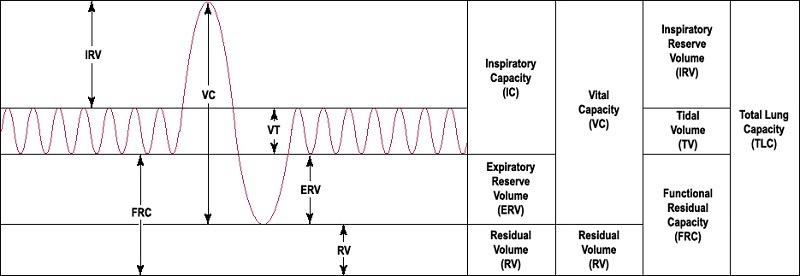
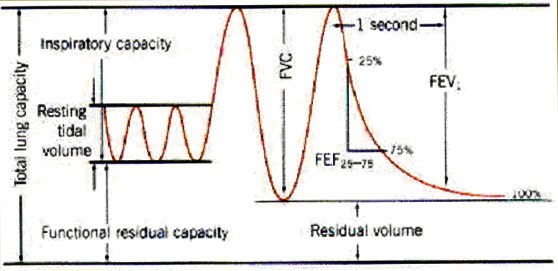
Residual volume is the volume of air still remaining in the lungs after the expiratory reserve volume is exhaled
What is the reason for a residual volume in the lungs?
We cannot empty our lungs completely, so after a forced expiration a residual volume will remain
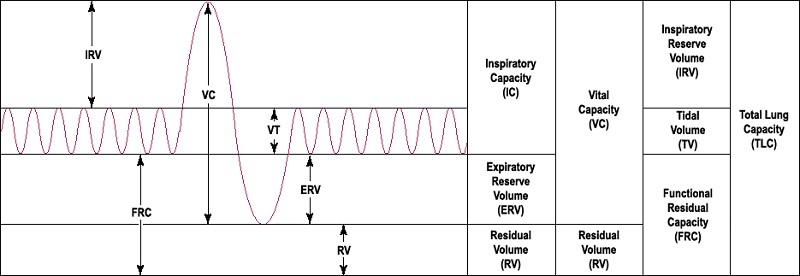
Lung capacities are defined relative to fixed points in the breathing cycle.
What are these?
- Maximum inspiration
- Maximum expiration
- End of quiet expiration
What is the purpose of spirometry?
Spirometry measures the movement of air during breathing as well as measuring lung volumes and capacities
What is vital capacity?
Vital capacity is the total amount of air that can be expired after fully inhaling (inspiratory reserve volume + tidal volume + expiratory reserve volume)
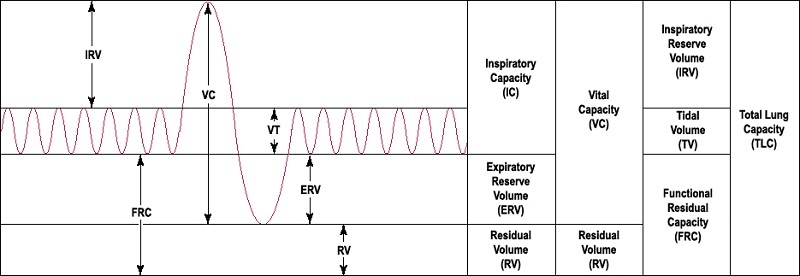
Vital capacity depends on maximal inspiration and maximal expiration.
Why may it be reduced?
- Lungs are not filled normally in inspiration
- Lungs are not emptied normally in expiration
- Or both
What is a time-volume graph?
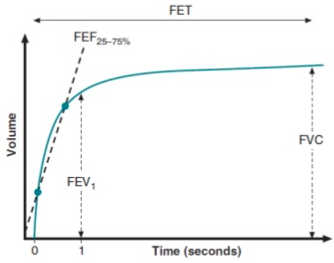
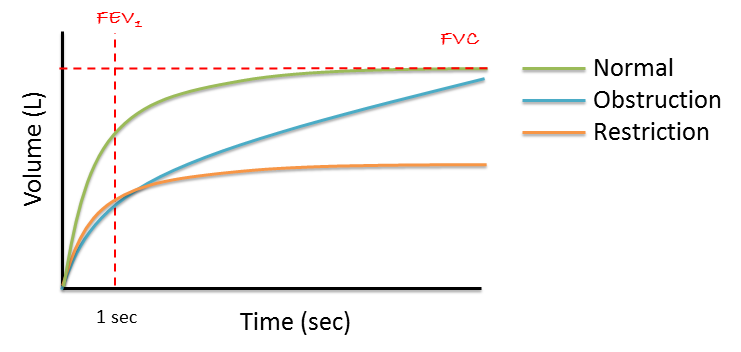
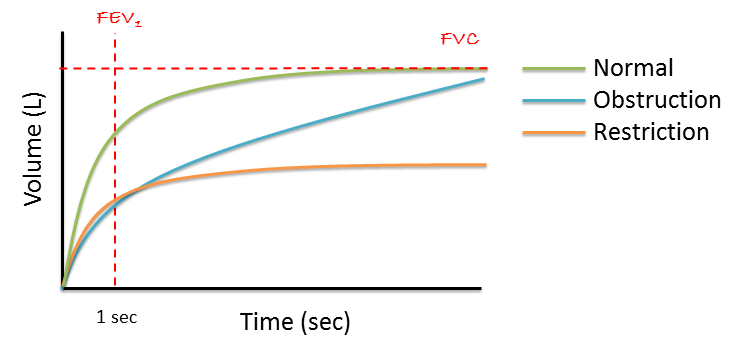
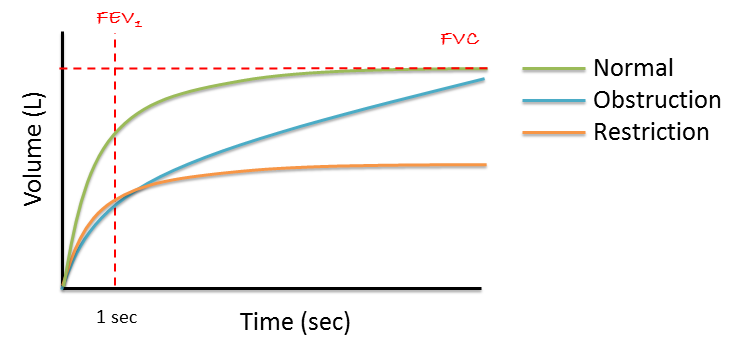
In spirometry, a time-volume graph is a graph which plots volume of air exhaled against time.
What determines the maximal filling of the lungs?
Maximal filling of the lungs is determined by the balance between maximum inspiratory effort and the force of recoil of the lungs
How is a restrictive deficit produced?
A restrictive deficit is produced when lungs are unusually stiff or inspiratory effort is compromised by muscle weakness, injury/deformity
See spirometry volume-time curve below:
How is an obstructive deficit produced?
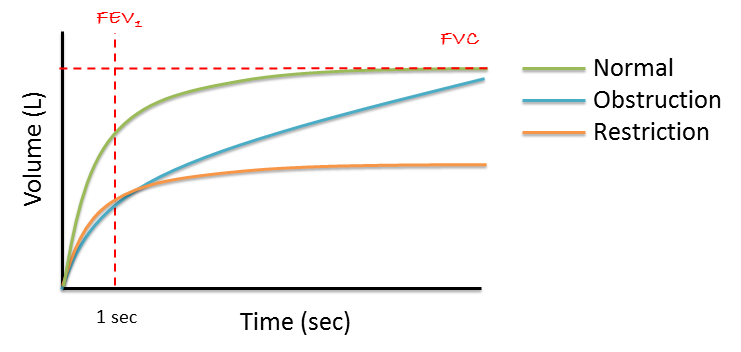
An obstructive deficit is produced when airways are narrowed resulting in compromised expiratory flow much earlier in respiration
How are obstructive and restrictive deficits distinguished?
Distinguished by measuring the FEV1:FVC
What is FEV1?
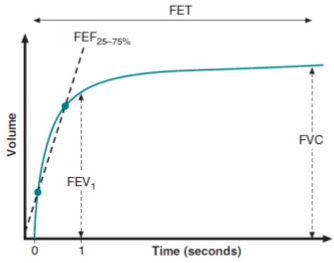
FEV1 is the forced expiratory volume in one second
What is FVC?
Forced vital capacity is the amount of air which can be forcibly exhaled from the lungs after taking the deepest breath possible
What is the Tiffeneau-Pinelli index (FEV1/FVC ratio) ?
- It is a calculated ratio used in the diagnosis of obstructive and restrictive lung disease
- It represents the proportion of a person’s vital capacity that they are able to expire in the first second of forced expiration to the full vital capacity
Usually, FEV1/FVC ratio > 70%
Describe FVC and FEV1 in an obstructive defect
- FVC is nearly normal
- FEV1 is reduced markedly
- FEV1/FVC ratio < 70%
Describe FVC and FEV1 in an restrictive defect
- FVC is reduced
- FEV1 is reduced proportionately
- FEV1/FVC ratio ≥ 70%
What is an expiratory flow volume loop?
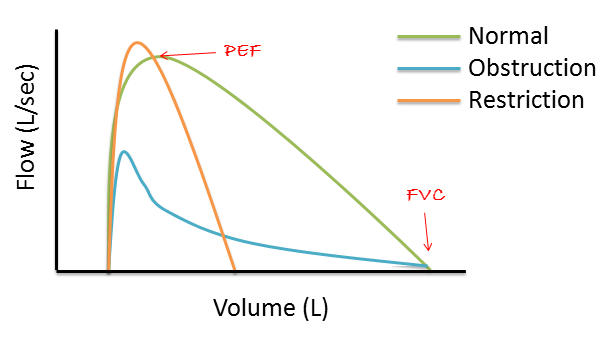
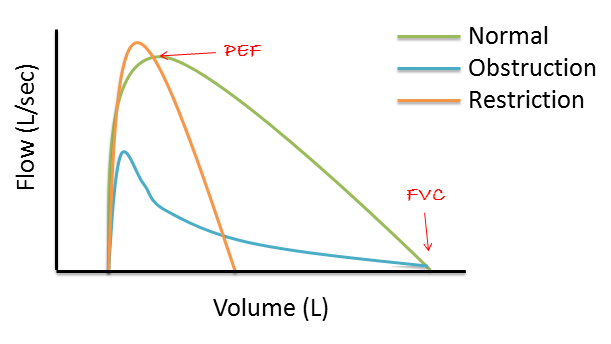
In spirometry, an expiratory flow volume loop is a graph which plots expiratory flow rate against lung volume
What is PEFR?
- Peak expiratory flow rate is a person’s maximum rate of expiration, as measured with a peak flow meter
- This occurs early in expiration as the airways are stretched to the largest diameter
Describe the normal expiratory flow in the lungs
As expiration continues, the small airways are narrowed by the compression of the lungs which increases flow resistance to the point where no more air can be driven out of the alveoli
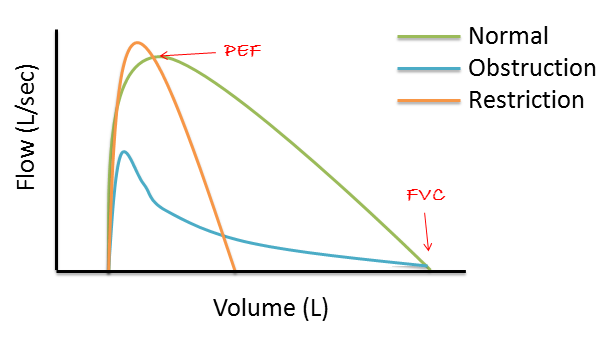
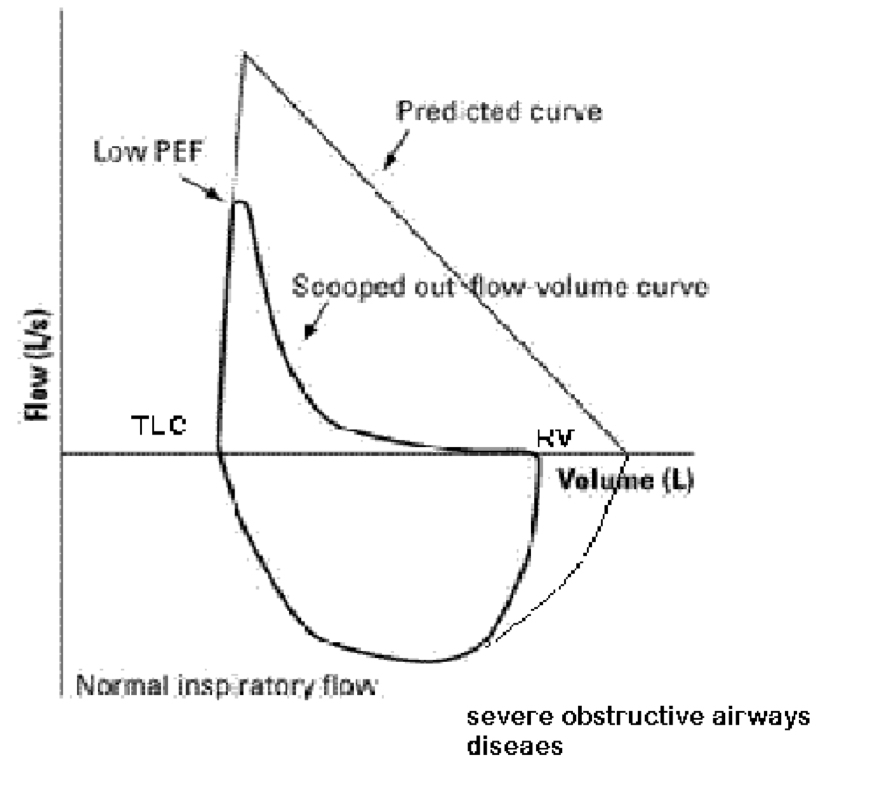
Obstructive deficits may be more senstively revealed by deriving an expiratory flow volume loop.
Why is this?
Where there is small airway obstruction, this narrowing produces a characteristic, early fall in expiratory flow rate
In normal individuals, what most affects PEFR?
PEFR is mostly affected by the resistance of large airways
Identify an obstructive respiratory deficit
Asthma
How can the mild obstruction of small airways be observed?
Mild obstruction leads to the ‘scalloping’ of the flow volume curve
How can one measure residual volume?
Residual volume can be measured using the helium dilution test


-
S1) Anatomy of the Respiratory System58
-
S2) Ventilation and Lung Mechanics42
-
S3) Properties of Gases28
-
S3) Gas Exchange in the Lungs31
-
S4) Carbon Dioxide in the Blood28
-
S4) Chemical Control of Breathing38
-
S5) Acid Base Balance60
-
S6) Lung Function Testing27
-
S6) Pulmonary Embolism23
-
S7) Respiratory Failure43
-
S8) Asthma31
-
S8) COPD21
-
S8) Cystic Fibrosis and Bronchiectasis10
-
S9) Tuberculosis42
-
S9) Lower Respiratory Tract Infections and Pneumonia40
-
S10) Radiology of the Chest39
-
S11) Signs and Symptoms of Respiratory Disease68
-
S12) Lung Cancer30
-
Clinical Conditions26



