What is Chronic Obstructive Pulmonary Disease?
- COPD is a disease state which encompasses both emphysema and chronic bronchitis and is characterised by airflow limitation that is not fully reversible
- Airflow limitation is progressive and associated with an abnormal inflammatory response of lungs to noxious particles/gases
What is emphysema?
Emphysema is a long-term, progressive disease of the lungs that primarily causes shortness of breath due to over-inflation of the alveoli
What is chronic bronchitis?
Chronic bronchitis is a chronic obstructive pulmonary disease involving a productive cough due to inflamed bronchial tubes and the overproduction of mucus
Describe the aetiology of COPD
- Tobacco smoking (90% of cases)
- Air pollution
- Occupational exposure
- Alpha-1 antitrypsin deficiency (rare)
Briefly, describe the pathophysiology of COPD
- The host response to inhaled cigarette smoke and other noxious substances causes a chronic inflammatory process and oxidative injury
- This affects central and peripheral airways, lung parenchyma, alveoli, and pulmonary vasculature
Describe 6 pathological changes which occur in COPD
- Enlargement of mucus-secreting glands
- Increased number of goblet cells
- Ciliary dysfunction
- Breakdown of elastin
- Larger air spaces → reduced gas exchange
- Vascular changes → pulmonary hypertension
What is the final pathological outcome of emphysema?
- Elastin breakdown
- Loss of alveolar integrity
- Loss of elastic recoil
- Permanent destructive enlargement of alveolar air spaces
What is the final pathological outcome of chronic bronchitis?
- Excessive mucus secretion (mucus glands & goblet cells)
- Impaired removal of the sections (ciliary dysfunction)
Provide 3 reasons as to why the pathological changes in COPD lead to increased airway resistance
- Luminal obstruction of airways by secretions
- Narrowing of small bronchioles due to elastin break down (loss of radial traction)
- Decreased elastic recoil leads to reduced expiratory force (air trapping)
In 5 steps, explain how pathological changes in COPD lead to pulmonary hypertension and right heart failure
⇒ Airway narrowing and destruction of lung parenchyma
⇒ Progressive hypoxia
⇒ Pulmonary vasoconstriction
⇒ Vascular smooth muscle thickening
⇒ Pulmonary hypertension (& right heart failure)
Identify 2 symptoms of COPD
- Cough (morning, productive)
- Breathlessness (initially on exertion, but progresses)
Identify and describe 5 signs of COPD
- Tachypnoea – compensate for hypoxia and hypoventilation
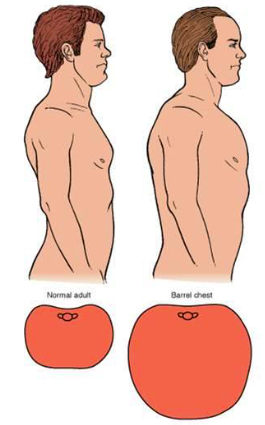
- Barrel chest – hyperinflation and air trapping due to incomplete expiration
- Hyper-resonance on percussion – hyperinflation and air trapping
- Reduced air entry – loss of lung elasticity and lung tissue breakdown
- Wheezing
Identify and describe 3 late signs of COPD
- Central cyanosis – respiratory failure
- Flapping tremors – CO2 retention (hypercapnia)
- Signs of right-sided heart failure (distended neck veins, hepatomegaly, ankle oedema) – pulmonary hypertension
Identify and describe 4 investigations for COPD
- Spirometry – obstructive pattern with FEV1/FVC ratio <70%, limited reversibility following treatment with bronchodilators
- Chest X-ray – hyper-inflated and hyperlucent lungs, flattened diaphragm, increased antero-posterior diameter of the chest
- Pulse oximetry and/or ABG analysis – assess for hypoxia and hypercapnia
- Alpha-1 antitrypsin level – atypical COPD (young patients and non-smokers)
Describe the conservative management of COPD
- Smoking cessation
- Patient education
- Pneumococcal vaccination
- Monitor patient weight, nutrition status and physical activity
Describe the specific management (pharmacological and surgical) of COPD
- Bronchodilators
- Inhaled corticosteroid
- Pulmonary rehabilitation (exercise, disease education, nutritional advice)
- Low dose oxygen therapy (long term – 16 hours per day)
- Surgery (removal of large bullae, lung volume reduction, lung transplant)
What is the acute exacerbation of COPD?
Acute exacerbation of COPD is an event characterised by a change in the patient’s baseline dyspnoea, cough, and/or sputum that is beyond normal day-to-day variations and is acute in onset
How do patients with acute infectious exacerbations present?
- Severe breathlessness
- Fever
- Chest pain
What are some complications of COPD?
- Recurrent pneumonia
- Pneumothorax
- Respiratory failure
- Right sided heart failure
Describe the management for the acute exacerbation of COPD
- Pulse oximetry and ABG analysis (hypoxia and hypercapnia)
- Antibiotics (Haemophillus influenzae, Strep pneumoniae)
- Nebulised bronchodilators
- Oral steroids
- Low dose oxygen therapy (24-28%)
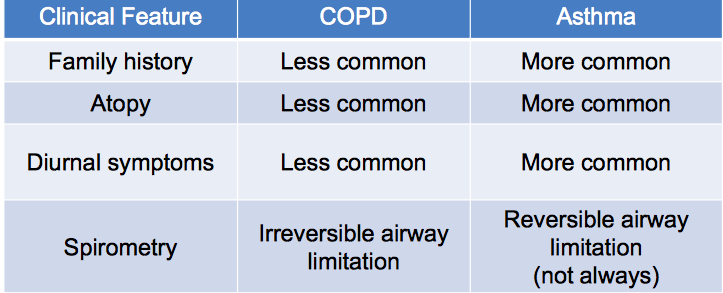
Distinguish between asthma and COPD in terms of the following factors:
- Family history
- Atopy
- Diurnal symptoms
- Spirometry

-
S1) Anatomy of the Respiratory System58
-
S2) Ventilation and Lung Mechanics42
-
S3) Properties of Gases28
-
S3) Gas Exchange in the Lungs31
-
S4) Carbon Dioxide in the Blood28
-
S4) Chemical Control of Breathing38
-
S5) Acid Base Balance60
-
S6) Lung Function Testing27
-
S6) Pulmonary Embolism23
-
S7) Respiratory Failure43
-
S8) Asthma31
-
S8) COPD21
-
S8) Cystic Fibrosis and Bronchiectasis10
-
S9) Tuberculosis42
-
S9) Lower Respiratory Tract Infections and Pneumonia40
-
S10) Radiology of the Chest39
-
S11) Signs and Symptoms of Respiratory Disease68
-
S12) Lung Cancer30
-
Clinical Conditions26



