Turbulence statistics differ case by case because of
- different surface forcing,
- geostrophic wind, or
- different sounding
Turbulence statistics differ case by case because of different surface forcing,
geostrophic wind, or different sounding.
But with proper …………….., most turbulent statistics of the PBL collapse onto some ……………….
scaling
universal curves, even though data are taken from different cases.
Turbulence statistics differ case by case because of different surface forcing, geostrophic wind, or different sounding.
But with proper scaling, most turbulent statistics of the PBL collapse onto some universal curves, even though data are taken from different cases.
In other words, ………………
if we can come up with proper scaling parameters, turbulent statistics obtained from a wide range of meteorological conditions can be normalized in such a way that their non‐dimensional statistics are similar.
Employing typical characteristic ……………………………enables us to derive …………………………….
length, time, and velocity scales
governing equations in a non‐dimensional form.
Employing typical characteristic length, time, and velocity scales enables us to derive governing equations in a non‐dimensional form.
The advantage is that we can
compare the relative importance of each contribution and reduce the number of parameters needed to study the atmospheric flow
Variables that frequently appear in combination with one another are grouped to form
new variables that may be nondimensional, such as the Richardson number,
Variables having simple dimensional units such as
velocity, length, or time in some cases are related to the most important scales of motion in the eddies
Turbulence Scales
- length scales
- Velocity scaales
- deardoff velocity scale (w*)
- Friction velocity scale (u*)
- time scales
length scales
- Altitude of the capping inversion, zi,
- for the whole boundary layer
- for statically unstable and neutral conditions.
- Aerodynamic roughness length z0
- for the surface layer (bottom 5% of PBL)
- indicates the roughness of the surface
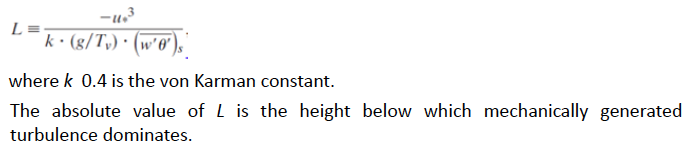
- Obukhov lenght (L)
- for statistically nonneutral conditions in the surface layer
Obukhov length (L)
Velocity Scales
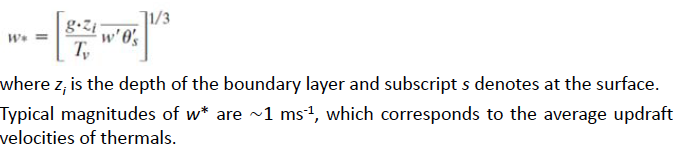
- Deardorff velocity scale (w*)
- characterizing the turbulent mixing due to free convection in an unstably stratified BL
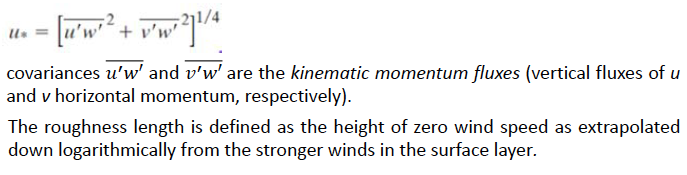
- Friction velocity velocity scale (u*)
- applicable to statically neutral conditions in the surface layer (the turbulence is mostly mechanically generated)
Deardorff velocity scale (w*) ‐
Friction velocity scale ‐ Another scale u*,
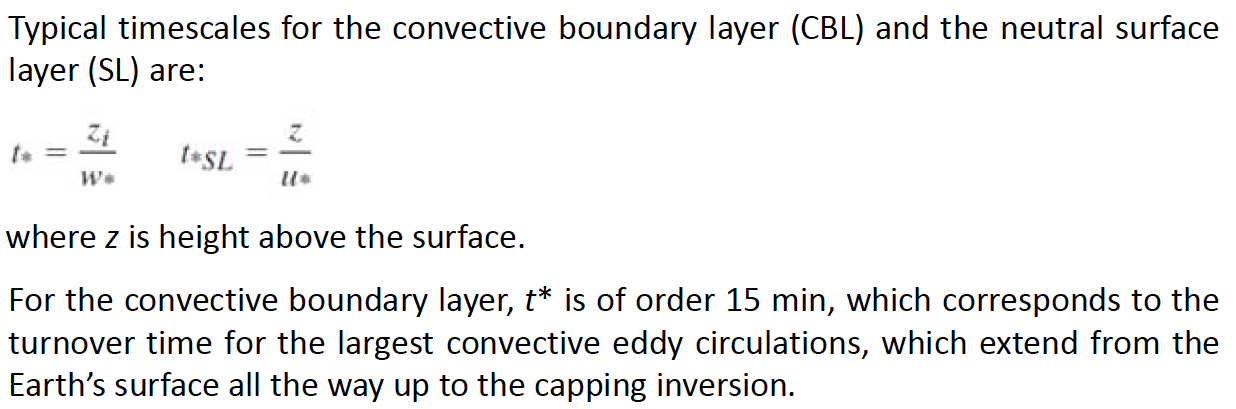
Time Scales
In summary, For convective boundary layers (ie………..) the relevant scaling parameters are ………….
(ie., unstable mixed layers)
w* and Zi
For the neutral surface layer, ……………… are applicable.
u* and z0
Scaling parameters for surface layers are
u*, z0, and L, provided that the stratification is not neutral.
Scaling laws describe
the functional relationship between two physical quantities that scale with each other over a significant interval.
Scaling laws describe the functional relationship between two physical quantities that scale with each other over a significant interval.
An example of this is
the scaling law for wind profile in the ABL
Wind profile ‐ the wind profile law
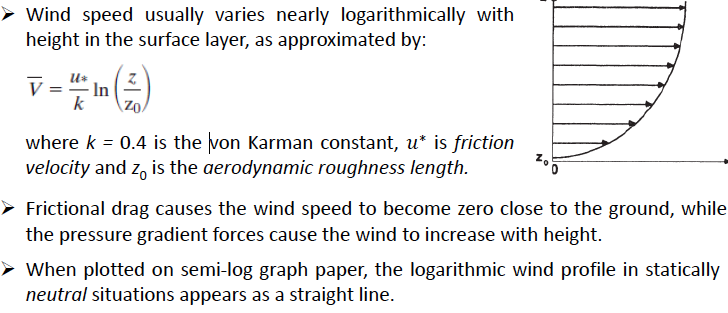
For non‐neutral situations. the wind profile
deviates slightly from logarithmic.
In stable boundary layers. the wind profile
is concave downward on a semi log plot
unstable boundary layers wind profile
are concave upward
Air stability refers to
the vertical moving tendency of an air parcel in response to a small disturbance.



