Turbulent statistics differ case by case because of
- surface forcing (surface temprature)
- geostrophic wind (impotant for wind shear)
- sounding (profile)
employing typical characteristic length, time and velocity scale enable us to
derive governing equations in non-dimentional form
scaling variables
- variables in combination to form new variable (ex: richardsons number Ri)
- variables having simple dimensional units (velocity, length, time)
- related to important scales of motion in eddies
length scales
- Zi: altitude of the capping inversion (length of BL for UNSTABLE and NEUTRAL)
- Zo (aerodynamic roughness length): indicates the roughness of the surface
- in the SL within 5% of the BL
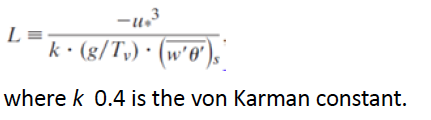
- L (Obukhau lenght): NON NEUTRAL at SL
- the absolute value of L indicates the height bellow which mechanically generated turbulences dominate
L equation
u3*: friction velocity
k: von kum. constant = 0.4
Tv: virtual temperature
w’g’: vertical turbulent heat flux at the surface
velocity scales:
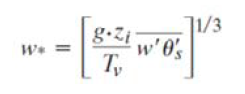
- Deardorff velocity scale (w*): for charactarising the turbulent mixing due to free convection in an unstable boundary layer
- typical magnitude (w*)= 1 m/s (average updraft velocity of thermals)
- thermals are small eddies that form during daytime
- typical magnitude (w*)= 1 m/s (average updraft velocity of thermals)
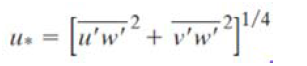
- friction velocitu (u*): applicable to NEUTRAL conditions in the SL
w* equation
Zi : PBL height
Tv: virtual temperature (depend on temperaure and moisture)
w’ O-‘: vertical heat flux
u* equation
u’w’ + v’w’: kinamatic momentum fluxes (vertical fluxes of u and v momentums (covarience))
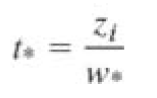
time scale for CBL
zi: PBL height
w*: PBL velocity
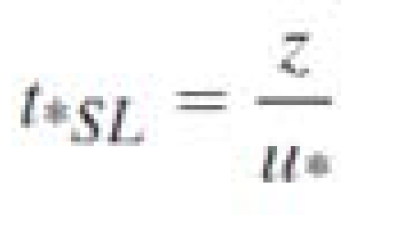
time scale for NEUTRAL SL
z: SL height
u*: friction velocity (velocity of surface layer)
summerize the scales
- length
- BL: Zi
- SL:
- Z0 (aerodynamic/ describe roughness)
- L (the height bellow which mechanical turbulences dominate)
- velocity
- BL: w*
- SL: u*
- Time
- BL: t*
- SL:t*SL
the scaling laws describe
the functional relationship between scaling variables
example: wind profile law for BL
wind profile law
(AND EQUATION)
wind speed varies near logarithmically with height in the SL
- Wind speed becomes zero near the ground due to FRICTIONAL DRAG
- wind increase with height due to PGF
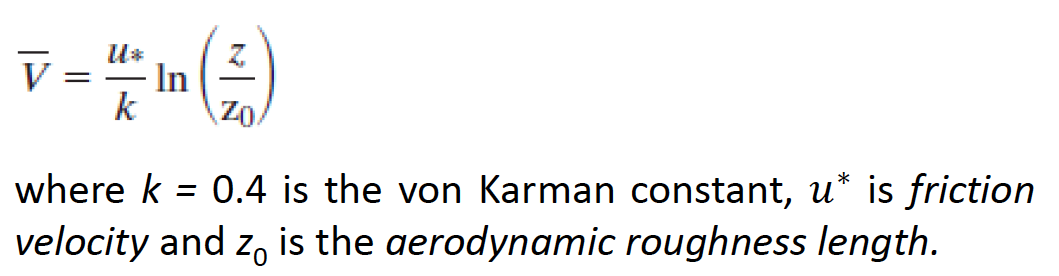
Wind profile law when plotted on semilog paper
- concave up for UNSTABLE BL
- straight line in neutral
- concave down for stable BL
IT increases non linearly
rate of change is different in different conditions (of stability)
Air stability
Tendancy (veritcal mixing tendancy) in responce to a small disturbance
- unstable: atm applifies and produce turbulances by BUOYANCY
- neutral: (wind shear) neutral conditions amplify due to:
- wind shear and
- viscous force
to produce turbulences (Shear turbulences/mechanical turb)
- stable: Richardson numbe <0.25 to produce mechanical turb
buoyance and turbulent production
- positive: UNSTABLE warm air rise
- generate turbulences
- Negative:
- destroy turbulences
stability criteria based on potential temperature
- positive: stable
- negative: unstable
- =0: neutral
to quantify the stability effects of the atmosphere two scaling variables:
- The richardon no
- the monin obukhov stability parameter
according to richardson number turbulent production depends on
- temperature stratification
- strength of winds
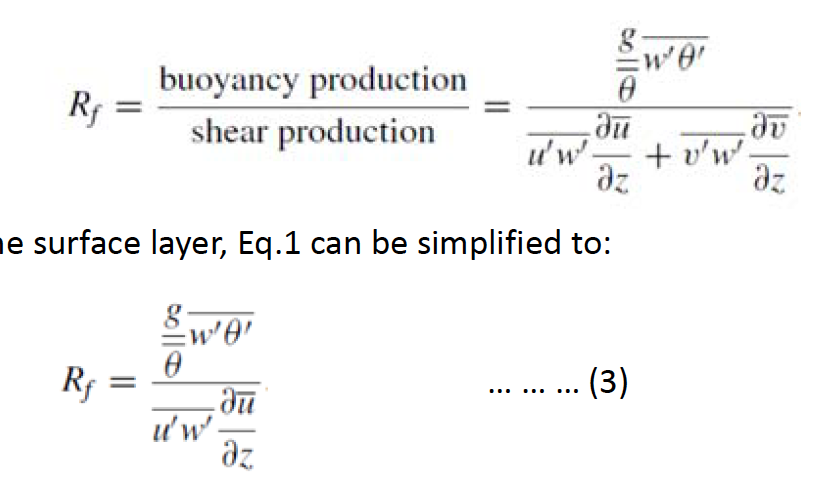
flux richardson number (Rf):
express the comined effect
- buoyancy can produce or destroy
- shear production of turbulence
flux richardson number equation:
term ignored because its small magnitude in the surface layer compared to u’w’….
stability criteria based on Rf
- Positive: STABLE
- shear prod > buoyancy prod
- buoyancy distroys turb
- shear prod > buoyancy prod
- =0: neutral
- negative: unstable
- shear prod < buoyancy prod
- both contribute to turbulences
- shear prod < buoyancy prod
how does buoyance and shear production change in convective boundary layer?
- Bouyancy term decreases linearly with ht
- Shear production term is highest near the surface and decrease more rapidly with ht (non linear)
- highest near the surface due to friction
Monin Obukhav stability parameter
donated by ع
is based on the fact that the vertical variation of
- mean flow and
- turbulent charactaristics
in SL depend on the surface momentum fluxes, measured by
- friction velocity u*
- buoyancy flux
- height z
A combination of these three gives (ع)



