Boyles law
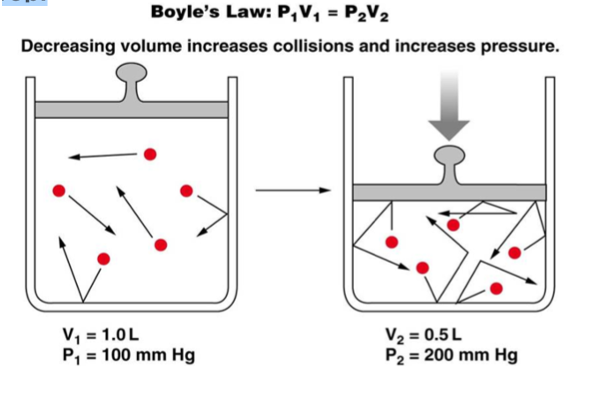
- Pressure (P) of a gas is inversely proportional to its volume (V)
- (if temperature & number of gas molecules remains constant in a closed system)
- This means that if you expand the space in which a gas is contained – the pressure will drop.
Kinetic theory of gases
Gas pressure is caused by the collisions of gas particles with the walls of the container
partial pressure gases
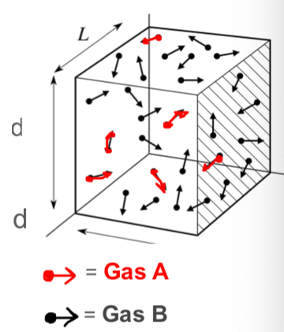
def: pp of gas is the pressure exerted by an individual gas in a mixture of gases
- Describes amount of a specific gas within a gas mixture
- Uses gas pp gradient to explain gas diffusion
- Gases diffuse down their pp gradient from high to low pp
- Use pp to calculate amount of gas dissolved in liquid
Calculating pp of gas in a gas mixture
(% gas A)x (total pressure) = partial pressure gas A
- Assumes there are no chemical reactions between gases
- Application of Daltons law
- In a. Mix of non-reacting gases, total pressure exerted is equal to the sum of pp of the individual gases
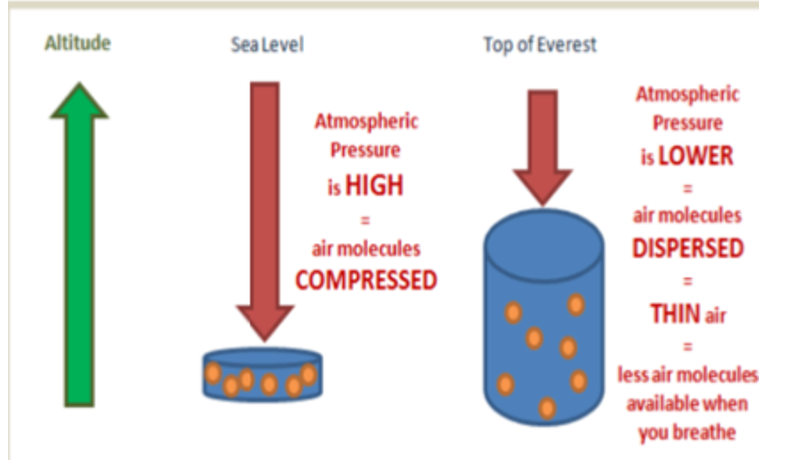
atmospheric pressure is the
- pressure exerted by the weight of the air above the earth in the atmosphere
At high altitudes
atmospheric pressure is lower (weight of air pressing down is less)
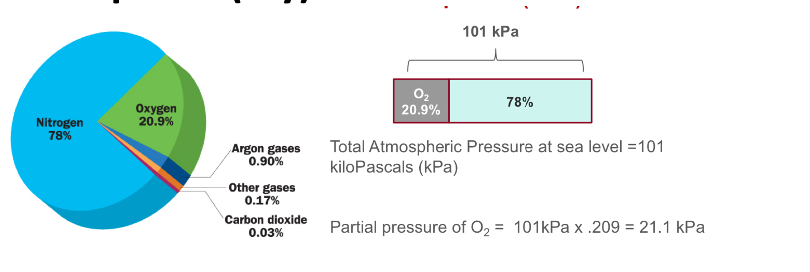
percentage of oxygen in atmospheric air
20.9%
percentage of nitrogen in atmospheric air
78%
percentage of argon in atmospheric air
0.17%
percentage of carbon dioxide in atmospheric air
0.03%
total atmospheric pressure (dry) at sea level
101kPa
partial pressure of O2 at dry atmopheric pressure at sea level
pp O2= 20.9% of 101kPa
therefore
0.209 x 101 kpa= ppO2= 21.1kPa
When we breath in air it is
moistened, water molecules in vapour form are added to air
Water vapour exerts a pressure called
saturated vapour pressure
displaces a proportion of the total pressure of the mixture of gases- in this cases, total atmospheric pressure
Saturated vapour pressure =……….. at body temp- only depends on temp
6.28 kPa
We need to subtract …………………from the total pressure of the dry gas mixture to arrive at the total pressure of gas mixture in a moist environment
water vapour pressure
pp of O2 and nitrogen in air we breath in (moist) at atmospheric pressure
therefore 101(kPa) – 6.28 (kPa) = 94.7 kPa =total pressure of gas mixture in a moist environment
- The other gases are still in the same ratios as in dry air
- pO2 = 94.7 kPa x .209 = 19.8 kPa= partial pressure oxygen in URT
- pN2 =(101-6.28)x.79 =73.8kPa
pCO2
partial pressure CO2- generic
pO2
partial pressure O2- generic
PACO2
partial pressure CO2 in alveoli ( big A= alveoli)
PAO2
partial pressure O2 in alveoli (big A= alveoli)
PaCO2
pp CO2 in arterial blood (little a= arterial)
PaO2
pp O2 in arterial blood (little a= arterial)
PvCO2
pp CO2 in venous blood


-
Lecture 1 & 2- Anatomy of the lungs47
-
Lecture 3- Mechanics underlying ventilation of the lungs58
-
Lecture 4- Clinical application in ventilation and lung mechanics88
-
Lecture 5- Gas exchange65
-
Lecture 5- V/ Q mismatch25
-
Lecture 6- Oxygen in blood and tissues28
-
Lecture 6- Other mechanisms facilitating oxygen delivery to tissues25
-
Lecture 7- CO2 transport in the blood45
-
Lecture 8- Chemical control of breathing: peripheral and central chemoreceptors29
-
Questions: V/Q mismatch and oxygen in the blood12
-
Lecture 9 - Respiratory and Urinary Unit Acid-Base Balance61
-
Lecture 10- Obstructive airway diseases68
-
Lecture 11- Chest X-ray part 166
-
Lecture 12- Pulmonary embolism61
-
Lecture 13- Pulmonary lung function tests50
-
Lecture 14- Lower respiratory tract infections and pneumonia68
-
Lecture 15- Bronchiectasis and Cystic fibrosis64
-
Tuberculosis and lung cancer quiz13
-
Lecture 16- Pneumothorax27
-
Lecture 17- Pleural effusion26
-
Lecture 18- CXR part 260
-
Lecture 19- Tuberculosis47
-
Lecture 20- Lung cancer38
-
Respiratory failure clinical signs and symptoms quiz13
-
Lecture 21- Respiratory failure60
-
Lecture 22- Symptoms and signs of respiratory disease58
-
Lecture 23- treating tobacco addiction11



