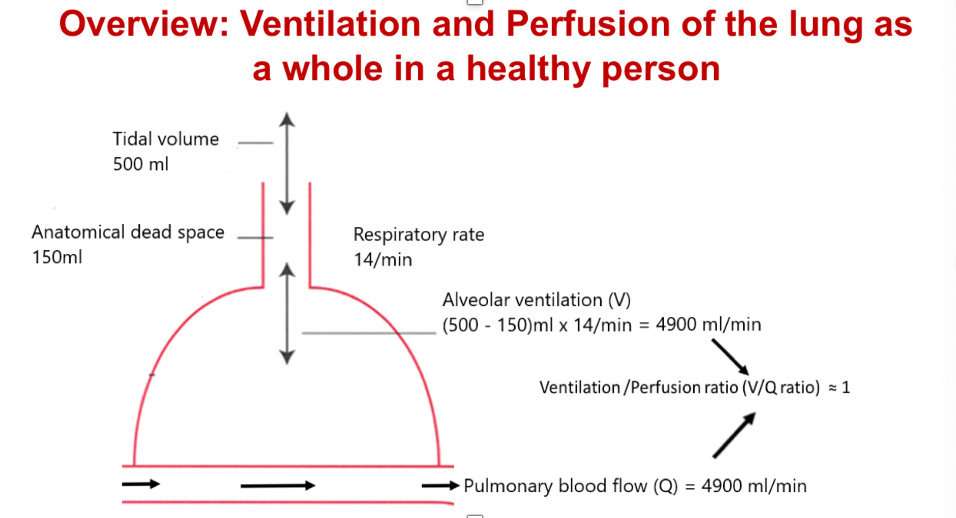
ventilation and perfusion of the lungs as a whole in a healthy person
- Ventilation
- tidal volume =500ml
- anatomical dead space (trachea , bronchi etc)= 150ml
- respiratory rate= 14/min
- alveolar ventilation (V)= (500-150) x 14/min= 4900ml/min
- Pulmonary blood flow (Q)
- =4900ml/min
- therefore Ventilation/perfusion ratio= 4900/4900= 1
will a well ventilated but poorl perfused lung have a V/Q ratio of above or below 1
give the equation your own numbers
2= done fully
1= not done fully
therefore
V= 2 (well ventilated)
Q= 1 (poorly perfused)
2/1= 2 therefore >1
therefore if its above 1= well ventilated, poorly perfused
will a well perfused but poorly perfused lung be above or below 1
give the equation your own numbers
2= done fully
1= not done fully
therefore
V= 1 (poorly ventilated)
Q= 2 (well perfused)
1/2= 0.5 therefore <1
therefore if its below 1= well perfused, poorly ventilated
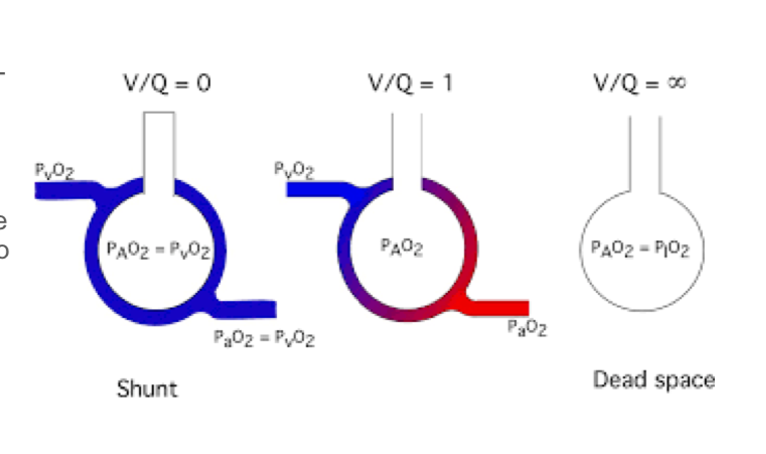
blood perfusing an area of lung that has no ventilation will
remain un-oxygenated- no gas exchange possibel –> SHUNT
V/Q= 0
Aeea of lung with normal venitlation but no perfusion- gas entering and leaving alveoli without gas exchnage- no o2 extraction, no CO2 added–> no gas exhange beecause there is no blood flow to the area–> this becomes….
dead space
when venitlation exceed perfusion
V/Q >1 = wasted air
when perfusion exceeds ventilation
V/Q <1 - low V/Q
- this is what is typically meant by V/Q mismatch
- arterial blood will have low Oxygen
Ventilation and perfusion has to be
be matched throughout the lungs
- Gas exchange optimal when: V/Q ratio of individual alveolar units=
1
- 300 million alveoli – may have differing amounts of
ventilation and perfusion
- Ideally:
- Alveoli with increased ventilation should have ……….. perfusion
- Alveoli with …………. ventilation should have decreased perfusion
increased
decreased
when alveolar pAO2 is low due to impaired ventilation…..
- hypoxic vasoconstriction of pulmonary arterioles occurs
- This diverts blood to better ventilated alveoli
- However, this process is not complete, so in disease states, poorly ventilated alveoli still have significant perfusion
in normal lungs v/Q is around
- 0.8 or 0.9
V/Q above 1 at the …………….and below 1 the ……………….
top of the lungs
further down the lungs
Ventilation increases more slowly than blood flow increases
Why do we have V/Q mismatch in normal lungs?
- As a reserve- V:Q match approaches 1 when we exercise
- V<q>
</q><li>V>Q= >1 (high V/Q)</li></q>
V/Q is the most common cause of
- of systemic arterial hypoxaemia in people with cardio-pulmonary disease- hypoxaemia= low pp oxygen in arterial blood
- Increases with ages
specific diseases associated with systemic arterial hypoxaemia caused by V/Q mismatch
- Asthma- airway narrowing but not uniformly dispersed in lungs
- Early stage COPD- airway narrowing but not uniformly dispersed in lung
- Pneumonia- acute inflammatory exudate in affected alveoli
- Respiratory distress syndrome in Newborn- some alveoli open, others not
- Pulmonary oedema- fluid in alveoli
- Pulmonary embolism
example diagram of healhy lung V/Q =1
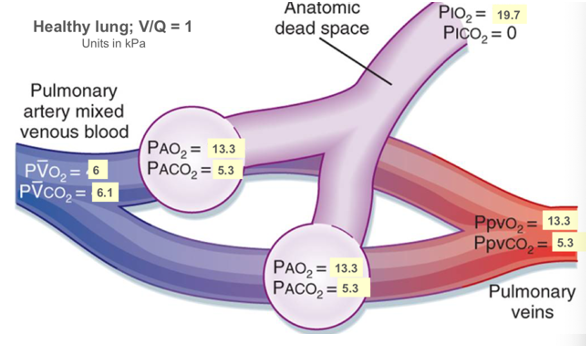
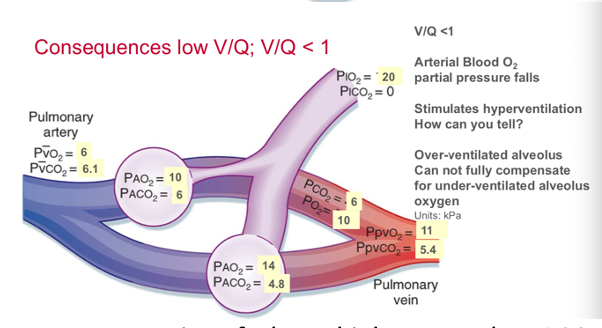
diagram showing consequence of low V/Q: V/Q <1
e. g. due to poor ventilation e.g. asthma
- perfusion all good
- arterial blood O2 will begin to fall
- stimulating hyperventilation
- However nearby alveoli can slightly compensate for poorly
- over-ventilated alveolus cannot fully compensate for e ventilated alveolus oxyge
- therefore pulmonary vein will have lower than normla PpVO2
- If the alveoli didn’t compensate the ppvo2 and Ppvco2 of the pulmonary vein would be lower pO2= 6 and PCO2=10, instead it is pO2= 11 and PCO2=5.4
Why cant over- ventilated alveoli fully compensate for under-ventilated alveoli?
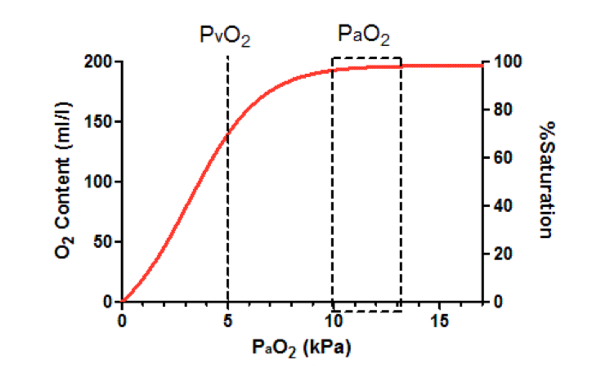
- 98% of our oxygen carried on Hb
- Only 2% oxygen dissolved
- PP reflects dissolved oxygen
- Going form a partial pressure of 13kPa to 15 kPa only increases dissolved oxygen by 0.02 mmol/L
- Hb is already carrying all that is can carry- saturated
- So very little additional oxygen for loading onto haemoglobin from poorly perfused alveoli
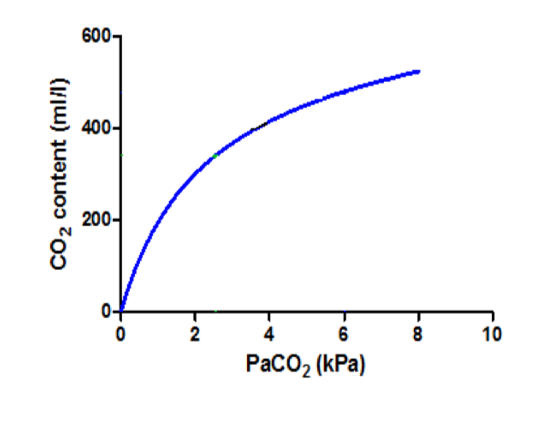
graph showing relationship between pCO2 and total CO2 contents in blood
- Relatively straight line in the physiological range of CO2 i.e. there is a linear relationship between pCO2 and blood total CO2
- This because CO2 is very soluble in blood
- The dissociation curve is also quite steep- meaning that it is easy for CO2 to drop with even small decreases in PP
- These two factors explain why CO2 in blood is directly proportional to alveolar minute ventilation
which two factors explain why CO2 in blood is directly proportional to alveolar minute ventilation
- This because CO2 is very soluble in blood
- The dissociation curve is also quite steep- meaning that it is easy for CO2 to drop with even small decreases in PP
Consequence of NO ventilation but still perfused- SHUNT
- Blockage e.g. tumour or mucus plug
- Blood still perfusing the alveolar- however due to blockage low pp in alveolar therefore pp of pulmonary artery will not change once passing this alveoli
- Pt now hyperventilating to increase oxygen level (which you can see in the alveoli compensating for the shunted alveoli)
- However compensation not enough – still too low in pulmonary vein (can never be compensated fully in a SHUNT situation)
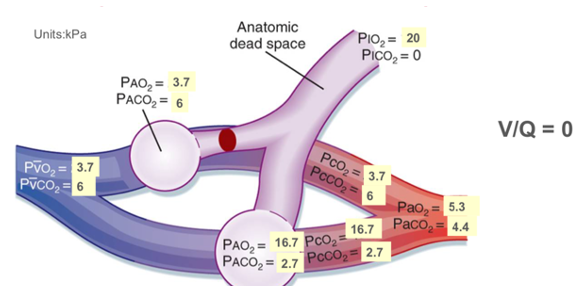
example of a V/Q mismatch higher than 1
Pulmonary embolism


-
Lecture 1 & 2- Anatomy of the lungs47
-
Lecture 3- Mechanics underlying ventilation of the lungs58
-
Lecture 4- Clinical application in ventilation and lung mechanics88
-
Lecture 5- Gas exchange65
-
Lecture 5- V/ Q mismatch25
-
Lecture 6- Oxygen in blood and tissues28
-
Lecture 6- Other mechanisms facilitating oxygen delivery to tissues25
-
Lecture 7- CO2 transport in the blood45
-
Lecture 8- Chemical control of breathing: peripheral and central chemoreceptors29
-
Questions: V/Q mismatch and oxygen in the blood12
-
Lecture 9 - Respiratory and Urinary Unit Acid-Base Balance61
-
Lecture 10- Obstructive airway diseases68
-
Lecture 11- Chest X-ray part 166
-
Lecture 12- Pulmonary embolism61
-
Lecture 13- Pulmonary lung function tests50
-
Lecture 14- Lower respiratory tract infections and pneumonia68
-
Lecture 15- Bronchiectasis and Cystic fibrosis64
-
Tuberculosis and lung cancer quiz13
-
Lecture 16- Pneumothorax27
-
Lecture 17- Pleural effusion26
-
Lecture 18- CXR part 260
-
Lecture 19- Tuberculosis47
-
Lecture 20- Lung cancer38
-
Respiratory failure clinical signs and symptoms quiz13
-
Lecture 21- Respiratory failure60
-
Lecture 22- Symptoms and signs of respiratory disease58
-
Lecture 23- treating tobacco addiction11



