Define:
Homogeneous equilibrium
Heterogeneous equilibrium
Homogeneous equilibrium = An equilibrium in which all th species making up the reactants and products are in the same physical state
Heterogeneous equilibrium = An equilibrium in which all th species making up the reactants and products are in different physical states
Define Le Chatelier’s Principle
When a system in dynamic equilibrium is subjected to an external change, the system readjusts itself to minimise the effect of the change and to restore equilibrium
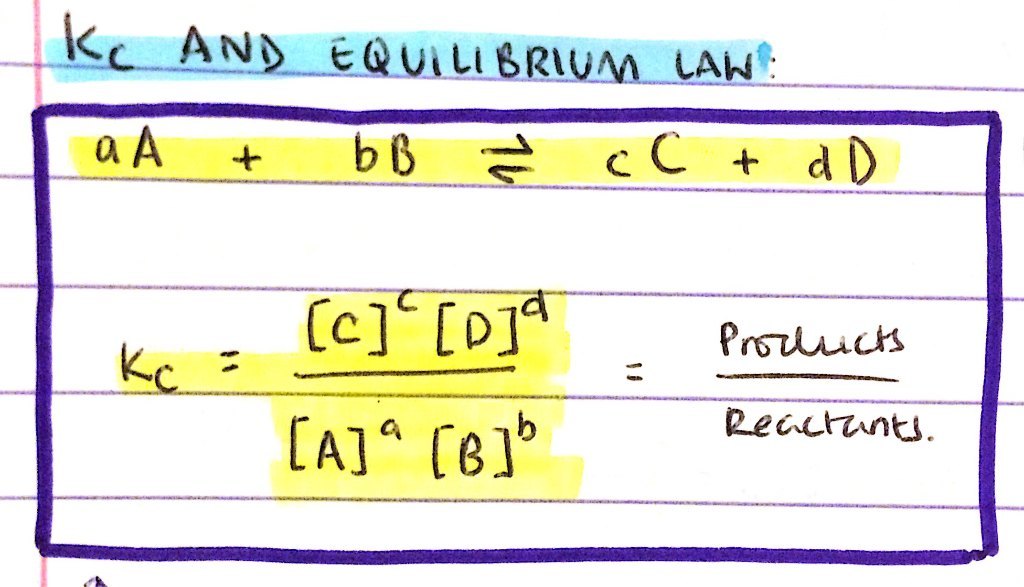
Define the equilibrium law and it’s relationship with Kc = ?
Units of Kc = ?
Units = Change but note that each concentration is moldm-3
What does each include:
- Kc
- Kp
Kc = gases, liquids and aqueous compounds
Kp = gases only
Equation:
Ideal gas law = ?
Units and common conversions
PV = nRT
P = Pressure / Pa
V = Volume / m3 (1m3 = 1000dm3 = 1 x 106cm3)
n = Moles
R = Gas constant (on data sheet)
T = Temperature / K (+273 to convert from °C → K)
Partial pressure of gas A = ?
Partial pressure of gas A = Mole fraction x Total pressure
Mole fraction of gas A = Moles of gas A / Total no’ of moles in mixture
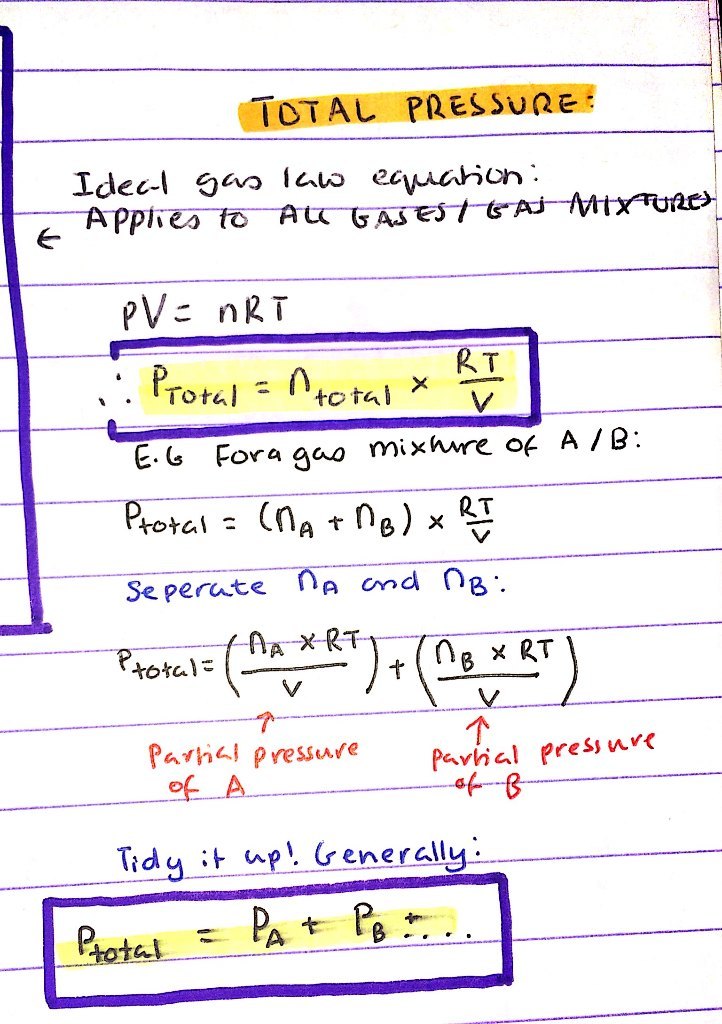
Total pressure = ?
PTotal = nTotal x (RT / V)
(rearrangement of PV = nRT)
You could also add up all the partial pressures:
PTotal = nA + nB + … x (RT / V)
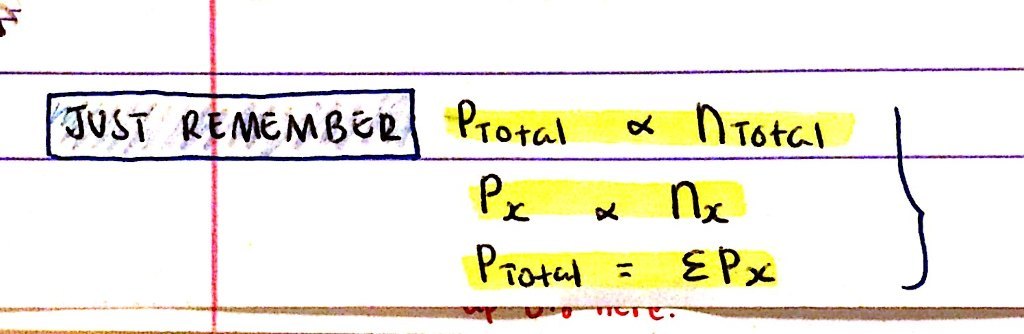
What is the relationship betwwen pressure and the no’ of moles?
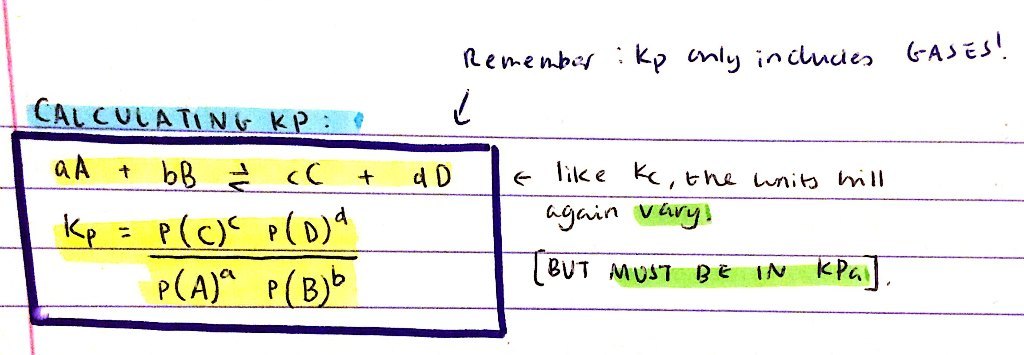
Define the equilibrium law and it’s relationship with Kp = ?
Units of Kp = ?
Units = Vary but must be in KPa
You can make these assumptions only when?
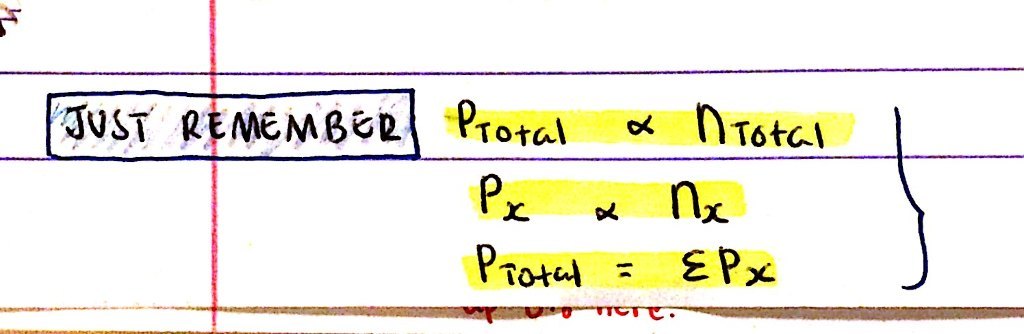
The temperature and volume are constant
Define what a dynamic equilibrium means (4)
Dynamic equilibrium = The equilibrium that exists in:
- A closed system
- When the rate of the forward reaction = rate of backward reaction
- Concentration (or anything macrophysical - can be measured) don’t change
- The equilibrium can be approached from both sides
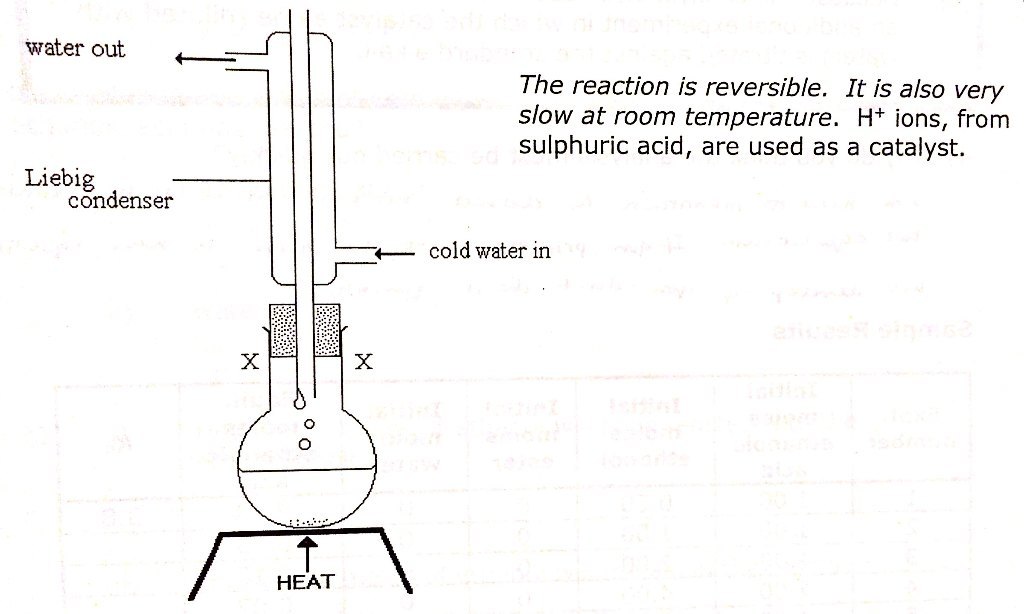
Describe an experiment to determine Kc from experimental results - esterification reaction: (5)
Use this as the example:
CH3CH2OH + CH3COOH ⇌ CH3COOCH2CH3 + H2O
Why does the analysis need to be carried out quickly?
- In conical flask:
- Mix known moles of ethanol, ethanoic acid, ethyl ethanoate and water with a small known mass of conc H2SO4 catalyst
- ethyl ethanoate = 0 at the start
- Mix known moles of ethanol, ethanoic acid, ethyl ethanoate and water with a small known mass of conc H2SO4 catalyst
- Flask is maintained at constant temperature until equilibrium has been reached
- Further flasks containing different initial amounts are prepared and allowed to equilibrate - put stopper on all flasks.
- Flasks are titrated against a standard solution of NaOH(aq)
- Create a control by adding an equal amount of the conc H2SO4 catalyst into a second flask, dilute it with water and titrate against standard solution of NaOH(aq)
- Need this because acid catalyst also reacts with the alkali
Analysis must be carried out as fast as you can because as soon as you pipette the solution out, it’s no longer in a closed system ∴ no longer the same equilibrium
The value of Kc and how this affects the position of equilibrium
Kc > 1
- Equil favours products - [large] / [small] ∴ Kc increases
Kc < 1
- Equil favours reactants - [small] / [large] ∴ Kc decreases
Kc = 1
- Dynamic equilibrium
The value of Kp and how this affects the position of equilibrium
Kp > 1
Equil favours products - [large] / [small] ∴ Kp increases
Kp < 1
Equil favours reactants - [small] / [large] ∴ Kp decreases
Kp = 1
Dynamic equilibrium
Factors that affect Kc
Temperature only!
Le Chatelier’s Principle takes care of changes in pressure and concentrations
Exothermic reactions:
- Increase temp
- Equil favours backward reaction as it’s endothermic
- More reactants produced
- Kc decreases - [small] / [large]
Endothermic reactions:
- Increase temp
- Equil favours forward reaction as it’s endothermic
- More prducts produced
- Kc increases - [large] / [small]
Factors that affect Kp
Temperature only!
Le Chatelier’s Principle takes care of changes in pressure and concentrations
Exothermic reactions:
- Increase temp
- Equil favours backward reaction as it’s endothermic
- Partial pressures of reactacts increase and partial pressures of products decrease
- Kp decreases - [small] / [large]
Endothermic reactions:
- Increase temp
- Equil favours forward reaction as it’s endothermic
- Partial pressures of reactacts decrease and partial pressures of products increase
- Kp increases - [large] / [small]
Affect of catalysts on equilibrium constants? (3)
No affect
- Catalysts affect the rate of a chemical reaction but not the position of equilibrium
- Catalysts speed up both the rate of the forward and backward reactions in the equilibrium by the same factor
- Equilibrium is reached quicker but the equilibrium position in not changed
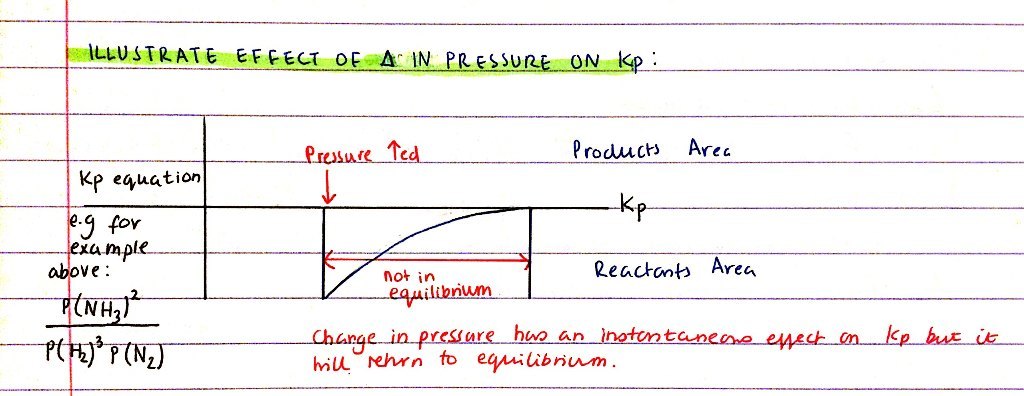
Illustrate through a graph the affect of a change in pressure on Kp
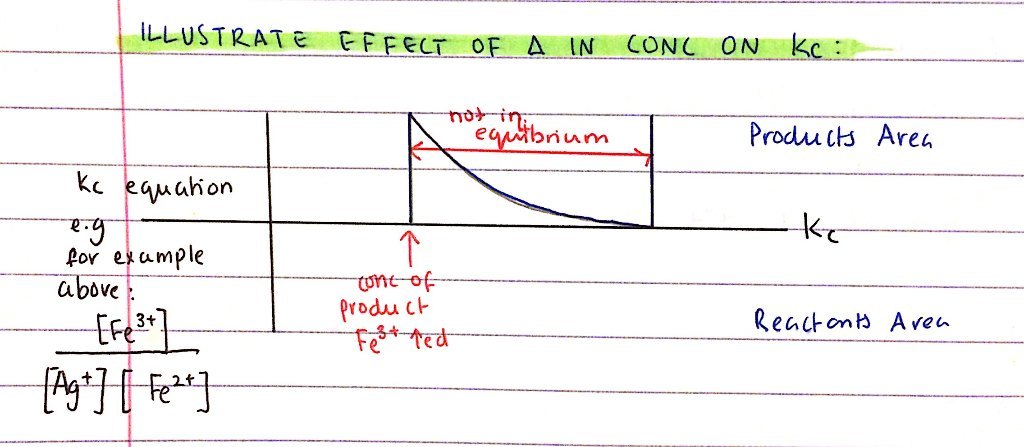
Illustrate through a graph the affect of a change in concentration on Kp

-
5A - Rates definitions10
-
5A - Rates23
-
5B - Equilibria definitions10
-
5B - Equilibria19
-
5C - Acids & pH definitions18
-
5C - Acids & pH32
-
5D - Lattice enthalpy & Free energy definitions19
-
5D - Lattice enthalpy & Free energy26
-
5E - Redox definitions13
-
5E - Redox35
-
5F - Transition elements definitions13
-
5F - Transition elements56
-
5F - Transition elements - oxidation state & colours18
-
6A - Aromatic compounds29
-
6B - Carbonyls20
-
6C - Acids & Esters41
-
6D - Amines, amides & polyamides39



