Define:
D-block element
Transition metal
D-block element = A element that has electrons entering the d-subshell
Transition metal = A d-block element that forms at least one ion with an incomplete d-subshell
What type of bonding exists in d-block elements and what is their stuctural arrangement?
Metallic bonding
Arranged in a giant lattice structure
Physical properties of D-block elements:
- Melting points / Boiling points
- Ability to conduct electricity
- Solubility in water
Give an example of each
HIGH MELTING / BOILING POINT:
- Strong electrostatic forces of attraction between +ve metal ions and delocalised electrons ∴ require large amounts of energy to break
- E.g. titanium to make irons
CONDUCTS ELECTRICITY BOTH MOLTEN AND SOLID:
- Solids: delocalised electrons free to move around and act as free mobile charge carriers. Ions are fixed in place.
- Molten: Both metal ions and delocalised electrons act as free mobile charge carriers
- E.g. Copper (electrical wiring)
INSOLUBLE IN WATER:
- Strong electrostatic forces of attraction between metal ions and delocalised electrons can’t be overcome by water molecules
- BUT some metals react with water, just very slowly such as iron rusting
- E.g. Iron used to make steel for buildings
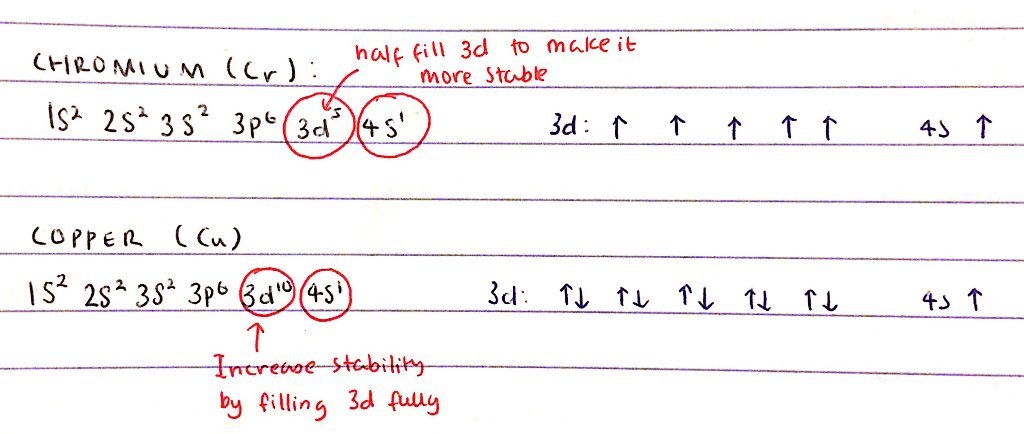
- State the 2 elements that are different when writing out electronic configuration
- Explain how are they different and write out their electronic configuration as well
Chromium:
- Takes 1 out from 4s to half fill the 3d sub-shell
Copper:
- Takes 1 out from 4s to completely fill the 3d sub-shell
They do this to make the element more stable
Properties of transition metals (3)
Give 2 examples of each property and include any necessary equations
MULTIPLE OXIDATION STATES:
- Iron in compounds can be Fe2+ or Fe3+
- Copper in compounds can be Cu+, Cu2+ or Cu3+
FORM COLOURED IONS IN SOLUTION:
- Fe2+(aq) = Pale green and Fe3+(aq) = Yellow
- Cu2+(aq) = Blue and Cu+(aq) = Colourless
THE ELEMENT AND THEIR COMPOUNDS CAN ACT AS CATALYSTS:
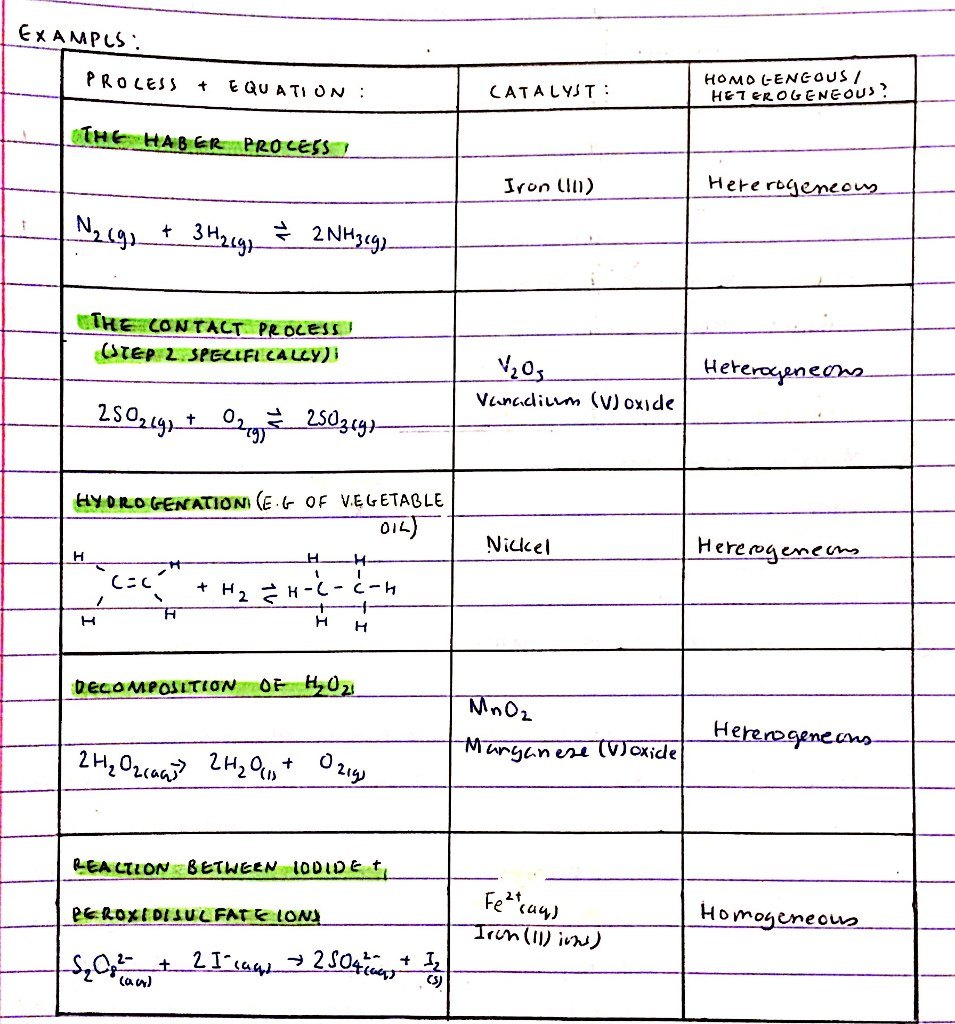
- Iron used in Haber process to produce NH3(g)
- N2(g) + 3H2(g) ⇌ 2NH3(g)
- V2O5 used as a catalyst for contact process
- 2SO2(g) + O2(g) ⇌ 2SO3(g)
Transition elements can quite easily form different oxidation states such as Fe2+ / Fe3+ but why is this not true for Group 1 and 2 metals?
- The energy difference in forming compounds of different oxidation states like Fe2+ / Fe3+ isn’t that great ∴ both can exist
- Not the case for Group 1 and 2 metals:
- Removing electrons involves big increases in ionisation energy because electrons are removed from shells closer to the nucleus
The different oxidation states of compounds formed and their stability
Transition elements have variable oxidation states, these won’t all have the same energy or stability so one oxidation state will be more favoured than the other
Transition metals form coloured ion solutions
How do we see the colours that we do? + Example
- When light passes through a coloured substance, specific wavelengths of light is absorbed
- We see a mixture of what’s NOT absorbed, the complementary colour to that which is absorbed
E.g. Solution that absorbs green light will appear red
How transition elements produce coloured ion solutions - electron promotion
How is white light produced? What transition metal would appear as white?
- Transition metal ions can absorb energy from visible light to promote electrons from lower to higher energy levels
- BUT that means there must be space available in d-orbital sub-shells to do this
White light = when 3d sub-shell is full or empty
- Zinc has a full 3d subshell
What does the transitional property of colour in transition elements forming coloured ion solutions depend upon?
The metal ions having a partially flled d-subshell
Transition elements and catalytic behaviour: (3)
Why do they make good catalysts?
- Variable oxidation states make them good catalysts
- Good homogeneous catalysts:
- Because they take part in Redox reactions and form intermediates with reactants through an alternative route where the Ea in lowered
- Good heterogeneous catalysts:
- Because they can easily adsorb reactants, weakening bond within reactants
Define adsorption
Adsorption = The process that occurs when a gas, liquid or solute is held the the surface pf a solid where the chemical reaction takes place on
THINK ADHERE!
Define catalyst
Catalyst = A substance that increases the rate of a chemical reaction by providing the reaction with an alternative route that has a lower activation energy. It alos doesn’t get used up in the process
2 advantages of using catalysts
- Reduced energy uasge
- Reduced from toxicity exposure to transition metals
Give 5 examples of transition metals being used as catalysts:
- Name of catalyst
- Reaction it’s used in
- Necessary equation
- Homogeneous / heterogeneous
Name the 2 redox titration reactions you need to know and what they are used for
Manganate (VII) titration
- Used to find the concentration of reducing agents
Iodine / Thiosulphate titration
- Used to find the concentration of oxidising agents
Give the steps for the general procedure for conducting a titration (7)
- Add standard solution of known conc into burette
- Use a volumetric pipette (10cm3) to pipette a sample of the solution being analysed into a conical flask (100cm3)
- If required, add a few drops of indicator as well as additional reactants
- e.g. excess H+ ions
- Carry out a rough titration
- Gives indication of end point
- Carry out accurate titrations until you have 2 or more concordant titres (± 0.1cm3)
- All values recorded to 2 d.p with units in a table
- Calculate mean average titre
Describe the procedure of carrying out a redox titration: manganate (VII) titration (7)
NOTE:
MnO4- ions are reduced ∴ other cheimcal must be oxidised (unknown is the reducing agent)
- Standard solution of KMnO4(aq) added to burette
- Use a volumetric pipette (10cm3) to pipette a sample to be analysed into a 100cm3 conical flask
- Add excess of dilute H2SO4(aq) to provide H+(aq) ions for the reduction of MnO4-(aq) ions.
- No indicator is needed
- Titration is complete when you add 1 extra drop of KMnO4(aq) and the solution produces a colour change colourless → pale pink
- Indicates an excess of MnO4-(aq) ions as they should decolourise as they react to produce a colourless solution
- Carry out 1 rough titiration then accurate titrations afterwards.
- Repeat experiment until 2 or more concordant titres are achieved (± 0.10 cm3)
- Take the mean average titre for calculations
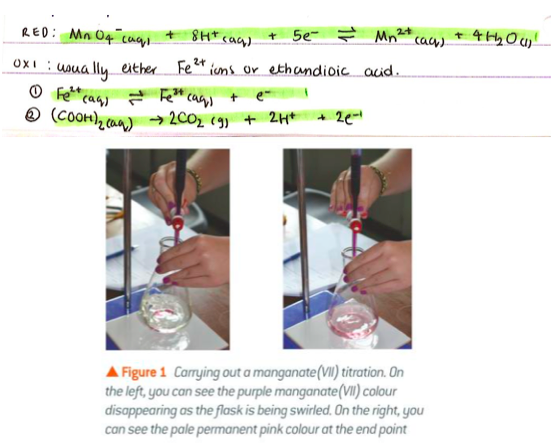
For a redox titration of manganate (VII):
- Why is reactions with Fe2+(aq) not a suitable redox titration at very high concentrations?
- What is (COOH)2 . xH2O?
- How is the value of x determined?
- What happens to xH2O when (COOH)2 . xH2O is dissolved in water?
- Reaction with Fe2+(aq) ions is not really a suitable redox titration at very high concentrations because Fe3+(aq) is ORANGE ∴ it would be hard to see the end point
- (COOH)2 . xH2O = solid ethanoic acid where x is determined through a redox titration with MnO4-(aq) ions
- xH2O becomes a part of the solvent when (COOH)2 . xH2O is dissolved in water
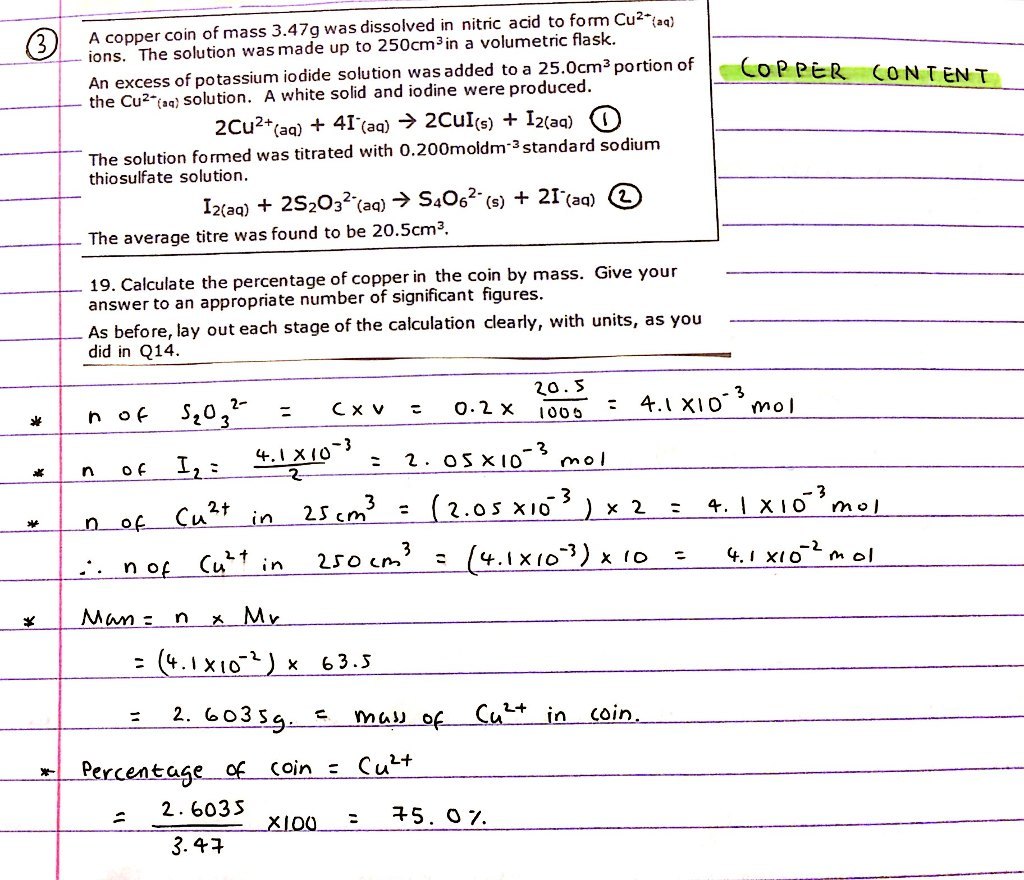
Question:
Redox calculation
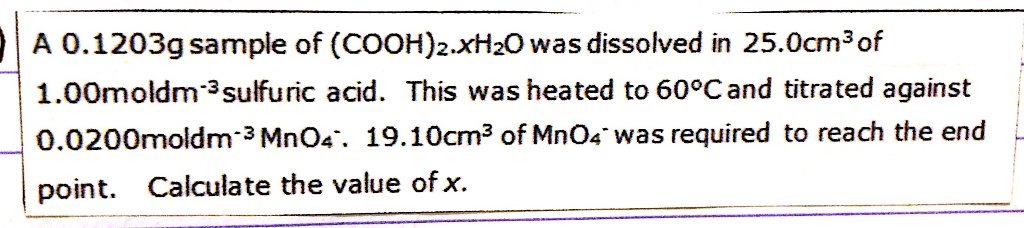
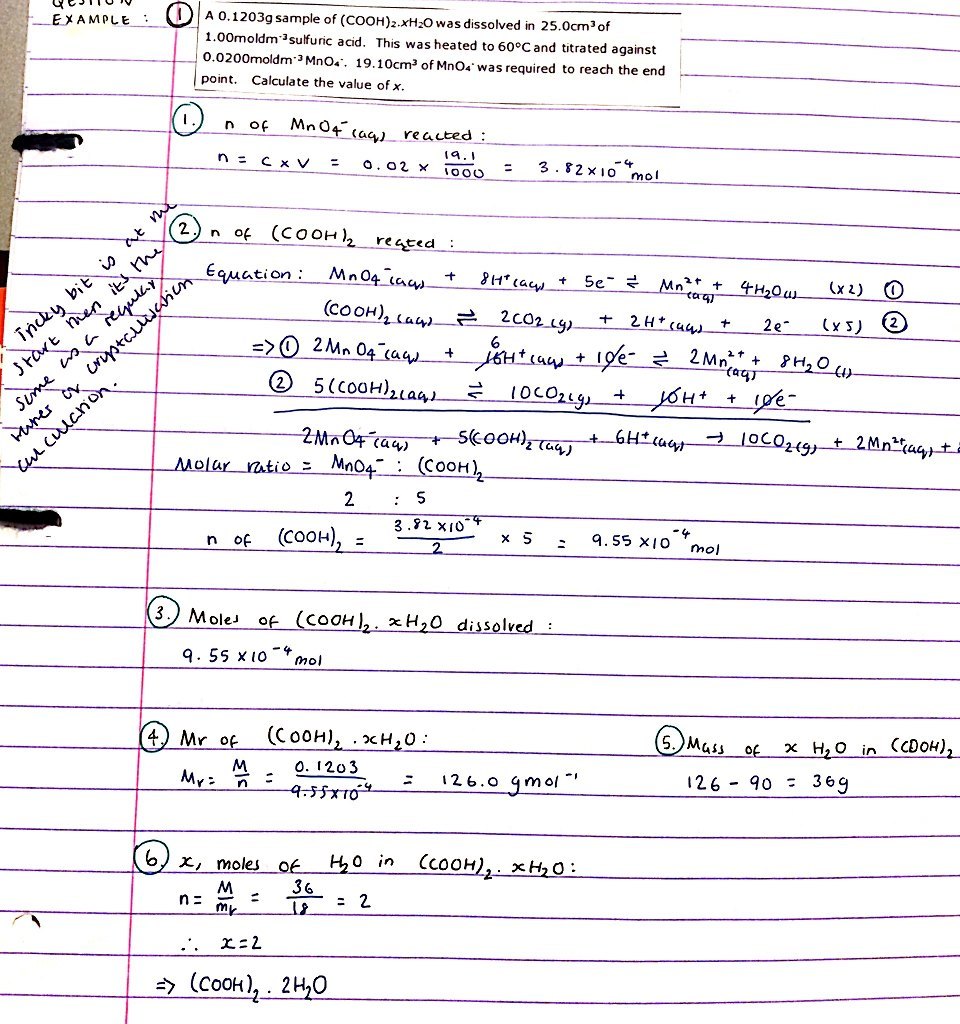
Question:
Redox titration
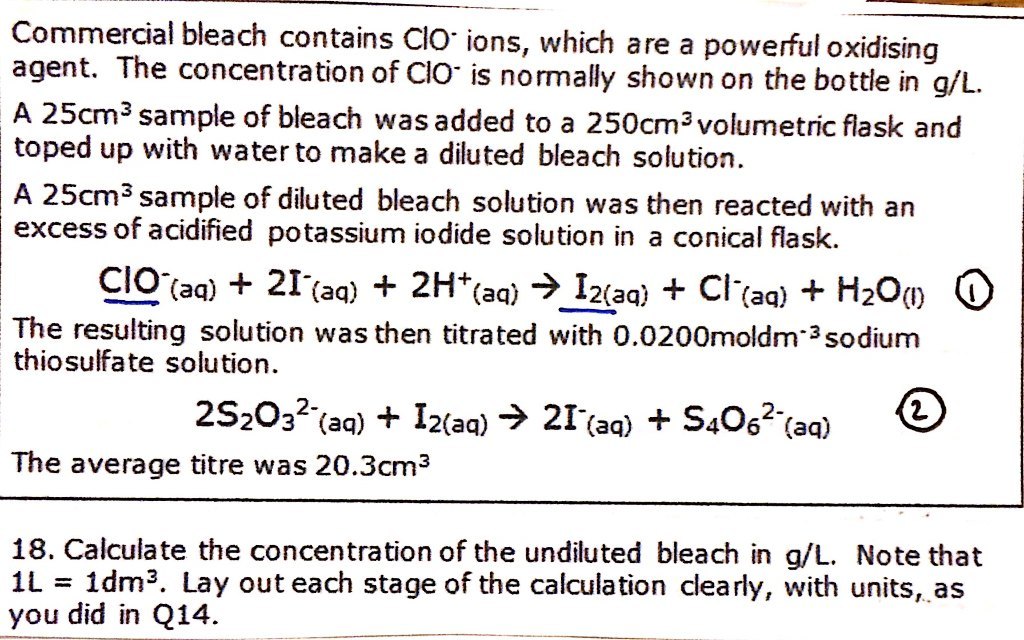
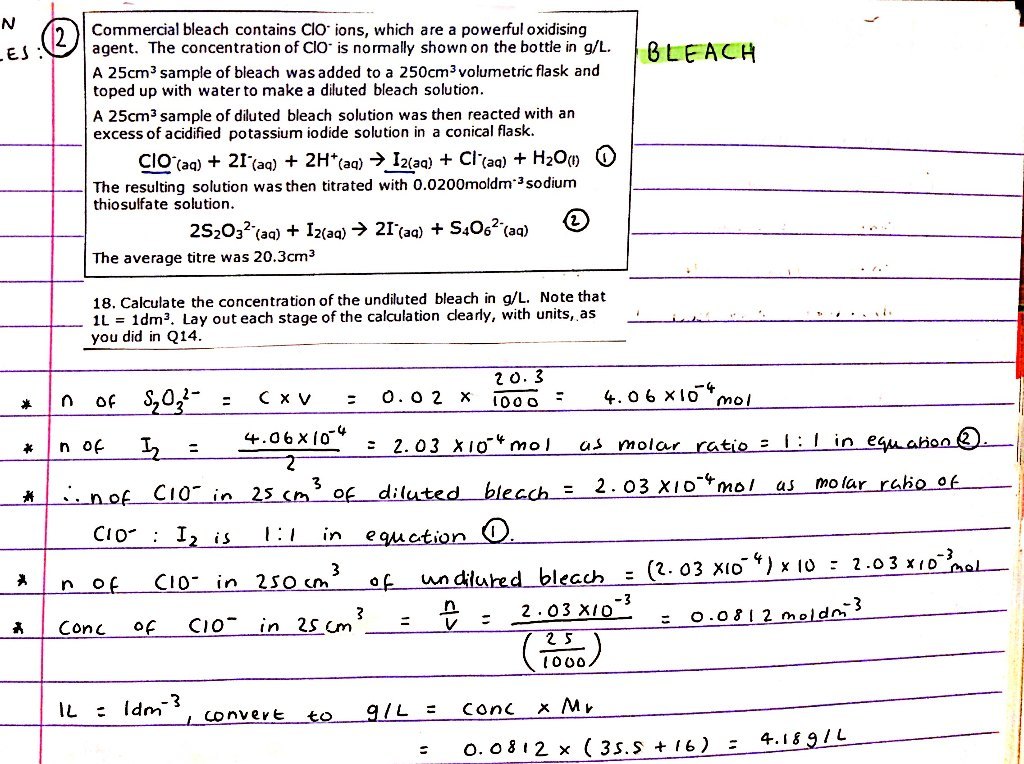
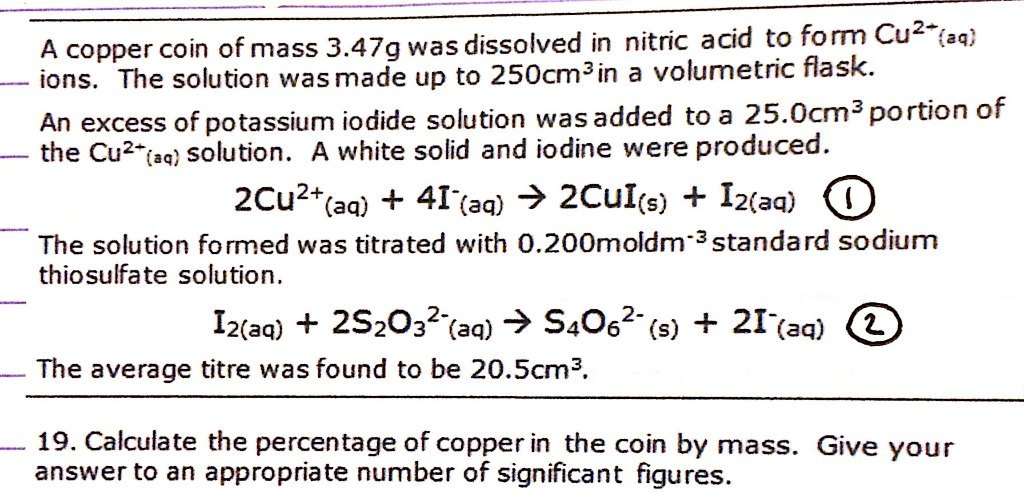
Question:
Redox titration
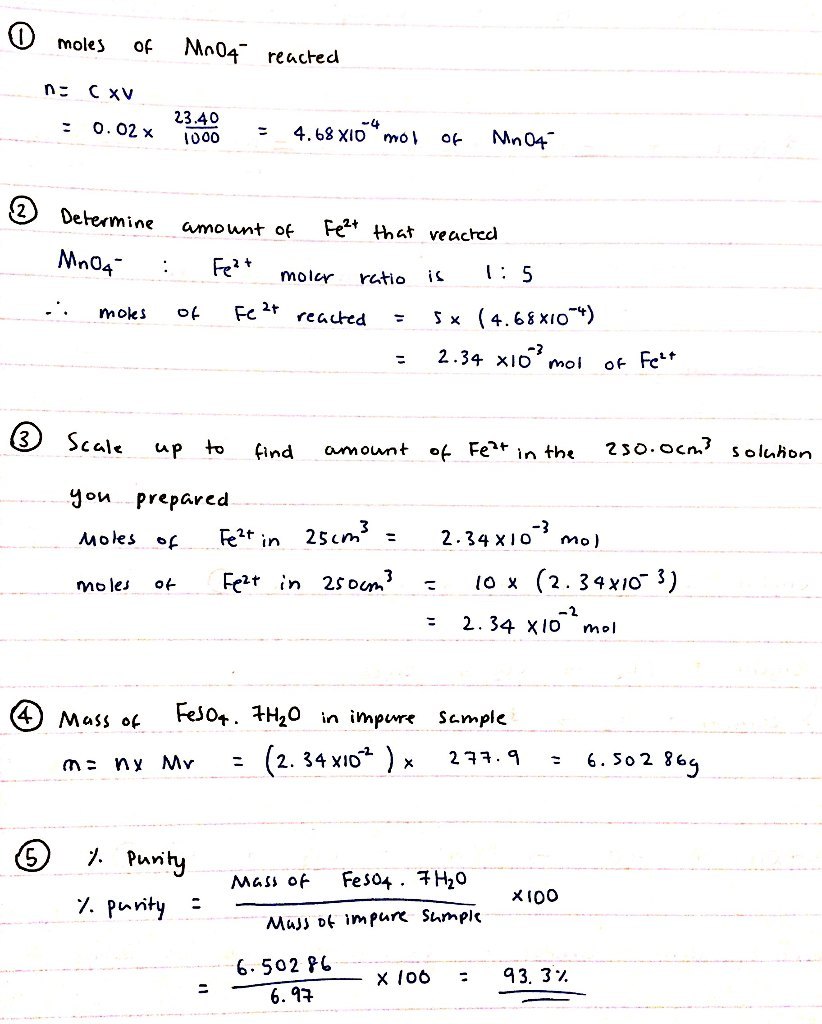
Analysing the percentage purity of an iron (II) compound from a redox titration
Describe an experiment to analyse oxidising agents through a redox titration (8)
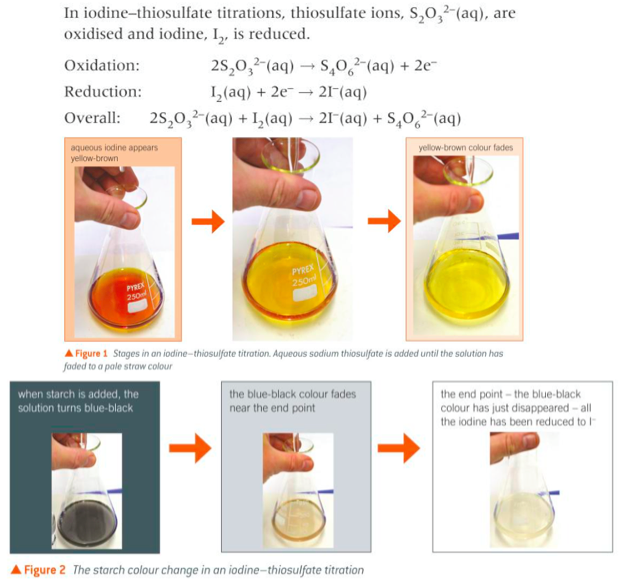
Redox titration of iodine / thiosulphate:
- Standard solution of Na2S2O3(aq) added to burette
- Volumetric pipette (10cm3) to pipette sample to be analysed into 100cm3 conical flask
- Add excess KI(aq) as unknown oxidising agent reacts with KI(aq) to produce I2(aq) which turns solution yellow-brown
- Titrate solution with Na2S2O3(aq). During titration, I2(aq) is also reduced to 2I-(aq) causing the yellow-brown colour to fase to a pale-straw colour
- Difficult to decide end point ∴ once near end point add a few drops of starch indicator. Colour change pale straw → blue black
- Continue dripping Na2S2O3(aq), end point is when one extra drop of Na2S2O3(aq) is added and solution changes from blue-black → colourless
- Repeat titration until 2 concordant titires are achieved (± 0.10 cm3)
- Calculate mean avergae titre


-
5A - Rates definitions10
-
5A - Rates23
-
5B - Equilibria definitions10
-
5B - Equilibria19
-
5C - Acids & pH definitions18
-
5C - Acids & pH32
-
5D - Lattice enthalpy & Free energy definitions19
-
5D - Lattice enthalpy & Free energy26
-
5E - Redox definitions13
-
5E - Redox35
-
5F - Transition elements definitions13
-
5F - Transition elements56
-
5F - Transition elements - oxidation state & colours18
-
6A - Aromatic compounds29
-
6B - Carbonyls20
-
6C - Acids & Esters41
-
6D - Amines, amides & polyamides39



