Define:
Acid
Base
Alkali
Salt
Acid = Proton donor in aqueous solution
Base = Proton acceptor in aqueous solution OR a compound that neutralises an acid to form a salt
Alkali = A type of base that dissolves in water forming OH- ions
Salt = The product of reaction in which the H+ ions of an acid is replaced by metal or ammonium ions
Define:
Conjugate acid and conjugate base
Conjugate acid = A species that releases a proton to form a conjugate base
Conjugate base = A species that accepts a proton to form a conjugate acid
Define + give an example of each:
Monobasic acid
Dibasic acid
Tribasic acid
Monobasic acids = Reacts with one base as it has only 1 proton - HCl
Dibasic acids = Reacts with 2 bases as it has 2 protons - H2SO4
Tribasic acids = Reacts with 3 bases as it has 3 protons - H3PO4
Define:
Brønsted - Lowry acid
Brønsted - Lowry base
Brønsted - Lowry acid = Proton donor
Brønsted - Lowry base = Proton acceptor
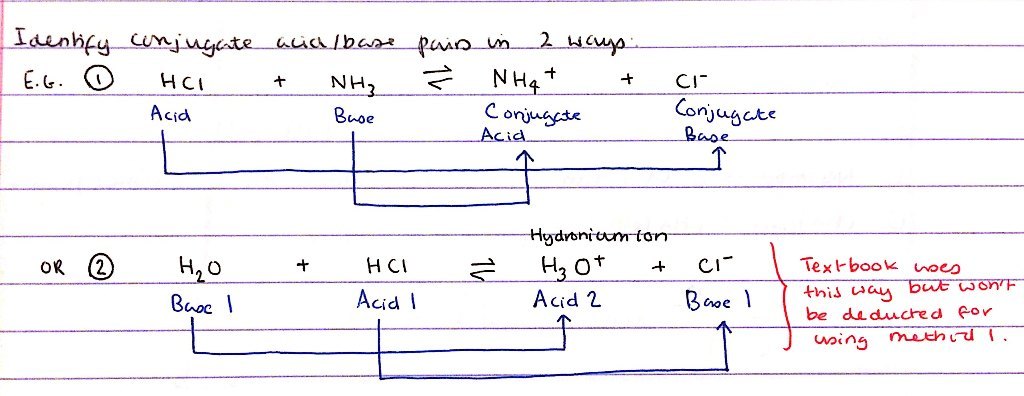
Identify the acid base pairs:
Conjugate acid base paris method:
- HCl + NH3 → NH4+ + Cl-
Acid 1 / Base 1 method:
- H2O + HCl → H3O+ + Cl-
What ion is H3O+?
Equation:
pH = ?
[H+] = ?
pH = -log( [H+] )
[H+] = 10-pH
Working out pH from a strong acid
Assumptions?
HA(aq) → H+(aq) + A-(aq)
[HA] = Conc of Acid
[H+] = [HA]
Assumptions:
- All of HA dissociates
Question:
Calculate the pH of 0.43moldm-3 of HCl(aq)
HCl is a strong acid ∴
[HA] = [H+]
Assumptions:
- No HA dissociates
[H+] = 0.43moldm-3
pH = log(0.43) = 0.376 (3 sig figs)
How do you show the role of H+ in the reactions of acids?
Question:
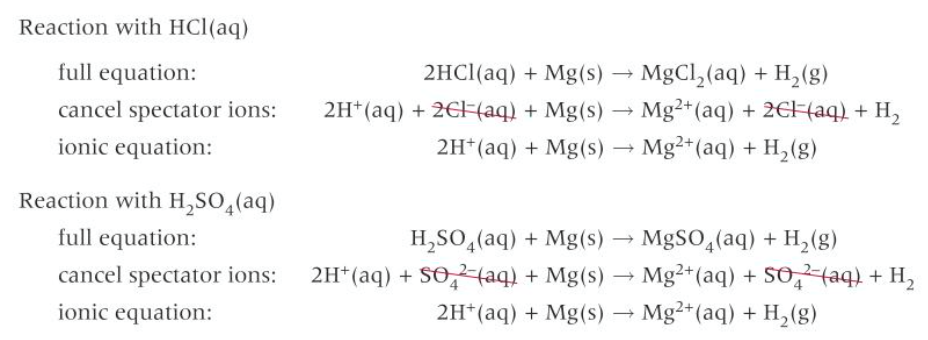
Show the role of H+ ions in the rold of the reaction between:
- Mg(s) with HCl(aq)
- Mg(s) with H2SO4(aq)
What is particular about the ionic equation?
Construct ionic equations
NOTE:
The ionic equations of both reactions are the same
Define spectator ion
Spectator ion = Ions that are present but don’t take part in a chemical reaction
What is the Acid dissociation constant (Ka)?
Units = ?
Assumptions?
Weak acids partially dissociate: HA(aq) ⇌ H+(aq) + A-(aq)
Ka = [H+] [A-] / [HA]
Assumptions:
- Contribution of [H+] from H2O is negligable
- [H+] = [A-]
- No acid dissociate ∴ [HA]equil = [HA]initial
∴ Ka = [H+]2 / [HA]
[H+] = √(Ka x [HA])
Units = moldm-3
Equation:
PKa = ?
Ka from PKa = ?
PKa = -log(Ka)
Ka = 10-Pka
Strong alkalis in solution = ?
Assumptions?
[OH-] = [Alkali]
Assumption:
- Alkali fully dissociates
Equation:
Ionic product of water (Kw) = ?
Units = ?
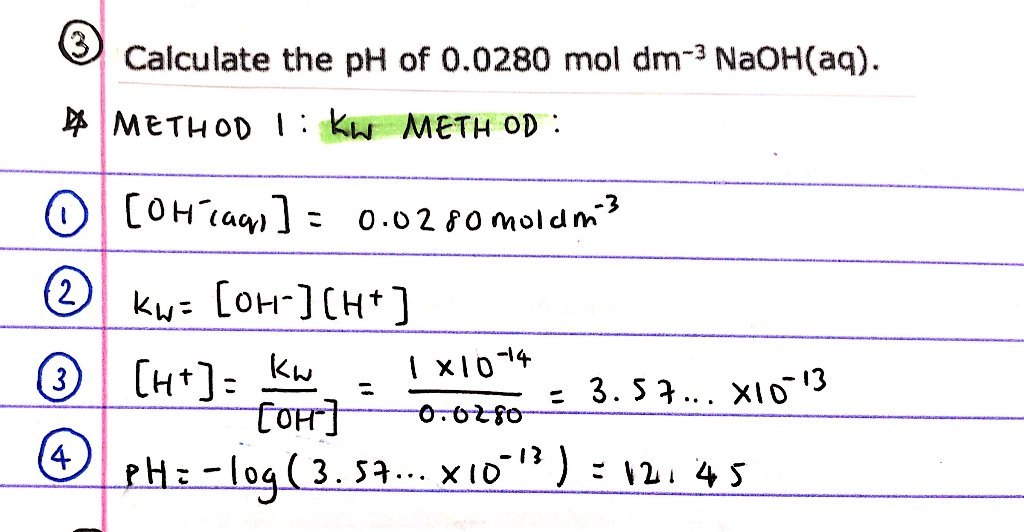
What is another way to work out pH from [OH-]?
Kw = [OH-] [H+]
At 25°C, Kw = 1 x 10-14
Units = mol2dm-6
OR
pOH = 14 - pH because pH + pOH = 14
Question:
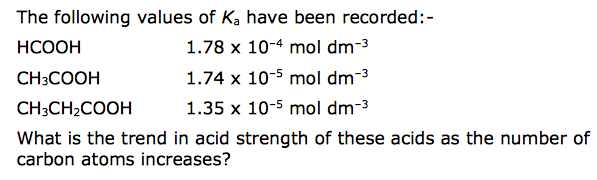
As no’ of carbons increase, acid strength decreases
Is it possible to calculate Ka without making the assumption that no acid dissociates so: [HA]equil = [HA]initial
Yes - sometimes
Define a buffer solution
Buffer solution = A solution that minimises the change in the pH by small additions of H+ or OH-
State 2 different type of buffers that can be made
Acid buffer
Alkali Buffer
How to form an ACID BUFFER
Assumptions?
WEAK ACID + SALT OF WEAK ACID → ACID BUFFER
HA(aq) ⇌ H+(aq) + A-(aq)
NaA → Na+ + A- (Na is just used as an example)
Ka = [HA] [A-] / [HA] ∴ [H+] = Ka x [HA] / [A-]
Assumptions:
- [H+] from H2O is negligable
- [A-] from acid is negligable, all [A-] comes from salt
- [HA]equil = [HA]initial i.e. no acid dissociates
Give an example of a mixture which would form an acid buffer solution in water
Ethanoic acid + sodium ethanoate
How do ACID BUFFERS work to minimise pH changes?
HA ⇌ H+ + A- (**Acid partially dissociates)
NaA → Na+ + A- (Salt fully dissociates) - Note that Na is just an example of the salt
ADD H+:
- [H+] increases, equil shifts to left
- More A- combining with H+ to form HA to do so
- Buffer action maintained until SALT used up
ADD OH-:
- [OH-] increases, H+ + OH- → H2O
- H+ decreases compared to OH- ratio ∴ equil shifts to right
- More HA dissociates to produce H+
- Buffer action maintained until ACID used up
How do ALKALINE BUFFERS work to minimise pH changes?
Use an example to explain this
Alkali used in this example = Ammonia
NH3 + H2O ⇌ NH4+ + OH-
NH4Cl → NH4+ + Cl-
ADD H+:
- H+ + OH- → H2O
- [H+] increases ∴ reduces the [OH-] ratio ∴ equil shifts to right
- NH3 will react with more H2O to produce more OH-
- Buffer action maintained until BASE used up
ADD OH-:
- [OH-] increases ∴ equil shifts to left
- More NH4+ will react with excess OH-
- Buffer action maintained until SALT used up
What are the 2 methods to calculate the pH of a buffer solution?
METHOD 1 - Acid dissociation constant
- Ka = [HA] [A-] / [HA] ∴ [H+] = Ka x [HA] / [A-]
- pH = -log( [H+] )
METHOD 2 - PKa form
- PKa = pH - log( [A-] / [HA] )
- To find PKa neutralise half of the acid ∴ [A-] and [HA] will cancel out so pKa = pH
Question:
Calculate the pH of 0.0280 moldm-3 NaOH(aq) using the Kw method


-
5A - Rates definitions10
-
5A - Rates23
-
5B - Equilibria definitions10
-
5B - Equilibria19
-
5C - Acids & pH definitions18
-
5C - Acids & pH32
-
5D - Lattice enthalpy & Free energy definitions19
-
5D - Lattice enthalpy & Free energy26
-
5E - Redox definitions13
-
5E - Redox35
-
5F - Transition elements definitions13
-
5F - Transition elements56
-
5F - Transition elements - oxidation state & colours18
-
6A - Aromatic compounds29
-
6B - Carbonyls20
-
6C - Acids & Esters41
-
6D - Amines, amides & polyamides39



