Acoustics
- branch of physics which studies mechanical waves, including vibrations, sound infrasound and ultrasound
- Acoustics observes generation, propagation of mechanical waves, their interaction with environment and the process of hearing.
What is a mechanical wave?
- spreading disturbance (forced displacement of particles) in elastic medium
- MW transfers energy but not mass.
- The MW may take a form of an elastic deformation in solids or a variation of pressure in gases
What is a sound?
- Sound is called any MW/mechanical vibrations producing hearing perception
- transmitted only through elastic media
- sound transfers energy but not mass
What is the acoustic range?
freq. from 20 Hz to 20kHz
Where can sound propagation occur
in elastic media only
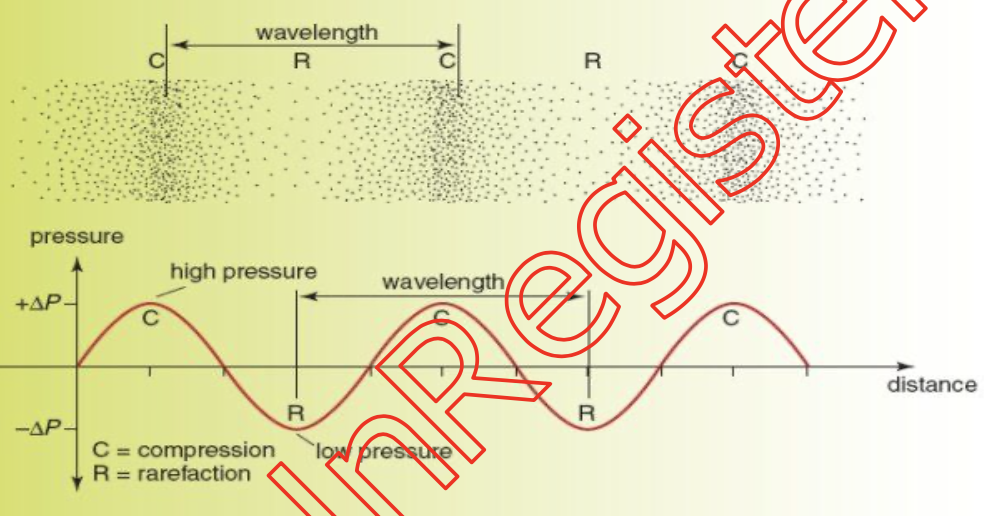
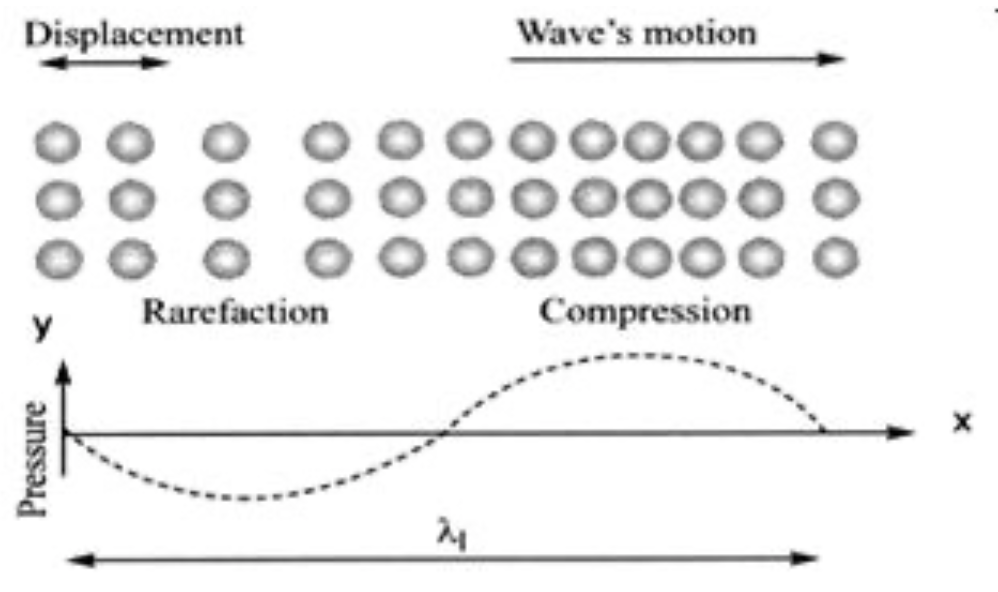
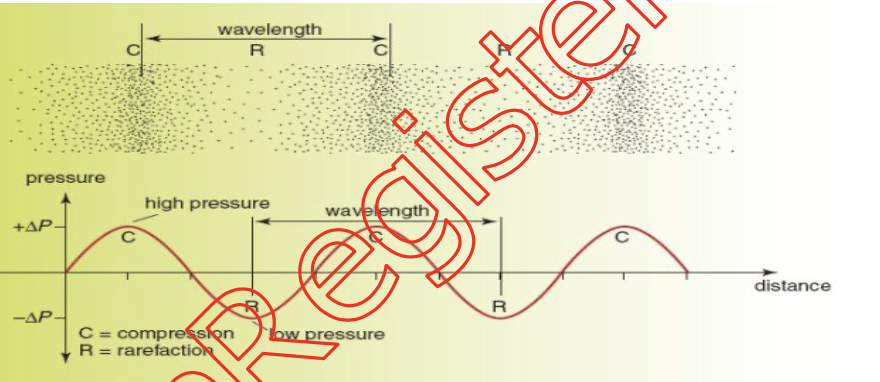
- vibrations in elastic matter are transmitted consecutively from particle to particle causing recurrent alteration of density
P(t) = ΔP sin φ
ΔP = maximal pressure increase/decrease
φ - phase of the given mechanical wave showing the rate of alterations
How do mechanical waves propagate?
Longitudinal and Transversal
Longitudinal
typical to gasses and liquids
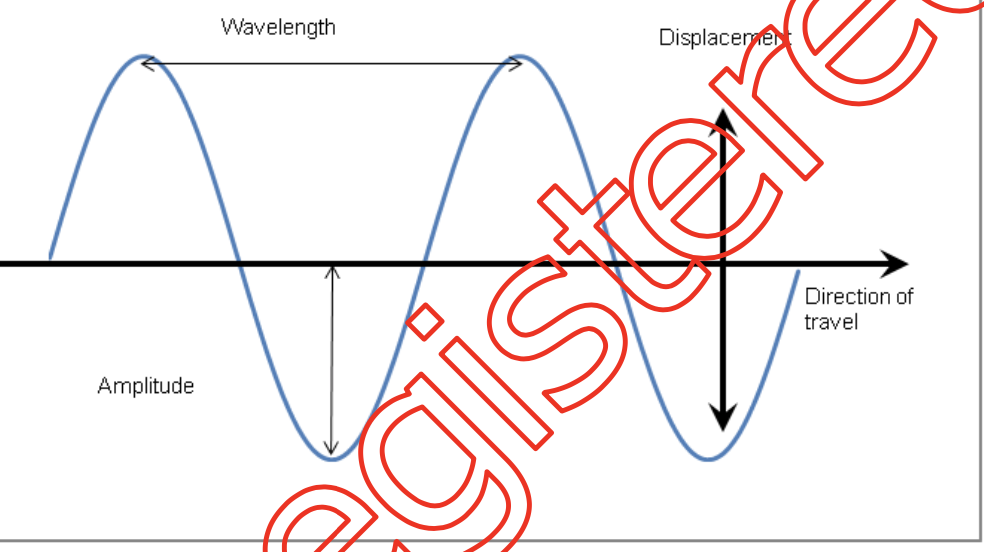
Transverse waves
typical for solids where particles displacement occurs perpendicularly to wave propagation
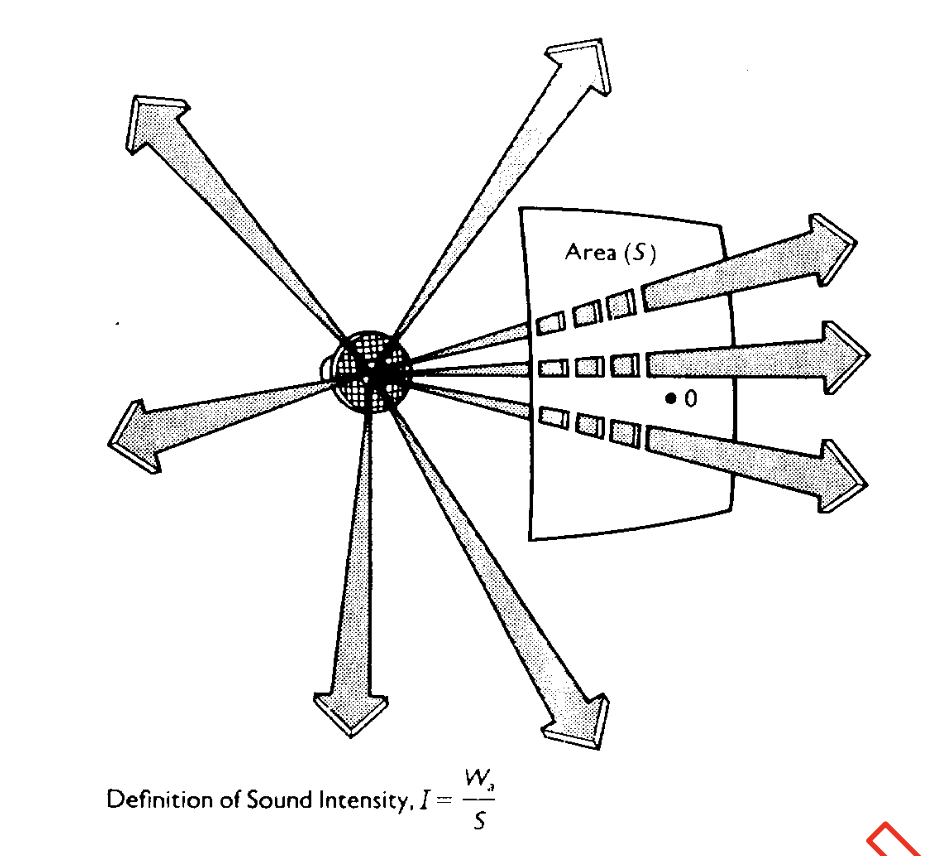
Physical characteristics of sound: Sound Intensity, I
I = E/t.S
- the sound energy transmitted per sec. through unit area, placed perpendicularly to the sound propagation
- Intensity is measured in watt per square meter. [W/m2]
Physical characteristics of sound: Sound pressure, P
P = ΔP sin φ added to Patm
- the relation between intensity and pressure:
I = p2/2Za
Physical characteristics of sound: Sound frequency, f
- Frequency is the number of vibrations (full alterations of the sound pressure or repetitions of motion of the particles) per sec
- It is measured in Hz
- 1 Hz equals to 1 vibration per sec
- A quantity which is directly related with f is the period: the time duration of 1 vibration
Physical characteristics of sound: sound velocity
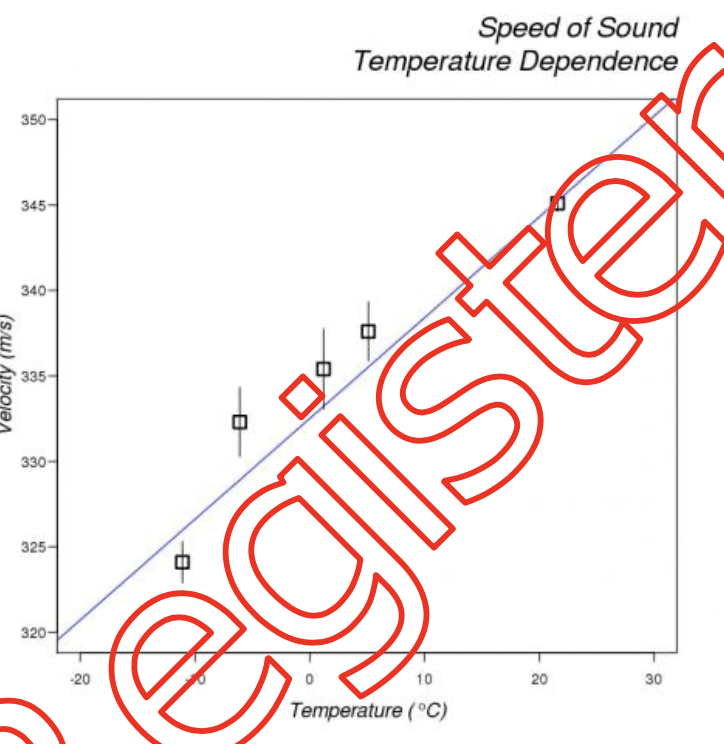
- quantity which depends on the properties of the medium through which sound propagates
- For example – At 20ºC SV in the air is about 340 m/s, but in water SV is about 1500 m/s
- The exact relationship between sound speed and matter properties threats elasticity as major factor.
Physical characteristics of sound: sound wavelength
The distance between two consecutive sound fronts\
λ = v.T=v/f
Physical characteristics of sound: Acoustic impedance
Z = ρ.v
ρ -density of the given medium
v – sound velocity
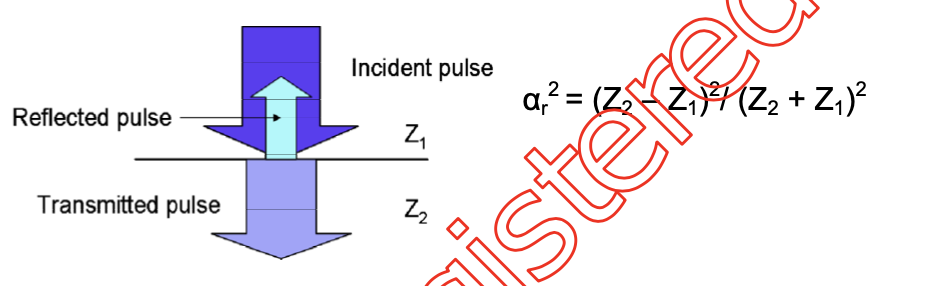
- Sound propagation through certain medium is determined from acoustic impedance Z of the latter
- When the sound wave encounters a border between two different media – a part of the wave reflects, and the other part passes due to differences in acoustic impedances Z1 and Z2
- The degree of reflection/transmission depends on difference sbetween Z1 and Z2
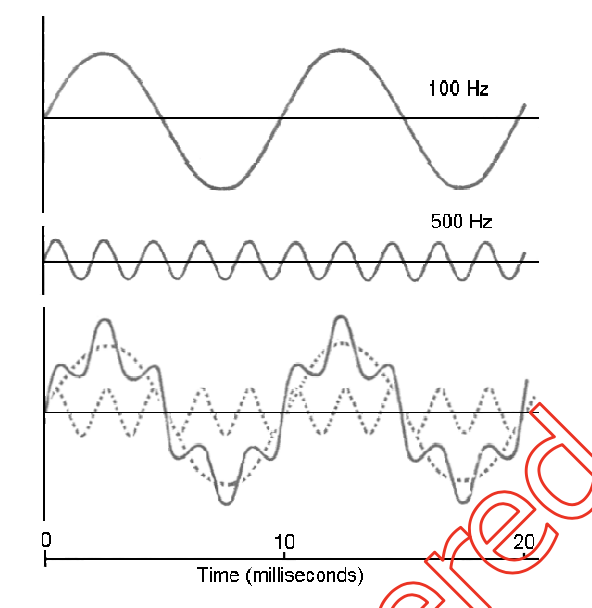
Simple tone and complex tone sounds
Simple - if vibration has sine shape and possesses certain frequency
Complex - when it consist of several simple tones as superposition of mechanical waves.
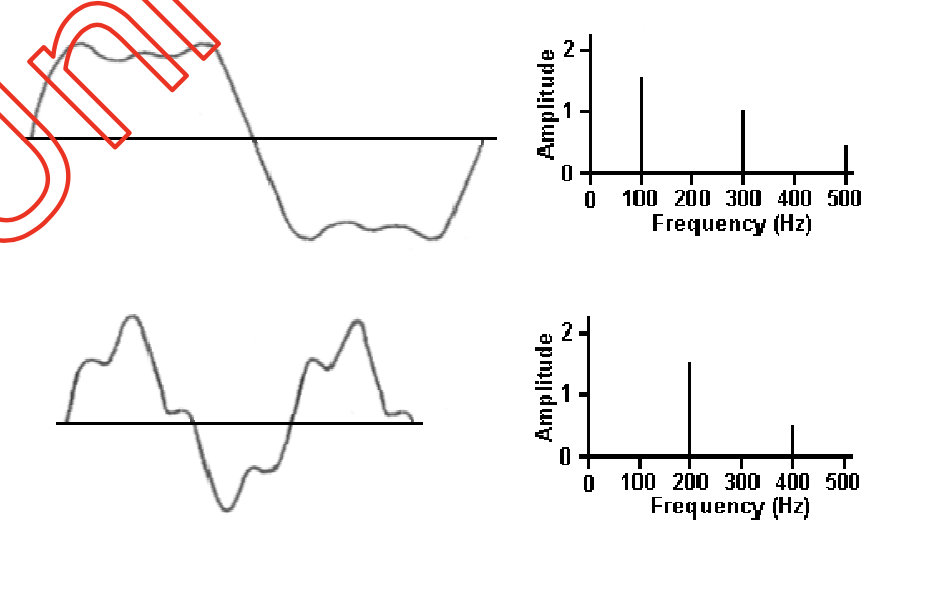
Acoustic Spectrum
- Combination of certain amplitudes and frequencies proportional to participant simple waves frequencies
- Each complex sound can be illustrated by graph representing its acoustic spectrum
- f0 - basic freq. - always has maximal amplitude
2f0, 3f0 etc. - amplitudes smaller
Psychophysical characteristics of sound
- Each physical (objective) characteristic of sound corresponds to respective psychophysical (subjective) analogue
- Human perception of sound is based on fundamental physiological Weber - Fechner law:
Perception ~ log(stimulus)
(Perceptions increases logarithmically with the stimulus)
Psychophysical characteristics of sound: Sound intensity
- Sound Intensity level E (E is defined at 1000 Hz sound frequency only)
E=k. lg( I/I0 ),
I = intensity of sound
I0 = threshold (at 1000Hz, 10-12 W/m2 - lowest in power vibration audible for human ears)
Intensity level is measured in bel B/ decibel dB (at k=1 and k=10 respectively)
Psychophysical characteristics of sound: Loudness of sound, L*
- quantity representing subjective human perception of the sound magnitude
L=k.lg(I/I0)
k = coefficient depending on frequency
I = intensity of the given sound
I0 = threshold of audibility of this sound
L is measured in Phon.
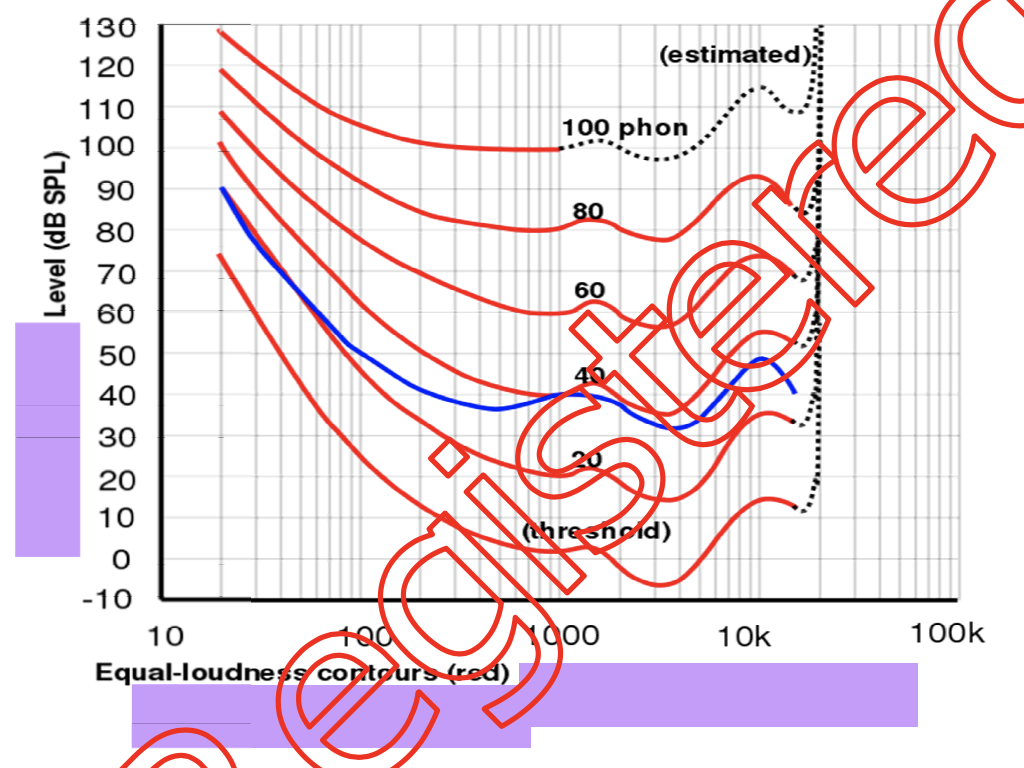
figure bellow - lines represent equal-loudness contours
- Each point of these curves corresponds to certain frequency and sound level in dB making the relation loudness- intensity level accessible.
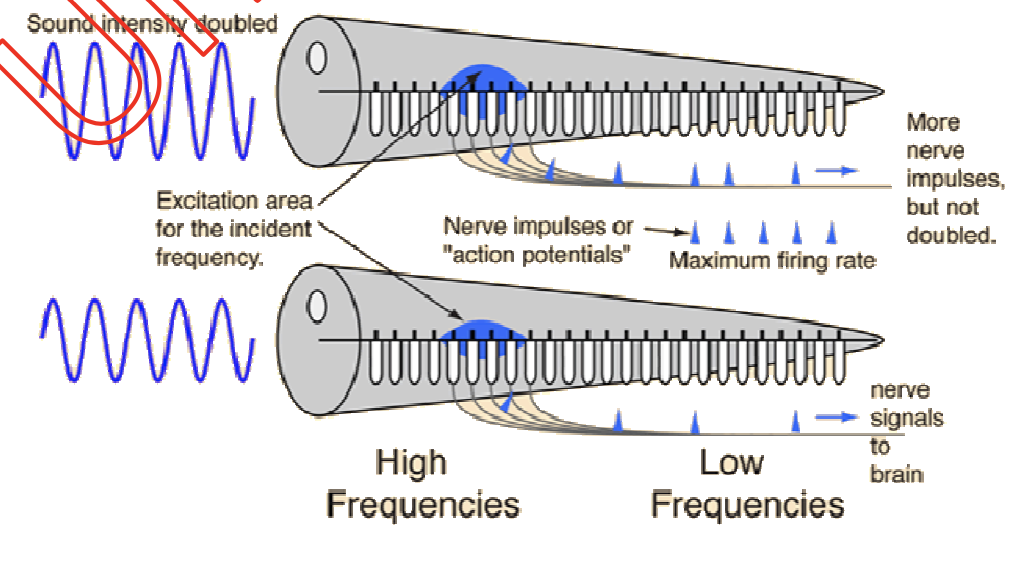
Why is it that doubling the sound intensity to the ear does not produce a dramatic increase in loudness?
- there are saturation effects
- Nerve cells have maximum rates at which they can fire, and it appears that doubling the sound energy to the sensitive inner ear does not double the strength of the nerve signal to the brain
This is just a model, but it seems to correlate with the general observations which suggest that something like ten times the intensity is required to double the signal from the innner ear.
- One difficulty with this “rule of thumb” for loudness is that it is applicable only to adding loudness for identical sounds
- If a second sound is widely enough separated in frequency to be outside the critical band of the first, then this rule does not apply at all.
- While not a precise rule even for the increase of the same sound, the rule has considerable utility along with the just noticeable difference in sound intensity when judging the significance of changes in sound level.
Psychophysical characteristics of sound: audibility area
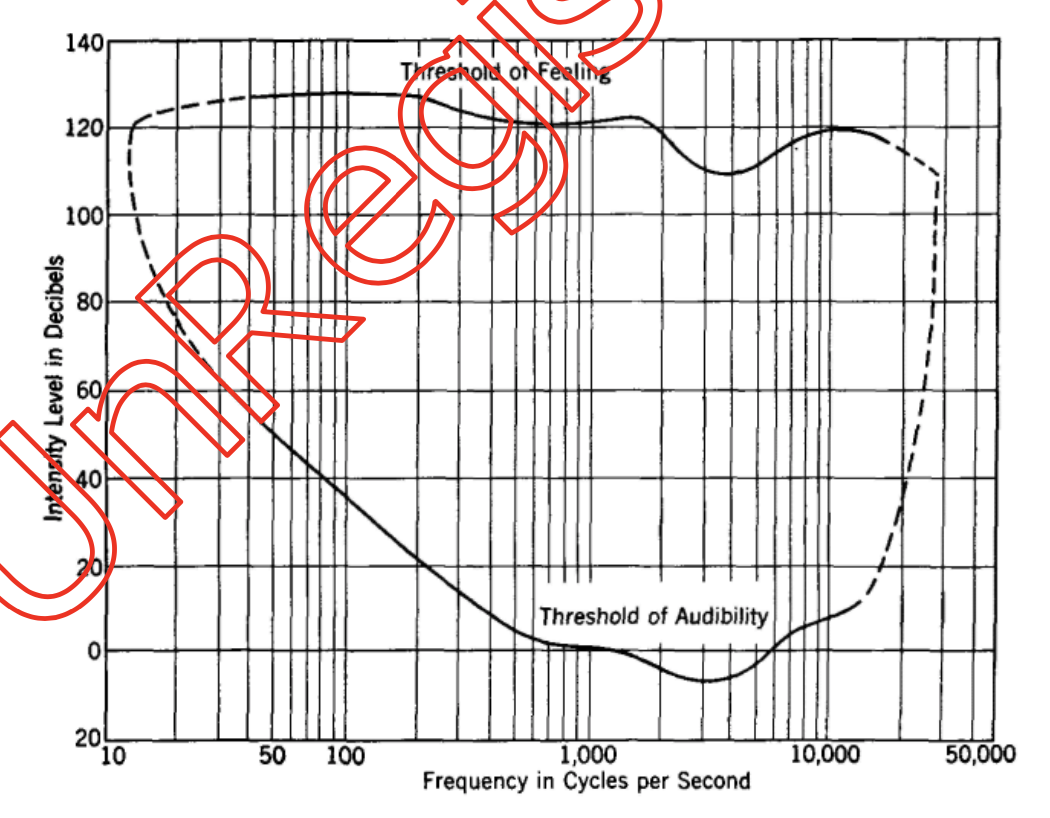
- On diagram bellow the closed area between threshold of audibility and threshold of pain/feeling represents audibility area
- All the sounds we can perceive are inside this area
- Our ears are most sensitive to sounds from 1000 – 4000 Hz range. Human speech is spread over 400 – 1000 Hz frequency range.
Psychophysical characteristics of sound: pitch
- subjective characteristic, corresponding to sound frequency
- The higher frequency – the higher pitch.
- The pitch of human voice is physiological feature. It is determined by the vibrating characteristics of vocal cords (their basic resonant frequency)
- For example: male basic frequency is in range 80-100 Hz and men’s voice sounds with lower pitch, whereas females basic frequency of vocal cords is about 400-500 Hz and this is the reason for the higher pitch of female voice.
Psychophysical characteristics of sound: timbre
- characterizes complex sounds
- Timbre allows different sound sources to be distinguished by their acoustic spectra.
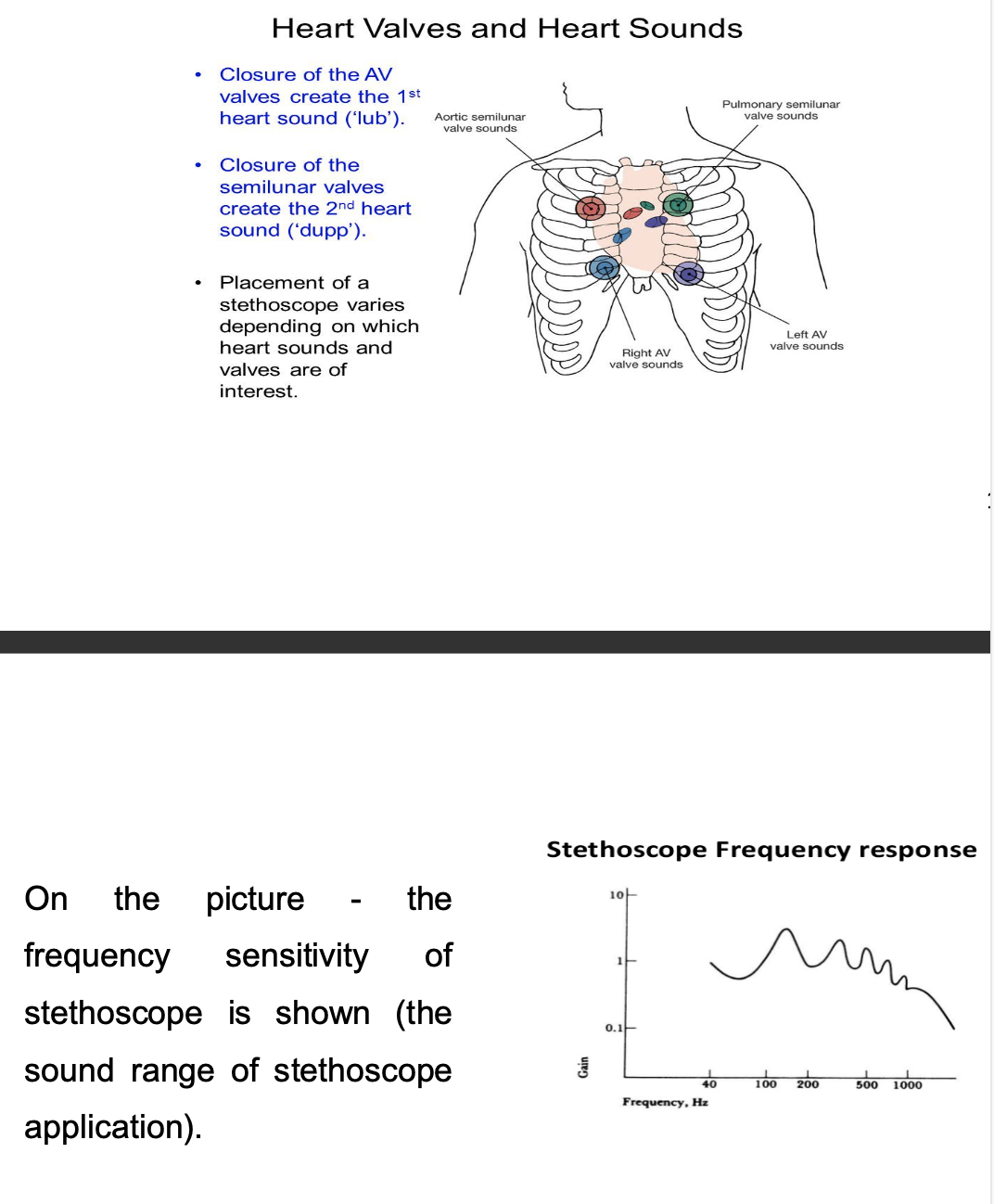
Sound as a diagnostic instrument: Auscultation
- The basic tool for auscultation is stethoscope.
- Mechanical stethoscopes amplify sound due to Standing wave phenomenon.
- There are optimal recording sites (sites to place chest-piece of stethoscope) for the various heart sounds
- Sound conductivity of a stethoscope is characterized by some features:
- firm application of the chest piece makes the diaphragm taut with pressure thereby causing an attenuation of low frequencies
loose-fitting earpiece cause leakage which reduces the coupling between the chest wall and the ear.