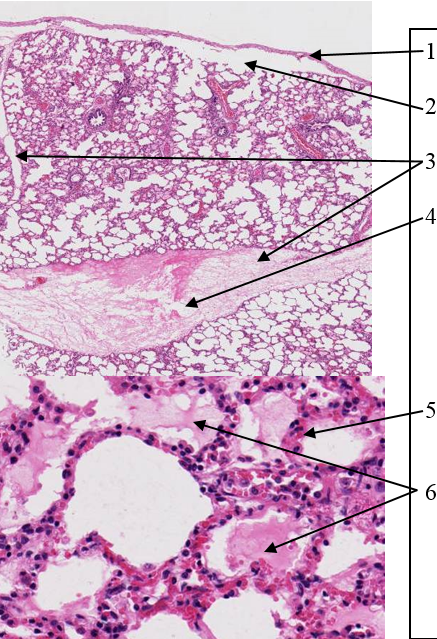
Lung, porcine. Clinically the pig may have had a left side heart murmur.
- What is 1
- 2
- 3
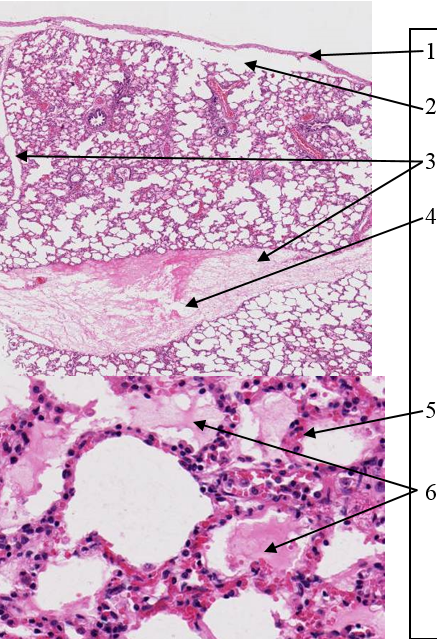
- Pleura
- Subpleural lymphatics
- Interlobular lymphatics
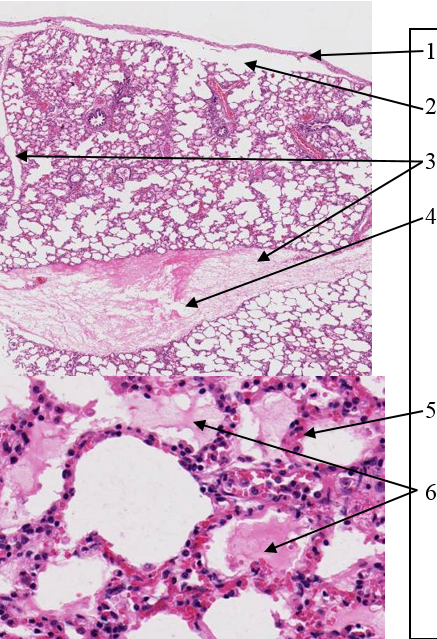
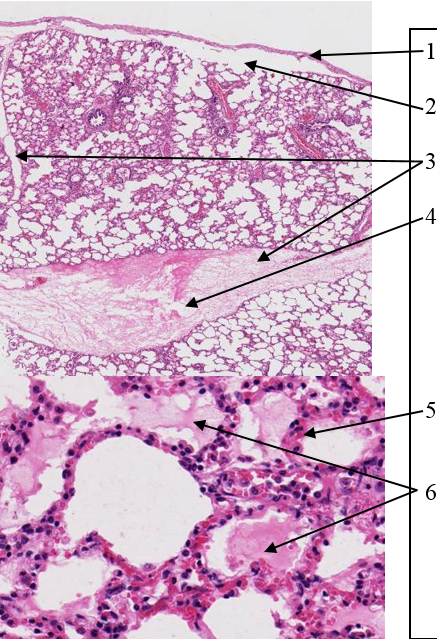
Lung, porcine. Clinically the pig may have had a left side heart murmur.
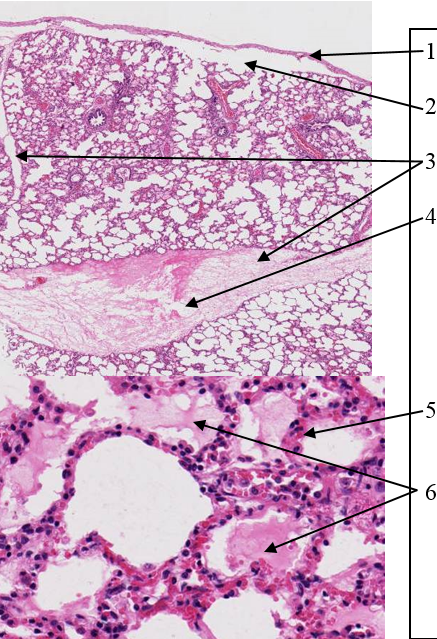
- What is 4?
- 5?
- 6?
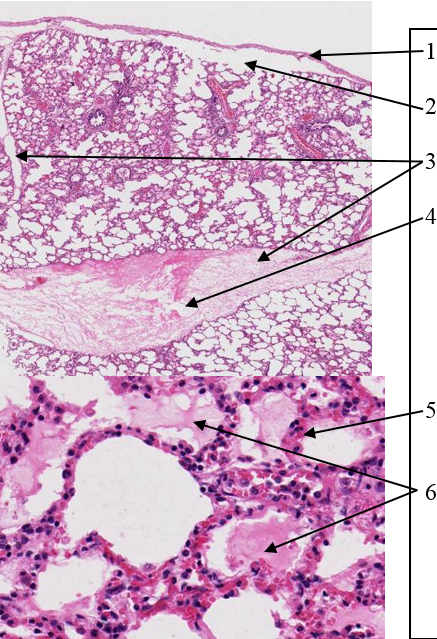
- 4- Lymphatic with edema
- 5- Alveolar hyperemia
- 6- Alveolar edema (with increased protein)
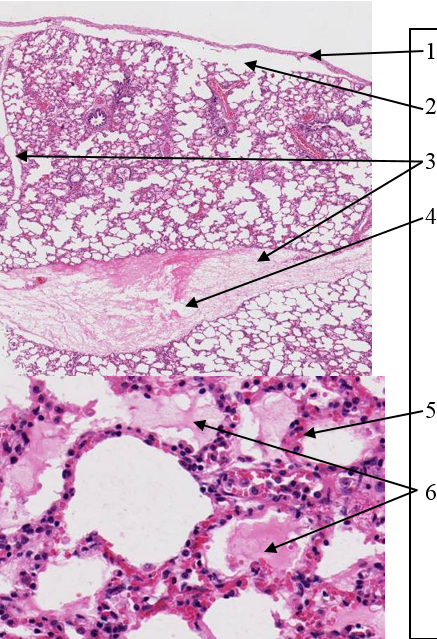
Lung, porcine. Clinically the pig may have had a left side heart murmur.
- What is the pale pink material in alveoli?
- What are the dilated clear spaces?
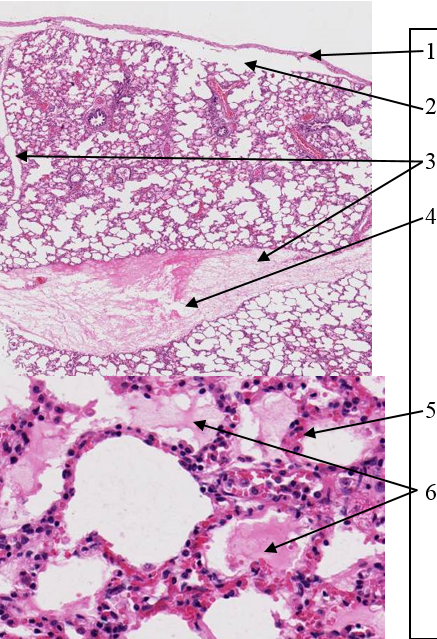
- Edema fluid that has some increase in protein (hence the pink color)
- These are lymphatics in the interlobular septa that are filled with and expanded by edema fluid. They are more evident because they are serving to carry away the excess fluid present in the lungs.
Lung, porcine. Clinically the pig may have had a left side heart murmur.
- Give a possible cause of this lung lesion.
- A lesion on the left AV valve causing insufficiency or stenosis of this valve would lead to increased back pressure into the pulmonary veins and pulmonary capillaries leading to increased hydrostatic pressure in post capillary venules and capillaries resulting in edema.
- Something wrong with the muscle of the left ventricle could also cause this.
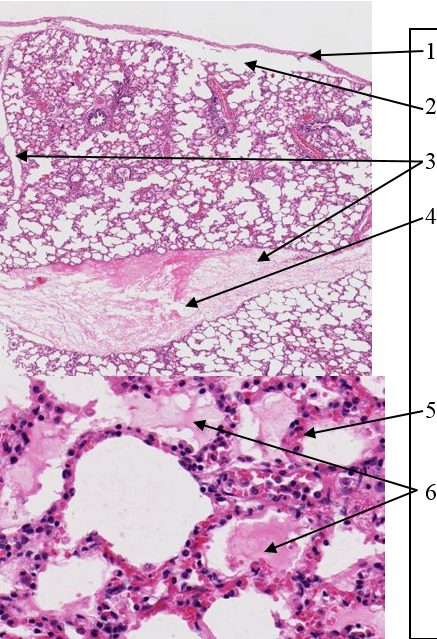
Lung, porcine. Clinically the pig may have had a left side heart murmur.
- What would this lung look like grossly?
- Grossly the lung would look diffusely dark red (venous congestion) and would be heavy and wet with expansion of the interlobular lymphatics with clear fluid (edema).
- Foamy pink material (pulmonary and tracheal edema fluid) might be found in the lumens of the bronchi.
Lung, porcine. Clinically the pig may have had a left side heart murmur.
- Histomorphologic diagnosis?
Moderate diffuse pulmonary congestion (passive hyperemia) and edema
Artery, canine
- What is 1?
- 2
- 3
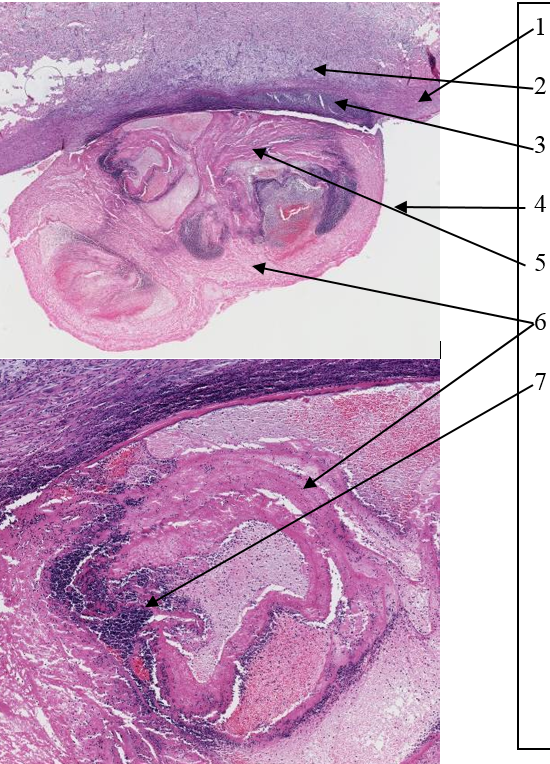
- Artery wall
- Granulation tissue
- Arteritis
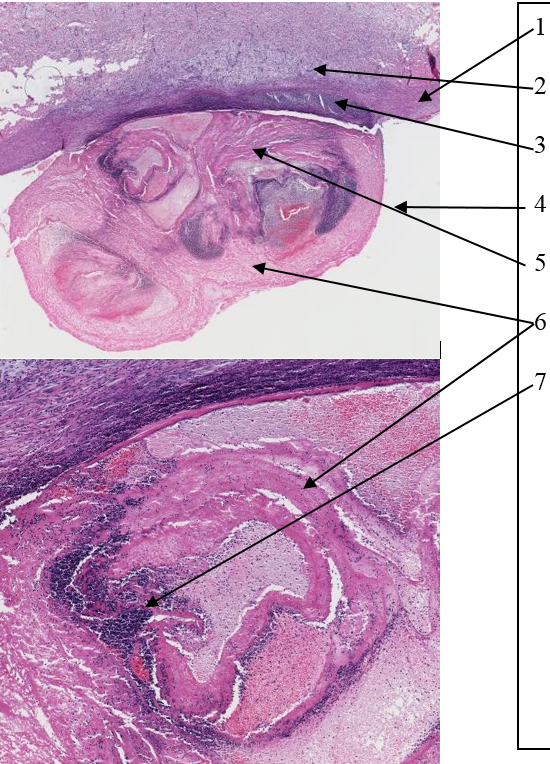
Artery, canine
- What is 4
- 5
- 6
- 7
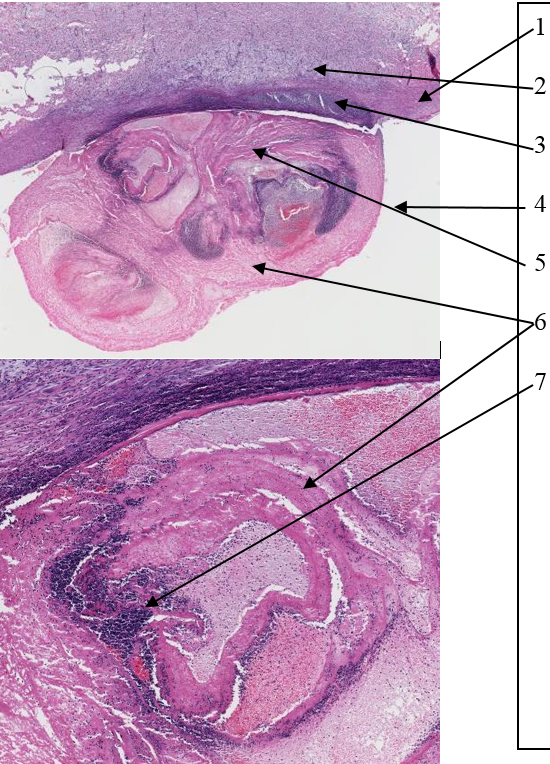
- 4- Luminal thrombus
- 5- Lines of Zahn
- 6- Fibrin
- 7- Leukocytes from blood
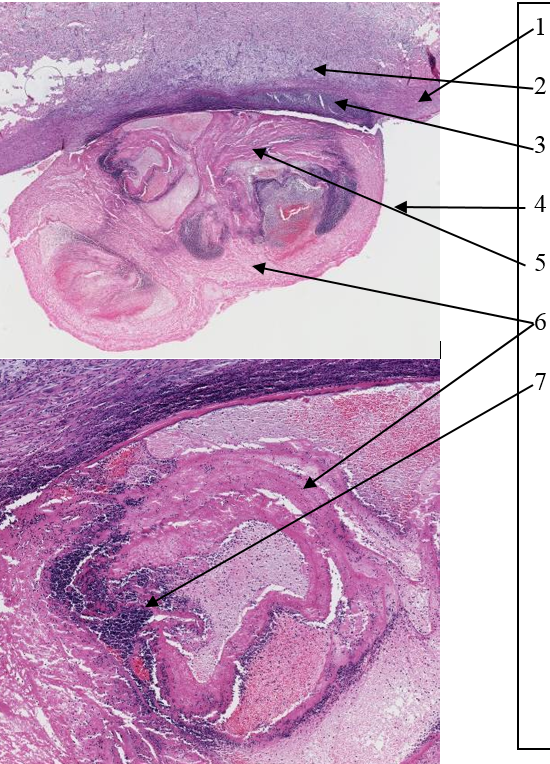
Artery, canine
- What are possible sequelae if fragments of this thrombus were to break free into the arterial lumen (antemortem of course)? Chose a location for the thrombus to elaborate on the consequences or assume that this is right renal artery
- Mesenteric artery?
- What will happen if there is bacteria in the thrombus?
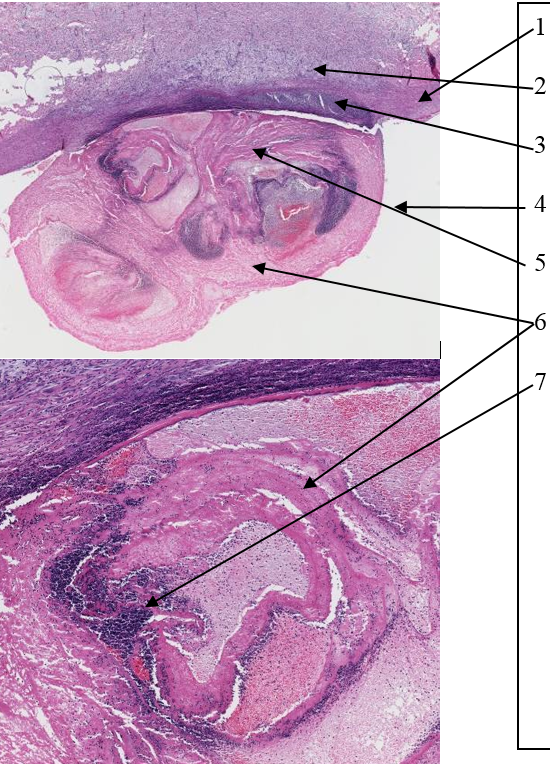
- The consequences of embolism occurring from this thrombus depend on where the thrombus is. If it is in the renal artery, emboli will lodge downstream and cause infarction of all or part of the kidney, depending on the size of the embolus and the size of the vessels occluded.
- If the embolus goes into a mesenteric artery, there may or may not be vascular compromise to a section of gut depending on the degree of collateral circulation. It is conceivable that no noticeable affect may occur.
- Because there are bacteria present, where ever the embolus comes to rest, it can cause another site of infection and possibly abscess formation.
How would you name this arterial lesion?
Arterial thrombus (chronic) with chronic arteritis
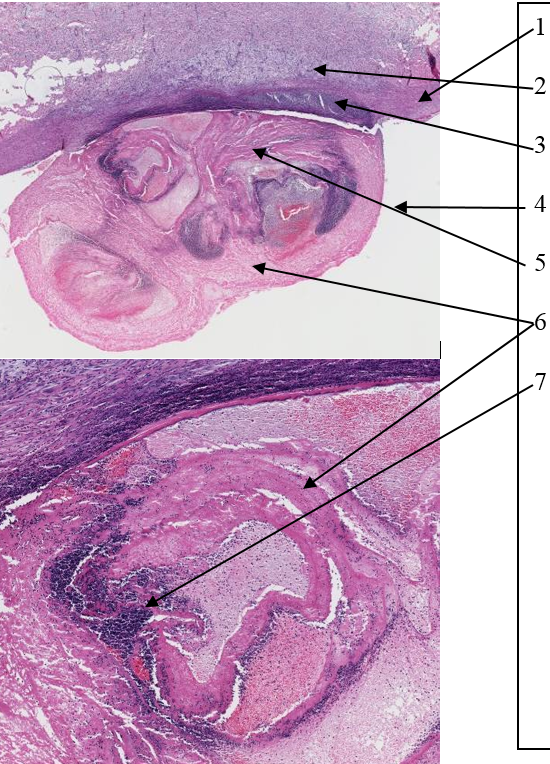
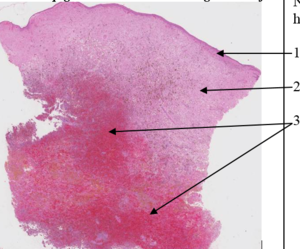
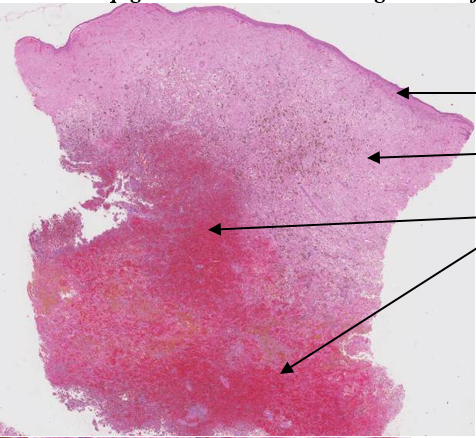
Nasal mass, horse. This specimen is from a mass that has been present in the nasal cavity of a horse for several weeks. Because of the mass, the horse has exhibited epistaxis.
- What is 1?
- 2
- 3
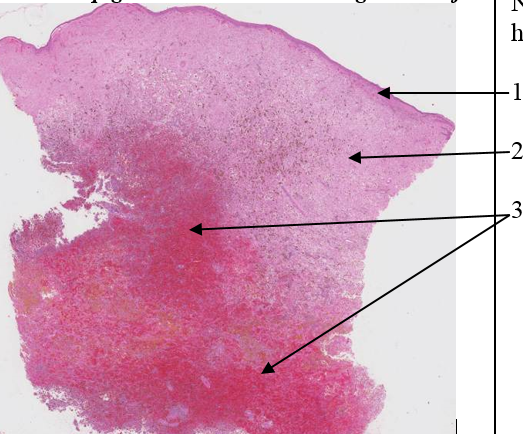
- Nasal epithelium
- Fibrosis (from granulation tissue)
- Hemorrhage resulting in a mass–hematoma
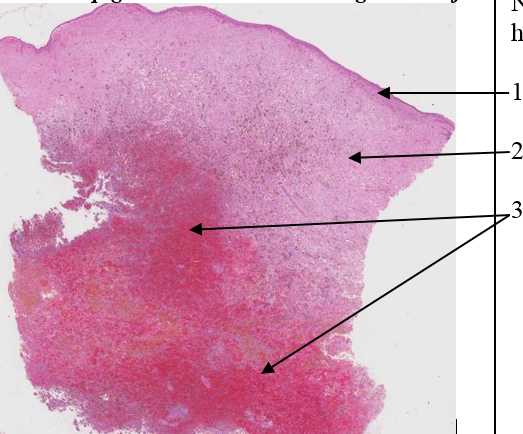
Nasal mass, horse. This specimen is from a mass that has been present in the nasal cavity of a horse for several weeks. Because of the mass, the horse has exhibited epistaxis.
- The mass is covered by stratified squamous epithelium. If this epithelium should be ciliated, pseudostratified, columnar epithelium, what do you term this alteration?
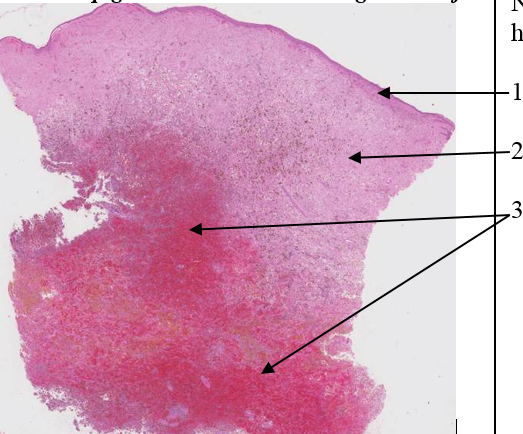
Squamous metaplasia of nasal mucosa.
Nasal mass, horse. This specimen is from a mass that has been present in the nasal cavity of a horse for several weeks. Because of the mass, the horse has exhibited epistaxis.
- What is the term for the free blood in the tissue?
Hemorrhage, which when it forms a swelling is a hematoma.
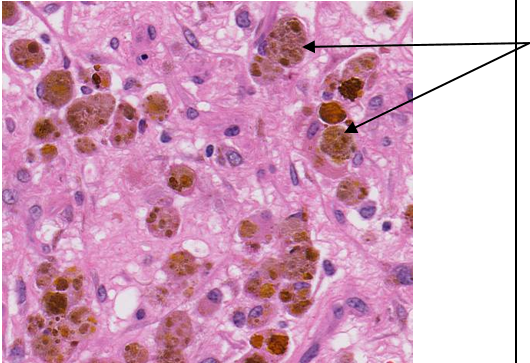
Nasal mass, horse. This specimen is from a mass that has been present in the nasal cavity of a horse for several weeks. Because of the mass, the horse has exhibited epistaxis.
- What is the arrow pointing at?
- How did it get there?
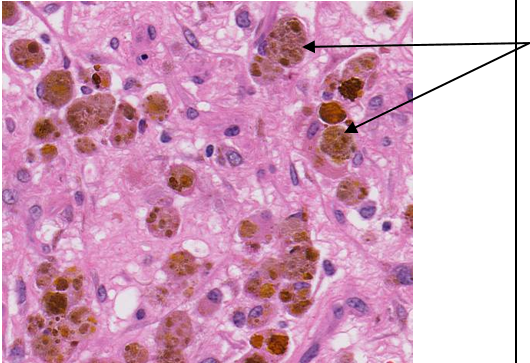
- Hemosiderin containing macrophages
- Phagocytosis of free red blood cells by macrophages resulted in breakdown of hemoglobin.
- You will recall that heme is processed to biliverdin and bilirubin while the iron component is processed to hemosiderin seen here.
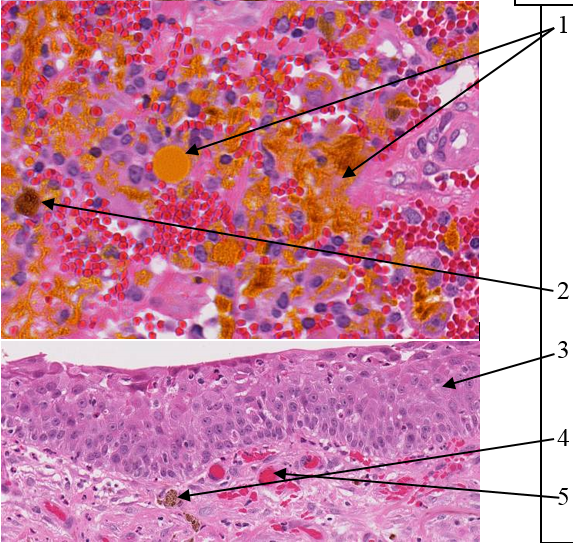
Nasal mass, horse. This specimen is from a mass that has been present in the nasal cavity of a horse for several weeks. Because of the mass, the horse has exhibited epistaxis.
- What is 1?
- How did 1 get there?
- 2?
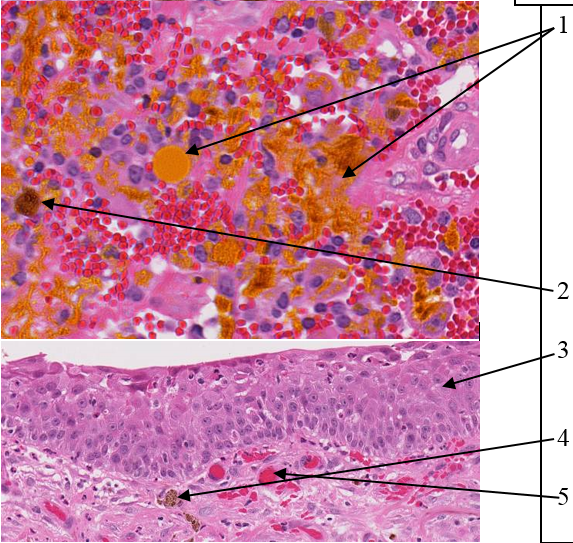
- Hematoidin
- The yellow pigment is local bilirubin (sometimes termed hematoidin when seen in tissue histologically), an early breakdown pigment when there are large areas of hemorrhage.
- Hemosiderin in macrophage
Nasal mass, horse. This specimen is from a mass that has been present in the nasal cavity of a horse for several weeks. Because of the mass, the horse has exhibited epistaxis.
- What is 3?
- 4?
- 5?
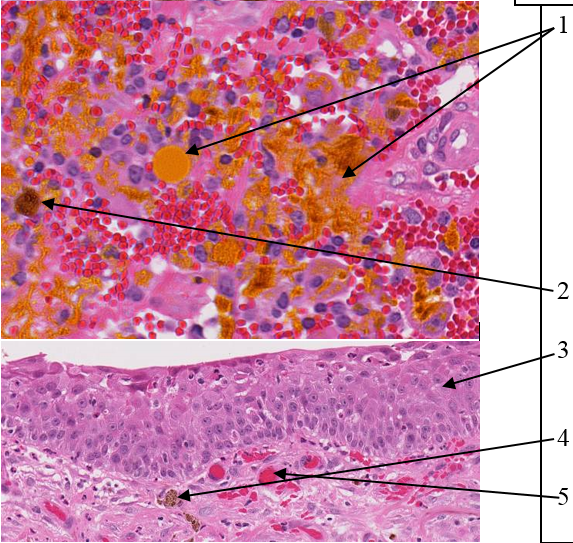
- 3- Stratified squamous epithelium (Squamous metaplasia)
- 4- Hemosiderin in macrophages
- 5- Dilated capillaries (hyperemia)
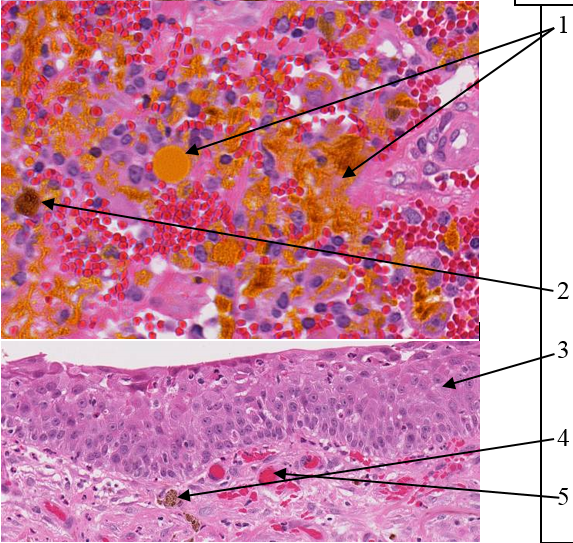
Nasal mass, horse. This specimen is from a mass that has been present in the nasal cavity of a horse for several weeks. Because of the mass, the horse has exhibited epistaxis.
- Less commonly there are areas of dark purple to black granular pigment. What would this be? (not entirely sure what she is pointing out on the slide)
calcification of chronically injured tissue—dystrophic calcification
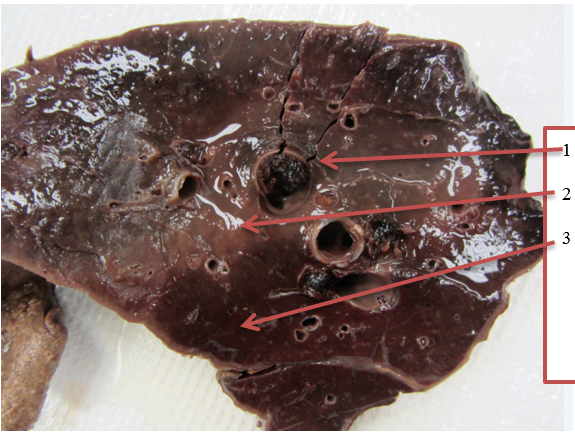
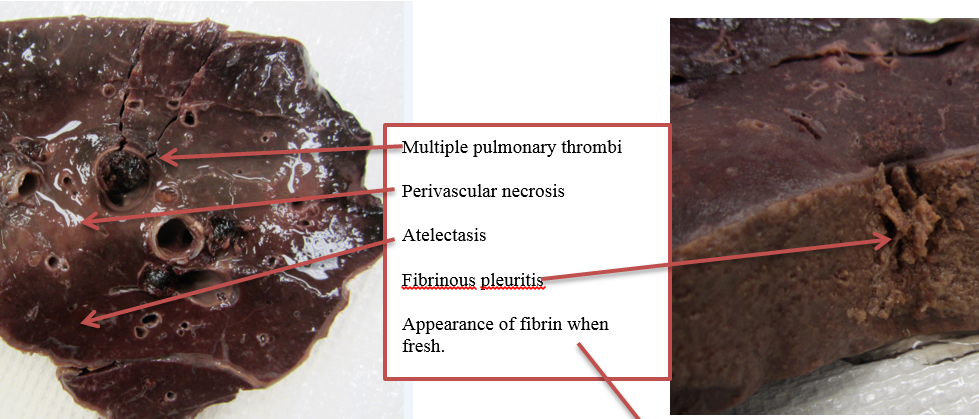
Signalment and history: Tissue from a 2 year old Thoroughbred stallion that presented for fever and dyspnea. Ultrasound revealed moderate amounts of fluid within the thoracic cavity.
- What organ is this?
- What is this?
- ?
- ?
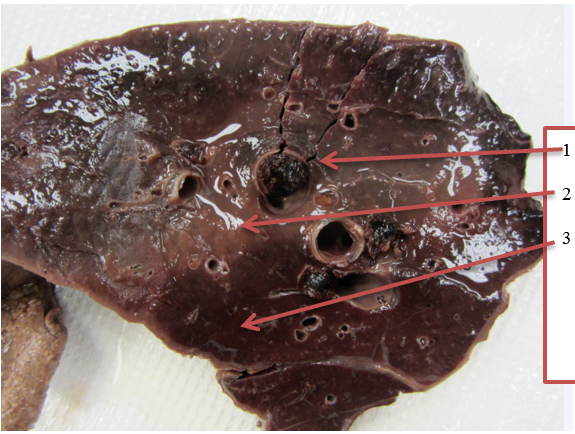
- Lung
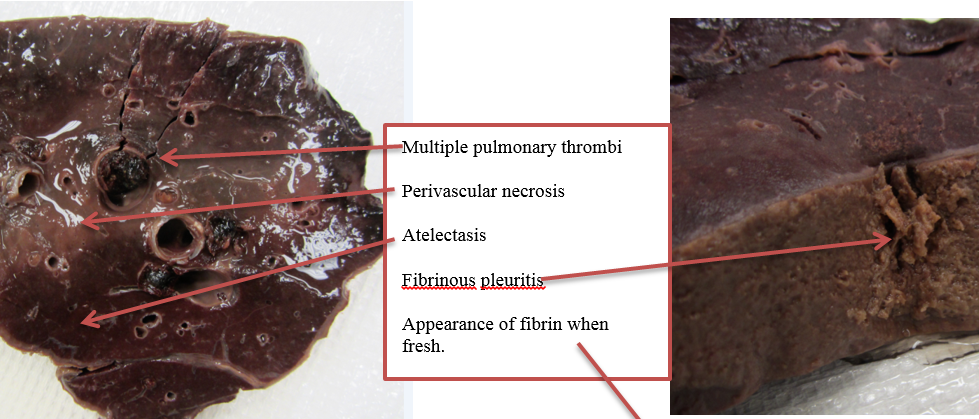
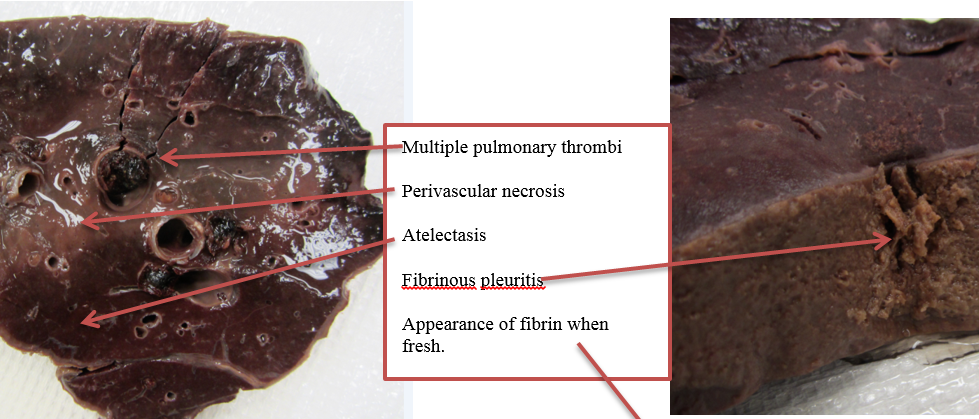
1. Multiple pulmonary thrombi
2. Perivascular necrosis
3. Atelectasis
Signalment and history: Tissue from a 2 year old Thoroughbred stallion that presented for fever and dyspnea. Ultrasound revealed moderate amounts of fluid within the thoracic cavity.
- What is this?
- this? (image is a fresh version of the lung lesions)
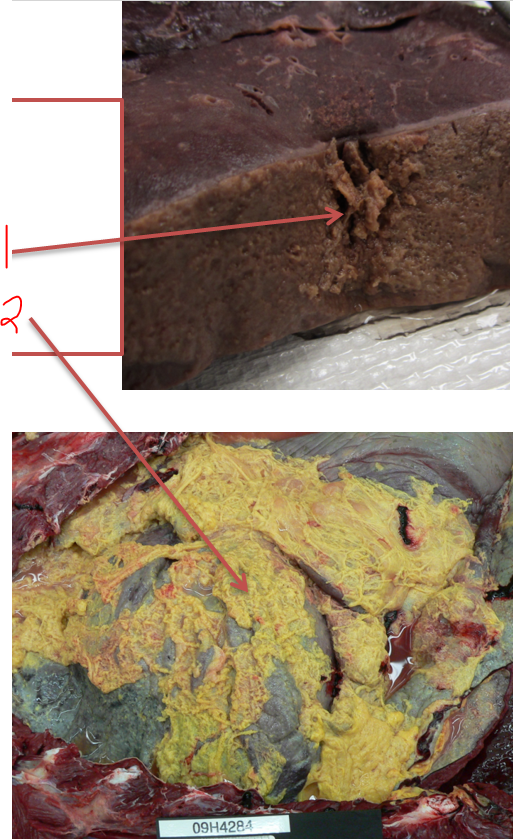
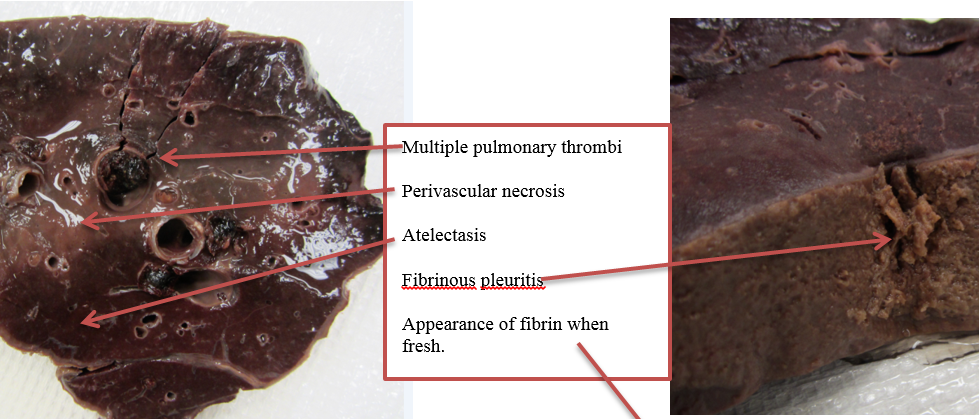
- Fibrinous pleuritis
- fibrin, appearance when fresh.
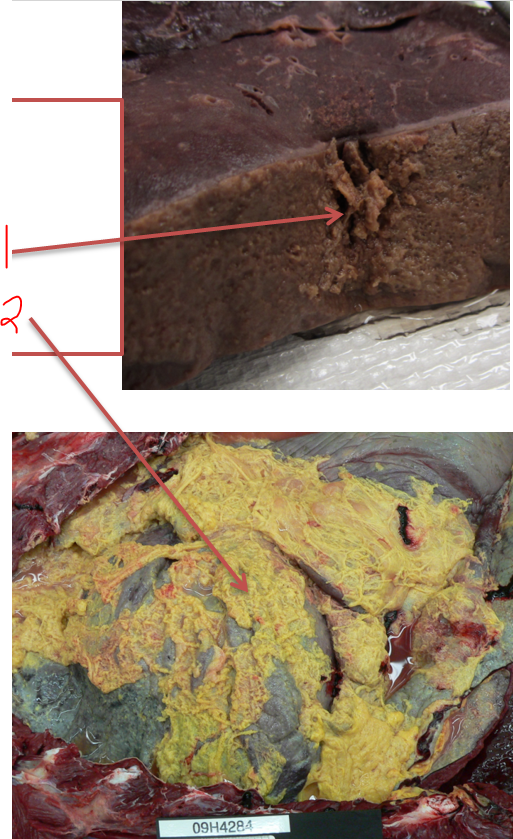
Signalment and history: Tissue from a 2 year old Thoroughbred stallion that presented for fever and dyspnea. Ultrasound revealed moderate amounts of fluid within the thoracic cavity.
- Describe the lesion: (some you may not be able to unless it was infront of you)
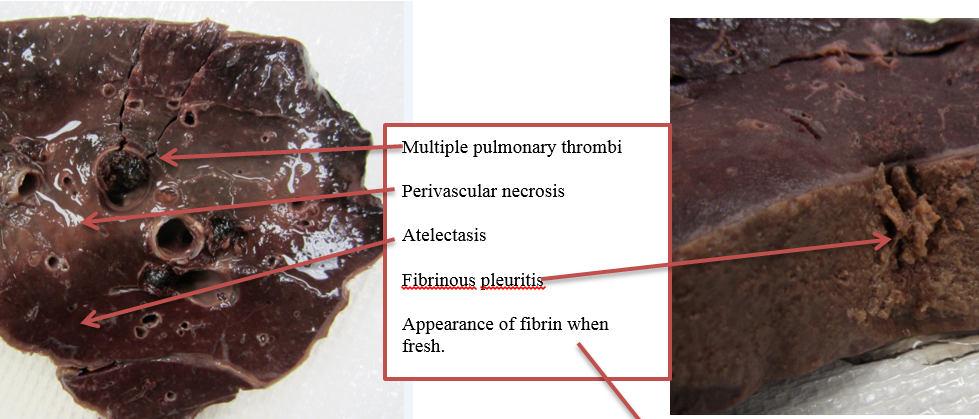
- The lung lob is firm (atelectatic) and dark red (congested).
- There are multiple dark red friable thrombi (.5-2cm) occluding pulmonary vessels.
- The parenchyma around these vessels had a gray/green discoloration (necrosis).
- The surface of the lung is covered by a shaggy layer of partially adherent tan friable material that is easily avulsed from the pleural surface(fibrin).
- The pleura is thickened
Signalment and history: Tissue from a 2 year old Thoroughbred stallion that presented for fever and dyspnea. Ultrasound revealed moderate amounts of fluid within the thoracic cavity.
- Why are there areas of pallor within the lung parenchyma?
The thrombus occluded blood flow to large areas of the pulmonary parenchyma, inducing ischemic necrosis and probable inflammation of the tissue.
Signalment and history: Tissue from a 2 year old Thoroughbred stallion that presented for fever and dyspnea. Ultrasound revealed moderate amounts of fluid within the thoracic cavity.
- Name at least 3 pulmonary lesions
- Diffuse pulmonary atelectasis
- multifocal thrombosis and locally extensive ischemic necrosis of pulmonary parenchyma
- Fibrinopurulent pleuritis
Signalment and history: Tissue from a 10 year old Paint horse who presented for colic with a distended stomach, producing large volumes of reflux fluid. Abdominal lactate was elevated. Patient improved with analgesics but deteriorated overnight.
- Describe the lesion
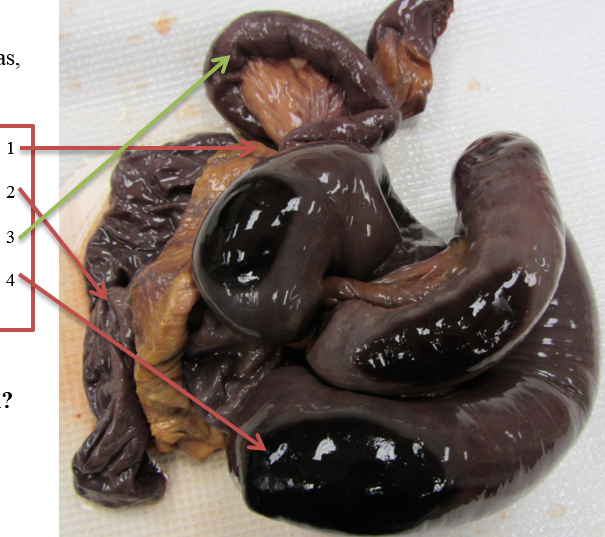
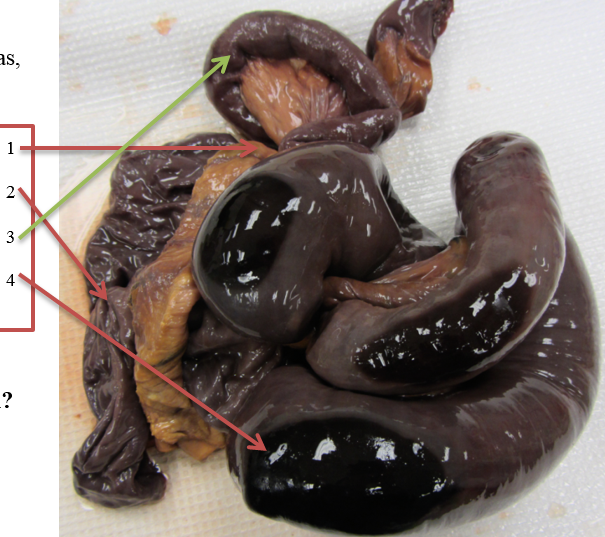
A ~2” long segment of small intestine is twisted along its axis (volvulus). The affected segments are distended with fluid and gas, appear dark red to purple in color
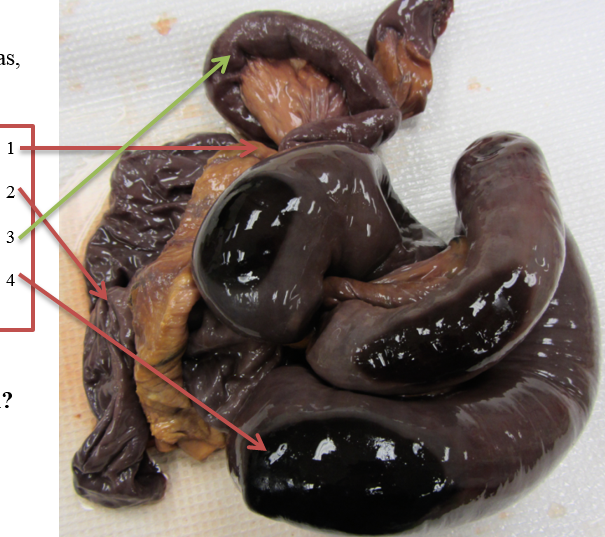
Signalment and history: Tissue from a 10 year old Paint horse who presented for colic with a distended stomach, producing large volumes of reflux fluid. Abdominal lactate was elevated. Patient improved with analgesics but deteriorated overnight.
- What is 1?
- ?
- ?
- ?
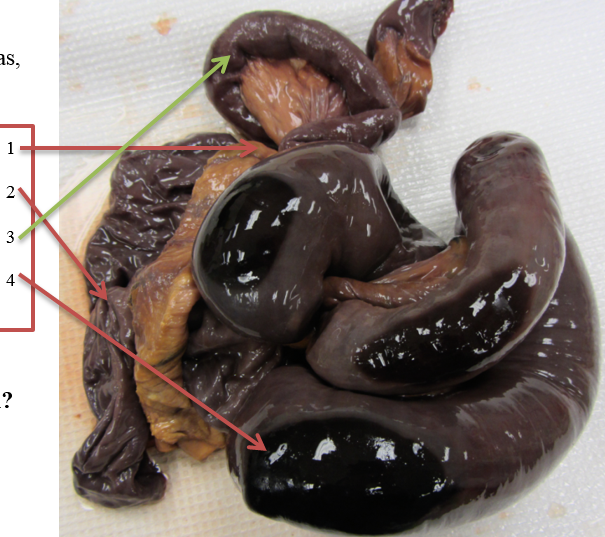
- Volvulus point
- Duodenum proximal to volvulus (distended)
- Duodenum distal to volvulus (normal diameter)
- Distended infarcted loops of bowel


-
Lecture 244
-
Lab 2, Acute Cell Swelling25
-
Lecture 3, Acute Cell Swelling27
-
Lecture 4: Types of Necrosis47
-
Lecture 5: Autolysis, Chronic Cell Injury22
-
Lecture 6: Cell Adaptation39
-
Lecture 7: Disturbances of Growth/Cellular Adaptation41
-
Lecture 8: Amyloid, calcification, pigments88
-
Lab 5: Accumulations24
-
Lab 3: Necrosis34
-
Lab 4: Chronic Cell Injury, Adaptations34
-
Lecture 9: Microcirculation and Interstitium31
-
Lecture 10: Fluid Distribution, Homeostasis21
-
Lecture 11: Hemostasis, thrombosis68
-
Lecture 14: Transudates and Exudates58
-
Lab 6: Circulatory Disturbances39
-
Lab 7: Acute Inflammation39
-
Lab 8: Chronic Inflammation and Repair28
-
Lecture 12: Blood Flow Alterations, Shock35
-
Lecture 13: Acute Inflammation 138
-
Lecture 15: Inflammation, Exudates50
-
Lecture 16: Chronic Inflammation38
-
Lecture 17: Wound Healing36
-
Lecture 18: Neoplasia I13



