ADH is released from where?
posterior pituitary !
where in kidney nephron is most dilute?
most dilute: at start of distal tubule (~ 100 mOsmol) (lots of Na / Cl has been removed)
which part of nephron controls blood pressure?
juxtaglomerular apparatus
loop of henle is responsible for filtering what % of Na and H20, from urine -> blood?
20% Na
15% H20
what would u use furosemide for? (2)
Furosemide removes excess water in the body: blocks NaKCC channel
indications:
- oedema
- resistant hypertension
Diabetes insipidus is caused by what?
Diabetes insipidus; damage to the hypothalamus or posterior pituitary leading to loss of ADH secretion. Result high volume of dilute urine.
how do thiazide diuretics work?
what is an AE of these?
Thiazide diuretics like bendroflumethiazide (Aprinox) inhibit reabsorption of sodium and chloride ions from the distal convoluted tubules in the kidneys by blocking a Na+/Cl− cotransporter.
One important adverse effect of long-term thiazide use is loss of potassium resulting in hypokalaemia.
where do u find the cells that release ANP ? what stimulus do they cause
what is their effect? where does the effect occur!
Specialised muscle cells: right atrium and inferior vena cava.
In response to stretch (indicating increased preload) these cells release atrial natriuretic peptide (ANP)
ANP decreases Na+ reabsorption in the distal tubule and collecting duct of the kidney.
what is the difference between osmoreceptors and baroreceptors?
- *Osmoreceptors** reside in hypothalamus and respond to changes of extracellular fluid (ECF) osmolality.
- *Baroreceptors** are mechanoreceptors that sense blood pressure in the vessel wall.
- Osmoreceptors respond to changes in osmotic pressure, which is the “pressure” of solutes in water trying to equalize their concentrations across a semipermeable barrier.*
- Baroreceptors respond to actual mechanical pressure, like when you touch or press on something, or when it touches or presses on you. They’re also found in the muscular walls of arteries where they sense the physical pressure of blood flowing through them.*
what are Arteriovenous malformations?
Arteriovenous malformations (AVMs) happen when a group of blood vessels in your body forms incorrectly. In these malformations, arteries and veins are unusually tangled and form direct connections, bypassing normal tissues.
* how do u calculate net filtration pressure? *
NFP = (HPc - HPif) - (OPc - OPif)
what does this describe: ‘specialised pits that undergo endocytosis’
caveolae
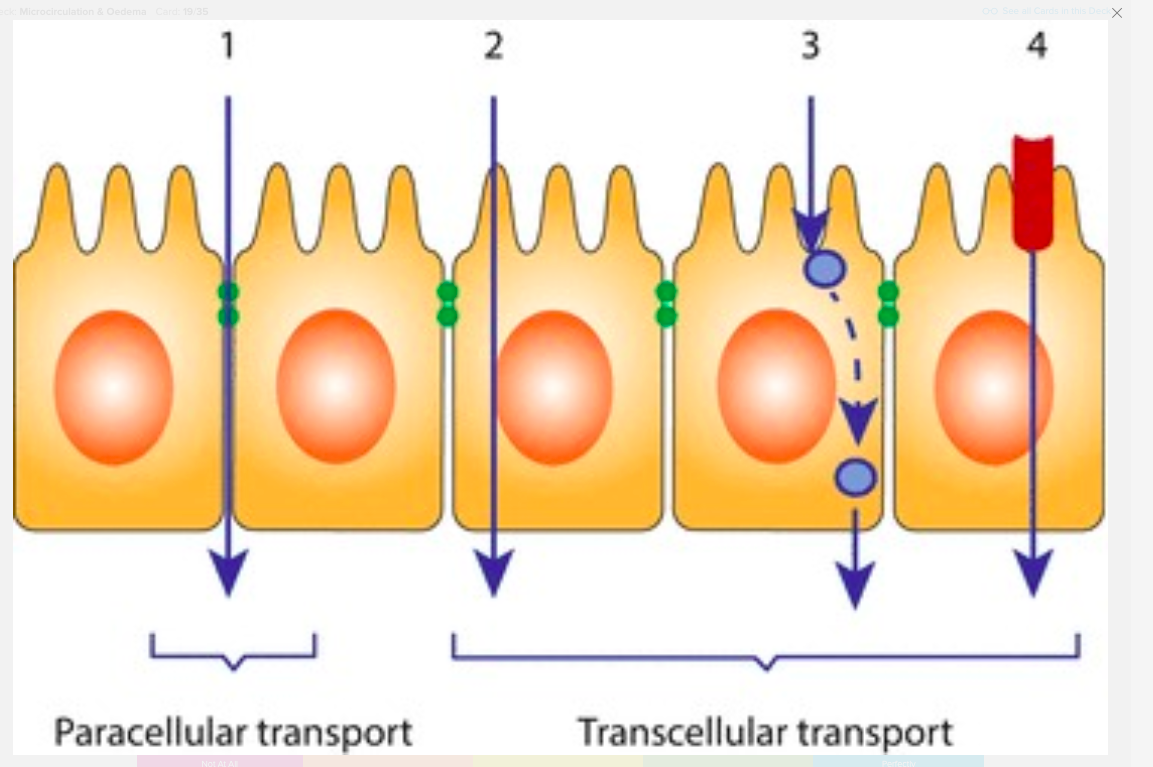
what is paracellular diffusion?
where does it occur? 1 example xo
Paracellular transport refers to the transfer of substances across an epithelium by passing through the intercellular space between the cells.
kidnyes
what are two reasons for lympathic blockage?
primary: genetic cause
secondary: damage to lymphatic system (e.g. surgery, elephantiasis - worm infection, tissue injury)
how do u subdivide different types of anaemia based on mean cell volume? (3)
how do u subdivide anaemia by production of rbc? (2)
based off mean cell volume (MVC)
- microcytic: MVC <80 fL (rbc are smaller than usual)
- normocytic: MVC 80 -100 fL (normal sized, but just less off them an expected)
- macrocytic: MVC > 100 fL (rbc are larger than usual)
//
increased destruction: high reticulocytes. due to bleeding or haemolysis
reduction production: low reticulocytes. anaemia of chronic disease, aplasia, cancers
there are 5 leukocytes. name which ones are granular and agranular (5)
- *granular**: neutrophils, basophils, eosinophils
- *agrunular**: monocytes, lymphocytes
what is the name of when neutrophils move through capillary cell wall?
diapedesis
what are the following caused by?
- microcytic:
- normocytic:
- macrocytic:
- microcytic: iron deficiency, thalassaemia (an inherited blood disorder that causes your body to have less hemoglobin than normal)
- normocytic: acute blood loss, renal failure, SCA, leukaemia
- macrocytic: alchohol and liver disease
what are eosinophils associated with? (3)
eosinophils: allergic reaction, parasitic infections & chronic inflammation
where in a lymph node would you find:
a) B cells
b) T cells
c) immature B cells
The nodes are covered by a capsule of dense connective tissue, and have find lymphocytes
- cortex (under the capsule) - lymphoid follices: B cells
- deep cortex: T cells
- medulla: B cells (immature)
how do u differentiate between B & T cells?
staining not useful - need to use immunohistochemistry (Immunohistochemistry (IHC) is the most common application of immunostaining. It involves the process of selectively identifying antigens (proteins) in cells of a tissue section by exploiting the principle of antibodies binding specifically to antigens in biological tissue
what are distinguishing features of the spleen? (2)
red and white pulp (1)
no cortex and medulla (1)
what do u find in red and white pulp in spleen?
which one makes up most of spleen?
white pulp: B and T cells, APCs and plasma cells
red pulp: old & damaged RBC, macrophages, lymphocytes
red pulp = 80%
what are Epithelial reticular cells? where do u find?
Epithelial reticular cells, or epithelioreticular cells (ERC) are a structure in both the cortex and medulla of the thymus.
Make sure that no T cells are allowed to survive which could attack the body’s own cells


-
The Mediastinum27
-
CR Anatomy: Question Bank17
-
The Heart and Coronary Arteries34
-
Clinical Skills: CV1
-
The Conducting System of the Heart & ECG43
-
Anatomy: Practical 1 - Mediastinum43
-
Smooth and Cardiac Muscle32
-
CVS Histology48
-
Anatomy: Practical 2 - Thorax and the Lungs41
-
Heart as a Pump40
-
Haemodynamics35
-
Carriage of Oxygen in the Blood24
-
Review of the Sympathetic Nervous System34
-
Neural Control of Blood Pressure28
-
Renal Function 128
-
Renal Function 227
-
Blood volume & pressure control after Haemorrhage0
-
Microcirculation & Oedema35
-
Microanatomy - Histology of Hematopoietic System29
-
Peripheral Vasculature of the Limbs39
-
Drug Treatments for CVD24
-
Anatomy of the respiratory system27
-
Hormonal Control of BP32
-
Introduction to Respiratory System29
-
Anatomy of the upper airway41
-
Anatomy: Practical 2 - Thorax and the Lungs (Part 2)36
-
Pulmonary Circulation25
-
Chest X-rays28
-
Respiratory Physiology I17
-
Respiratory Physiology II25
-
:)51
-
Histology of Resp. System34
-
Pharmacology of the Airways14
-
Histology Qs7
-
Acid-Base Control of Respiration28
-
Gas Exchange and Lung Function Tests27
-
big boys29
-
::)53
-
:O50
-
:L54
-
:D13



