Forearm and Wrist Flashcards

(126 cards)

1
Q

What joint is the wrist?

A

The radiocarpal joint

2
Q

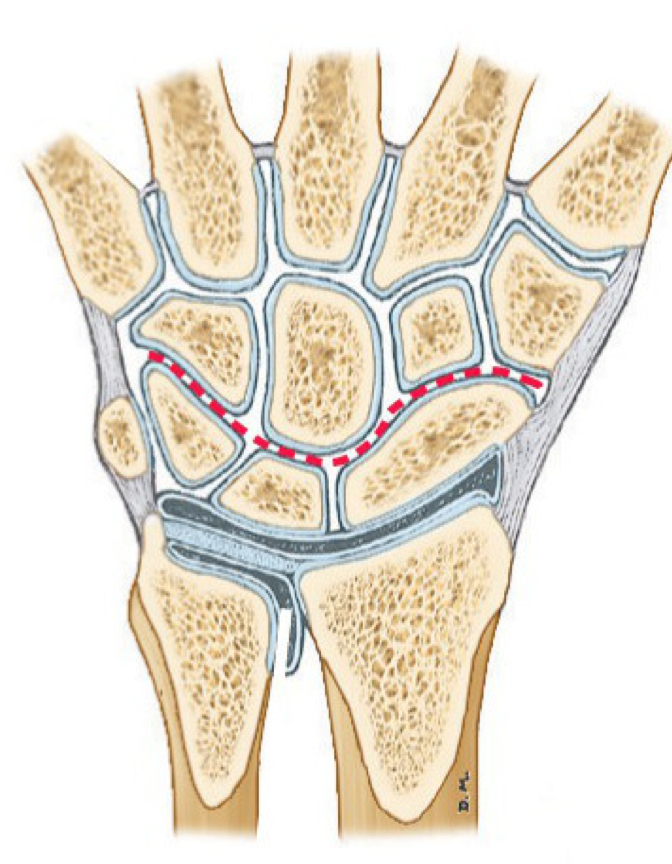
What forms the radiocarpal joint?

A

Articulation between the distal radius and 2 of the carpal bones: scaphoid and lunate N.B. the ulna is NOT involved
3
Q

What type of joint is the wrist?

A

Synovial joint

4
Q

What ligaments strengthen the wrist joint? Where do they strengthen it?

A

Radiocarpal ligaments strengthen the joint anteriorly and posteriorly

5
Q

Where does the radius sit in relation to the ulna?

A

Radius is thumb side Ulna sits medial side (closest to body)

6
Q

What does the radius and the ulna both articulate with proximally?

A

The humerus (= elbow)

7
Q

Where do the radius and ulna articulate with each other? What movement is this responsible for?

A

At the proximal and distal radioulnar joints Pronation and supination

8
Q

What membrane connects the radius and ulna?

A

A strong interosseous membrane (IOM)

9
Q

The IOM has holes/apertures in it. What does this allow?

A

Allows the passage of vessels

10
Q

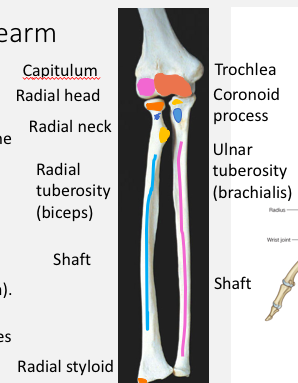
Diagram of bones of the forearm

A
11
Q

What is the radial styloid/styloid process?

A

Bony projection at distal end of radius

12
Q

What muscle inserts on the ulna tuberosity?

A

Brachialis

13
Q

What muscle inserts on the radial tuberosity?

A

Biceps

14
Q

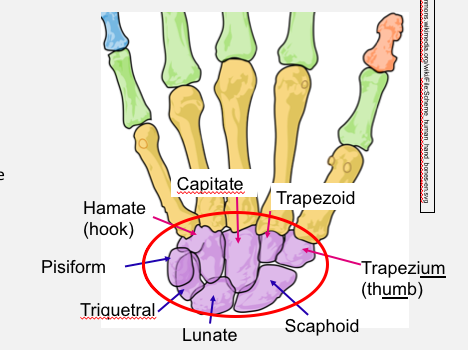
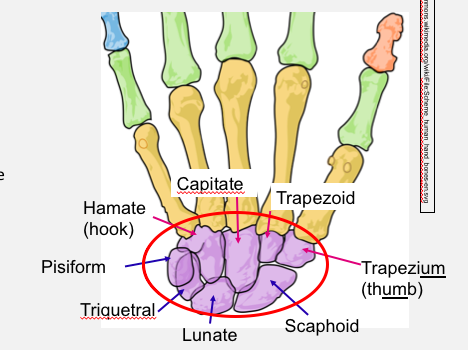
What is the ‘carpus’?

A

The wrist

15
Q

How many bones make up the carpus?

A

8 small bones arranged in 2 rows

16
Q

What are the names of the 8 bones of the carpus?

A
  1. Lunate
  2. Triquetral
  3. Pisiform
  4. Hamate (hook)
  5. Capitate
  6. Trapezoid
  7. Trapezium (thumb)
  8. Scaphoid
17
Q

What are the bones in the wrist and hand separated into?

A

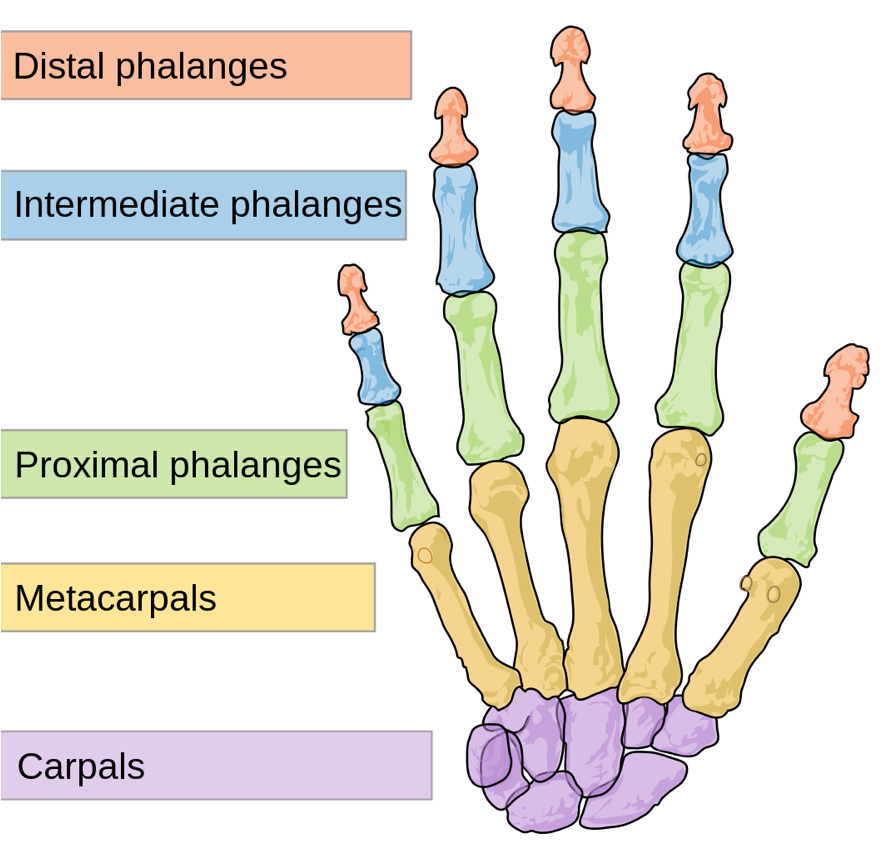
Heading from wrist towards fingertips:

  1. Carpals
  2. Metacarpals
  3. Proximal phalanges
  4. Intermediate phalanges
  5. Distal phalanges
18
Q

How do the bones of the thumb differ?

A

Only have 2 phalanges: proximal and distal (no intermediate)
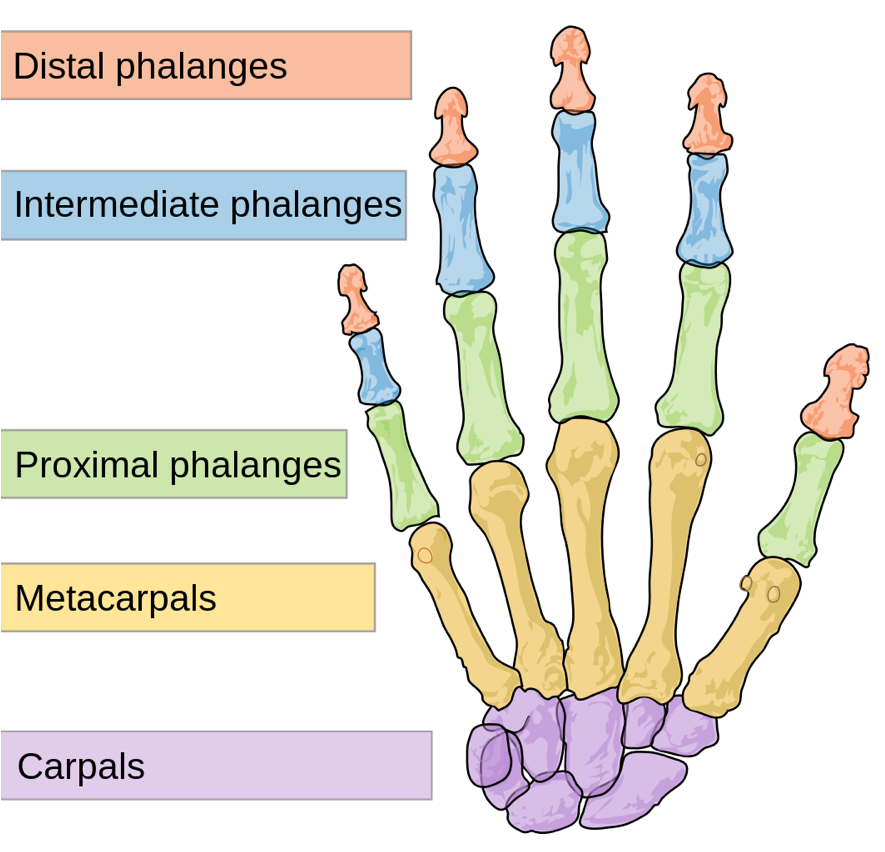
19
Q

How many phalanges are found in the 4 fingers?

A

3; proximal, intermediate, distal

20
Q

What joints are found in the hand?

A
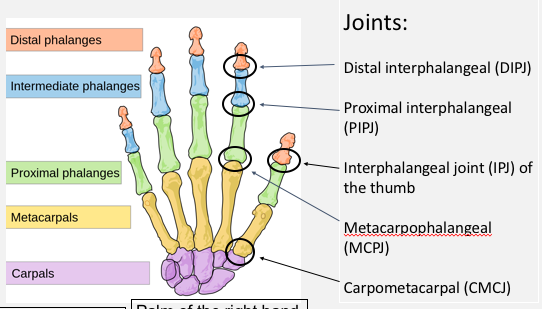
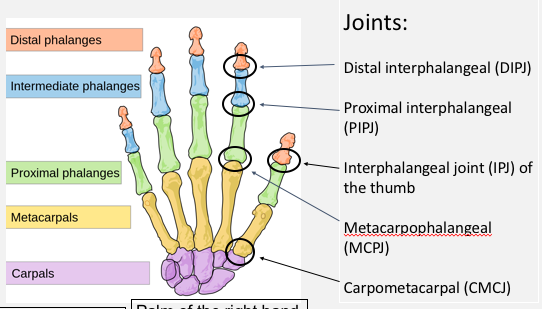
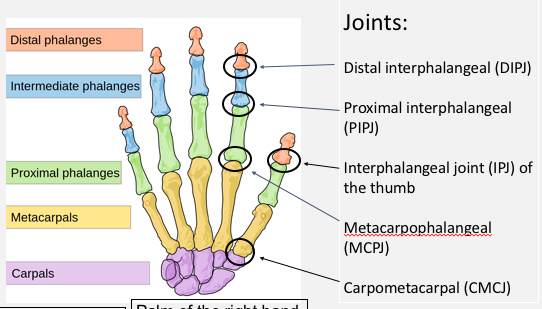
  1. Carpometacarpal (CMCJ)
  2. Metacarpophalangeal (MCPJ)
  3. Interphalangeal joint (IPJ) of the thumb
  4. Proximal interphalangeal (PIPJ)
  5. Distal interphalangeal (DIPJ)
21
Q

What joint is found between the carpals and the metacarpals?

A

The carpometacarpal joint (CMCJ)

22
Q

What joint is found between the metacarpals and the proximal phalanges?

A

The metacarpophalangeal (MCPJ)

23
Q

What joint is found between the proximal phalanges and the intermediate phalanges?

A

Proximal interphalangeal joint (PIPJ) –> only found in the 4 fingers

24
Q

What joint is found between the intermediate phalanges and the distal phalanges?

A

The distal interphalangeal joint (DIPJ)

25
What joint is found between the proximal phalanges and the distal phalanges in the thumb?
Interphalangeal joint (IPJ) of the thumb
26
What joint is only found in the 4 fingers?
Proximal interphalangeal joint (PIPJ)
27
What joint is only found in the thumb?
The interphalangeal joint (IPJ) of the thumb
28
What can the forearm muscles move?
Contains muscles that move the wrist, elbow, proximal radioulnar joint, thumb and fingers
29
What are the 2 muscle compartments in the forearm?
Anterior and posterior
30
How do muscles in the anterior compartment of the forearm move the wrist?
Flex the wrist (and digits)
31
How do muscles in the posterior compartment of the forearm move the wrist?
Extend (straighten) the wrist (and digits)
32
What are the movements at the wrist joint?
Flexion, extension, abduction, adduction Combine all 4 = circumduction
33
Movements of the fingers?
Abduction, adduction, flexion, extension
34
What are the 2 joints where flexion/extension of the fingers can happen?
MCP, PIP and DIP
35
What are the movements of the thumb?
Abduction, adduction, extension, flexion, opposition, reposition Look at difference between abduction and extension !! --\> extension moves thumb away in same plane as hand, abduction move thumb away from hand
36
How many layers of muscles of the anterior forearm are there?
3 layers --\> superfical, middle, deep
37
What are most of the muscles of the anterior forearm innervated by?
Most by the median nerve (C5-T1), a couple by the ulnar nerve (C8-T1)
38
Where do the muscles of the anterior forearm insert?
Insert on metacarpals or bones of the digits
39
Where do **most** of the muscles of the anterior forearm originate from?
The **medial epicondyle** of the humerus --\> the 'common flexor origin'
40
How many muscles of the anterior forearm pronate the forearm?
2 muscles pronate the forearm
41
Is the origin or insertion of the anterior forearm tendons key for clinical practice?
Insertion points
42
How many muscles make up the superficial layer of the anterior forearm? What are their names?
4: 1 pronator, 3 wrist flexors Pronator --\> **pronator teres** 3 wrist flexors: * **Flexor carpi radialis** * **Flexor carpi ulnaris** * **Palmaris longus**
43
What does the flexor carpi radialis flex? What side is it found on?
Flexor of the wrist, radial side (shown in orange)
44
What does the pronator teres help to pronate?
Helps to pronate the proximal radio-ulnar joint --\> does NOT act on wrist
45
What does the flexor carpi ulnaris flex? What side is it on?
Flexor of the wrist, ulnar side
46
Where does the flexor carpi radialis originate/insert?
Originates from the medial epicondyle, attaches to the base of metacarpals II and III.
47
Where does the flexor carpi ulnaris originate/insert?
Originates from the medial epicondyle with the other superficial flexors. It also has a long origin from the ulna. It passes into the wrist and attaches to the pisiform carpal bone / proximal part of 5th metacarpal
48
Action of the pronator teres?
Pronation of the forearm.
49
What are the muscles of the superficial layer of the anterior forearm innervated by?
All supplied by the **median nerve** EXCEPT the flexor carpi ulnaris which is supplied by the **ulnar nerve** I.e.: * Pronator teres --\> median * Flexor carpi radialis --\> median * Flexor carpi ulnaris --\> ulnar * Palmaris longus --\> median
50
Action of the palmaris longus?
Flexion of wrist
51
Where does the palmaris longus insert?
Doesn't have a bony insertion in the hand but instead inserts onto a small sheet of fascia in the hand called the **palmar aponeurosis**
52
What composes the middle layer of the anterior forearm?
1 muscle with 4 tendons --\> **flexor digitorum superficialis**
53
Where does the flexor digitorum superficialis insert?
Inserts on the middle phalanx of digits 2-5 (i.e. the fingers not the thumb)
54
What happens to the tendons of the flexor digitorum superficialis (FDS) when it reaches the fingers?
Each tendon splits into 2 --\> inserts either side of the middle phalanx
55
Action of the flexor digitorum superficialis (FDS)?
Flexes the metacarpophalangeal joints and proximal interphalangeal joints at the 4 fingers, and flexes at the wrist.
56
What is the FDS innervated by?
the median nerve
57
How many muscles compose the deep anterior forearm? What are they called?
3 muscles 1. Flexor digitorum profundus 2. Flexor pollicis longus 3. Pronator quadratus
58
What muscle is essentially the deeper parter to flexor digitorum superficialis?
Flexor digitorum profundus
59
How many tendons does the flexor digitorum profundus have? Where do they attach to?
At the wrist, it splits into four tendons, that pass through the carpal tunnel and attach to the distal phalanges of the four fingers.
60
What is the action of the flexor pollicis longus?
Flexes on the interphalangeal and the metacarpophalangeal joint of the thumb
61
Insertion of the flexor pollicis longus?
Inserts on the distal phalnx of the thumb
62
Which muscles of the deep anterior forearm contribute to flexion of the wrist?
Flexor digitorum profundus and flexor pollicis longus
63
Movement of pronator quadratus?
Pronates the forearm (at distal radio-ulnar) --\> does NOT contrubute to flexion of the wrist
64
Where does the pronator quadratus originate and insert?
Originates from the anterior surface of the ulna and attaches to the anterior surface of the radius.
65
Diagram of insertions of deep muscles of anterior forearm
Purple --\> flexor pollicis longus Yellow --\> flexor digitorum profundus (travels in between the partition in the flexor digitorum superficialis tendon - shown here in black)
66
Surrounding the long flexor tendons in the finger is 2 sheaths. What are they and what is their purpose?
Surrounding the long flexor tendons in the finger is a fibrous and a synovial sheath. Give the tendons protection, anchor the tendons and also allows tendons to move smoothly without friction.
67
How many layers of muscle make up the posterior forearm?
2; superficial and deep
68
What are all muscles of the posterior forearm innervated by?
Radial nerve (C5-T1)
69
Where do **most** of the muscles of the posterior forearm originate?
From the lateral epicondyle of the humerus --\> the 'common extensor origin'
70
Where do the muscles of the posterior forearm insert?
On the metacarpals or bones of the digits
71
Movements of the muscles of the posterior forearm?
Extend either the wrist, thumb or fingers (Those that extend the thumb and fingers contribute to extension at the wrist)
72
How many muscles make up the superficial layer of the posterior forearm?
6 * 3 wrist extensors * 2 finger extensors * Brachioradialis
73
What are the names of the 3 wrist extensors of the superficial posterior forearm? What are their insertions?
They insert onto the **metacarpals** 1. Extensor carpi radialis longus --\> 2nd MC 2. Extensor carpi radialis brevis --\> 3rd MC 3. Extensor carpi ulnaris --\> 5th MC I.e. 2 on radius side and 1 on ulna side
74
What side is the anterior side of the forearm?
The palm side
75
What are the names of the 2 finger extensors in the superficial layer of the posterior forearm?
1. Extensor digitorum 2. Extensor digiti minimi
76
What is the main extensor of the fingers?
Extensor digitorum
77
What is origin and pathway of extensor digitorum?
Originates from the lateral epicondyle. The tendon continues into in the distal part of the forearm, where it splits into four and travels to digits 2-5
78
Function of extensor digiti minimi?
Originates from the lateral epicondyle of the humerus. It attaches (only has 1 tendon), with the extensor digitorum tendon, to the little finger
79
What is an extensor expansion?
* The special connective attachments by which the extensor tendons insert into the phalanges --\> roughly triangular shaped * Sits on posterior side (back of hand)
80
How does the extensor expansion act as an attachment site?
The tendons of some posterior forearm muscles come down and blend with the tissue of the extensor expansion
81
Where does the brachioradialis lie?
On the lateral most aspect of the posterior compartment
82
How does brachioradialis differ from the other 5 muscles of the superficial posterior forearm? What is this due to?
Its origin and innervation are characteristic of an extensor muscle, but it is actually a flexor at the elbow. Due to the insertion of this muscle --\> attaches to the distal end of the radius so doesn't cross wrist
83
How many muscles make up the deep posterior forearm? What are their names?
5 * Supinator * 1 finger extensor * Extensor indicis * 2 thumb extensors * Extensor pollicis longus * Extensor pollicis brevis * 1 thumb abductor * Abductor pollicis longus
84
Origin and insertion of supinator?
It has two heads of origin. One originates from the lateral epicondyle of the humerus, the other from the posterior surface of the ulna. They insert together into the posterior surface of the radius.
85
Action of supinator?
Supinates the forearm
86
Insertion of the extensor indicis?
Attaches to the index finger --\> inserts onto extensor expansion (shown in purple)
87
Action of the extensor indicis?
Extends the index finger --\> This muscle allows the index finger to be independent of the other fingers during extension.
88
What does 'pollicis' mean?
a Latin word meaning "of the thumb"
89
Where does the extensor pollicis longus insert? What are its actions?
Insertion: It attaches to the **distal phalanx** of the thumb (shown in pink) Actions: Extends all joints of the thumb: carpometacarpal, metacarpophalangeal and interphalangeal.
90
Where does the abductor pollicis longus insert? What are its actions?
Insertion: Inserts onto lateral aspect of the 1st metacarpal (in blue) Action: Abducts the thumb
91
Insertion of extensor pollicis brevis?
Inserts: proximal phalanx of the thumb (shown in black) Action: Extends at the metacarpophalangeal (and carpometacarpal joints) of the thumb.
92
What is the anatomical snuffbox (ASB)?
A triangular depression found on the lateral aspect of the dorsum of the hand between the tendons
93
What forms the boundaries of the anatomical snuffbox?
**Ulnar (medial) border**: Tendon of the extensor pollicis longus (blue) **Radial (lateral) border:** Tendons of the extensor pollicis brevis (black) and abductor pollicis longus (pink)
94
Main contents of the anatomical snuffbox?
1. Radial artery 2. Superficial branch of the radial nerve 3. Cephalic vein
95
What are the main arteries of the forearm?
Radial and ulnar artery --\> these are the terminal branches of the brachial artery as it bifurcates They course down the forearm to the wrist
96
What branches does the ulnar artery give off? What do these supply?
* Common interosseous artery is a branch of the ulnar * This then divides into an anterior and posterior interosseous artery * Anterior branch runs down and supplies muscles in anterior forearm * Posterior branch which makes its was through the interosseous membrane to get to posterior compartment
97
What are the nerves that travel into down the hand on the **anterior forearm** (i.e. into the palm)? Out of these nerves, which travels through the carpal tunnel?
* The median and ulnar nerves * Only the median nerve travels through the **carpal tunnel** * The ulnar nerve goes over the top of it on the ulna side
98
What are the boundaries of the cubital fossa?
* *Superior:* An imaginary line between the **epicondyles** of the humerus * *Lateral:* border of the brachioradialis muscle * *Medial:* border of pronator teres
99
Where does the brachial artery bifurcate into the radial and ulnar artery?
In the cubital fossa
100
Does the median nerve innervate any muscles of the proximal arm?
No, only passes through to reach the forearm and hand
101
Contents of the cubital fossa?
1. **Median nerve** --\> going on to supply the majority of the flexor muscles in the forearm. 2. **Brachial artery** --\> birfucating into radial and ulnar arteries. 3. **Biceps tendon** --\> runs through the cubital fossa, attaching to the radial tuberosity.
102
What are the 2 major branches that the median nerve gives off in the forearm?
1. Anterior interosseous nerve 2. Palmar cutaneous nerve
103
What does the anterior interosseous nerve innervate?
The deep muscles of the **anterior forearm**
104
How does the median nerve innervate: 1. Superficial layer 2. Intermediate layer 3. Deep layer of muscles of the anterior forearm?
1. Median nerve itself (small branches) 2. Median nerve itself (small branches) 3. Anterior interosseous nerve
105
What does the ulnar nerve innervate?
* Primarily innervates the small muscles of the hand * Innvervates a couple of muscles in the anterior forearm --\> **flexor carpi ulnaris** and **_half of_ the flexor digitorum profundus**
106
Describe the innervation of the flexor digitorum profundus
Has a **dual innervation** * 1/2 on radial side of forearm --\> innervated by the median nerve * 1/2 on ulnar side of forearm --\> innervated by the ulnar nerve
107
What are the 2 sets of veins in the upper limb?
Superficial and deep veins
108
What do the deep veins of the upper limb follow?
Arteries
109
What are the 2 major superficial veins of the upper limb?
Cephalic and basilic veins
110
What do the cephalic and basilic veins play an important role in?
* Draining the hand * Important clinically for venepuncture / IV access
111
Where does the cephalic vein form?
In the anatomical snuffbox
112
What does the basilic vein drain?
The **medial** aspect (i.e. side nearest little finger) of the dorsum of the hand
113
Where do the basilic and cephalic vein normally communicate?
In the **cubital fossa** via the **median cubital vein**
114
X-ray of a **normal** forearm and wrist
115
What has happened here?
Fracture of distal radius
116
What has happened here?
?
117
What bone has been fractured?
?
118
What tendons / muscles / nerves / vessels are at risk here?
* Tendons: Flexor digitorum superficialis, flexor digitorum profundus * To test this --\> test the function * Test movement at PIP joint and DIP joint
119
Step 1 - are there any tendons in this region? Which ones? Step 2 – where do these tendons insert? What is their function? Step 3 - we need to test the function of these tendons to see if they are injured. What movements do we need to ask the patient to try and do in order to assess if the tendons at risk are working normally?
?
120
What is carpal tunnel syndrome?
Compression of the median nerve within the carpal tunnel can cause carpal tunnel syndrome (CTS). Compression caused by any condition that reduces space in the carpal tunnel.
121
What is affected in CTS?
The skin and the muscles that are innervated by median nerve branches distal to the CT are affected
122
What forms the roof and floor of the carpal tunnel?
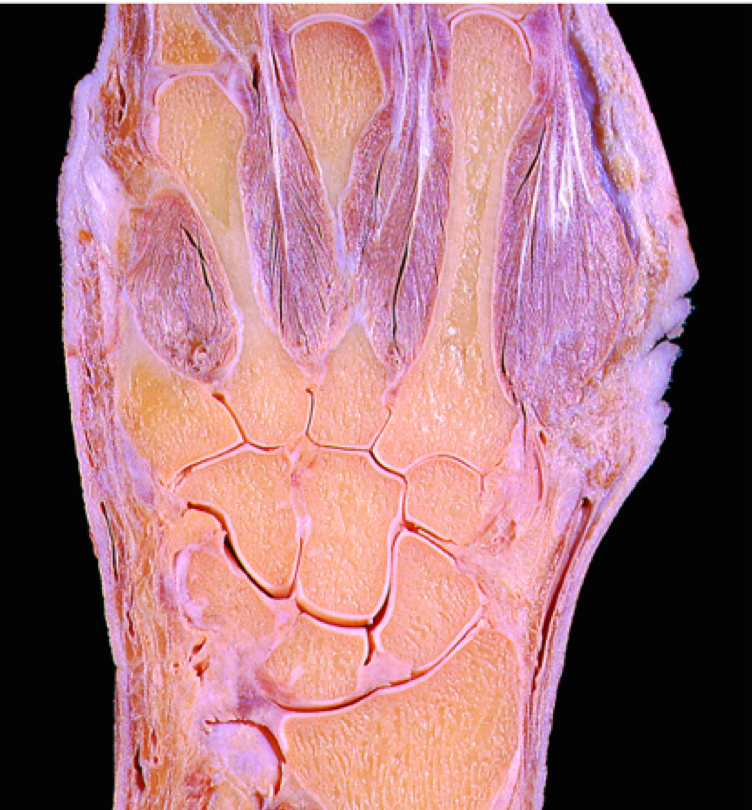
Roof --\> a fibrous sheet (flexor retinaculum) Floor --\> the arch of the carpus
123
What travels through the carpal tunnel?
Long flexor tendons and the median nerve
124
Presentation of carpal tunnel syndrome?
* Sensory symptoms (pain, pins and needles, tingling) in the areas of skin innervated by the median n. * Weakness in the hand muscles innervated by the median n. \> the small muscles of the thumb
125
What is result if CTS is not treated?
Wasting (atrophy) and weakness of the small thumb muscles
126
How is CTS treated?
By cutting 'releasing' of the flexor retinaculum