Candida
- >200 species
- Candida albicans is the only significant animal pathogen
- Grows as budding yeast cell in culture and tissues • Hyphae or pseudophyphae may also be seen in tissues
- Culture
- No special requirements
- White, shiny, high‐convex colonies in 24‐48 hours • Grows well at 25°C and 37°C
Candida albicans generals
Worldwide distribution • Natural Habitat
- Commensal of mucocutaneous areas • Intestinal Tract
- Genital Tract
• Endogenous infections due to:
- Immunosuppression
- Prolonged antibiotic therapy
- Concurrent infection
• Malnutrition
Candida albicans- virulence factors
Candida albicans
- Virulence Factors and Pathogenesis
- Neuraminidase- influenza
- Proteases
- Aid in tissue invasion
- Glycoproteins
- Endotoxin‐like activity
- Yeast form colonizes epithelial surfaces
- Transition to (pseudo)hyphal form for tissue invasion
- Inflammatory response is usually neutrophilic (not granulomatous)
—————“Sour crop”
—————-Corrugated yellow‐gray necrotic pseudomembrane
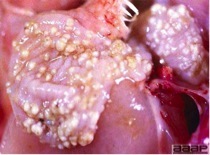
Candida albicans
candida albicans dx
Candida albicans
• Laboratory Diagnosis
- ———Lesional scrapes
- ——— Centrifuged milk (mastitis)
- ——— Biopsy/Tissue in formalin (histopath)
• Microscopy
- ———Gram stain (appears purple‐blue)
- ———KOH preparation
- ——— Stained tissue sections (or cultured samples)
——————–Thin‐walled,oval,buddingyeastcells+/‐(pseudo)hyphae ———-“Germ tube” formation is characteristic
• Isolation and Identification
———- Colonies visible in 24‐72 hours
- ———White/cream, shiny, convex
- ——— “Beery” smell
- ———Specialized media available
- ———— CHROMagar
- —————— C. albicans, C. tropicalis, C. krusei
————- API‐yeast‐Ident- smell like beer
Cryptococcus
>30 species
Cryptococcus neoformans is the only significant
animal (and human) pathogen
Spherical to oval, thin‐walled, budding yeast
Cells are surrounded by a large mucoid polysaccharide capsule
Daughter cells are single and connected to parent by narrow neck
- Four serotypes:
- A: C. neoformans var. grubii (Worldwide; soil/dust)
- B/C: C. neoformans var. gattii * (Associated with decaying eucalyptus wood)
• D: C. neoformans var. neoformans (Worldwide; soil/dust)
Cryptococcus Serotypes
Cryptococcus neoformans
• Natural habitat
- Serotypes A (C. n. var. grubii) and D (C. n. var. neoformans):
- Worldwide in soil and dust
- Skin, mucous membranes, and intestinal tract of normal mammals and birds
• Yeasts are concentrated in pigeon feces (rich in creatinine)
- >1 year survivability
- Serotypes B and C (C. n. var. gattii):
- Subtropical and temperate areas
- Eucalyptus and gum trees, also other trees
Cryptococcus neoformans pathogenesis and virulence factors
Cryptococcus neoformans- CATS WITH UPPER RESPIRATORY DISEASE
Pathogenesis
• Virulence is mainly associated with the large capsule
• Capsule is diminished in high salt/sugar concentration environments
———- Spores may be aerosolized
Productionofcapsuleinitiatedintissues
Anti‐phagocytic
Immunosuppressive
• Other virulence factors: • Phenoloxidase
- Melanin
- Anti‐oxidant
- Protects yeast in oxidants in phagolysosomes
- Phospholipase
- Mannitol
- Pathogenesis (cont’d)
- Lesions
- Rangefromgranulomastomyxomatousneoplasms
- Containcapsularslime,yeastcells,andinflammatorycells
- Route/Spread of infection
- Usuallyrespiratory
- Localized infection in nasalcavityandsinuses • Eventuallymayinvolvebrainandmeninges
- Subcutaneousgranulomas
- Species affected
- CATS:Rhinitis,nasalgranulomas,CNSinvolvement,
ocular/cutaneous infections
• Dogs:Respiratorytractinfections,someocular/cutaneous manifestations
Cattle:Mastitis(rare)
Horses:Nasalgranulomas
Koalas:Respiratorytractinfections,CNSinvolvement
Humans:Similartocats
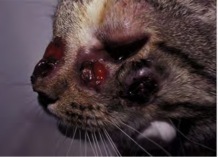
Cryptococcus neoformans
C. neoformans- dx
Cryptococcus neoformans
- Laboratory Diagnosis
- BE CAREFUL! Zoonotic agent!
- Biosafety hood recommended
- Useful samples:CSF,exudates,milk,tissue/biopsies
- Directmicroscopy
- India ink or nigrosin stains (outlines capsule)
- Mayer’s mucicarmine (stains capsule and cell wall) • Isolation/Culture
- Blood or SabDex agar
- Chocolate agar for enhanced capsule production
Streak as for bacteria, 48 hours – 2 weeks
Aerobic, 37°C (other Crypto. species will not tolerate 37°C)
Smooth, moist, shiny colonies; white to yellowish
Mucoid growth with age
Capsule is less pronounced from culture
Melanin is produced on birdseed agar
• Immunologicalandmoleculardiagnosticsexist
- Treatment
- Fluconazole,itraconazole • 5‐fluorocytosine
- AmphotericinB
Malassezia generals
Malassezia
20 species
Commensal organisms on oily areas of skin and
ears of dogs/cats
• Malassezia pachydermatis is the most significant species in animals
• Otitis externa
• Seborrheic dermatitis
- Feline chin acne
- Small, bottle‐ or peanut‐shaped yeast (broad‐ based bud)
- Reproduce by bud fission (septum detachment)
Malassezia pachydermatis
pathogenesis and dx
Malassezia pachydermatis
• Pathogenesis
Predisposing factors
• Immunosuppression
• Allergic dermatitis
• Hairyand/or pendulous ears
• Virulence factors
•Zymogen(activates complement, damages keratinocytes, inflammation/pruritis)
• Proteases(damageearcanalmucosa)
Lipases(adjust the sebum consistency to a more favorable environment for yeast)- why it can live in ears
• Leads to more sebaceous secretions
Laboratory diagnosis
- Interpretcarefully(normalflora?)
- Consider clinical signs and number of organisms
- Directmicroscopy(Gramstainormethyleneblue) • Isolation
- SabDex agar, 35‐37°C
- Colonies are small, smooth, “wet‐dog” odor
- Moleculartechniques(PCR)allowspeciesdifferentiation(ifneeded)
Dimorphic Fungi
Sporothrix, Blastomyces, Coccidioides, Histoplasma
Dimorphic Fungi growth forms
- Present two growth forms
- Appear as a mold when growing saprophytically in the environment
- Or in culture at 25‐30°C
- Usually the more stable form
- Appear as a yeast in animal tissues
- Or in culture/enriched media at 37°C
- May cause deep or systemic mycosis in animals and humans
- Cultures are biohazardous to laboratory workers. Be careful!
Sporothrix schenkii
- Disease
- Sporotrichosis
- “Rose‐handler’s disease”
- Distribution
- Worldwide (especially tropics and subtropics)
- Hosts
- Horses, dogs, cats, humans
- Natural Habitat
- Wooden posts, rose thorns, dead vegetation, soil
• Site of Lesions
• Subcutaneous nodules, Lymphocutaneous ulcerations
• Lymphatics (especially horses)
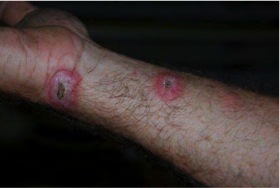
Sporothrix schenkii
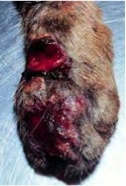
Sporothrix schenkii
Sporothrix schenkii morphology
- Colonial morphology
- Grows well on SabDex agar
- White to cream colonies, wrinkled with aerial hyphae
- Becomes dark and leathery
- Microscopic appearance
37°C Culture- CIGAR SHAPED
Cytology
- Plentiful yeast seen with methylene blue stain (especially samples from cats)
- Appearance varies depending on culture conditions (cigar‐shapes)
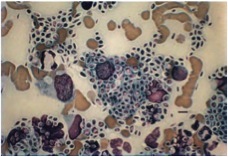
Sporothrix schenkii
Plentiful yeast seen with methylene blue stain (especially samples from cats)
Disease Patterns of S. schenkii
- Dogs, Horses
- Cutaneous/subcutaneous pyogranulomatous inflammation and ulceration at site of inoculation
Infectious process follows subcutaneous lymph channels with suppurative ulcers at intervals
- Disseminated disease is rare in immunocompetent
- Cats
- Similar to dogs initially, but disseminated disease may develop regardless of immune status
- Dissemination to viscera, joints, bones, CNS
• Epidemiology of S. schenkii
Typically acquired from the non‐living environment- mechanical transmission
• Zoonotic transmission from cats to humans occurs
Laboratory Diagnosis of S. schenkii
Direct examination of exudates
May be difficult to distinguish from Histoplasma or Cryptococcus
Culture
Immunological tests (AGID, latex agglutination)
Molecular Tests (PCR)
Treatment of S. schenkii
Sodium or Potassium Iodides
Amphotericin B, flucytosine (disseminated forms)
Ketoconazole, itraconazole
Terbinafine (cutaneous forms)
No vaccines available
Blastomyces dermatitidis
- Disease
- Blastomycosis
- Distribution
- Eastern North America (sporadically Europe, India, Middle East)
• Hosts
• Dogs, cats, horses, humans
- Natural Habitat
- Acidic soil rich in organic material
- Site of Lesions
- Primary lesions in lungs
- Metastasis to skin and other organs


-
Test 1359
-
Test 2- Pseudomonas spp20
-
Test 2- Burkholderia22
-
Test 2-• Francisella13
-
Test 2- Taylorella19
-
Test 2- Bordetella34
-
Test 2- Brucella30
-
Test 2- Herpesviridae188
-
Test 2- Moraxella15
-
Test 2 -Pasteurella29
-
Test 2- Haemophilus13
-
test 2 - Ornithobacterium5
-
Test 2- Enterobacteriaceae54
-
Test 2- Salmonella31
-
Test 2- Klebsiella2
-
Test 2- Yersinia15
-
Test 2- Shigella Citrobacter Enterobacter Providencia5
-
Test 2- Proteus4
-
Test 2- Actinobacillus28
-
Test 2- Vibrio19
-
Test 2- Rare gram negatives8
-
Test 3- Mycobacterium79
-
Test 3- Spirochetes37
-
Test 3- Mollicutes22
-
Test 3- Campylobacter and Arcobacter18
-
Test 3- Helicobacter and Lawsonia13
-
Test 3- RIckettsiales55
-
Test 3- Intro To Fungi and Funigal Infections21
-
Test 3- Pathogenic Yeast27
-
FINAL General REVIEW53
-
FINAL REVIEW- EYES, EARS, and RESP system74
-
FINAL SKIN REVIEW64
-
FINAL REVIEW- Gastrointestinal system Urogenital system54
-
FINAL REVIEW- Nervous Musculoskelteal, Cardiovascular and Lymphatic Systems50



